

Microsoft’s newest Fairwater AI superfactory in Atlanta marks a decisive escalation in how hyperscalers build and operate infrastructure for frontier AI: purpose-built, ultra-dense GPU racks, a dedicated AI optical backbone that stitches multiple sites into a unified compute plane, and a strong focus on power, cooling and operational efficiency to run synchronized, trillion‑parameter workloads at scale.
Microsoft is positioning Fairwater not as a conventional multi‑tenant datacenter but as a rack‑scale supercomputer factory — a distributed campus of tightly coupled GPU clusters designed to behave as a single, elastic compute fabric for training and serving the most demanding AI models. The Atlanta Fairwater joins Microsoft’s earlier Fairwater build and is explicitly linked into the company’s broader AI WAN so that multi‑site jobs can run as if they were local, synchronized compute runs.
Fairwater’s public messaging emphasizes four engineering priorities:
Key rack characteristics reported in vendor and Microsoft descriptions include:
The company reports external heat exchangers, massive fan arrays, and a sealed chilled loop intended to keep freshwater withdrawals low while still dumping the thermal load to atmosphere — an engineering tradeoff that reduces evaporative water but still requires electricity for pumps, chillers and fans.
At the same time, many of the boldest claims rest on metric choices and vendor‑driven configuration details: the “10×” performance headline must be interpreted against the specific workloads and precisions used to produce it, and proprietary networking and availability tradeoffs require closer independent inspection. If Microsoft delivers what it describes — reproducible throughput gains, transparent environmental accounting, and robust multi‑site orchestration — Fairwater will materially shift the economics and feasibility of frontier model training. Companies evaluating this infrastructure should demand benchmark transparency, contractual clarity on SLAs and capacity, and full lifecycle environmental disclosures before drawing long‑term strategic conclusions.
Fairwater is not just a single datacenter announcement; it is a blueprint for how cloud infrastructure will be industrialized for generative and reasoning AI — fast, dense, networked, and optimized for scale. The technical promise is large; the practical verification and governance work will determine how broadly that promise benefits customers, communities and the climate.
Source: Windows Report Microsoft Announces Fairwater, Its AI Superfactory Located in Atlanta
 Background / Overview
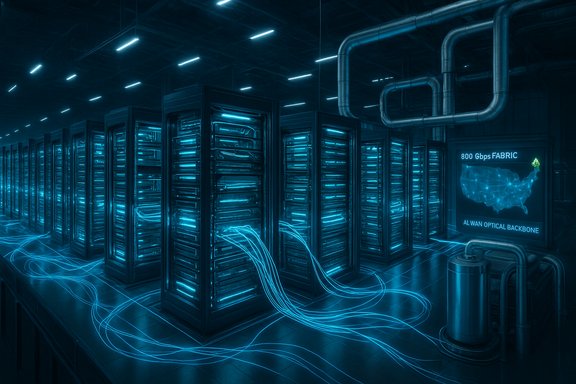
Microsoft is positioning Fairwater not as a conventional multi‑tenant datacenter but as a rack‑scale supercomputer factory — a distributed campus of tightly coupled GPU clusters designed to behave as a single, elastic compute fabric for training and serving the most demanding AI models. The Atlanta Fairwater joins Microsoft’s earlier Fairwater build and is explicitly linked into the company’s broader AI WAN so that multi‑site jobs can run as if they were local, synchronized compute runs.Fairwater’s public messaging emphasizes four engineering priorities:
- Extreme compute density via rack‑scale NVIDIA Blackwell (GB‑family) systems.
- Ultra‑low latency interconnects inside racks (NVLink/NVSwitch) and high‑bandwidth fabrics between racks/pods (800 Gbps‑class links).
- A dedicated AI WAN and substantial fiber additions to enable cross‑site synchronous training.
- Sustainability and grid‑aware operations that minimize water use and try to reduce the need for large on‑site backup generators.
What’s inside Fairwater: compute, memory and the rack-as-accelerator
Rack‑scale GPU architecture
The core compute building block at Fairwater is a rack‑scale NVIDIA GB‑family configuration commonly described as an NVL72-style unit. Microsoft and vendor materials show that these racks can combine up to 72 Blackwell GPUs with paired Grace‑class host CPUs into a single NVLink domain, making the entire rack appear to schedulers and runtimes as a single, giant accelerator. This model reduces expensive cross‑host transfers and simplifies placement for very large models.Key rack characteristics reported in vendor and Microsoft descriptions include:
- Up to 72 Blackwell GPUs per rack in NVL72 configurations, with associated Grace CPUs for host functions.
- Very high intra‑rack NVLink bandwidth (vendor platform summaries indicate aggregate figures measured in terabytes per second), enabling ultra‑low latency GPU‑to‑GPU exchanges. Specific published numbers vary by GB200 vs GB300 family.
- A pooled “fast memory” envelope at rack scale (reported ranges from the mid‑teens of TB up to ~37–40 TB depending on GB200 vs GB300 families and configuration choices).
Important specification nuance: GB200 vs. GB300 and published numbers
Public descriptions reference both GB200 and GB300‑class rack families; vendor documents and Microsoft’s materials use different representative numbers depending on the generation and the intended workload (training vs inference/reasoning). For example, some NVL72 GB200 deployments are described with ~1.8 TB/s GPU‑to‑GPU bandwidth and ~14 TB pooled GPU memory per rack, while GB300 NVL72 descriptions show substantially larger intra‑rack bandwidth and pooled memory envelopes (figures like ~130 TB/s aggregate NVLink and ~37–40 TB pooled fast memory appear in vendor briefings for certain GB300 configurations). These variances are real: they reflect generational and SKU differences, so treat any single number as configuration‑specific rather than universal.Networking: two‑tier fabric, SONiC and the AI WAN
Two‑tier, ultra‑high bandwidth fabric
Fairwater pairs the NVLink intra‑rack fabric with an external two‑tier networking approach for pod‑ and site‑level scale‑out. Microsoft describes an 800 Gbps‑class Ethernet/InfiniBand backbone inside the site for cross‑rack communication, deployed with fat‑tree or non‑blocking topologies to avoid congestion at scale. The company leverages a SONiC‑based switch OS across parts of the fabric to gain operational flexibility and to avoid single‑vendor lock‑in in the commodity portions of the network.Multi‑Path Reliable Connected (MRC) protocol — a proprietary optimization
Microsoft says it co‑developed a protocol called Multi‑Path Reliable Connected (MRC) with partners to improve telemetry, route selection and congestion control for ultra‑reliable AI data flows. At the time of the announcement, MRC was described in broad terms inside Microsoft’s technical messaging, but detailed, third‑party‑auditable specifications were not publicly disclosed, so the community has limited visibility into its exact mechanics and interoperability profile. Readers should treat MRC as a company‑specific optimization until full technical documentation is published.A national AI optical backbone
Beyond site fabric, Microsoft explicitly positions Fairwater as part of an AI WAN optical backbone that connects Azure AI datacenters nationwide. The company reports adding roughly 120,000 fiber miles in the prior year to support congestion‑free, low‑latency connectivity between supercomputers and Fairwater sites — enabling jobs and storage to span states with behavior close to a homogeneous local cluster. That investment is central to the company’s claim that multiple Fairwater sites can act as one logical supercomputer.Power, cooling and sustainability engineering
Closed‑loop liquid cooling and two‑story halls
Fairwater’s thermal design centers on closed‑loop liquid cooling that recirculates coolant and aims to minimize routine potable water use. Microsoft emphasizes the initial coolant fill as the primary operational water draw and uses outside‑air and sealed loops to limit evaporative tower usage. To enable extreme rack densities, Fairwater uses two‑story server halls and heavier structural elements to shorten cable and coolant runs and to compress latency between tightly coupled racks.The company reports external heat exchangers, massive fan arrays, and a sealed chilled loop intended to keep freshwater withdrawals low while still dumping the thermal load to atmosphere — an engineering tradeoff that reduces evaporative water but still requires electricity for pumps, chillers and fans.
Grid‑aware operation: availability versus capital cost
Microsoft framed part of Fairwater’s value proposition in terms of a tradeoff between availability and cost, using the phrasing “4×9 availability at 3×9 cost” to communicate high uptime without duplicative capital investments in on‑site generation. Instead of relying on large, costly backup diesel farms, the company relies on highly available grid power plus software and GPU‑level energy controls to smooth demand spikes and avoid wasteful overprovisioning. Measures include dynamic workload shaping, GPU power thresholds, and on‑site storage to buffer short spikes — techniques that help the site stay within local grid constraints while maintaining high utilization. These are design choices that shift some operational risk to the grid and to Microsoft’s software controls rather than to standalone redundancy hardware.Performance claims: what’s verifiable and what needs context
The “10× fastest supercomputer” headline
Microsoft’s public communications include a dramatic headline: Fairwater will deliver roughly 10× the throughput of today’s fastest supercomputer for AI training and inference workloads. That statement is metric dependent. Conventional supercomputer rankings (Top500) are based on LINPACK and are not directly comparable to AI training throughput, while AI performance can be reported in tokens/sec, model‑specific throughput, or sustained training FLOPS at particular precisions. Microsoft’s 10× positioning therefore appears to be a targeted, workload‑centric claim (large‑model training throughput on purpose‑built GB‑family hardware) rather than a universal, apples‑to‑apples superiority claim across every HPC benchmark. Independent benchmarking will be required to validate the headline in a neutral context.Per‑rack throughput and tokens‑per‑second metrics
Vendor and provider documents supply representative per‑rack measures that offer better comparators for AI workloads. Microsoft has published per‑rack throughput and tokens‑per‑second figures for specific configurations (these are useful for assessing large‑model training speed), but those numbers depend on model architecture, batch sizes, precision modes (FP16, FP8, FP4), sparsity and software stack tuning. In short: per‑rack or per‑pod tokens/sec metrics are strong indicators of AI training velocity for comparable workloads, but they do not replace third‑party, reproducible benchmarks for broader performance claims.Strengths: what Fairwater brings to Azure AI customers
- High‑density rack domains reduce communication overhead. Treating racks as single accelerator domains simplifies model placement and reduces step synchronization time for very large models.
- Synchronized multi‑site training becomes practical. The AI WAN and high bisection bandwidth fabrics enable multi‑site synchronous runs that previously would have been hampered by latency and congestion.
- Operational efficiency at scale. Grid‑first, software‑assisted energy controls and closed‑loop cooling can reduce capital outlays and water usage compared with older evaporative tower designs.
- Vendor ecosystem alignment. Built around NVIDIA GB‑family hardware and common networking building blocks, Fairwater benefits from large ecosystem and software support for model‑parallel tooling.
Risks, caveats and potential downsides
1) Metric clarity and benchmarking
Big headline claims are sensitive to how performance is measured. Without standardized, third‑party benchmark results across multiple representative workloads, marketing claims such as “10× the fastest supercomputer” remain promising but not independently verified. Buyers and planners should ask for reproducible benchmark data on workloads closely matching their production use cases.2) Environmental and lifecycle impact
While closed‑loop cooling can drastically reduce operational potable water withdrawals, operational water is only one piece of the environmental equation. Embodied carbon from construction, the emissions profile of grid firming or backup power during renewable shortfalls, and electricity consumption for pumps and chillers are material factors. Marketing claims about near‑zero water use should be read as operational water reductions rather than a full lifecycle environmental absolution.3) Grid dependency and local community impact
Fairwater’s approach accepts more dependence on the local grid in exchange for capital savings. That creates exposure to regional grid reliability and requires careful contracts and community engagement (the company notes prepayment and sourcing arrangements intended to avoid upward pressure on local consumer rates). Local stakeholders will still expect transparency about how energy is sourced, how outages will be handled and what employment and tax outcomes the build produces. The Atlanta deployment follows this model and will be watched closely by regional planners.4) Concentration and vendor dependence
Fairwater’s stack heavily leans on NVIDIA GB‑family technology and vendor interconnects like NVLink; that accelerates performance but also concentrates supply‑chain and vendor‑specific dependency. Enterprises must consider lock‑in risks, hardware refresh trajectories, and negotiation of SLAs that protect access and pricing as the platform evolves.5) Proprietary protocols and telemetry opacity
Items such as the MRC protocol and specific availability‑cost tradeoffs are described as company‑or partner‑specific innovations. Until detailed technical specifications and interoperability tests are published, these parts of the stack remain partially opaque — useful, perhaps, but not independently auditable. Customers should demand clarity on telemetry, congestion control behavior and failure modes before committing critical workloads.What Fairwater means for developers, enterprises and the AI market
- For large model developers and AI labs, Fairwater opens access to rack‑scale memory envelopes and ultra‑low latency fabrics that reduce the complexity of multi‑host sharding and can shorten time‑to‑train for very large models.
- For enterprises seeking managed frontier compute, Fairwater-style capacity lets organizations avoid building their own specialized facilities while getting access to purpose‑built hardware optimized for inference at scale (reasoning‑class workloads, agentic systems, multimodal services).
- For the AI market as a whole, repeated Fairwater builds amount to an industrialization of frontier compute capacity — standardized factory nodes that can be programmatically combined to match model growth and commercial demand. That has downstream effects on model design and economics: developers can push model size, context windows and agent complexity knowing that large, synchronized fabric is available.
Practical guidance for customers and procurement teams
- Request reproducible benchmarks that match your workload (architecture, precision, batch sizes). Avoid taking tokens/sec or talk of “10×” at face value without comparable metrics.
- Negotiate SLAs and capacity guarantees that specify access windows and fair usage rules for large‑scale synchronous runs; these are critical when multiple tenants might compete for the same hard resource.
- Ask for energy and water transparency: demand data on operational water withdrawals, embodied carbon estimates for the facility build, and details of any pre‑purchase renewable energy agreements that back the site.
- Validate network behavior under realistic job patterns, including congestion response and failure modes of proprietary protocols like MRC, before committing production training runs that assume cross‑site synchronicity.
Conclusion
Fairwater’s Atlanta AI superfactory is a visible crystallization of the hyperscaler strategy for frontier AI: build repeating, ultra‑dense rack‑scale compute modules, tightly couple them with high‑bandwidth fabrics, and stitch those modules with an optical AI WAN so multiple sites can function as one coherent supercomputer. The engineering primitives — 72‑GPU NVL72 racks, NVLink pooled memory domains, 800 Gbps‑class interconnects, closed‑loop liquid cooling and grid‑aware operational controls — are real and meaningful for large‑model workloads.At the same time, many of the boldest claims rest on metric choices and vendor‑driven configuration details: the “10×” performance headline must be interpreted against the specific workloads and precisions used to produce it, and proprietary networking and availability tradeoffs require closer independent inspection. If Microsoft delivers what it describes — reproducible throughput gains, transparent environmental accounting, and robust multi‑site orchestration — Fairwater will materially shift the economics and feasibility of frontier model training. Companies evaluating this infrastructure should demand benchmark transparency, contractual clarity on SLAs and capacity, and full lifecycle environmental disclosures before drawing long‑term strategic conclusions.
Fairwater is not just a single datacenter announcement; it is a blueprint for how cloud infrastructure will be industrialized for generative and reasoning AI — fast, dense, networked, and optimized for scale. The technical promise is large; the practical verification and governance work will determine how broadly that promise benefits customers, communities and the climate.
Source: Windows Report Microsoft Announces Fairwater, Its AI Superfactory Located in Atlanta
