

ZDNET’s Adrian Kingsley-Hughes examined cheap OBD2 “fuel saver” dongles being sold online in 2026 and found that the devices are not ECU tuning tools at all, but simple LED-blinking circuits that may waste money, damage a vehicle’s diagnostic port, or create electrical risk. The safer fuel-saving answer is less glamorous: tire pressure, smoother driving, reduced load, and maintenance. That is not as clickable as a miracle chip, but it has one advantage the dongles lack: it is grounded in how cars actually work.
The pitch is familiar because the scam is old. Every fuel-price spike seems to produce a new generation of devices promising to outsmart automakers, oil companies, emissions rules, or physics itself. The current version has traded magnets and fuel-line clamps for a plastic plug that fits into the OBD2 port under the dashboard.
That change matters because the OBD2 port looks technical enough to make the claim feel plausible. Drivers know mechanics plug scan tools into that connector. Many owners have used Bluetooth OBD adapters to read check-engine codes, watch coolant temperature, or log trip data. So when a seller says a small device can “optimize” the engine through that same port, the lie borrows credibility from a real diagnostic interface.
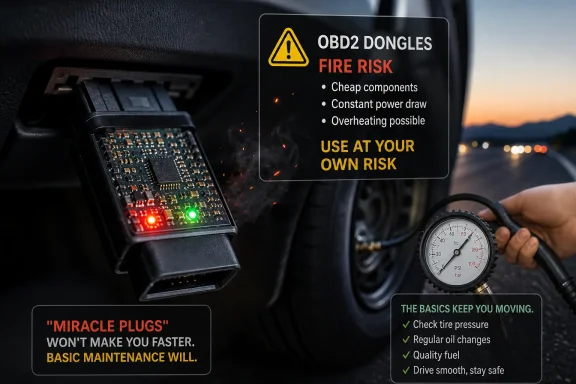
Kingsley-Hughes’ teardown strips away the illusion. Inside the reviewed dongle was not a fuel map, not a processor doing serious control work, and not a vehicle-specific tuning module. It was the electronics equivalent of a stage prop: a timer chip, resistors, LEDs, a button, and just enough connection to pull power and blink convincingly.
That is the heart of the story. The scam is not merely that the savings are exaggerated. It is that the product’s entire theatrical purpose is to make a driver believe something computational is happening when, in many cases, the only thing being optimized is the seller’s margin.
But “can communicate with the car” is not the same as “can safely rewrite the car.” Real tuning is vehicle-specific, engine-specific, software-specific, and risk-specific. It usually involves calibrated changes to fuel, ignition, boost, torque limits, emissions systems, or transmission behavior. It also requires knowing what the vehicle is, what firmware it runs, what sensors report, and what protections the manufacturer has in place.
The generic fuel-saver dongle pitch depends on flattening all of that complexity into one fantasy: plug in a universal device, press a reset button, drive a few miles, and let the magic box learn your habits. That is not how modern engine control works. A gasoline engine already operates under closed-loop control, emissions constraints, knock limits, thermal limits, and drivetrain protection logic.
A legitimate scan tool can read diagnostic trouble codes. A legitimate data logger can show engine load, short-term fuel trim, oxygen sensor behavior, and temperatures. A legitimate tuner can alter certain parameters on certain vehicles under controlled conditions. A $5-to-$30 mystery dongle claiming to work across makes, models, engine types, and model years is not in that category.
Consumers have been trained by routers, chargers, storage devices, diagnostic tools, and battery packs to associate blinking lights with work being done. The device appears to boot, scan, learn, and adapt. The fact that the light show can be reproduced with a simple 12-volt power supply makes the act no less persuasive to someone who sees it under the dashboard.
That is why the teardown matters. It turns the promise into something observable. If only three pins are connected, if there is no meaningful computing hardware, and if the board is built to animate LEDs rather than speak intelligently to the ECU, then the device is not a misunderstood breakthrough. It is a prop.
The worst version of this scam is not merely fake; it is parasitic on real technical literacy. It uses acronyms like OBD2, ECU, chip tuning, and optimization to sound adjacent to legitimate automotive diagnostics. The more a buyer knows just enough to recognize the vocabulary, the more convincing the pitch can become.
A car’s OBD2 port is connected to systems that technicians rely on for diagnosis, inspection, emissions readiness, and repair. Damage the connector, bend pins, lodge a broken contact inside it, or short something that should not be shorted, and a cheap gadget can become an expensive appointment. The repair bill is not proportional to the price of the scam.
Kingsley-Hughes also points to poor assembly as a risk. Loose solder, rattling wires, and cheap construction are not theoretical annoyances in a vehicle environment. Cars vibrate, heat-cycle, and expose electronics to conditions far harsher than a desk drawer. A badly built device sitting under the dash does not become safer because its marketing copy says “eco.”
There is also a subtler risk: distraction from actual maintenance. A driver who believes a plug-in device is improving fuel economy may ignore low tire pressure, overdue service, dragging brakes, bad alignment, or aggressive driving habits. The dongle then costs twice: once at purchase, and again by delaying the fixes that would have made a measurable difference.
Fuel economy is not a neglected feature. It is central to regulation, consumer comparison shopping, fleet planning, and engineering competition. Automakers spend enormous sums shaving weight, reducing friction, improving transmissions, managing turbocharging, refining combustion, calibrating hybrid systems, and meeting emissions limits. There is no secret consumer-friendly map hidden in the ECU waiting for a plastic key.
That does not mean every factory calibration is tuned for maximum fuel economy in every circumstance. Manufacturers balance emissions, drivability, durability, warranty exposure, fuel quality, noise, heat, performance, and regulatory compliance. Aftermarket tuning can change those tradeoffs, sometimes dramatically. But changing tradeoffs is not the same as producing free savings.
A real tune that leans out fueling, alters boost, changes shift behavior, or disables emissions-related systems may increase economy under some conditions while increasing risk elsewhere. It may reduce engine safety margins, violate emissions laws, void warranties, or make the car worse to drive. The miracle dongle skips the tradeoff conversation because acknowledging tradeoffs would kill the miracle.
Older scams leaned on magnets, fuel additives, vapor systems, or combustion enhancers. The OBD2 dongle is the same idea updated for a software-defined age. Instead of claiming to restructure gasoline molecules, the seller claims to “remap” the car’s computer. The vocabulary changed because the car changed.
That shift is important for WindowsForum readers because it mirrors a broader consumer-tech problem. As everyday products become more computerized, scams increasingly attach themselves to the legitimate complexity of those systems. A modern vehicle really is a networked computing platform. That makes real diagnostics more powerful, but it also gives fraudsters a larger vocabulary to abuse.
The lesson is not that all aftermarket electronics are suspect. Dash cameras, scan tools, battery monitors, fleet telematics, and performance tuners can be real products with real uses. The lesson is that the more universal and effortless the claim, the more evidence it should require.
Under-inflated tires increase rolling resistance. Aggressive acceleration and braking waste energy as heat. Extra weight forces the engine to do more work. Roof racks and cargo boxes increase aerodynamic drag, especially at highway speeds. Poor maintenance can leave an engine, transmission, brakes, or fluids operating outside their intended range.
None of this has the seduction of a “plug and drive” device, but it has a direct mechanical relationship to fuel consumption. You are either reducing resistance, reducing wasted acceleration, preserving efficient operation, or avoiding unnecessary load. There is no need to pretend a blinking box is negotiating with the ECU.
The irony is that the real fixes are often cheaper than the scam. A tire pressure gauge costs little. Many cars already show tire pressure in the instrument cluster. Removing cargo is free. Driving more smoothly costs nothing except patience. Following the maintenance schedule costs money, but it is money spent on preserving the machine rather than decorating its diagnostic port.
Hard acceleration demands more fuel. Late braking throws away energy that could have been conserved by easing off earlier. High-speed cruising increases aerodynamic drag sharply. Short trips in cold engines punish efficiency because the vehicle spends more time outside its optimal operating temperature.
Modern cars are already designed to smooth some of this out. Automatic transmissions shift earlier in economy modes. Hybrids recapture braking energy. Turbocharged engines can deliver efficiency under light load and power under boost. But the driver still controls demand, and demand is where fuel consumption begins.
This is why the dongle scam is so attractive. It promises to save fuel without asking the driver to do anything differently. It converts a behavioral and mechanical problem into a consumer-electronics purchase. That is always an easier sell.
The fuel-saver dongle has no such accountability. If mileage does not improve, the seller can blame driving style, fuel quality, learning time, installation procedure, or the vehicle. The product’s vagueness is part of its defense. A promise to “optimize” is much harder to pin down than a promise to replace worn plugs or inflate tires to the specified pressure.
There is a useful distinction here between measurement and superstition. If you want to know whether your fuel economy is improving, track miles driven and gallons used over multiple tanks. Watch for seasonal fuel blends, weather, tire changes, route changes, idling, and highway mix. Real-world mileage is noisy, which is exactly why scammers can hide inside normal variation.
A driver can fill up after installing a dongle, take a few gentler trips, and believe the device worked. Or fuel economy can improve because the weather warmed, traffic eased, or the route changed. Without disciplined measurement, the blinking lights get credit for everything.
A basic OBD2 reader can help identify why a check-engine light appeared. A Bluetooth adapter paired with a reputable app can show live sensor values. More advanced tools can help diagnose misfires, monitor readiness status, and guide conversations with repair shops. For enthusiasts, OBD data can reveal how a car behaves under load, temperature, and speed.
The difference is that a diagnostic tool reports. It does not claim to generate free energy. It does not promise universal fuel savings from an opaque algorithm. It does not need a fake learning ritual to make the buyer feel involved.
This is where the consumer test becomes simple. If a device says it reads codes, logs data, or displays sensor information, ask whether the app, documentation, and supported protocols are clear. If it says it saves fuel by silently rewriting or optimizing everything across all cars, assume the burden of proof is enormous.
That emotional context is part of the business model. The advertisements often imply that ordinary drivers have been denied a simple solution by automakers, oil companies, or regulators. This turns skepticism into complicity: if you doubt the device, maybe you are siding with the people who want fuel to stay expensive.
That is classic conspiracy-flavored marketing. It does not need to prove the product works; it only needs to make the buyer feel like the product is forbidden knowledge. The more implausible the claim, the more the story supplies villains to explain why no one else is using it.
The antidote is not cynicism about all technology. It is proportionality. A claim that a small adapter can read diagnostic codes is ordinary. A claim that a universal adapter can materially reduce fuel consumption across millions of vehicles without tradeoffs is extraordinary. Extraordinary claims should arrive with extraordinary evidence, not a warranty card and LEDs.
Modern vehicles are networks of controllers, sensors, software, and buses. That makes them more capable and more diagnosable, but also more confusing to ordinary owners. Scammers thrive in that gap between real complexity and consumer understanding. They do not need to hack the car if they can hack the driver.
There is a useful parallel to fake PC optimizers. For years, users were sold utilities promising to make Windows dramatically faster by cleaning secret junk, repairing vague registry errors, or unlocking hidden performance. Some were useless, some were harmful, and many relied on the same visual language: scans, progress bars, warnings, and technical-sounding labels.
The OBD2 fuel saver is the automotive version of that trick. It replaces the fake registry scan with fake ECU learning. It replaces the progress bar with blinking LEDs. It replaces “system optimization” with “fuel optimization.” The underlying sales psychology is identical.
Imagine the same useless device paired with a slick mobile app, animated dashboards, fabricated “efficiency scores,” and pseudo-AI language about adapting to your commute. That would not make the underlying claim more plausible, but it would make the theater harder to dismiss. The scammer’s job is not to build an engine-control breakthrough; it is to build enough interface to make disbelief feel old-fashioned.
That is why Kingsley-Hughes’ advice travels beyond one plastic dongle. Do not plug sketchy things into your car. Do not trust vague optimization claims just because they borrow the vocabulary of legitimate diagnostics. Do not confuse access to a data port with authority over the engine. And when a product promises to solve a physical problem with a tiny black box and no tradeoffs, remember that sometimes the safest upgrade is refusing the upgrade at all.
 The Miracle Plug-In Is the Old Fuel-Saver Scam in USB Clothing
The pitch is familiar because the scam is old. Every fuel-price spike seems to produce a new generation of devices promising to outsmart automakers, oil companies, emissions rules, or physics itself. The current version has traded magnets and fuel-line clamps for a plastic plug that fits into the OBD2 port under the dashboard.That change matters because the OBD2 port looks technical enough to make the claim feel plausible. Drivers know mechanics plug scan tools into that connector. Many owners have used Bluetooth OBD adapters to read check-engine codes, watch coolant temperature, or log trip data. So when a seller says a small device can “optimize” the engine through that same port, the lie borrows credibility from a real diagnostic interface.
Kingsley-Hughes’ teardown strips away the illusion. Inside the reviewed dongle was not a fuel map, not a processor doing serious control work, and not a vehicle-specific tuning module. It was the electronics equivalent of a stage prop: a timer chip, resistors, LEDs, a button, and just enough connection to pull power and blink convincingly.
That is the heart of the story. The scam is not merely that the savings are exaggerated. It is that the product’s entire theatrical purpose is to make a driver believe something computational is happening when, in many cases, the only thing being optimized is the seller’s margin.
OBD2 Was Built for Diagnosis, Not Dashboard Alchemy
On-Board Diagnostics II is one of those standards that became invisible because it worked. Since the mid-1990s, vehicles sold in the United States have exposed standardized diagnostic information through a port that allows technicians and emissions testers to query faults and live data. The port can be useful, powerful, and absolutely legitimate.But “can communicate with the car” is not the same as “can safely rewrite the car.” Real tuning is vehicle-specific, engine-specific, software-specific, and risk-specific. It usually involves calibrated changes to fuel, ignition, boost, torque limits, emissions systems, or transmission behavior. It also requires knowing what the vehicle is, what firmware it runs, what sensors report, and what protections the manufacturer has in place.
The generic fuel-saver dongle pitch depends on flattening all of that complexity into one fantasy: plug in a universal device, press a reset button, drive a few miles, and let the magic box learn your habits. That is not how modern engine control works. A gasoline engine already operates under closed-loop control, emissions constraints, knock limits, thermal limits, and drivetrain protection logic.
A legitimate scan tool can read diagnostic trouble codes. A legitimate data logger can show engine load, short-term fuel trim, oxygen sensor behavior, and temperatures. A legitimate tuner can alter certain parameters on certain vehicles under controlled conditions. A $5-to-$30 mystery dongle claiming to work across makes, models, engine types, and model years is not in that category.
Blinking Lights Are the User Interface of False Confidence
The genius of these devices is not technical. It is psychological. A dark plastic dongle would look like nothing; a dongle with red and green LEDs looks like a process.Consumers have been trained by routers, chargers, storage devices, diagnostic tools, and battery packs to associate blinking lights with work being done. The device appears to boot, scan, learn, and adapt. The fact that the light show can be reproduced with a simple 12-volt power supply makes the act no less persuasive to someone who sees it under the dashboard.
That is why the teardown matters. It turns the promise into something observable. If only three pins are connected, if there is no meaningful computing hardware, and if the board is built to animate LEDs rather than speak intelligently to the ECU, then the device is not a misunderstood breakthrough. It is a prop.
The worst version of this scam is not merely fake; it is parasitic on real technical literacy. It uses acronyms like OBD2, ECU, chip tuning, and optimization to sound adjacent to legitimate automotive diagnostics. The more a buyer knows just enough to recognize the vocabulary, the more convincing the pitch can become.
The Real Risk Is Not Just Losing Thirty Dollars
It is tempting to treat these dongles as harmless junk. If the worst outcome were simply paying too much for blinking plastic, the advice would be easy: do not buy one, laugh, move on. But plugging unknown electronics into a vehicle is not the same as buying a bad phone charger for a drawer.A car’s OBD2 port is connected to systems that technicians rely on for diagnosis, inspection, emissions readiness, and repair. Damage the connector, bend pins, lodge a broken contact inside it, or short something that should not be shorted, and a cheap gadget can become an expensive appointment. The repair bill is not proportional to the price of the scam.
Kingsley-Hughes also points to poor assembly as a risk. Loose solder, rattling wires, and cheap construction are not theoretical annoyances in a vehicle environment. Cars vibrate, heat-cycle, and expose electronics to conditions far harsher than a desk drawer. A badly built device sitting under the dash does not become safer because its marketing copy says “eco.”
There is also a subtler risk: distraction from actual maintenance. A driver who believes a plug-in device is improving fuel economy may ignore low tire pressure, overdue service, dragging brakes, bad alignment, or aggressive driving habits. The dongle then costs twice: once at purchase, and again by delaying the fixes that would have made a measurable difference.
Automakers Did Not Leave a Universal 30 Percent MPG Button Under the Dash
The most useful sanity check is also the simplest. If a universal plug-in device could safely improve fuel economy by 15, 20, or 30 percent across ordinary vehicles without tradeoffs, automakers would not need to be tricked into using it. They would already have built it in.Fuel economy is not a neglected feature. It is central to regulation, consumer comparison shopping, fleet planning, and engineering competition. Automakers spend enormous sums shaving weight, reducing friction, improving transmissions, managing turbocharging, refining combustion, calibrating hybrid systems, and meeting emissions limits. There is no secret consumer-friendly map hidden in the ECU waiting for a plastic key.
That does not mean every factory calibration is tuned for maximum fuel economy in every circumstance. Manufacturers balance emissions, drivability, durability, warranty exposure, fuel quality, noise, heat, performance, and regulatory compliance. Aftermarket tuning can change those tradeoffs, sometimes dramatically. But changing tradeoffs is not the same as producing free savings.
A real tune that leans out fueling, alters boost, changes shift behavior, or disables emissions-related systems may increase economy under some conditions while increasing risk elsewhere. It may reduce engine safety margins, violate emissions laws, void warranties, or make the car worse to drive. The miracle dongle skips the tradeoff conversation because acknowledging tradeoffs would kill the miracle.
The FTC Has Seen This Movie Before
The Federal Trade Commission has spent decades warning consumers about fuel-saving products that promise dramatic mileage gains without reliable proof. The product category changes with the era, but the template stays the same: a small device, a large claim, a pseudo-technical explanation, and an appeal to drivers who feel trapped by fuel prices.Older scams leaned on magnets, fuel additives, vapor systems, or combustion enhancers. The OBD2 dongle is the same idea updated for a software-defined age. Instead of claiming to restructure gasoline molecules, the seller claims to “remap” the car’s computer. The vocabulary changed because the car changed.
That shift is important for WindowsForum readers because it mirrors a broader consumer-tech problem. As everyday products become more computerized, scams increasingly attach themselves to the legitimate complexity of those systems. A modern vehicle really is a networked computing platform. That makes real diagnostics more powerful, but it also gives fraudsters a larger vocabulary to abuse.
The lesson is not that all aftermarket electronics are suspect. Dash cameras, scan tools, battery monitors, fleet telematics, and performance tuners can be real products with real uses. The lesson is that the more universal and effortless the claim, the more evidence it should require.
The Safer Fixes Are Boring Because Physics Is Boring
The uncomfortable truth for gadget lovers is that the safer solution is not a gadget at all. It is a set of habits and checks that reduce wasted energy in ways that are easy to explain.Under-inflated tires increase rolling resistance. Aggressive acceleration and braking waste energy as heat. Extra weight forces the engine to do more work. Roof racks and cargo boxes increase aerodynamic drag, especially at highway speeds. Poor maintenance can leave an engine, transmission, brakes, or fluids operating outside their intended range.
None of this has the seduction of a “plug and drive” device, but it has a direct mechanical relationship to fuel consumption. You are either reducing resistance, reducing wasted acceleration, preserving efficient operation, or avoiding unnecessary load. There is no need to pretend a blinking box is negotiating with the ECU.
The irony is that the real fixes are often cheaper than the scam. A tire pressure gauge costs little. Many cars already show tire pressure in the instrument cluster. Removing cargo is free. Driving more smoothly costs nothing except patience. Following the maintenance schedule costs money, but it is money spent on preserving the machine rather than decorating its diagnostic port.
The Best Fuel-Saving Tool May Be the Driver’s Right Foot
Driving style remains the factor many motorists least want to confront. It is emotionally easier to buy a device than to change the way one accelerates, brakes, and cruises. But fuel economy is brutally responsive to behavior.Hard acceleration demands more fuel. Late braking throws away energy that could have been conserved by easing off earlier. High-speed cruising increases aerodynamic drag sharply. Short trips in cold engines punish efficiency because the vehicle spends more time outside its optimal operating temperature.
Modern cars are already designed to smooth some of this out. Automatic transmissions shift earlier in economy modes. Hybrids recapture braking energy. Turbocharged engines can deliver efficiency under light load and power under boost. But the driver still controls demand, and demand is where fuel consumption begins.
This is why the dongle scam is so attractive. It promises to save fuel without asking the driver to do anything differently. It converts a behavioral and mechanical problem into a consumer-electronics purchase. That is always an easier sell.
Maintenance Beats Magic Because Maintenance Has Failure Modes
Maintenance is not glamorous, but it is accountable. A dirty air filter on some vehicles, worn spark plugs, low fluid, dragging brakes, failing oxygen sensors, bad alignment, or incorrect oil can all have diagnosable effects. A mechanic can inspect them. A scan tool can sometimes reveal them. A repair can be verified.The fuel-saver dongle has no such accountability. If mileage does not improve, the seller can blame driving style, fuel quality, learning time, installation procedure, or the vehicle. The product’s vagueness is part of its defense. A promise to “optimize” is much harder to pin down than a promise to replace worn plugs or inflate tires to the specified pressure.
There is a useful distinction here between measurement and superstition. If you want to know whether your fuel economy is improving, track miles driven and gallons used over multiple tanks. Watch for seasonal fuel blends, weather, tire changes, route changes, idling, and highway mix. Real-world mileage is noisy, which is exactly why scammers can hide inside normal variation.
A driver can fill up after installing a dongle, take a few gentler trips, and believe the device worked. Or fuel economy can improve because the weather warmed, traffic eased, or the route changed. Without disciplined measurement, the blinking lights get credit for everything.
Cheap Diagnostic Tools Are Useful When They Tell the Truth
There is a danger that stories like this make consumers suspicious of the OBD2 port itself. That would be the wrong conclusion. Cheap diagnostic adapters can be extremely useful when they are honest about what they do.A basic OBD2 reader can help identify why a check-engine light appeared. A Bluetooth adapter paired with a reputable app can show live sensor values. More advanced tools can help diagnose misfires, monitor readiness status, and guide conversations with repair shops. For enthusiasts, OBD data can reveal how a car behaves under load, temperature, and speed.
The difference is that a diagnostic tool reports. It does not claim to generate free energy. It does not promise universal fuel savings from an opaque algorithm. It does not need a fake learning ritual to make the buyer feel involved.
This is where the consumer test becomes simple. If a device says it reads codes, logs data, or displays sensor information, ask whether the app, documentation, and supported protocols are clear. If it says it saves fuel by silently rewriting or optimizing everything across all cars, assume the burden of proof is enormous.
The Scam Works Because Fuel Prices Turn Patience Into a Luxury
Fuel-saver scams do not spread in a vacuum. They spread when drivers are angry, anxious, and tired of paying more to do the same commute. A device that costs less than a tank of gas and promises savings every week lands differently when household budgets are already strained.That emotional context is part of the business model. The advertisements often imply that ordinary drivers have been denied a simple solution by automakers, oil companies, or regulators. This turns skepticism into complicity: if you doubt the device, maybe you are siding with the people who want fuel to stay expensive.
That is classic conspiracy-flavored marketing. It does not need to prove the product works; it only needs to make the buyer feel like the product is forbidden knowledge. The more implausible the claim, the more the story supplies villains to explain why no one else is using it.
The antidote is not cynicism about all technology. It is proportionality. A claim that a small adapter can read diagnostic codes is ordinary. A claim that a universal adapter can materially reduce fuel consumption across millions of vehicles without tradeoffs is extraordinary. Extraordinary claims should arrive with extraordinary evidence, not a warranty card and LEDs.
The WindowsForum Angle Is the Computerization of Everything
This is not a Windows story in the narrow sense, but it is very much a WindowsForum story in the broader sense. The same readers who know not to run a mystery executable from a spam email should recognize the pattern in a mystery device for a car. The attack surface has moved from the desktop to the driveway.Modern vehicles are networks of controllers, sensors, software, and buses. That makes them more capable and more diagnosable, but also more confusing to ordinary owners. Scammers thrive in that gap between real complexity and consumer understanding. They do not need to hack the car if they can hack the driver.
There is a useful parallel to fake PC optimizers. For years, users were sold utilities promising to make Windows dramatically faster by cleaning secret junk, repairing vague registry errors, or unlocking hidden performance. Some were useless, some were harmful, and many relied on the same visual language: scans, progress bars, warnings, and technical-sounding labels.
The OBD2 fuel saver is the automotive version of that trick. It replaces the fake registry scan with fake ECU learning. It replaces the progress bar with blinking LEDs. It replaces “system optimization” with “fuel optimization.” The underlying sales psychology is identical.
The Evidence Points Away From the Plug and Toward the Basics
The practical lesson is not complicated, but it is worth stating plainly before the next viral ad arrives. If a cheap OBD2 fuel saver claims to cut fuel use through automatic ECU optimization, treat it as a red flag rather than a clever hack.- A generic plug-in dongle cannot safely and universally remap modern engine computers across makes, models, engines, and software versions.
- Blinking LEDs are not evidence that a device is communicating meaningfully with a vehicle or changing fuel behavior.
- A damaged OBD2 port can turn a cheap purchase into a costly repair problem.
- Legitimate OBD2 tools are useful for diagnostics and data, but they do not create effortless fuel savings.
- The most reliable fuel-saving steps remain proper tire inflation, smoother driving, reduced drag and weight, and regular maintenance.
- Any product promising dramatic mileage gains should be judged by independent testing, not testimonials or technical buzzwords.
The Next Scam Will Look More Like Software
The current dongles are crude enough that a teardown can expose them quickly. The next wave may be less obvious. As vehicles become more connected and as drivers become more accustomed to software updates, subscriptions, telemetry, and app-linked accessories, fuel-saving scams will probably adopt a more polished interface.Imagine the same useless device paired with a slick mobile app, animated dashboards, fabricated “efficiency scores,” and pseudo-AI language about adapting to your commute. That would not make the underlying claim more plausible, but it would make the theater harder to dismiss. The scammer’s job is not to build an engine-control breakthrough; it is to build enough interface to make disbelief feel old-fashioned.
That is why Kingsley-Hughes’ advice travels beyond one plastic dongle. Do not plug sketchy things into your car. Do not trust vague optimization claims just because they borrow the vocabulary of legitimate diagnostics. Do not confuse access to a data port with authority over the engine. And when a product promises to solve a physical problem with a tiny black box and no tradeoffs, remember that sometimes the safest upgrade is refusing the upgrade at all.
References
- Primary source: ZDNET
Published: 2026-06-28T12:52:09.442924
I looked into OBD2 fuel savers, and found a much safer solution to save car gas instead
No, there's no cheap dongle that you can plug into your car to save you money. Here's the truth.www.zdnet.com - Related coverage: ftc.gov
FTC Seeks to Shut Down Bogus Automotive Fuel Saver Operation
The Federal Trade Commission has asked a U.S.www.ftc.gov - Related coverage: myantispyware.com
NeoSocket Fuel Saver Reviews, EcoDrive Pro OBD2 Fuel Saver Scam Exposed - MyAntiSpyware
NeoSocket Fuel Saver, also branded as EcoDrive Pro OBD2, is promoted as a plug-and-play gadget that promises to slash your gas costs by optimizing your car’s fuel efficiency. It’s pushed hard through flashy social media ads and a slick website (miifah.com), touting “Smart ECU Optimization” and...www.myantispyware.com - Related coverage: energy.gov
- Related coverage: epa.gov
Discover Fuel-Saving Tips | US EPA
A list of simple steps for combating climate change while driving.www.epa.gov - Related coverage: heise.de
Spam warning: Scammers lure with alleged fuel-saving dongles | heise online
Due to the Iran war, fuel prices remain high. Spammers are exploiting this and trying to sell useless OBD2 dongles to victims. www.heise.de
- Related coverage: reviewopedia.com
EcoMac Fuel Saver Reviews - Legit or Scam?
The EcoMac is a purported fuel saving device claimed to reduce gas consumption by up to 35%. Is it legit or a scam? Read customer reviews.www.reviewopedia.com - Related coverage: malwaretips.com
Don't Buy Optrimo Fuel Saver - The Deceptive Scam Uncovered
Finding ways to save money on gas is top of mind for many drivers these days, with fuel prices reaching record highs. This has led to a proliferation ofmalwaretips.com - Related coverage: tiremeetsroad.com
