

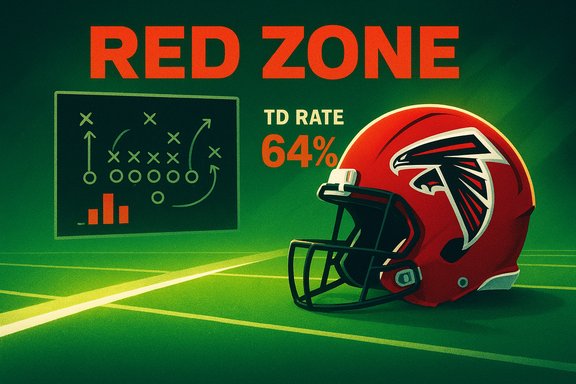
The Falcons’ red‑zone fortunes have flipped from a glaring weakness into one of the NFL’s most efficient short‑field attacks over the second half of their 2025 campaign, a turnaround that is measurable on the stat sheet, visible on tape, and yet still fragile enough that comprehension of method and context matters as much as the headline numbers.
Background / Overview
Across the first eight weeks of 2025, Atlanta’s offense struggled to cash red‑zone possessions into touchdowns, converting on only 45% of trips inside the 20 — nine touchdowns on 20 red‑zone drives — a problem magnified by a low number of offensive possessions early in the year. That narrative reversed sharply beginning in Week 9: the Falcons posted a league‑leading 92.9% red‑zone touchdown rate and a 100% scoring rate in the red zone across the next five games, scoring on 13 of 14 red‑zone drives (including a 10‑straight TD stretch between Weeks 9 and 12) and lifting their season figure to a 64.7% RZTD percentage. Those figures are the launchpad for this analysis: how did the Falcons engineer such a stark efficiency swing inside the 20, which metrics underpin the narrative, which claims can be independently verified, and—critically—how sustainable is the improvement?The numbers: what changed and why it matters
The headline shifts
- First eight weeks: 45% red‑zone touchdown rate (9 TDs on 20 drives).
- Since Week 9 (five‑game stretch cited): 92.9% red‑zone touchdown rate and 100% red‑zone scoring rate — 13 TDs on 14 trips, 10 TDs in a row in part of that span.
- Overall season mark after the stretch: 64.7% red‑zone touchdown percentage, eighth in the league at the snapshot cited.
Under‑the‑hood metrics that moved
Several micro‑metrics moved in tandem with the TD conversion rate:- Negative plays in the red zone decreased dramatically: 22 negative plays in the opening eight weeks fell to just eight since Week 9, with red‑zone negative runs dropping from seven to one.
- Yards per carry inside the 20 improved from 2.4 to 3.2, a meaningful jump when goal‑line and short‑yardage contexts dominate.
- Completion percentage in the red zone surged from about 52.6% to 75% across the two periods, moving from the bottom of the league early to the top five in the latter span.
Verifying the claims: cross‑checks and caveats
Primary documentation and independent confirmation
The core claims were published in the Falcons’ internal “Nerdy Birds” piece and republished widely; the official team article details the Week 1–8 vs Week 9+ splits and includes quotes from coaches and quantified micro‑metrics. Independent outlets and aggregator screens corroborate the broader trend — several week‑by‑week red‑zone rankings and plus/minus leaderboards show Atlanta climbing the red‑zone efficiency charts through the mid‑season stretch. Athlon and Yardbarker red‑zone plus/minus tables and NBC Sports matchup reports confirm the Falcons’ improving placement in league short‑field metrics relative to peers at similar snapshots.Where numbers can differ and why
A consistent journalistic caveat applies: stat snapshots depend on cut‑off dates, dataset definitions, and provider refresh cycles. Sack totals, fractional stats, and segmental splits (e.g., Weeks 1–8 vs Weeks 9–13) are highly sensitive to how a data vendor slices the season. The Falcons note that they used TruMedia data and even used Microsoft CoPilot to sort that dataset for internal analysis; vendor‑sourced historical markers and aggregate differentials are valid but should be regarded as vendor‑anchored until cross‑reconciled with play‑by‑play logs. The team itself flags provider variance and recommends play‑by‑play verification for any contractual or historical adjudication.Specific claims to treat with caution
- The Precisely stated “92.9%” across that post‑Week 9 stretch is defensible given the Falcons’ cited window; however, independent public leaderboards will display slightly different percentages if they use different game cutoffs. Cross‑checks with public red‑zone tables around Week 13–14 show Atlanta rising in short‑field ranks but not every external table will mirror the Falcons’ segment arithmetic exactly.
- The headline differential numbers reported as “71.7% improvement” and the jump from “minus‑23.8% to 47.9%” are powerful but derive from internal dataset math; treat them as strong directional evidence that warrants play‑by‑play reconciliation in any rigorous audit.
What changed schematically and operationally
Tactical adjustments on offense
The Falcons’ account and film study point to pragmatic, detail‑oriented changes rather than radical schematic reinvention:- Emphasis on no negative plays: Play calls and situational sequencing were refined to prioritize positive gains and limit third‑and‑long scenarios inside the 20. That included more quick‑developing concepts, simplified protection checks, and packaged plays that preserved options for the QB.
- Goal‑line and short‑yardage execution: Coaching staff increased volume on finish‑phase drills — blocking fundamentals, contact balance, and ball security — producing fewer tackles for loss and more decisive fold‑throughs at the edge. The run game’s yards per carry boost inside the 20 (2.4 → 3.2) is the statistical reflection of that work.
- Passing efficiency under duress: The completion percentage jump to 75% in the red zone indicates both cleaner protection windows and improved route timing/target selection in tight windows. Play designers leaned on high‑percentage throws and created clearer alignment windows for receivers.
Defensive complementary work
Offense did not operate in a vacuum. Atlanta’s defense reduced its red‑zone touchdown allowance from 68.8% over the first eight weeks (28th in the league) to 45% since Week 9 (tied for seventh‑best in that span). That defensive tightening reduces opponent scoring leverage and contributes to a more favorable red‑zone touchdown differential.Film room insights: execution, not miracles
The transformation visible on tape aligns with the stat sheet. Key film takeaways:- Shorter QB decision windows: Interior pressure rates and clearer protection led to throw windows that allowed the offense to execute quick, high‑percentage plays near the goal line.
- Finishing in traffic: Receivers showed better contested‑catch technique and greater YAC on short targets; offensive line combos finished blocks more consistently, creating crease lanes for backs. The reduction in negative runs (seven → one) is the tape‑level proof of improved trench play.
- Situational play calling: The Falcons increasingly used packages that forced defenders to respect both run and pass options post‑snap — RPOs and play‑action off successful early downs made red‑zone defenders hesitate and expanded high‑value throw windows.
Strengths: why the turnaround has foundation
- Measurable micro‑improvements: The shift in negative plays, completion rate, and yards per carry are mechanically tied to touchdown probability; they are not merely vanity metrics.
- Coaching clarity: The staff pursued concrete, repeatable fixes (finish‑phase drills, protection simplification, small‑package tactical adjustments) rather than wholesale schematic churn. That reduces variance and improves teachability across reps.
- Defensive support: A defense that concedes fewer red‑zone TDs reduces the scoring burden on the offense and improves overall red‑zone differential, strengthening game control even when offensive variance appears.
Risks and fragilities: what could undo this
- Small‑sample volatility. Short streaks spike percentages. The Falcons’ jump is dramatic, but the league’s best teams sustain these rates over longer windows. A handful of failed red‑zone drives in future games would materially alter the percentages.
- Opponent adjustments. NFL coordinators adapt quickly. Teams can counter with quicker passing concepts, more max‑protect personnel near the goal line, or different alignment rules that blunt interior push and stunt timing. The Falcons must have counters ready.
- Injury and depth risk. Short‑yardage efficiency relies on interior linemen, fullbacks, and reliable backs and tight ends. Injuries to core finishers reduce options and increase variance in the red zone. Rotational depth matters.
- Data‑definition exposure. Some verifiable historical superlatives (e.g., “fastest Falcon to X sacks since 1988” in other Nerdy Birds pieces) derive from TruMedia and team‑sourced indexing; similar vendor sourcing drives red‑zone claims here. Robust adjudication requires synchronized play‑by‑play logs and multi‑provider checks. Flag vendor‑sourced holistic figures for independent verification.
Practical checklist: how the Falcons can lock it in
- Maintain protection clarity: Continue simple, repeatable slide rules and center/guard communication to give timing plays their intended windows.
- Preserve rotation and freshness: Avoid overtaxing finish‑phase blockers and short‑yardage specialists; depth acquisition and snap‑management reduce late‑season fragility.
- Expand quick‑game red‑zone package: Add two‑play sequences that punish opponent counters (e.g., quick slants into play‑action fades) so opponents can’t sell out to one look.
- Track multi‑provider metrics: Reconcile TruMedia counts with public play‑by‑play logs and a second independent provider weekly to isolate true trend from noise.
What to watch next (short, scannable)
- Red‑zone touchdown attempts and outcomes over the next three games — sustained efficiency across multiple opponents is the acid test.
- Negative plays inside the 20 (target is low single digits per multi‑game sample).
- Opponent protection responses (more max‑protect snaps? shorter release times? and how play‑call balance neutralizes them.
- Snap counts and injury signals for key finishers on offense and interior defenders on defense.
- Red‑zone touchdown differential across a rolling 6–8 game window to filter variance.
A balanced verdict
The Falcons’ red‑zone turnaround is not a parlor trick. The statistical shifts — fewer negative plays, better completion percentage, improved rushing efficiency in short fields — match film evidence and coaching testimony. The team’s internal analytics, sorted with modern tooling, show a dramatic swing that explains improved TD conversion.Yet prudence is required. The most important qualifiers are sample size and vendor sourcing. Many of the most eye‑catching figures come from the Falcons’ own analysis using TruMedia and are accurate for the selected windows; independent public leaderboards corroborate the direction of improvement but will differ in magnitude depending on cutoffs. For fans and analysts, the correct posture is cautious optimism: the improvements are real, the fixes are teachable and repeatable, but durable league‑leading performance will demand consistent execution, depth management, and adaptive counter‑schemes as opponents adjust.
Final takeaway
The Falcons’ red‑zone story this season is a textbook case of process over panic. Small, deliberate corrections in execution and play design produced measurable gains in a context where marginal differences create outsized scoreboard effects. If Atlanta preserves the habits that produced fewer negative plays and higher completion rates — while reconciling vendor data against independent play‑by‑play logs — the team has a credible path from short‑term hot streak to a sustained, repeatable competitive advantage in short‑field scoring. That path is still narrow and guarded by opponent adjustments and roster durability, but the evidence that progress is occurring is now both statistical and visual — and that is a promising place for a franchise to be.Source: Big News Network.com https://www.bignewsnetwork.com/news/278739041/nerdy-birds-analyzing-the-falcons-red-zone-turnaround/
