

The long-asked-for overhaul of two of the most beloved post-apocalyptic RPGs is finally real: inside sources say Fallout 3 and Fallout: New Vegas are both receiving remastered treatments — planned projects intended to modernize these classics for current systems while preserving the gameplay that made them enduring favorites. The report, published by Windows Central and attributed to executive editor Jez Corden’s sources, specifically frames these projects as being similar in approach to The Elder Scrolls IV: Oblivion Remastered — a surprise Unreal Engine 5-powered revamp that shadow-dropped in 2025 — rather than full-from-the-ground-up remakes.
The two games in question are pillars of the modern Fallout legacy. Fallout 3 launched in 2008 as Bethesda Game Studios’ ambitious transition of the franchise into 3D and real-time combat, and Fallout: New Vegas, released in 2010, cemented Obsidian Entertainment’s reputation for tightly written, choice-rich RPG design. Both titles were built on the Gamebryo engine, an older middleware engine that underpins gameplay systems and file formats which are now difficult to run cleanly on modern Windows installations. Their age, engine quirks, and patching histories have made both notoriously finicky on current PCs — a core reason why remasters would offer clear technical value to the PC audience. The Windows Central piece makes three central claims:
However, the devil is in the details: the chosen developer, the decision on mod support, and how faithfully quest systems are preserved will determine whether these releases are celebrated restorations or contentious re-releases. The Oblivion Remastered template offers a successful proof of concept, but past remasters show that community engagement, transparent tooling, and post-launch support matter as much as initial graphical fidelity.
For now, treat the reports as credible and encouraging: official announcements and technical disclosures are the next necessary steps for verifying scope, timing, and community impact. Until then, the safest expectation is a conservatively modernized remaster that prioritizes stability and visual upgrades — but fans should watch for commitments around mods and tool support before celebrating fully.
Source: Windows Central Surprise! Both Fallout 3 and New Vegas are getting remasters after all
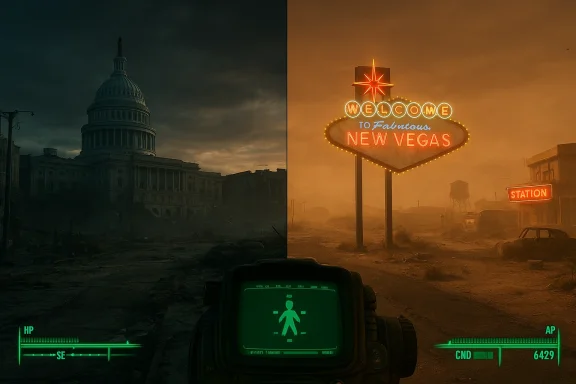 Background / Overview
The two games in question are pillars of the modern Fallout legacy. Fallout 3 launched in 2008 as Bethesda Game Studios’ ambitious transition of the franchise into 3D and real-time combat, and Fallout: New Vegas, released in 2010, cemented Obsidian Entertainment’s reputation for tightly written, choice-rich RPG design. Both titles were built on the Gamebryo engine, an older middleware engine that underpins gameplay systems and file formats which are now difficult to run cleanly on modern Windows installations. Their age, engine quirks, and patching histories have made both notoriously finicky on current PCs — a core reason why remasters would offer clear technical value to the PC audience. The Windows Central piece makes three central claims:- Remasters of Fallout 3 and Fallout: New Vegas are planned and in development.
- These remasters will likely follow the template used for Oblivion Remastered — i.e., a UE5 visual and asset overhaul layered onto the legacy gameplay systems — rather than a complete rebuild that alters core game systems.
- The remasters are not the mysterious reveal tied to a countdown timer on the Fallout TV show's interactive website; that timer likely relates to the series itself, not a surprise game drop.
Why a remaster — and why now?
The technical reality: Gamebryo’s limits meet modern Windows
Both Fallout 3 and New Vegas were originally developed on Gamebryo (also known historically as NetImmerse), a 2000s-era engine that powered Bethesda’s open-world designs before the Creation Engine era. Gamebryo’s file formats, runtime expectations, and middleware dependencies (physics, scripting, etc. cause compatibility headaches on current Windows releases and modern GPU driver stacks. The result for players is frequent installation pitfalls, crashes, and brittle mod compatibility — problems that have persisted despite community patches and modding projects. A remaster that modernizes rendering, shaders, memory handling, and I/O could substantially improve stability and performance on contemporary hardware.Market timing: Fallout TV series resurgence and player demand
The Fallout television adaptation — now well into its second season — has reenergized mainstream and streaming audiences for the franchise, creating a favorable commercial environment for refreshing the classic games. Timely remasters can capture both nostalgic players and newcomers who discover the franchise through the show, which is a strategic pattern Microsoft and Xbox have used before when aligning media releases with game releases on Game Pass and retail. However, sources told Windows Central the TV show's countdown is unrelated to a game drop, reducing the likelihood of a synchronized shadow-drop tied to that reveal.What “Oblivion-style” remasters mean — technical and design implications
The Oblivion Remastered precedent
Bethesda’s Oblivion Remastered (announced and released in 2025) was rebuilt using Unreal Engine 5 by an external team and presented a substantial graphical overhaul — modern lighting, higher-fidelity assets, updated animations, and quality-of-life improvements — while largely preserving the original game's systems and design. That project demonstrated a hybrid approach: replace the rendering and asset layers while maintaining the game’s core logic and quest scripting, which is often tightly coupled to the original engine’s runtime. Public reporting identified Virtuos and UE5 packaging as central to that release. The commercial success of that shadow drop appears to be a motivating factor behind adopting the same formula for other legacy Bethesda-era titles.What this approach likely entails for Fallout 3 / New Vegas
If Bethesda and Microsoft choose the same model, expect:- A complete visual and asset upgrade implemented in Unreal Engine 5 (or a similarly modern renderer).
- Preservation of original quest logic, NPC scripts, and core gameplay behavior tied to the original Gamebryo runtime — potentially achieved through emulation, middleware translation layers, or maintaining a thin Gamebryo compatibility layer for gameplay while offloading rendering and streaming to UE5.
- Quality-of-life improvements such as modern UI/UX, improved input handling, reworked save systems, and default modern settings (higher resolutions, uncapped framerates, etc..
- Packaging on current storefronts, and a strong probability of a Game Pass release (based on Microsoft’s typical first-party strategy).
Who might build them? Developer candidates and constraints
In-house Bethesda vs. external studios
Several development routes are feasible:- In-house Bethesda (or an Xbox Game Studios sibling) could handle development to retain tight IP control.
- A trusted external contractor — as with Oblivion Remastered — could execute the heavy lifting, especially if Microsoft wants a faster turnaround or to avoid diverting Bethesda Game Studios’ resources.
- Obsidian Entertainment is an intriguing candidate: the studio built New Vegas originally and is now a first-party Xbox studio with multiple projects in flight. Windows Central’s reporting points to Obsidian having multiple projects and notes the studio’s historical connection to New Vegas; Tim Cain’s more recent involvement in Obsidian further fuels speculation that the studio could contribute in some capacity. That said, public reporting does not confirm Obsidian’s direct involvement in these remasters.
Practical constraints and incentives
- A UE5 re-skin requires specialist art and engineering capacity to recreate thousands of assets, environmental kits, and character models — work typically suited to teams with AAA remaster experience or external partners with scalable art pipelines.
- Preserving quest fidelity while changing the renderer is technically tricky; it requires accurate mapping between original data structures and the new runtime layer, or keeping the original runtime as an emulated component.
- Microsoft’s Game Pass model incentivizes day-one inclusion when possible, because a remaster can boost subscription retention and serve as a catalog refresh for legacy content.
What fans should expect — benefits and limitations
Immediate upsides
- Significant improvements in stability and performance on modern Windows versions and current consoles, addressing long-standing installation and runtime fragility.
- Modern graphics, lighting, and animations that make the worlds feel fresh to new players.
- Bundling of DLC into convenient editions and improved compatibility with modern storefronts and cloud services.
- A likely Game Pass availability model, increasing access for subscribers and driving broad playthroughs. Microsoft’s store listings and third-party trackers already show Fallout titles distributed through Game Pass tiers.
Important limitations and risks
- Gameplay fidelity vs. modernization: an Oblivion-style remaster preserves gameplay quirks. For many fans that is a feature, not a bug; for others, persistent old-system issues (inventory friction, save-bloat mechanics) may feel outdated unless deliberately addressed.
- Mod support uncertainty: Oblivion Remastered reportedly launched without official mod tools, prompting immediate concerns from mod communities. If Bethesda chooses a similar approach and maintains closed toolchains or different file formats, community mods — a major longevity driver for both Fallout 3 and New Vegas — could be more difficult to produce or port. This will be a crucial point for the PC audience.
- Preservation trade-offs: moving assets and renderers into a new pipeline may make it harder to maintain classic modding workflows and archival compatibility unless the studio intentionally supports legacy formats or provides modding tools.
- Potential price and monetization decisions: whether these remasters ship as paid retail products, Game Pass additions, or Deluxe Editions could shape community reaction.
The mod community and the “two-games-in-one” question
Long before official remasters, the modding community solved many compatibility and enhancement problems. Notably, the Tale of Two Wastelands project and similar comprehensive fan conversions have long merged Fallout 3 and New Vegas content or modernized assets. Community patches such as Viva New Vegas and numerous mod packs have significantly improved stability, performance, and features — often exceeding official patches for niche compatibility scenarios. Any official remaster must reckon with this existing ecosystem: should it support it, subsume it, or sideline it? There’s also a tantalizing but speculative idea raised in coverage: a formal 2-for-1 bundle that harmonizes both games’ assets and mechanics for cross-play or combined campaigns. While modders have long achieved these effects, an official bundled product would require careful legal, design, and engineering work — particularly for reconciling quests, leveling curves, and mechanics across two distinct design lineages.Business strategy: Why Microsoft and Bethesda might pursue staggered remasters
Microsoft and Xbox Game Studios are executing a long-game strategy for legacy IP value. Remasters:- Reinvigorate older catalog titles on Game Pass, increasing subscriber retention.
- Create low-risk content that benefits from modern technical advances and marketing synergies with ancillary media (like the TV show).
- Offer opportunities to monetize Deluxe Editions, physical collections, and merchandising without the enormous investment required by new AAA productions.
What remains unverified — and why caution is warranted
Several details reported in early coverage are plausible but not yet confirmed:- Which studio(s) will handle the remasters (Bethesda in-house, Obsidian, Virtuos, or another partner) remains unconfirmed in public reporting. Windows Central notes Obsidian’s capacity and connection but does not provide a firm attribution. This is important because the developer identity will shape design priorities and community trust.
- The exact technical architecture — for example, whether the remasters will run an emulated Gamebryo layer for gameplay with UE5 purely for rendering, or whether gameplay systems will be reimplemented — is not publicly known and will materially affect modding and compatibility outcomes. The Oblivion precedent suggests a hybrid approach, but the engineering specifics are still speculation.
- Release windows and commercial terms (price, Game Pass availability at launch, platform parity) have not been announced. Historical practice suggests a high probability of Game Pass inclusion at launch for Microsoft first-party projects, but until official confirmation is given, that remains a strong hypothesis, not a fact.
Potential roadmaps and timeline scenarios
While no firm dates exist, industry signals and past patterns allow for cautious timeline modeling:- Short-term (months): Internal planning, prototype work, and vendor selection; corporate announcements may be timed to Xbox events or Bethesda communications.
- Medium-term (6–18 months): Visible marketing, closed betas for compatibility testing, and early gameplay reveals. If Microsoft follows the Oblivion playbook, a surprise “shadow drop” remains possible but is not guaranteed.
- Long-term (18–36 months): Full release, DLC bundling, and subsequent patches for mod support and community compatibility.
Critical analysis: strengths, opportunities, and risks
Strengths and opportunities
- Technical modernization: Upgrading to a modern rendering and streaming pipeline will make these games accessible to a much broader set of players and will reduce the friction of installation and play on modern hardware.
- Commercial upside: The approach has low development risk relative to a full remake and strong revenue and engagement potential via Game Pass and retail sales.
- Preservation of narrative and design: Fans who prize the original story, tone, and quest design should welcome a remaster that preserves these elements while improving visuals.
- New audience potential: With a successful TV adaptation feeding interest, remasters are well-positioned to convert viewers into players.
Key risks and downsides
- Mod ecosystem disruption: If official remasters break or fail to support community mod formats, a major portion of the franchise’s longevity may be undermined.
- Perception of low-effort upgrades: Fans can be suspicious of "graphics-only" remasters; careful communication and meaningful QoL improvements will be essential to avoid backlash.
- Unclear stewardship: The identity of the lead developer will influence credibility; Obsidian’s historical involvement with New Vegas would inspire trust, but outside contractors without a strong community track record might face skepticism.
- Technical fidelity traps: Translating aged quest and scripting systems into a new runtime can introduce regressions or subtle behavioural differences that break emergent gameplay or quests in unexpected ways.
What to watch for next — signals that will matter
- Official confirmation from Bethesda or Microsoft that names the developer and platform strategy.
- Clear guidance on modding support, tools, and whether the release will be compatible with existing fan patches.
- Technical deep dives or developer diaries showing the architecture chosen for preserving quest scripting while modernizing render pipelines.
- Pricing and Game Pass timing — Day-one Game Pass inclusion would be a strong indicator of Microsoft’s strategic priorities for the remasters.
Final assessment
The prospect of Fallout 3 and Fallout: New Vegas receiving modern remasters is a meaningful piece of news for both preservation and accessibility. The likely path — a UE5-powered visual overhaul that keeps the original gameplay intact — is a sensible compromise between technical modernization and design preservation. It addresses a tangible pain point for PC players while minimizing the risk and cost of a full remake.However, the devil is in the details: the chosen developer, the decision on mod support, and how faithfully quest systems are preserved will determine whether these releases are celebrated restorations or contentious re-releases. The Oblivion Remastered template offers a successful proof of concept, but past remasters show that community engagement, transparent tooling, and post-launch support matter as much as initial graphical fidelity.
For now, treat the reports as credible and encouraging: official announcements and technical disclosures are the next necessary steps for verifying scope, timing, and community impact. Until then, the safest expectation is a conservatively modernized remaster that prioritizes stability and visual upgrades — but fans should watch for commitments around mods and tool support before celebrating fully.
Quick takeaways (at a glance)
- Windows Central reports remasters of Fallout 3 and Fallout: New Vegas are planned.
- The work is likely to mirror Oblivion Remastered: modern renderer (UE5) + preserved gameplay systems.
- The TV show countdown is reportedly not a game drop; expect separate communications for the remasters.
- Mod support and developer identity are the two biggest outstanding questions that will shape community reception.
Source: Windows Central Surprise! Both Fallout 3 and New Vegas are getting remasters after all
