

Microsoft’s wave of 3,200 Xbox layoffs has cut more than 50 Bethesda employees in Rockville, Maryland, and Dallas, Texas, leaving at least one developer unsure how Fallout 76 can keep receiving updates unless Bethesda brings in an external studio to help. That warning does not prove the game is closing, but it exposes a live-service continuity problem that Microsoft cannot solve merely by declaring Fallout one of its strongest franchises. After eight years of patches and new content, Fallout 76 now sits at the uncomfortable intersection of Xbox’s demand for efficiency, Bethesda’s specialized technology, and a player community whose expectations survive even when the developers serving it do not.
Fallout 76 arrived in late 2018 as an unusually public failure for Bethesda. Its limited content, severe technical problems, and multiplayer-first design collided with the expectations attached to a series known for expansive single-player role-playing games, producing scathing reviews and months of controversy.
The significant fact today is not that Fallout 76 launched badly. It is that Bethesda kept working on it.
Over eight years of steady patches and content updates, the studio transformed the game from a cautionary tale into a durable online product with a healthy community. That recovery created value for Bethesda and repaired some of the reputational damage caused by the launch, but it also created an operating commitment: once a publisher persuades players that an online world is stable, supported, and worth investing in, continued maintenance becomes part of the product.
A conventional single-player game can reach a relatively settled state. Its publisher may issue occasional compatibility fixes or rereleases, but the game does not normally require a permanent production organization to keep its core experience viable.
A live-service game is different. Content, client updates, server operations, account systems, storefront activity, customer support, security work, quality assurance, platform certification, and emergency fixes form a chain. Weakening one link does not necessarily shut the game immediately, but it can progressively reduce what the remaining team is able to deliver.
That is why the reported comment from a Bethesda developer matters. According to Windows Central, drawing on reporting from IGN, the developer said they “have no idea how they’ll continue updating Fallout 76 without hiring an external studio.”
The important word is not end. It is continue. The developer’s concern suggests that the existing production model may no longer have enough internal capacity to operate as it did before the layoffs.
Microsoft, Xbox, and Bethesda have not announced that Fallout 76 support is ending. Any claim that shutdown is imminent would go beyond the available evidence. But the layoffs have made the game’s current update model questionable, and that is already a material change for its players.
Ars Technica’s coverage described substantial losses across Bethesda-linked operations, while PC Gamer highlighted the Bethesda Game Studios union’s objection to the idea that the cuts were confined to unnecessary management. According to the union’s account, the company lost programmers, artists, designers, and testers—the production roles that convert a franchise strategy into functioning software.
That distinction matters because corporations frequently explain restructuring in terms of reducing duplication, simplifying decision-making, or removing organizational layers. Those goals can sound almost frictionless, as if a company were deleting boxes from an organization chart rather than removing people from active development pipelines.
For Fallout 76, the layoffs are not an abstract reduction in overhead. They reportedly affect the organization responsible for producing, testing, and maintaining the game.
The two Bethesda-operated online games discussed in the reporting show different versions of the same pressure:
The table illustrates why headcount figures alone cannot predict a game’s fate. A service can survive substantial cuts if work is narrowed, delayed, redistributed, or transferred, but each of those choices changes the service even when its servers remain online.
The layoffs therefore force Bethesda to decide what “support” means. It could mean preserving current access while reducing new content. It could mean maintaining seasonal activity with fewer ambitious additions. It could mean moving significant development to an outside partner. Or it could eventually mean entering a maintenance-only phase before active development concludes.
Those outcomes are not equivalent for players, even though a corporate announcement might describe all of them as continued support.
An outside developer does not arrive with an immediate understanding of a game’s architecture, build systems, content pipeline, undocumented workarounds, historical defects, or design assumptions. It must learn how changes are made, which systems are fragile, where automated testing is insufficient, and whom to contact when a routine update triggers an unexpected failure.
That process consumes time from the remaining internal team. The people best equipped to train a contractor are often the same people already being asked to cover the work left behind after layoffs.
The result is a familiar restructuring paradox: management reduces headcount to make an organization leaner, then discovers that the survivors must spend months transferring knowledge before the promised efficiency can appear. During that interval, output may slow while operational risk rises.
An external partner could still be the best available option. Specialized support studios routinely contribute art, testing, porting, engineering, and content production to major games, and a carefully managed partner could help Fallout 76 maintain a meaningful release cadence.
But Microsoft would need to define the partner’s mandate. There is a large difference between adding production capacity under Bethesda’s direction and transferring practical ownership of day-to-day development to a lower-cost contractor.
The first model preserves Bethesda as the technical and creative authority while buying it additional labor. The second risks hollowing out the internal team until the external studio knows more about current operations than the franchise owner does.
That distinction becomes especially important when a service encounters an emergency. Routine content can be scheduled and documented; a severe regression, platform-specific failure, security problem, or corrupted production build may require people who remember why a system was constructed in a particular way years earlier.
Contractors can acquire that knowledge, but they cannot acquire it retroactively after the people who held it have already left.
IGN’s reporting, as repeated across coverage of the layoffs, raised fears that remaining developers could spend substantial time training contractors who do not know how Bethesda’s proprietary tools work. That concern affects more than Fallout 76, but an eight-year-old online game is particularly vulnerable to knowledge loss.
Long-running software accumulates history. Some components have been rewritten, others extended beyond their original purpose, and still others preserved because changing them would introduce too much risk. The most valuable knowledge is frequently not what the documentation says, but what experienced developers know not to touch without additional testing.
This is institutional knowledge, and layoffs can remove it faster than management can measure it.
A company can count eliminated positions. It cannot easily count the debugging intuition, informal relationships, tool expertise, and historical context leaving with those positions.
Fallout 76 adds another layer of complexity because it adapted Bethesda’s role-playing technology to an online multiplayer environment. Whatever its current technical condition, maintaining it requires familiarity with the interaction between a characteristically Bethesda-style world and the systems needed to operate that world as a continuing service.
Training a new team on the engine is therefore only the beginning. That team must also understand the live game as it exists after eight years of modification.
This does not make outsourcing impossible. It makes rushed outsourcing dangerous.
If Microsoft has already secured a capable partner and begun an orderly transition, the developer’s warning may reflect uncertainty among employees rather than the absence of a plan. No such plan has been publicly detailed, however, and the reported confusion inside Bethesda is itself consequential.
A robust continuity plan should be visible to the people expected to execute it. When a developer working close enough to the game to comment on its future says they have no idea how updates will continue, the problem is not only staffing. It is also communication and transition management.
Xbox CEO Asha Sharma has similarly argued that Xbox needs to “move faster” with core intellectual property such as Fallout. Taken together, those statements appear to establish a straightforward strategy: concentrate resources on the brands with the greatest audience value and deliver new products from them more frequently.
Fallout 76 complicates that strategy because it is both an asset and an obligation.
As the most recent released Fallout game, it gives Microsoft an active product through which players can engage with the franchise. Its regular updates keep Fallout present between major releases and give Bethesda a place to channel interest generated elsewhere around the property.
At the same time, every employee assigned to Fallout 76 is an employee not assigned to another project unless Microsoft expands capacity. A company trying to accelerate its core franchises may decide that maintaining an eight-year-old live service competes with creating the next product meant to drive those franchises forward.
That is the accounting problem behind the rhetoric. Supporting a strong franchise does not necessarily mean supporting every current product within it equally.
Microsoft may regard Fallout 76 as a valuable bridge. It may instead regard the game as an expensive legacy operation whose resources would produce greater returns elsewhere. Both choices can be presented publicly as investments in Fallout.
The phrase “strongest franchises” therefore offers less protection than it initially appears to. It establishes Fallout’s importance, but it does not establish Fallout 76’s priority within the franchise.
Ending active development would carry its own cost. It would contradict the spirit, if not the wording, of Microsoft’s promise to move faster with Fallout, and it could weaken confidence among players who watched Bethesda spend eight years persuading them that Fallout 76 had a future.
Keeping the game alive without funding it adequately could be worse. A prolonged period of thin updates, recurring defects, unclear communication, and declining confidence would preserve the service in a technical sense while gradually reducing its relevance.
Microsoft’s most credible option is to make the trade-off explicit: either fund a viable internal team, install an external partner with a structured handover, or announce a transparent transition to a less ambitious maintenance phase. Ambiguity may be convenient during a restructuring, but live-service communities interpret silence as information.
That language is worth examining because online games rarely jump directly from normal operation to closure. They usually pass through a series of smaller changes that can each be explained as prioritization.
A roadmap shifts. A planned feature moves. A release contains fewer substantial additions. Major updates become less frequent, while events and previously produced content carry more of the calendar.
None of those developments proves that a service is ending. Together, however, they can mark a publisher’s decision to reduce investment while preserving revenue and avoiding the disruption of an immediate shutdown.
Fallout 76 could follow a similar path. Its servers and store could remain available while the size and cadence of updates decline. Bethesda could focus on bug fixes, recurring activities, and modest additions rather than content requiring extensive art, design, engineering, and testing.
From a corporate perspective, this can be a rational middle ground. The game continues serving its community, Microsoft retains an active Fallout product, and the reduced team costs less to operate.
From a player’s perspective, the distinction between active growth and managed decline matters. People decide whether to subscribe, purchase optional content, recruit friends, or continue investing time based partly on their belief that the world will keep developing.
The company does not need to guarantee endless expansion. It does need to describe the level of support players are actually buying into.
The Elder Scrolls Online reporting also demonstrates that cuts within one part of ZeniMax do not remain isolated. When multiple online teams are simultaneously losing staff, Bethesda has fewer internal places from which to borrow expertise or temporary capacity.
A publisher can sometimes protect a priority project by moving developers from another team. That becomes harder when the entire organization is being reorganized and each surviving group is defending its own schedule.
This is why the scale of the Xbox layoffs matters even if only a portion directly touched Fallout 76. A service depends not just on its named development team but on shared publishing, quality assurance, platform, localization, support, and technical functions. A reduction elsewhere can still lengthen the path between identifying a problem and delivering a fix.
Existing work may already be far enough along to ship despite the layoffs. Live-service teams commonly prepare content in advance, so releases appearing after a staffing reduction do not necessarily indicate that the long-term production pipeline is healthy.
The more revealing period comes later, when Bethesda must replace projects that were conceived, built, and tested before the cuts. That is when reduced capacity, onboarding demands, and changed priorities are likely to become visible.
Players should watch the substance of updates rather than their mere existence. A patch can contain meaningful new content, or it can primarily recycle activities and adjust existing systems. Both allow a publisher to say that the game is still being updated, but they require very different levels of investment.
Communication cadence matters as well. Delayed roadmaps, vaguer commitments, or a shift away from long-range promises would not prove that development is ending, but reportedly changing staffing would make those signals more significant.
The external-studio question may also become visible through changes in consistency. New teams often need time to match established art direction, narrative tone, encounter design, technical standards, and quality expectations. A well-managed partner can become effectively indistinguishable from the internal group; a rushed transition can produce uneven releases and recurring regressions.
Bethesda should therefore resist the temptation to reassure players with language that is technically true but operationally empty. “Support will continue” means little unless the company clarifies whether that support includes major content, regular patches, basic maintenance, or simply continued server availability.
Fallout 76’s recovery succeeded partly because Bethesda kept showing up. The studio continued patching and expanding the game after the easiest business decision might have been to minimize further investment.
The layoffs now test whether that persistence was an enduring commitment or a temporary arrangement dependent on staffing Microsoft no longer intends to maintain.
But a future Fallout project does not automatically replace Fallout 76’s current role.
Game production takes time, and an unreleased title cannot provide patches, events, or continuity for an existing community. Nor can it absorb the obligations associated with an online service simply because both products share a franchise name.
Obsidian’s involvement may nevertheless reduce Microsoft’s strategic dependence on Fallout 76. If Xbox believes another Fallout game will become the franchise’s next major commercial and cultural focus, it may be less willing to make long-term investments in an older service.
That would explain why concentrating on a “strongest franchise” could coincide with reducing the team behind its newest released game. Microsoft may be moving resources from franchise maintenance toward franchise renewal.
The danger is a gap between those strategies. Scaling down Fallout 76 before its successor is ready could leave Microsoft with a powerful brand but no actively growing game carrying it forward.
There is also a trust issue that extends beyond Fallout. Players evaluating any future Xbox live-service title will remember how Microsoft handled mature games after their growth years. A company’s approach to the late life of one service becomes part of the implied bargain attached to the next.
No online game can be supported forever, and eight years is a substantial run. The question is not whether Bethesda has a right to conclude active development; it plainly does. The question is whether layoffs will force that conclusion without a deliberate plan for the community or the employees expected to manage the transition.
If Obsidian’s project represents the future, Microsoft still needs a strategy for the present. Treating those as the same problem would leave Fallout 76’s players carrying the cost of the gap.
This is particularly stark at Bethesda, where proprietary tools and long development histories make individual experience unusually important. Replacing a developer on paper does not replace their accumulated understanding of the Creation Engine, the current build pipeline, or the dependencies connecting a live game to the rest of the organization.
The reported cuts also challenge Xbox’s stated ambition to move faster. Speed in software development rarely comes from removing experienced contributors and asking fewer people to absorb more responsibilities.
A smaller organization can move faster when the reduction eliminates duplicated authority and simplifies decisions. It can move slower when the reduction removes production capacity, increases onboarding work, and leaves surviving employees afraid of further cuts.
According to the reporting around Bethesda, employees are worried about precisely those downstream effects. The concern is not merely that fewer people will produce fewer assets. It is that lost expertise will create delays and additional pressure throughout development.
That pressure can spread from Fallout 76 into Bethesda’s other work. If remaining engine specialists, testers, and producers must divide their time between maintaining an online game, training contractors, and supporting larger projects, Microsoft has not eliminated the work. It has concentrated the work onto fewer people.
Outsourcing can redistribute labor, but it cannot substitute for accountable product ownership. Bethesda still needs an internal group capable of setting priorities, reviewing changes, responding to incidents, and deciding what Fallout 76 should become.
If that core is too small, the publisher risks entering a cycle in which outside teams maintain systems they did not design while internal staff lose the time required to supervise them. The service may continue, but the organization’s ability to change it safely diminishes.
This is the quiet danger behind large-scale restructuring. The first visible result is a layoff number. The lasting result may be a company that owns more valuable brands than it has coherent teams to sustain.
The uncertainty is what form that effect will take.
Microsoft could authorize Bethesda to rebuild the team. It could bring in an external studio while retaining enough experienced employees to manage the transition. It could scale down the content calendar, or it could begin preparing the game for an eventual maintenance-only period.
Each is plausible. None has been confirmed.
What would be difficult to believe is that a reduction of this magnitude produces no change at all. Windows Central reached the same broad conclusion in its coverage: whether development stops or merely slows, the cuts are likely to become visible in the update cadence.
Bethesda’s own continued activity around Fallout 76 demonstrates that the game remains a live product, not an abandoned archive. That makes transparency more urgent, because players are still making decisions based on the assumption of ongoing service.
Microsoft does not need to publish internal staffing charts. It should, however, say whether the current roadmap remains intact, whether a partner will join development, and what level of support the company intends to provide over the foreseeable future.
The absence of an immediate announcement is understandable during a large restructuring. Prolonged silence would be less defensible.
A live-service team cannot promise certainty, but it can provide boundaries. Bethesda can distinguish major content development from routine maintenance, explain whether cadence is changing, and give players enough information to decide how much time and money they want to continue investing.
Without those boundaries, “strongest franchises” becomes corporate reassurance detached from product reality.
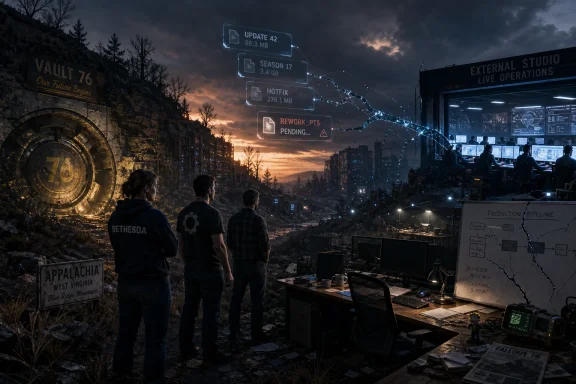 Fallout 76 Turned a Failed Launch Into an Eight-Year Obligation
Fallout 76 arrived in late 2018 as an unusually public failure for Bethesda. Its limited content, severe technical problems, and multiplayer-first design collided with the expectations attached to a series known for expansive single-player role-playing games, producing scathing reviews and months of controversy.The significant fact today is not that Fallout 76 launched badly. It is that Bethesda kept working on it.
Over eight years of steady patches and content updates, the studio transformed the game from a cautionary tale into a durable online product with a healthy community. That recovery created value for Bethesda and repaired some of the reputational damage caused by the launch, but it also created an operating commitment: once a publisher persuades players that an online world is stable, supported, and worth investing in, continued maintenance becomes part of the product.
A conventional single-player game can reach a relatively settled state. Its publisher may issue occasional compatibility fixes or rereleases, but the game does not normally require a permanent production organization to keep its core experience viable.
A live-service game is different. Content, client updates, server operations, account systems, storefront activity, customer support, security work, quality assurance, platform certification, and emergency fixes form a chain. Weakening one link does not necessarily shut the game immediately, but it can progressively reduce what the remaining team is able to deliver.
That is why the reported comment from a Bethesda developer matters. According to Windows Central, drawing on reporting from IGN, the developer said they “have no idea how they’ll continue updating Fallout 76 without hiring an external studio.”
The important word is not end. It is continue. The developer’s concern suggests that the existing production model may no longer have enough internal capacity to operate as it did before the layoffs.
Microsoft, Xbox, and Bethesda have not announced that Fallout 76 support is ending. Any claim that shutdown is imminent would go beyond the available evidence. But the layoffs have made the game’s current update model questionable, and that is already a material change for its players.
Xbox’s Reset Cuts Directly Into the Work It Still Needs Done
The broader restructuring is enormous: 3,200 Xbox layoffs accompanied by four studio divestments. Teams under the ZeniMax and Bethesda umbrella have reportedly been affected “significantly,” placing some of Microsoft’s most recognizable properties inside one of the deepest reorganizations in Xbox history.Ars Technica’s coverage described substantial losses across Bethesda-linked operations, while PC Gamer highlighted the Bethesda Game Studios union’s objection to the idea that the cuts were confined to unnecessary management. According to the union’s account, the company lost programmers, artists, designers, and testers—the production roles that convert a franchise strategy into functioning software.
That distinction matters because corporations frequently explain restructuring in terms of reducing duplication, simplifying decision-making, or removing organizational layers. Those goals can sound almost frictionless, as if a company were deleting boxes from an organization chart rather than removing people from active development pipelines.
For Fallout 76, the layoffs are not an abstract reduction in overhead. They reportedly affect the organization responsible for producing, testing, and maintaining the game.
The two Bethesda-operated online games discussed in the reporting show different versions of the same pressure:
| Service | Reported staffing impact | Current support signal | Most plausible near-term risk | Confirmed outcome |
|---|---|---|---|---|
| Fallout 76 | Bethesda lost more than 50 employees across Rockville and Dallas | A developer reportedly sees external help as necessary to continue updates | Smaller updates, slower cadence, outsourcing, or eventual end of active development | No official change announced |
| The Elder Scrolls Online | Its developer suffered more than 200 cuts | Content roadmaps are reportedly “shifting” | Reduced or reorganized content delivery | Roadmap change reported, but no shutdown announced |
The layoffs therefore force Bethesda to decide what “support” means. It could mean preserving current access while reducing new content. It could mean maintaining seasonal activity with fewer ambitious additions. It could mean moving significant development to an outside partner. Or it could eventually mean entering a maintenance-only phase before active development concludes.
Those outcomes are not equivalent for players, even though a corporate announcement might describe all of them as continued support.
An External Studio Is a Production Strategy, Not a Spare Part
Outsourcing is the most obvious way to reconcile Microsoft’s desire to reduce internal costs with Bethesda’s need to keep Fallout 76 operating. It is also far more difficult than the phrase “hire an external studio” makes it sound.An outside developer does not arrive with an immediate understanding of a game’s architecture, build systems, content pipeline, undocumented workarounds, historical defects, or design assumptions. It must learn how changes are made, which systems are fragile, where automated testing is insufficient, and whom to contact when a routine update triggers an unexpected failure.
That process consumes time from the remaining internal team. The people best equipped to train a contractor are often the same people already being asked to cover the work left behind after layoffs.
The result is a familiar restructuring paradox: management reduces headcount to make an organization leaner, then discovers that the survivors must spend months transferring knowledge before the promised efficiency can appear. During that interval, output may slow while operational risk rises.
An external partner could still be the best available option. Specialized support studios routinely contribute art, testing, porting, engineering, and content production to major games, and a carefully managed partner could help Fallout 76 maintain a meaningful release cadence.
But Microsoft would need to define the partner’s mandate. There is a large difference between adding production capacity under Bethesda’s direction and transferring practical ownership of day-to-day development to a lower-cost contractor.
The first model preserves Bethesda as the technical and creative authority while buying it additional labor. The second risks hollowing out the internal team until the external studio knows more about current operations than the franchise owner does.
That distinction becomes especially important when a service encounters an emergency. Routine content can be scheduled and documented; a severe regression, platform-specific failure, security problem, or corrupted production build may require people who remember why a system was constructed in a particular way years earlier.
Contractors can acquire that knowledge, but they cannot acquire it retroactively after the people who held it have already left.
The Creation Engine Makes Institutional Memory Part of the Product
Bethesda’s proprietary Creation Engine sits at the center of the concern. It is not merely a brand name attached to the studio’s games; it represents a collection of tools, workflows, conventions, and technical assumptions that Bethesda employees have learned through direct experience.IGN’s reporting, as repeated across coverage of the layoffs, raised fears that remaining developers could spend substantial time training contractors who do not know how Bethesda’s proprietary tools work. That concern affects more than Fallout 76, but an eight-year-old online game is particularly vulnerable to knowledge loss.
Long-running software accumulates history. Some components have been rewritten, others extended beyond their original purpose, and still others preserved because changing them would introduce too much risk. The most valuable knowledge is frequently not what the documentation says, but what experienced developers know not to touch without additional testing.
This is institutional knowledge, and layoffs can remove it faster than management can measure it.
A company can count eliminated positions. It cannot easily count the debugging intuition, informal relationships, tool expertise, and historical context leaving with those positions.
Fallout 76 adds another layer of complexity because it adapted Bethesda’s role-playing technology to an online multiplayer environment. Whatever its current technical condition, maintaining it requires familiarity with the interaction between a characteristically Bethesda-style world and the systems needed to operate that world as a continuing service.
Training a new team on the engine is therefore only the beginning. That team must also understand the live game as it exists after eight years of modification.
This does not make outsourcing impossible. It makes rushed outsourcing dangerous.
If Microsoft has already secured a capable partner and begun an orderly transition, the developer’s warning may reflect uncertainty among employees rather than the absence of a plan. No such plan has been publicly detailed, however, and the reported confusion inside Bethesda is itself consequential.
A robust continuity plan should be visible to the people expected to execute it. When a developer working close enough to the game to comment on its future says they have no idea how updates will continue, the problem is not only staffing. It is also communication and transition management.
“Strongest Franchises” Is a Promise With an Accounting Problem
Bethesda president Jill Braff reportedly told employees that the company needs to organize itself to better support its “strongest franchises.” VGC and other outlets treated that language as evidence of a shift away from studio-by-studio planning and toward franchise-level priorities.Xbox CEO Asha Sharma has similarly argued that Xbox needs to “move faster” with core intellectual property such as Fallout. Taken together, those statements appear to establish a straightforward strategy: concentrate resources on the brands with the greatest audience value and deliver new products from them more frequently.
Fallout 76 complicates that strategy because it is both an asset and an obligation.
As the most recent released Fallout game, it gives Microsoft an active product through which players can engage with the franchise. Its regular updates keep Fallout present between major releases and give Bethesda a place to channel interest generated elsewhere around the property.
At the same time, every employee assigned to Fallout 76 is an employee not assigned to another project unless Microsoft expands capacity. A company trying to accelerate its core franchises may decide that maintaining an eight-year-old live service competes with creating the next product meant to drive those franchises forward.
That is the accounting problem behind the rhetoric. Supporting a strong franchise does not necessarily mean supporting every current product within it equally.
Microsoft may regard Fallout 76 as a valuable bridge. It may instead regard the game as an expensive legacy operation whose resources would produce greater returns elsewhere. Both choices can be presented publicly as investments in Fallout.
The phrase “strongest franchises” therefore offers less protection than it initially appears to. It establishes Fallout’s importance, but it does not establish Fallout 76’s priority within the franchise.
Ending active development would carry its own cost. It would contradict the spirit, if not the wording, of Microsoft’s promise to move faster with Fallout, and it could weaken confidence among players who watched Bethesda spend eight years persuading them that Fallout 76 had a future.
Keeping the game alive without funding it adequately could be worse. A prolonged period of thin updates, recurring defects, unclear communication, and declining confidence would preserve the service in a technical sense while gradually reducing its relevance.
Microsoft’s most credible option is to make the trade-off explicit: either fund a viable internal team, install an external partner with a structured handover, or announce a transparent transition to a less ambitious maintenance phase. Ambiguity may be convenient during a restructuring, but live-service communities interpret silence as information.
Fallout 76 and The Elder Scrolls Online Show How Retreat Usually Begins
The Elder Scrolls Online provides the closest comparison inside Bethesda’s portfolio. Its developer reportedly suffered more than 200 cuts, and the game’s content roadmaps are described as “shifting.”That language is worth examining because online games rarely jump directly from normal operation to closure. They usually pass through a series of smaller changes that can each be explained as prioritization.
A roadmap shifts. A planned feature moves. A release contains fewer substantial additions. Major updates become less frequent, while events and previously produced content carry more of the calendar.
None of those developments proves that a service is ending. Together, however, they can mark a publisher’s decision to reduce investment while preserving revenue and avoiding the disruption of an immediate shutdown.
Fallout 76 could follow a similar path. Its servers and store could remain available while the size and cadence of updates decline. Bethesda could focus on bug fixes, recurring activities, and modest additions rather than content requiring extensive art, design, engineering, and testing.
From a corporate perspective, this can be a rational middle ground. The game continues serving its community, Microsoft retains an active Fallout product, and the reduced team costs less to operate.
From a player’s perspective, the distinction between active growth and managed decline matters. People decide whether to subscribe, purchase optional content, recruit friends, or continue investing time based partly on their belief that the world will keep developing.
The company does not need to guarantee endless expansion. It does need to describe the level of support players are actually buying into.
The Elder Scrolls Online reporting also demonstrates that cuts within one part of ZeniMax do not remain isolated. When multiple online teams are simultaneously losing staff, Bethesda has fewer internal places from which to borrow expertise or temporary capacity.
A publisher can sometimes protect a priority project by moving developers from another team. That becomes harder when the entire organization is being reorganized and each surviving group is defending its own schedule.
This is why the scale of the Xbox layoffs matters even if only a portion directly touched Fallout 76. A service depends not just on its named development team but on shared publishing, quality assurance, platform, localization, support, and technical functions. A reduction elsewhere can still lengthen the path between identifying a problem and delivering a fix.
Players Will Probably See Cadence Changes Before They See a Shutdown Notice
The most likely short-term consequence is not an abrupt disappearance of Fallout 76. It is uncertainty in the production calendar.Existing work may already be far enough along to ship despite the layoffs. Live-service teams commonly prepare content in advance, so releases appearing after a staffing reduction do not necessarily indicate that the long-term production pipeline is healthy.
The more revealing period comes later, when Bethesda must replace projects that were conceived, built, and tested before the cuts. That is when reduced capacity, onboarding demands, and changed priorities are likely to become visible.
Players should watch the substance of updates rather than their mere existence. A patch can contain meaningful new content, or it can primarily recycle activities and adjust existing systems. Both allow a publisher to say that the game is still being updated, but they require very different levels of investment.
Communication cadence matters as well. Delayed roadmaps, vaguer commitments, or a shift away from long-range promises would not prove that development is ending, but reportedly changing staffing would make those signals more significant.
The external-studio question may also become visible through changes in consistency. New teams often need time to match established art direction, narrative tone, encounter design, technical standards, and quality expectations. A well-managed partner can become effectively indistinguishable from the internal group; a rushed transition can produce uneven releases and recurring regressions.
Bethesda should therefore resist the temptation to reassure players with language that is technically true but operationally empty. “Support will continue” means little unless the company clarifies whether that support includes major content, regular patches, basic maintenance, or simply continued server availability.
Fallout 76’s recovery succeeded partly because Bethesda kept showing up. The studio continued patching and expanding the game after the easiest business decision might have been to minimize further investment.
The layoffs now test whether that persistence was an enduring commitment or a temporary arrangement dependent on staffing Microsoft no longer intends to maintain.
Obsidian Changes the Future of Fallout, Not the Present of Fallout 76
The report that Obsidian is now making a new Fallout game changes Microsoft’s portfolio calculation. It offers a path toward the faster development of a core franchise that Sharma has said Xbox wants.But a future Fallout project does not automatically replace Fallout 76’s current role.
Game production takes time, and an unreleased title cannot provide patches, events, or continuity for an existing community. Nor can it absorb the obligations associated with an online service simply because both products share a franchise name.
Obsidian’s involvement may nevertheless reduce Microsoft’s strategic dependence on Fallout 76. If Xbox believes another Fallout game will become the franchise’s next major commercial and cultural focus, it may be less willing to make long-term investments in an older service.
That would explain why concentrating on a “strongest franchise” could coincide with reducing the team behind its newest released game. Microsoft may be moving resources from franchise maintenance toward franchise renewal.
The danger is a gap between those strategies. Scaling down Fallout 76 before its successor is ready could leave Microsoft with a powerful brand but no actively growing game carrying it forward.
There is also a trust issue that extends beyond Fallout. Players evaluating any future Xbox live-service title will remember how Microsoft handled mature games after their growth years. A company’s approach to the late life of one service becomes part of the implied bargain attached to the next.
No online game can be supported forever, and eight years is a substantial run. The question is not whether Bethesda has a right to conclude active development; it plainly does. The question is whether layoffs will force that conclusion without a deliberate plan for the community or the employees expected to manage the transition.
If Obsidian’s project represents the future, Microsoft still needs a strategy for the present. Treating those as the same problem would leave Fallout 76’s players carrying the cost of the gap.
The Cuts Expose the Difference Between Owning IP and Sustaining It
Microsoft owns a formidable collection of game properties, but intellectual property does not develop itself. The layoffs reveal the distance between possessing a franchise and retaining the people capable of producing it.This is particularly stark at Bethesda, where proprietary tools and long development histories make individual experience unusually important. Replacing a developer on paper does not replace their accumulated understanding of the Creation Engine, the current build pipeline, or the dependencies connecting a live game to the rest of the organization.
The reported cuts also challenge Xbox’s stated ambition to move faster. Speed in software development rarely comes from removing experienced contributors and asking fewer people to absorb more responsibilities.
A smaller organization can move faster when the reduction eliminates duplicated authority and simplifies decisions. It can move slower when the reduction removes production capacity, increases onboarding work, and leaves surviving employees afraid of further cuts.
According to the reporting around Bethesda, employees are worried about precisely those downstream effects. The concern is not merely that fewer people will produce fewer assets. It is that lost expertise will create delays and additional pressure throughout development.
That pressure can spread from Fallout 76 into Bethesda’s other work. If remaining engine specialists, testers, and producers must divide their time between maintaining an online game, training contractors, and supporting larger projects, Microsoft has not eliminated the work. It has concentrated the work onto fewer people.
Outsourcing can redistribute labor, but it cannot substitute for accountable product ownership. Bethesda still needs an internal group capable of setting priorities, reviewing changes, responding to incidents, and deciding what Fallout 76 should become.
If that core is too small, the publisher risks entering a cycle in which outside teams maintain systems they did not design while internal staff lose the time required to supervise them. The service may continue, but the organization’s ability to change it safely diminishes.
This is the quiet danger behind large-scale restructuring. The first visible result is a layoff number. The lasting result may be a company that owns more valuable brands than it has coherent teams to sustain.
Action checklist for admins
Organizations managing shared Windows gaming PCs, demonstration systems, or community gaming spaces should prepare for possible changes without treating an unconfirmed shutdown as fact.- Inventory where Fallout 76 is installed and how each deployment is licensed, updated, and authenticated.
- Keep managed clients on supported builds rather than freezing an older version to avoid future changes.
- Test major client updates on a limited group of PCs before broad deployment where bandwidth or uptime matters.
- Preserve locally managed configuration information before reinstallations or troubleshooting work.
- Monitor official Microsoft, Xbox, and Bethesda communications for roadmap or support-policy changes.
- Distinguish reduced content production from server closure when communicating with users; neither outcome has been officially announced.
Microsoft Now Owes Players a Definition of Continued Support
The central uncertainty is not whether the layoffs will affect Fallout 76. Removing more than 50 Bethesda employees amid a wider 3,200-person Xbox reduction is almost certain to affect how work is allocated, even if players never receive a formal explanation of every internal change.The uncertainty is what form that effect will take.
Microsoft could authorize Bethesda to rebuild the team. It could bring in an external studio while retaining enough experienced employees to manage the transition. It could scale down the content calendar, or it could begin preparing the game for an eventual maintenance-only period.
Each is plausible. None has been confirmed.
What would be difficult to believe is that a reduction of this magnitude produces no change at all. Windows Central reached the same broad conclusion in its coverage: whether development stops or merely slows, the cuts are likely to become visible in the update cadence.
Bethesda’s own continued activity around Fallout 76 demonstrates that the game remains a live product, not an abandoned archive. That makes transparency more urgent, because players are still making decisions based on the assumption of ongoing service.
Microsoft does not need to publish internal staffing charts. It should, however, say whether the current roadmap remains intact, whether a partner will join development, and what level of support the company intends to provide over the foreseeable future.
The absence of an immediate announcement is understandable during a large restructuring. Prolonged silence would be less defensible.
A live-service team cannot promise certainty, but it can provide boundaries. Bethesda can distinguish major content development from routine maintenance, explain whether cadence is changing, and give players enough information to decide how much time and money they want to continue investing.
Without those boundaries, “strongest franchises” becomes corporate reassurance detached from product reality.
The Signals That Will Define Appalachia’s Next Phase
The story is no longer simply that Fallout 76 survived its disastrous launch. It is whether the operating structure that enabled that recovery can survive Microsoft’s effort to make Xbox smaller and faster.- More than 50 Bethesda employees were cut across Rockville and Dallas during the 3,200-person Xbox layoff wave.
- One Bethesda developer reportedly believes continued Fallout 76 updates may require an external studio.
- Microsoft, Xbox, and Bethesda have not announced the end of Fallout 76 support.
- Reduced update size or cadence is more plausible in the near term than an immediate shutdown.
- The Creation Engine makes contractor onboarding and knowledge transfer consequential production risks.
- Obsidian’s new Fallout project may strengthen the franchise while reducing Microsoft’s incentive to fund its eight-year-old online game at the same level.
References
- Primary source: Windows Central
Published: 2026-07-09T20:10:18.131920
"I have no idea how they'll continue": Bethesda dev is worried Xbox layoffs could end Fallout 76 updates without help from "an external studio" | Windows Central
This week's Xbox and Bethesda cuts have made the future of Fallout 76 uncertain.www.windowscentral.com - Related coverage: techradar.com
Xbox announces 'the most significant restructure' in its history — and it'll cause 1,600 'painful' job losses today and numerous studio sales | TechRadar
The rumors were true: Xbox announces thousands of job layoffs and some serious studio restructuringwww.techradar.com - Related coverage: tomshardware.com
Microsoft 'resets' Xbox by cutting 3,200 jobs this year, divesting five game studios — firm cites 'margins that are 3-10x lower than comparable platform and publishing businesses' | Tom's Hardware
1,600 jobs will be eliminated today, the rest throughout FY27www.tomshardware.com - Related coverage: pcgamer.com
Bethesda Game Studios and ZeniMax hit hard by Xbox layoffs, says union | PC Gamer
ZeniMax Online Studios and id Software have survived the latest bloodbath at Microsoft, but it sounds like they've been cut deeply.www.pcgamer.com - Related coverage: gamesradar.com
Fallout and Elder Scrolls union says Bethesda layoffs didn't hurt Microsoft's "14 layers of management" – "We lost dozens of programmers, artists, designers and testers" | GamesRadar+
Bethesda Game Studios didn't escape Xbox's layoffs unscathedwww.gamesradar.com - Related coverage: arstechnica.com
Bethesda, id Software reportedly hit hard by Microsoft layoffs - Ars Technica
As much as 50 percent of some teams affected by reductions, and more could be coming.arstechnica.com
- Related coverage: techspot.com
Microsoft is cutting 3,200 Xbox jobs and spinning off four game studios | TechSpot
In a public memo to Xbox employees, CEO Asha Sharma confirmed that Microsoft will eliminate approximately 3,200 positions across the gaming division between now and July 2027,...www.techspot.com - Related coverage: fortune.com
Xbox's CEO on 3,200 layoffs, four studios cut, and her warning that 'we spread ourselves too thin' | Fortune
Asha Sharma unveiled sweeping changes at the Microsoft unit Monday, including downsizing that will impact 20% of staff.fortune.com
- Related coverage: forbes.com
Xbox To Lay Off 3,200 Workers, And Five Studios Will Leave The Brand
The industry has been bracing for large-scale Xbox layoffs in the wake of a new administration running the brand. Today, those layoffs have arrived,www.forbes.com - Related coverage: geekwire.com
A ‘painful’ reset for Xbox: 3,200 job cuts, studio spinoffs, and a vow to return to growth in 2027 – GeekWire
Xbox CEO Asha Sharma calls it the most significant restructuring in Xbox history: 3,200 job cuts, four studio spinoffs, a new COO, and a flattened management structure — all aimed at turning around a division she says has been losing 64 cents on every dollar invested in its studios.www.geekwire.com - Related coverage: washingtonpost.com
Loading…
www.washingtonpost.com - Related coverage: au.variety.com
Xbox to Cut Up to 3,200 Staffers
Xbox is set to lay off staffers in what CEO Asha Sharma calls the "most significant restructure" in the Microsoft division's history. au.variety.com
- Related coverage: gamespot.com
Xbox CEO Reflects On Massive Cuts: "We Simply Spread Ourselves Too Thin" - GameSpot
Xbox is in an "unhealthy" spot, CEO Asha Sharma says.www.gamespot.com - Related coverage: psu.com
Multiple Bethesda Staff Say Xbox Layoffs Will Have 'Substantial And Cascading Effect' On The Elder Scrolls VI - PlayStation Universe
Various Bethesda staff members have stated that the mass layoffs will have a major impact on the development of The Elder Scrolls 6.www.psu.com - Related coverage: tech.yahoo.com
After Xbox cuts, one Bethesda dev fears Fallout 76 updates may end without help from "an external studio"
Microsoft's cuts at Xbox and Bethesda have one developer worried that the studio won't be able to continue updating Fallout 76 without outside help.tech.yahoo.com - Related coverage: bizjournals.com
Zenimax Media hit with layoffs as Microsoft cuts video game units - Washington Business Journal
Microsoft's Xbox division cuts 3,200 workers, including 400 at Rockville-based ZeniMax Media and its online studios affiliate.www.bizjournals.com - Related coverage: resetera.com
- Related coverage: fallout.bethesda.net
- Related coverage: videogameschronicle.com
Bethesda boss tells staff it will restructure around ‘our strongest franchises’ after cuts | VGC
Bethesda will reportedly rebuild around Fallout, The Elder Scrolls, Doom, Quake…www.videogameschronicle.com - Related coverage: insider-gaming.com
Fallout 76 Updates Could Stop 'Without External Studio', It's Suggested - Insider Gaming
One Bethesda Game Studios developer has suggested that Fallout 76 updates might not pan out without serious support from external studios.insider-gaming.com - Related coverage: latimes.com
Microsoft’s Xbox to shift Obsidian studio to new ‘Fallout’ video game
Obsidian Entertainment, a subsidiary of Microsoft Corp.’s Xbox, has canceled multiple projects and will begin working on a new game in the popular Fallout franchise as part of the division’s broader restructuring, according to people familiar with the matter.www.latimes.com - Related coverage: technical.ly
Microsoft gaming reset brings layoffs to Maryland studios
Following a pandemic-era corporate buying spree, 3,200 Xbox positions face cuts.technical.ly - Related coverage: squaredcast.com