

Britain’s AI Advice Problem Has Moved From Hypothetical to Operational
The most important word in the Reuters report is not “ChatGPT,” “Claude,” or “Gemini.” It is “trust.” Mills’ review found that more than a quarter of UK consumers trust general-purpose AI tools for financial advice, even though many have limited awareness that the protections attached to regulated financial services do not extend to those services.
That gap is where the regulatory argument begins. A consumer who asks an authorised adviser whether to move pension savings, buy an investment product, or consolidate debt is entering a heavily policed environment. A consumer who asks a chatbot the same question may receive a fluent, personalised answer that feels like advice but legally sits somewhere else.
The FCA has long treated financial advice as a regulated activity that authorised firms may provide under specific obligations. Generic guidance, by contrast, can explain concepts without recommending a personal course of action. Large language models make that boundary harder to defend because their entire interface is built around adaptation: they remember context, respond to personal details, and produce an answer that sounds tailored even when the service provider insists it is not acting as an adviser.
This is not merely a British problem. The UK happens to be airing it in a financial-regulatory idiom, but the same pattern appears wherever general-purpose AI is dropped into a specialised domain. A system sold as a general assistant can become a tax explainer, a medical triage aide, a coding partner, a legal summariser, or an investment whisperer depending on what the user types into the box.
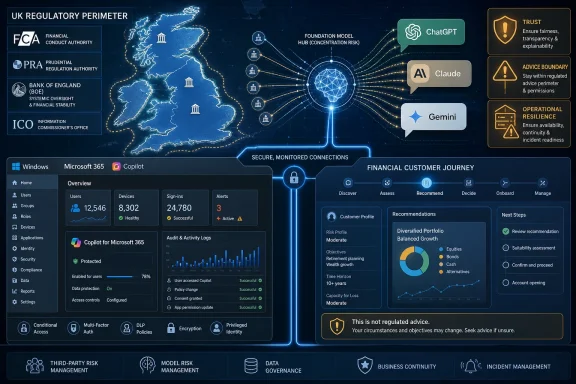
That is why the Mills review matters beyond the City of London. It is one of the clearest signals yet that regulators are beginning to move from regulating uses of AI inside firms to asking whether some AI models, interfaces, and providers are becoming part of the regulated supply chain themselves.
The Chatbot Did Not Apply for an Advice Licence, but It May Be Doing the Job Anyway
Financial regulation is built around role definition. A bank takes deposits. An insurer underwrites risk. An adviser recommends products. A technology vendor supplies infrastructure. The compliance burden follows the role.
AI assistants scramble that neat map. A model provider may not intend to provide regulated financial advice, but its product can generate a personalised recommendation if the prompt contains enough detail. The provider may call the output “information,” the user may experience it as advice, and the downstream harm may look exactly like the harm regulators already exist to prevent.
Mills’ recommendation, as described by Reuters, is carefully framed. He is not demanding an immediate crackdown on OpenAI, Anthropic, or Google. He is asking the FCA to consider within three to six months whether it needs to “secure and adapt” the regulatory perimeter by reviewing the scale, nature, and impact of AI models that currently sit outside it.
That phrase should land heavily with anyone who has watched financial technology evolve. Regulators often begin with perimeter questions because the perimeter defines everything else: who must register, who must disclose, who must test, who must preserve records, who must compensate customers, and who can be sanctioned when things go wrong.
The hard part is that general-purpose models are not financial products in the ordinary sense. ChatGPT can draft a resignation letter, explain mortgage amortisation, write PowerShell, summarise a PDF, or suggest an asset allocation. Claude can help edit a contract and then walk a user through a household budget. Gemini can sit inside a broader productivity ecosystem and mediate search, email, documents, and decisions.
If the FCA regulates the model, it risks dragging an entire class of general-purpose computing into financial supervision. If it regulates only financial firms using the model, it leaves consumer-facing advice-like interactions outside the gate. If it regulates only explicit financial-advice products, it may miss the very interface consumers are already using.
This is the same structural puzzle that has haunted platform regulation for years. The more general the platform, the harder it is to pin responsibility to a single regulated function. The more indispensable the platform becomes, the less credible it is to pretend it is just neutral plumbing.
The UK’s Principles-Based Bet Is Meeting Its First Real AI Stress Test
The FCA’s official Mills Review page says the regulator has not planned to introduce extra AI rules and has instead leaned on existing, principles-based, outcomes-focused frameworks. That is the classic UK regulatory posture: avoid prescriptive technology law where possible, keep obligations tied to outcomes, and let firms innovate inside flexible guardrails.
That approach has strengths. It avoids writing brittle rules around today’s model architecture. It lets supervisors judge whether customers were treated fairly rather than whether a firm complied with a checklist written for obsolete software. It also aligns with the FCA’s broader growth-and-competitiveness mandate, which matters in a post-Brexit market trying to keep London relevant as a financial technology centre.
But principles-based regulation has a dependency: someone inside the regulated perimeter must be accountable for the outcome. If a bank deploys an AI complaints assistant that mishandles vulnerable customers, the FCA can look to the bank. If an insurer uses a model in underwriting and produces discriminatory pricing, the insurer remains responsible. If a wealth platform wraps a chatbot around investment recommendations, the platform cannot simply blame the API.
The problem Mills is pointing to is different. Consumers increasingly go straight to general-purpose AI systems before they ever reach a regulated firm. In that setting, the model provider may not be authorised, the user may not know the distinction, and the firm that ultimately receives the customer may have no visibility into the advice-like path that led them there.
That creates a regulatory blind spot. The conduct risk happens upstream of the regulated transaction. The persuasion happens in a conversational interface. The consumer may arrive at a regulated marketplace having already made a decision shaped by an unregulated system.
The UK can keep saying that existing rules are flexible enough. Mills is effectively asking whether that remains true when the most influential financial interface may not be a bank branch, a broker app, or a comparison website, but a chatbot running on a hyperscale AI stack.
Concentration Risk Is the Part of the Story Enterprise IT Should Not Ignore
The consumer-advice angle is the headline, but the concentration-risk angle is the system administrator’s story. Reuters reported that Mills also warned that financial firms’ reliance on a handful of technology providers could introduce system-wide risks. That should sound familiar to anyone who has managed Windows fleets, cloud identity outages, endpoint-security failures, or SaaS dependencies at scale.
Modern enterprise IT already has a concentration problem. Many organisations depend on the same cloud regions, the same identity providers, the same EDR vendors, the same collaboration suites, the same payment processors, and the same managed-service chains. AI adds another layer to that stack: the same foundation models, the same vector databases, the same orchestration frameworks, the same GPU clouds, and the same model gateways.
In finance, shared dependence can turn ordinary vendor risk into correlated behaviour. If dozens of firms use the same model to triage complaints, detect fraud, approve exceptions, or generate investment guidance, a model failure is no longer isolated. A subtle behavioural shift after a model update could ripple through customer service, compliance workflows, trading support, and risk scoring across institutions.
This is not science fiction. IT history is full of single points of failure that looked diversified because they were branded differently at the application layer. A bank may have one chatbot, an insurer another, and a fintech a third, yet all three may be calling the same model family through the same cloud provider with similar retrieval pipelines and the same managed identity architecture.
Financial regulators already understand operational resilience. The UK has been developing a Critical Third Parties regime to deal with systemic dependency on technology suppliers. The FCA’s own Mills Review page explicitly points to operational resilience, outsourcing, hyperscalers, and chains of accountability among firms, senior managers, technology providers, and model developers.
AI makes that discussion more urgent because model behaviour is not as easily captured as uptime. A cloud outage is visible. A model degradation can be subtle. A hallucination pattern, prompt-injection vulnerability, biased refusal behaviour, or faulty reasoning chain may not look like a service failure until customers have already been affected.
Agentic AI Turns Bad Advice Into Automated Action
The next step is not a chatbot that tells a user what to do. It is an AI agent that does it. Bank of England deputy governor Sarah Breeden, in remarks reported by Reuters a week before the Mills story, warned that increasingly capable agentic systems may require bespoke regulation because existing frameworks were not built to contemplate autonomous agents.
That is the escalation path regulators are now trying to anticipate. An advice-like chatbot is risky because it can persuade. An agentic system is riskier because it can execute. In retail finance, that could mean switching accounts, rebalancing portfolios, initiating payments, filing claims, negotiating insurance, or selecting credit products with limited human intervention.
The comforting phrase “human in the loop” starts to weaken in that world. If every agentic action requires meaningful human approval, the automation benefit collapses. If approval becomes a rubber stamp, the human is not really a control. If firms rely on post-hoc monitoring, the damage may occur at machine speed.
WindowsForum readers will recognise this from endpoint automation and admin tooling. A script that recommends a registry change is one kind of risk. A script that pushes that change across thousands of machines is another. The difference is not intelligence; it is authority.
Financial AI agents raise the same issue with money instead of machines. A system that explains compound interest is an educational tool. A system that automatically moves a consumer into a higher-yield product may be helpful, but it also crosses into execution, suitability, consent, auditability, and redress.
That is why the FCA and Bank of England threads belong together. Mills is worrying about the blurred perimeter around advice. Breeden is worrying about autonomous systems that can act inside markets. The common theme is that AI collapses the distance between information, recommendation, and action.
Big Tech’s Consumer Interface May Become the New Bank Branch
The Mills Review page makes an important observation: AI could shift market power from financial services firms toward AI firms that control consumer interfaces, consumer data, and AI agents. That is a bigger claim than “chatbots sometimes get finance wrong.” It is a theory of market restructuring.
For decades, banks worried about being reduced to balance-sheet utilities while technology companies owned the customer relationship. Mobile wallets, comparison sites, open banking, and embedded finance all pushed in that direction. AI agents could accelerate the shift by becoming the first place consumers go to interpret their finances.
If the user asks an AI assistant which savings account to choose, which insurance policy to renew, or whether a loan is affordable, the assistant becomes a gatekeeper. It can rank options, frame trade-offs, ignore some providers, privilege others, or steer the user toward whatever products its ecosystem can see. Even without explicit advertising, the interface shapes the market.
This matters because financial regulation often assumes that firms communicate directly with customers. Disclosure rules, suitability checks, risk warnings, vulnerability guidance, and complaint rights all presuppose an identifiable relationship. AI intermediaries complicate that relationship by inserting a conversational layer between the regulated firm and the consumer.
The result could be beneficial. A well-designed AI agent could help consumers avoid inertia, compare products more effectively, spot junk fees, understand risk, and escape predatory offers. It could make financial markets less confusing and less dependent on brand loyalty.
But the same mechanism could also concentrate power. If a small number of model providers control the interface through which consumers compare financial products, they may acquire influence comparable to app stores, search engines, or payment networks. The financial firm remains regulated, but the decisive moment may occur inside a non-bank AI environment.
This is the quiet strategic problem for Microsoft, Google, OpenAI, Anthropic, and the firms building on them. The more successful the assistant becomes, the harder it is to maintain that it merely provides neutral text completion. At scale, interface design becomes market design.
The Advice Boundary Was Already Under Pressure Before AI Arrived
It is tempting to treat this as an AI-only problem, but the advice-guidance boundary was already strained. Financial regulators have spent years trying to close the “advice gap,” where consumers need help making decisions but cannot or will not pay for full regulated advice. Firms want to provide more useful guidance without accidentally triggering advice obligations.
AI intensifies that old tension because it makes personalised guidance cheap, conversational, and always available. The traditional compliance workaround was to keep guidance generic: explain what an ISA is, explain diversification, explain risk appetite, but do not recommend a specific product for a specific person. A chatbot can obey that rule in one answer and erode it over a multi-turn conversation.
The problem is cumulative context. A user may disclose age, income, savings, debts, family circumstances, tax status, risk tolerance, and goals. The system may then produce a response that avoids saying “I recommend” but still clearly points toward one course of action. From the consumer’s perspective, the distinction is legal hair-splitting.
This will be especially difficult in complaints handling and investment guidance, two areas Reuters says British companies are increasingly exploring for customer-facing AI. A complaints bot may need to understand vulnerability, distress, affordability, and regulatory obligations. An investment-guidance bot may need to avoid turning education into personalised recommendation while still being useful enough to justify deployment.
For firms, the compliance challenge is not solved by adding a disclaimer at the top of the chat window. Regulators have seen too many ineffective disclosures to accept that magic words neutralise actual conduct. If a system behaves like an adviser, is marketed like an adviser, and is relied upon like an adviser, the legal analysis will not stop at the banner text.
That is why the Mills recommendation is not as radical as it first sounds. It asks whether the perimeter should adapt to observed behaviour. In financial regulation, what a product does often matters more than what its provider calls it.
Windows Shops Will Feel This Through Governance Before They Feel It Through Law
Most WindowsForum readers are not running UK retail banks. But many are managing Microsoft 365 tenants, Copilot deployments, browser policies, endpoint controls, data-loss-prevention systems, and sanctioned or unsanctioned AI access. The regulatory debate will reach them through procurement and governance before it reaches them through direct legal obligation.
If financial firms become more cautious about general-purpose models, their IT policies will harden. Expect more attention to approved AI tools, logging, retention, prompt filtering, model-routing controls, and vendor due diligence. The question will not be simply “Can employees use ChatGPT?” but “Which model, through which tenant, under which data boundary, with which audit trail, for which business process?”
Microsoft’s role is especially interesting because Windows enterprises increasingly encounter AI through familiar surfaces: Microsoft 365 Copilot, Edge, Teams, Windows, Azure AI Foundry, GitHub Copilot, and security tooling. That gives IT administrators a more governable path than random consumer chatbot use, but it does not eliminate the underlying issue. If an AI feature affects a regulated customer outcome, the firm still needs accountability.
For sysadmins, the AI governance stack will look a lot like the security stack, only messier. Identity matters because model access must be tied to roles. Data classification matters because prompts can leak sensitive information. Endpoint management matters because browser extensions and shadow AI tools can bypass sanctioned channels. Logging matters because investigations require reconstructing who asked what, which data was retrieved, and which output influenced a decision.
The hard part is that AI use is not confined to a single application. Employees can paste information into a chatbot, use a meeting assistant to summarise customer calls, ask a coding assistant to generate workflow automation, or rely on a document summariser to interpret policy. Each action may look low risk in isolation. Together, they can shape regulated decisions.
The FCA’s review should therefore be read as an early warning for enterprise AI controls. Even outside the UK, regulated firms will increasingly need to prove not just that they have an AI policy, but that they can enforce it technically.
Model Providers Are Being Pulled Toward the Accountability Layer
OpenAI, Anthropic, and Google were not immediately available for comment to Reuters, according to the report. Their likely position is predictable: general-purpose AI tools are not authorised financial advisers, users should not treat them as such, and developers should build domain-specific compliance layers for regulated use cases.
That position is understandable. A foundation-model provider cannot easily become licensed for every regulated activity its model might discuss. The same model can generate cooking tips, legal-style explanations, travel plans, malware analysis, investment commentary, and emotional support. Turning the model provider into the regulated actor for every possible domain would be legally and operationally chaotic.
But the counterargument is also getting stronger. Model providers are not passive libraries. They design the interface, tune the model, set policies, provide system prompts, build memory features, sell enterprise controls, integrate with search and productivity suites, and market assistants as capable of helping users make decisions. The more they move up the stack, the more accountability follows.
There is a spectrum here. A raw model API used by a regulated bank inside a tightly controlled workflow is one thing. A consumer-facing assistant that invites users to discuss savings, pensions, mortgages, or debt is another. A fully agentic assistant that can compare products and execute transactions would be something else again.
Regulators may eventually differentiate among those layers. They could leave core model development mostly outside financial regulation while imposing obligations on consumer-facing AI interfaces that provide advice-like outputs. They could require regulated firms to use only models meeting assurance standards. They could create duties for critical third-party AI providers without making them financial advisers.
None of those paths is simple. All of them are more plausible today than they were two years ago.
The UK Is Trying to Avoid an AI Act While Inventing One Sector by Sector
Britain has deliberately avoided copying the European Union’s broad AI Act model. Its preference has been sectoral regulation, with existing regulators applying existing powers. The FCA’s position has fit that pattern: do not create new AI rules for their own sake; use Consumer Duty, operational resilience, senior-manager accountability, and supervision to manage outcomes.
The Mills review does not abandon that strategy. It tests its limits. If general-purpose AI systems increasingly affect financial outcomes from outside the perimeter, a purely sectoral model may need connective tissue between financial regulators, competition authorities, data-protection regulators, and broader AI-safety institutions.
The FCA page itself points toward that multi-regulator reality, naming bodies such as the Competition and Markets Authority, the Information Commissioner’s Office, and the Digital Regulation Cooperation Forum. That matters because the AI finance problem is not reducible to one legal category. It involves consumer protection, competition, privacy, operational resilience, cybersecurity, and market stability.
The UK’s advantage is flexibility. It can move faster than jurisdictions that must legislate a comprehensive AI code before supervisors act. The disadvantage is fragmentation. Firms may face overlapping expectations from multiple regulators, each insisting that existing principles apply but none providing the certainty engineers and compliance officers want.
That uncertainty is not just a legal nuisance. It shapes product design. A financial firm deciding whether to deploy an AI assistant in customer service needs to know what counts as advice, what logs must be retained, what explanations are required, whether model updates need validation, and how responsibility is allocated between the firm and vendor. Vague principles can support innovation, but only until ambiguity becomes a deployment blocker.
Mills’ three-to-six-month recommendation is therefore a governance deadline as much as a policy suggestion. It tells the FCA that the perimeter question cannot remain an academic 2030 scenario. Consumer behaviour has already moved.
The Real Risk Is Not That AI Gives One Bad Answer
Public debate often gets stuck on hallucinations. A chatbot invents a case, misstates a rule, or confidently gives wrong advice. Those failures matter, especially in finance, but they are not the deepest regulatory concern.
The deeper concern is scale. A human adviser can be incompetent, conflicted, or careless, but their reach is limited. A widely used AI system can shape millions of micro-decisions, each individually small, each difficult to trace, and each embedded in a broader pattern of nudges and recommendations.
The second concern is opacity. A consumer may not know why an AI assistant recommended one option over another. A firm may not be able to explain fully why a model produced a particular output. A regulator may not have access to the training data, prompt chain, retrieval context, or model-weight changes needed to reconstruct the event.
The third concern is correlation. If many firms and consumers rely on similar systems, they may converge on similar behaviours. In markets, that can mean herding. In customer service, it can mean repeated unfair treatment. In fraud detection, it can mean shared blind spots. In cybersecurity, it can mean common vulnerability to prompt injection or model manipulation.
The fourth concern is accountability. Financial regulation is full of duties, but duties need an accountable person or entity. AI supply chains distribute responsibility across model developers, cloud providers, application vendors, integrators, regulated firms, and end users. Everyone can plausibly claim that someone else controlled the decisive layer.
That is why a narrow debate over whether ChatGPT should be “regulated” misses the point. The harder question is how to build accountability around systems that are general-purpose at design time but domain-specific at use time.
The Compliance Burden Will Move Closer to the Prompt
For years, regulated firms have treated vendor management as a procurement and resilience problem. Does the supplier meet security standards? Can it survive outages? Where is the data stored? What happens if the contract ends? AI adds a new layer: what behaviour is the vendor enabling at the moment of interaction?
That moves compliance closer to the prompt. Firms will need to know not only which model is used, but which system instructions constrain it, which retrieval sources feed it, which tools it can call, which user data it can access, which outputs are blocked, and which conversations require escalation to a human.
This is a different discipline from traditional software validation. A deterministic workflow can be tested against expected inputs and outputs. A language model must be evaluated statistically, adversarially, and continuously. Model updates can change behaviour without changing the surrounding application code. Retrieval changes can alter answers without a vendor shipping a new version number.
For Windows-heavy enterprises, this will likely translate into practical controls. Browser access to unsanctioned AI services may be restricted. Approved assistants may be integrated through identity-aware enterprise plans. Sensitive data may be blocked from consumer AI endpoints. AI-generated content may require labelling or review in regulated workflows. Admins may be asked to produce logs that compliance teams previously never imagined needing.
The cultural shift may be larger than the technical one. Employees have learned to treat AI as a private productivity enhancer. Regulators will increasingly treat it as part of the decision environment. That means the prompt box becomes a recordable, governable, auditable space when it touches regulated activity.
This will annoy users. It will also be unavoidable.
The FCA’s Next Move Will Set a Template Others Can Borrow
The FCA says it is not bound to act on Mills’ recommendations. That is formally true and politically incomplete. Once a senior official has placed consumer reliance, advice boundaries, and concentration risk on the table, inaction becomes a choice that must be defended.
The regulator could respond modestly. It might issue guidance clarifying when AI-generated financial guidance becomes regulated advice. It might strengthen expectations for firms using AI in customer-facing contexts. It might coordinate with the Bank of England on systemic third-party dependencies. It might ask model providers and financial firms for data on usage, incidents, and controls.
It could also go further. It might recommend legislative changes for certain AI intermediaries. It might push for assurance standards for models used in retail finance. It might require regulated firms to assess upstream consumer AI journeys when designing products. It might support a regime where critical AI providers face direct oversight when their services become embedded in financial infrastructure.
The likely path is incremental rather than dramatic. British regulators tend to prefer layered expectations, supervisory pressure, consultation, and perimeter reviews before blunt prohibitions. The point is not to ban consumers from asking chatbots about money. It is to prevent a shadow advice market from forming outside the rules while regulated firms are still held to the old standard.
Other jurisdictions will be watching. The FCA has a reputation for shaping fintech supervision beyond Britain’s borders, and the advice-boundary problem exists everywhere consumer AI is available. If the UK finds a workable approach, expect regulators elsewhere to borrow the vocabulary.
The Chatbot Perimeter Is Becoming a Board-Level Risk
The immediate lesson is not that every AI answer about money should require a licence. It is that financial institutions and their technology suppliers can no longer treat general-purpose AI as an informal layer outside compliance. Mills’ review gives boards, CIOs, CISOs, and compliance officers a preview of the questions supervisors are likely to ask next.
- Firms should assume that customer-facing AI systems will be judged by their practical effect, not by disclaimers describing them as generic guidance.
- Technology teams should map which models, cloud providers, plugins, retrieval systems, and agentic tools support regulated or quasi-regulated workflows.
- Compliance teams should prepare for advice-boundary reviews that examine multi-turn conversations, not just single approved scripts.
- Security teams should treat model concentration, prompt injection, data leakage, and unapproved AI use as operational-resilience issues, not just acceptable-use-policy violations.
- Vendors should expect more pressure to provide auditability, model-change transparency, incident reporting, and contractual commitments for regulated deployments.
- Consumers should understand that asking a chatbot for financial help is not the same as receiving advice from an authorised firm with formal duties and redress mechanisms.
The FCA’s review is best understood as a perimeter flare. It illuminates the place where consumer trust, enterprise dependency, and regulatory accountability are starting to collide.
The next phase of AI regulation will not be fought only over model weights, safety benchmarks, or grand theories of artificial general intelligence. It will be fought in the mundane places where people ask software what to do with their money, where firms wire assistants into customer journeys, and where administrators decide which AI endpoints belong inside the corporate boundary. Britain’s regulators are not declaring that the chatbot is a bank adviser today, but they are making it harder for everyone else to pretend the distinction will remain obvious tomorrow.
References
- Britain should consider regulating AI models, FCA official says 101 WIXX · 2026-07-06T12:50:14.819944