

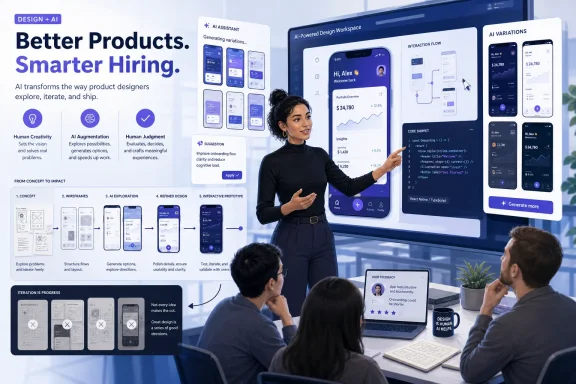
Figma’s design leadership says AI has not lowered the bar for product-design job candidates; it has raised it. Noah Levin, Figma’s vice president of product design, told Business Insider that candidates are now expected to show ideas in far higher fidelity because AI tools can produce interactive prototypes quickly without deep engineering skills.
A decade ago, Levin said, designers often could not turn an idea into something that convincingly behaved like a real product. Building multiple working concepts took too much time and technical effort. Now, AI-assisted prototyping makes rapid exploration practical, shifting interview expectations from polished static screens toward interactive demonstrations of product thinking.
Per Business Insider, Levin wants candidates to be current with new AI tools and able to use them to communicate a design at the “highest fidelity possible.” That does not mean presenting a stack of AI-generated mockups with little judgment behind them.
The distinction matters. A generated interface can look credible within minutes, but it does not prove that the candidate understands user needs, interaction design, accessibility, information architecture, edge cases, or the trade-offs behind a product decision. Levin said Figma is looking for the designer’s own craft and problem-solving rather than default model output.
Figma’s own product direction backs up that expectation. Its Figma Make tool is built around turning prompts and existing design context into interactive, code-backed prototypes. In a July 9 update, Figma said Make had added GPT-5.6 to improve initial prototype quality and iteration speed. The company also expanded Make’s connection to local production code in May, further narrowing the distance between a concept, a demo, and implementation.
For Windows developers and IT teams hiring product designers, that suggests a sharper interview test than asking for a visually polished portfolio. Ask candidates to walk through an interactive prototype, explain which user problem it targets, identify what AI helped accelerate, and show where human judgment changed or rejected the first output.
Candidates should treat AI fluency as baseline tooling, not as a substitute for a design process.
A decade ago, Levin said, designers often could not turn an idea into something that convincingly behaved like a real product. Building multiple working concepts took too much time and technical effort. Now, AI-assisted prototyping makes rapid exploration practical, shifting interview expectations from polished static screens toward interactive demonstrations of product thinking.
 The portfolio standard is changing
Per Business Insider, Levin wants candidates to be current with new AI tools and able to use them to communicate a design at the “highest fidelity possible.” That does not mean presenting a stack of AI-generated mockups with little judgment behind them.The distinction matters. A generated interface can look credible within minutes, but it does not prove that the candidate understands user needs, interaction design, accessibility, information architecture, edge cases, or the trade-offs behind a product decision. Levin said Figma is looking for the designer’s own craft and problem-solving rather than default model output.
Figma’s own product direction backs up that expectation. Its Figma Make tool is built around turning prompts and existing design context into interactive, code-backed prototypes. In a July 9 update, Figma said Make had added GPT-5.6 to improve initial prototype quality and iteration speed. The company also expanded Make’s connection to local production code in May, further narrowing the distance between a concept, a demo, and implementation.
Show the discarded work, too
Levin’s more useful interview advice may be to include failure rather than edit it out. He told Business Insider that the strongest candidates show prototypes and directions that did not make the cut, because that reveals how they explored the problem and why they chose a final approach.For Windows developers and IT teams hiring product designers, that suggests a sharper interview test than asking for a visually polished portfolio. Ask candidates to walk through an interactive prototype, explain which user problem it targets, identify what AI helped accelerate, and show where human judgment changed or rejected the first output.
Candidates should treat AI fluency as baseline tooling, not as a substitute for a design process.
References
- Primary source: Business Insider
Published: 2026-07-16T07:32:45.312000+00:00
Figma Design Lead Said He Expects More From Job Candidates in AI Era - Business Insider
Noah Levin told Business Insider he wants to see candidates use AI to create high-quality product mock-ups, without regressing to "AI slop" designs.www.businessinsider.com - Related coverage: figma.com
Free AI UX Design Generator | Figma
Design better user experiences with AI in Figma Make. Generate flows, layouts, and interactions with prompts—prototype, test, and refine in one place.www.figma.com
