

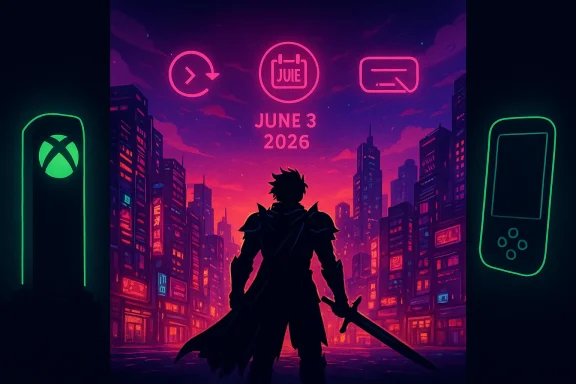
Square Enix has confirmed that FINAL FANTASY VII REBIRTH will arrive on Xbox Series X|S and Xbox PC with Xbox Play Anywhere support on June 3, 2026, marking a decisive step in the publisher’s pivot away from timed platform exclusivity and into a true multiplatform release strategy. This announcement — revealed alongside versions for Nintendo’s Switch 2 during today’s partner showcase — not only sets a concrete date for one of 2026’s most anticipated RPG releases but also crystallizes several broader shifts in platform strategy, publisher-publisher relationships, and how major Japanese RPG franchises will roll out across consoles and PC going forward.
FINAL FANTASY VII REBIRTH is the second chapter in Square Enix’s ambitious three-part remake of the legendary 1997 JRPG, itself a franchise-defining title that moved Final Fantasy into 3D and into mainstream blockbuster territory. Rebirth first launched on PlayStation 5 on February 29, 2024, followed by PC releases through Steam and the Epic Games Store in January 2025. Today’s announcement confirms that the game will join the expanding set of Final Fantasy titles available across Xbox platforms — and, crucially, that purchases will participate in Xbox Play Anywhere, enabling cross-device entitlement and shared saves between Xbox consoles and Windows PCs.
Square Enix’s own release messaging — echoed by multiple outlets and captured during the partner showcase — included a short message noting: “We’ve announced that FINAL FANTASY VII REBIRTH will launch on June 3. With the addition of Switch 2 and Xbox, the game will be released as a full multi‑platform title.” Game director Naoki Hamaguchi also signaled that Square Enix plans to “share more updates on the FINAL FANTASY VII Remake Project than ever before,” fueling expectations that the third (and final) installment could follow the same multiplatform path.
Key consumer benefits for Rebirth under Xbox Play Anywhere:
Naoki Hamaguchi’s comments hint at a more communicative and open roadmap approach: “We plan to share more updates on the FINAL FANTASY VII Remake Project than ever before.” While that language does not guarantee a simultaneous launch for Part 3, it does imply a publisher working to reduce platform siloes and to coordinate messaging across ecosystems. If Part 3 adopts day-and-date multiplatform release parity, it would represent the most definitive break from the era when major JRPGs frequently landed first (or exclusively) on PlayStation consoles.
Strengths of this pivot:
Three technical areas to watch:
But the mechanics behind this shift are complex. Delivering a polished cross-platform experience requires meticulous engineering, clear communications about platform-specific trade-offs, and honest post-launch support commitments. From a platform-strategy perspective, Microsoft benefits by further populating Xbox and Windows with high-tier JRPG content while Nintendo secures another marquee third-party launch for Switch 2. For players, the most important variables between now and June 3 will be the clarity of technical disclosures and the quality of the first-day experience on their chosen platform.
Square Enix has taken a clear step toward making the Final Fantasy VII remake project an ecosystem-wide phenomenon rather than a single-platform showcase. If the studio can match that ambition with robust technical work and transparent communications, this multiplatform rollout could be an exemplar for how major JRPGs navigate a cross-device future. If not, the community’s enthusiasm will quickly recalibrate to technical reality — and in that gap between expectation and execution, the launch’s ultimate reception will be decided.
Conclusion
FINAL FANTASY VII REBIRTH’s June 3, 2026 launch on Xbox Series X|S and Xbox PC (with Xbox Play Anywhere) is a meaningful milestone: it shortens the wait for non-PlayStation players, strengthens the multiplatform precedent set by Square Enix, and highlights the operational challenges of delivering large-scale AAA titles across divergent hardware. Players should expect more updates from the team this year, and they should pay attention to platform-specific technical breakdowns as launch approaches. For now, the announcement is a clear signal that one of the industry’s most storied franchises is being positioned for maximum reach — but turning that reach into a uniformly excellent experience across platforms will require the kind of careful engineering and communication that this project’s scale demands.
Source: Windows Central 'Final Fantasy 7 Rebirth' Xbox Play Anywhere launch dated
 Background / Overview
FINAL FANTASY VII REBIRTH is the second chapter in Square Enix’s ambitious three-part remake of the legendary 1997 JRPG, itself a franchise-defining title that moved Final Fantasy into 3D and into mainstream blockbuster territory. Rebirth first launched on PlayStation 5 on February 29, 2024, followed by PC releases through Steam and the Epic Games Store in January 2025. Today’s announcement confirms that the game will join the expanding set of Final Fantasy titles available across Xbox platforms — and, crucially, that purchases will participate in Xbox Play Anywhere, enabling cross-device entitlement and shared saves between Xbox consoles and Windows PCs. Square Enix’s own release messaging — echoed by multiple outlets and captured during the partner showcase — included a short message noting: “We’ve announced that FINAL FANTASY VII REBIRTH will launch on June 3. With the addition of Switch 2 and Xbox, the game will be released as a full multi‑platform title.” Game director Naoki Hamaguchi also signaled that Square Enix plans to “share more updates on the FINAL FANTASY VII Remake Project than ever before,” fueling expectations that the third (and final) installment could follow the same multiplatform path.
Why this date matters: timing, context, and the market
The June 3, 2026 date matters for three interconnected reasons:- It sets a firm calendar slot for a marquee AAA RPG in a crowded release window, affecting platform marketing, retail calendars, and subscription strategies.
- It confirms Square Enix’s public commitment to releasing the remake trilogy broadly rather than sustaining a PlayStation-first arrangement.
- It signals to players and platform holders that the company intends to lean on cross-platform conveniences — like Xbox Play Anywhere — to reduce friction for consumers who want to move between console and PC ecosystems.
What Xbox Play Anywhere means for players and platform parity
Xbox Play Anywhere is a deceptively simple but powerful consumer-facing feature: buy once, play on Xbox or Windows PC with shared save progress and achievements across both systems. For players who currently split time between living-room consoles and portable or desktop Windows devices, Play Anywhere eliminates duplication and eases transitions between hardware.Key consumer benefits for Rebirth under Xbox Play Anywhere:
- Single purchase entitlement — one purchase, two ecosystems.
- Shared saves — keep progress synchronized between an Xbox Series console and a Windows PC without manual transfer steps.
- Unified achievements and DLC continuity — consistent meta-progression and add-on ownership across devices.
Square Enix’s strategic pivot: leadership, multiplatform intent, and risk appetite
Square Enix’s recent corporate posture has been visibly shifting toward multiplatform distribution. Public commentary from the development team — and Square Enix press releases from 2025 onward — underscore a corporate directive to broaden the audience for Final Fantasy and other key IPs by supporting Xbox and other platforms. The arrival of Final Fantasy XVI, Final Fantasy VII Remake Intergrade, and now Rebirth on Xbox platforms over a tight time window supports this thesis.Naoki Hamaguchi’s comments hint at a more communicative and open roadmap approach: “We plan to share more updates on the FINAL FANTASY VII Remake Project than ever before.” While that language does not guarantee a simultaneous launch for Part 3, it does imply a publisher working to reduce platform siloes and to coordinate messaging across ecosystems. If Part 3 adopts day-and-date multiplatform release parity, it would represent the most definitive break from the era when major JRPGs frequently landed first (or exclusively) on PlayStation consoles.
Strengths of this pivot:
- Wider addressable market at launch, which can drive higher initial player counts and streaming viewership.
- Less fragmentation of community between console ecosystems, improving multiplayer and shared social signaling.
- New commercial levers: day-one Game Pass inclusions (for titles that fit the model), cross-sell opportunities, and expanded retail options.
- Higher certification and optimization burden across divergent hardware (Switch 2, Xbox Series hardware, multiple PC configurations).
- Potential revenue trade-offs where platform partners negotiate exclusivity or timed content in exchange for marketing support or storefront placement.
- Player expectations for parity: any performance or features delta between platforms will be amplified for a title of this profile.
Technical considerations: ports, performance targets, and handheld realities
Bringing a PS5-flagship title like Rebirth to Xbox Series consoles and PCs — especially with the promise of Play Anywhere — demands careful technical work. Porting is rarely simple parity; it involves shader pipelines, input mapping, performance tuning, and platform-specific certification.Three technical areas to watch:
- Shader and first-run performance
- Modern PC and handheld ecosystems have become sensitive to first-run shader compilation hitching. Microsoft and partners have tools (precompiled shader bundles, advanced shader delivery) to mitigate these issues, but ports must be prepared to take advantage of them during packaging to avoid tarnished launch-day impressions.
- Handheld and UI scaling on Switch 2 and Windows handhelds
- UI legibility, button prompts, and control mappings are non-trivial on handheld displays. Titles that launch on both living-room consoles and handheld devices must ensure readable text and comfortable HUD layouts at lower resolutions and variable aspect ratios.
- Feature parity and optional platform-specific enhancements
- Framerate targets, ray tracing toggles, and assist options (e.g., streamlined progression features added to recent Intergrade updates) can differ by platform. Transparent disclosure of these choices reduces community backlash.
Business and ecosystem implications for Microsoft and Nintendo
For Microsoft:- Rebirth’s arrival enriches the Xbox catalogue with a marquee JRPG, improving the platform’s attractiveness to players who prioritize story-driven single-player experiences.
- Xbox Play Anywhere support adds a consumer-friendly purchase proposition that ties into Microsoft’s longer-term goal of platform convergence between consoles and Windows PCs.
- The title strengthens Microsoft’s negotiating position with other Japanese publishers by demonstrating reliable, high-profile third-party partnerships.
- Rebirth on Switch 2 reinforces Nintendo’s continued role as a major platform for third-party AAA titles — especially when Nintendo hardware is in demand for handheld play.
- The Switch 2 release expands Nintendo’s post-launch catalogue for early adopters and helps the platform maintain relevance in a year crowded with high-profile entries.
What to expect next: part 3 and roadmap visibility
Hamguchi’s promise to “share more updates … than ever before” is a deliberate invitation for increased transparency. Practically, this means the community should expect:- Developer diaries, feature deep dives, and perhaps a partial roadmap toward the trilogy’s culminating chapter.
- Technical discussions about porting decisions, performance goals, and cross-save/DLC compatibility.
- Clarification on whether the untitled third entry will follow the same day-and-date multiplatform path — and whether any exclusive timed content will be used as promotional leverage.
Consumer guidance: pre-orders, editions, and what to watch on day one
Square Enix’s announcement included pre-order availability and introductory discounts for the Xbox and Switch 2 versions. For players planning purchases or preorders, consider the following checklist:- Confirm which edition you want (Standard, Deluxe, or Collector-style bundles) and whether cross-buy applies under Xbox Play Anywhere.
- If you own the title on another platform and plan to move between devices, verify cloud-save behavior and whether platform-specific DLC or bonuses will transfer.
- Watch for pre-load windows on your platform of choice to avoid long day-one download waits.
- If you’re gameplay-sensitive (framerate, resolution), wait for platform-specific technical previews or early patch notes before judging performance.
Strengths — why this is good for players and the industry
- Broader access: More players can play Final Fantasy VII Rebirth on their preferred hardware, reducing platform gatekeeping.
- Cross-device continuity: Xbox Play Anywhere lowers friction and increases the return value of a single purchase.
- Market signaling: Square Enix’s move demonstrates a major Japanese publisher embracing multiplatform distribution as a long-term strategy.
- Potential for improved support: Wider platform availability increases the commercial base for DLC, remasters, and updates, which can fund longer-term support and live services where applicable.
Risks, unknowns, and what to be cautious about
- Performance and parity concerns: Multiplatform releases accelerate technical complexity; uneven experiences across platforms create community division.
- Monetization clarity: How DLC, season passes, and deluxe upgrades are handled across platforms (and whether they remain cross-buy) must be made explicit to avoid consumer confusion.
- Supply-side pressure: Porting and certifying across Xbox Series, Switch 2, and multiple PC storefronts compress QA timelines; last-minute delays remain a plausible risk.
- Unverifiable forward claims: Any promises about Part 3’s launch behavior (day-and-date, features, or content parity) should be treated cautiously until Square Enix provides formal confirmation. Naoki Hamaguchi’s comments are encouraging but not definitive proof of day-one multiplatform parity for the trilogy’s finale.
Final analysis: a pragmatic win for players, a harder road for engineers
The announcement of FINAL FANTASY VII REBIRTH for Xbox with Xbox Play Anywhere support on June 3, 2026 represents a pragmatic win for players: greater choice, less duplication, and smoother cross-device continuity. For Square Enix, the decision prioritizes reach over platform exclusivity and aligns the publisher with a multiplatform commercial stance that may help stabilize earnings and expand the franchise’s audience.But the mechanics behind this shift are complex. Delivering a polished cross-platform experience requires meticulous engineering, clear communications about platform-specific trade-offs, and honest post-launch support commitments. From a platform-strategy perspective, Microsoft benefits by further populating Xbox and Windows with high-tier JRPG content while Nintendo secures another marquee third-party launch for Switch 2. For players, the most important variables between now and June 3 will be the clarity of technical disclosures and the quality of the first-day experience on their chosen platform.
Square Enix has taken a clear step toward making the Final Fantasy VII remake project an ecosystem-wide phenomenon rather than a single-platform showcase. If the studio can match that ambition with robust technical work and transparent communications, this multiplatform rollout could be an exemplar for how major JRPGs navigate a cross-device future. If not, the community’s enthusiasm will quickly recalibrate to technical reality — and in that gap between expectation and execution, the launch’s ultimate reception will be decided.
Conclusion
FINAL FANTASY VII REBIRTH’s June 3, 2026 launch on Xbox Series X|S and Xbox PC (with Xbox Play Anywhere) is a meaningful milestone: it shortens the wait for non-PlayStation players, strengthens the multiplatform precedent set by Square Enix, and highlights the operational challenges of delivering large-scale AAA titles across divergent hardware. Players should expect more updates from the team this year, and they should pay attention to platform-specific technical breakdowns as launch approaches. For now, the announcement is a clear signal that one of the industry’s most storied franchises is being positioned for maximum reach — but turning that reach into a uniformly excellent experience across platforms will require the kind of careful engineering and communication that this project’s scale demands.
Source: Windows Central 'Final Fantasy 7 Rebirth' Xbox Play Anywhere launch dated
