

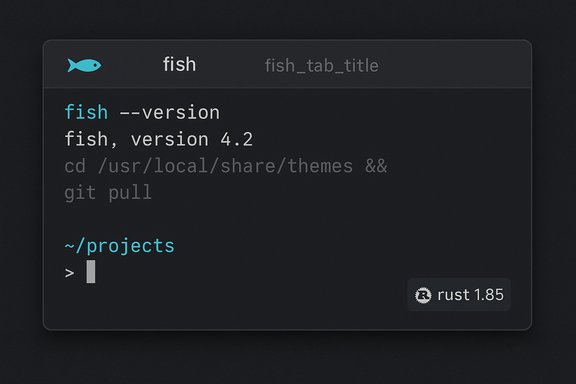
Fish 4.2 lands with practical usability fixes, stronger defaults, and a build-system change that aims to make upgrades safer for running shells while raising the minimum Rust version for builders.
Background / Overview
Fish (the Friendly Interactive SHell) has long pitched itself as an opinionated, user-friendly alternative to bash and zsh, with features like syntax highlighting, smart completions, and history-based suggestions that reduce typing. The project’s major technical pivot arrived with fish 4.0, when the core implementation was ported from C++ to Rust — a large engineering effort that changed the build and packaging landscape for distributions and contributors. The fish 4.2 release continues that post‑rewrite evolution with a mixture of incremental interactive improvements, encoding and localization changes, build-time policy updates, and a bundle of bug fixes designed to shore up regressions introduced in earlier 4.x releases. The most visible end-user changes in 4.2 are enhancements to the long-standing history-based autosuggestions, a new default assumption of UTF‑8 character encoding even on non‑UTF‑8 systems, and the ability to set a terminal tab title independently from the window title. Under the hood, the release makes standalone build mode the default, embedding the shell’s helper functions into the binary to prevent upgraded installations from breaking shells that are already running. The release also bumps fish’s minimum supported Rust version to Rust 1.85, a practical consequence of the ongoing Rust-centric development.What’s new in fish 4.2
History-based autosuggestions now handle multi-line commands
One of the most practical improvements in fish 4.2 is that history-based autosuggestions — the inline, predictive hints that appear as you type — now correctly handle multi-line commands pulled from your history. For users who work with here-documents, command substitutions, or multi-line function definitions at the prompt, this means the suggestion engine can now match and propose entries that span lines, and you can accept them in the usual way (right-arrow or Ctrl+F for the full suggestion, Alt+Right Arrow to accept the first word). This change is aimed at reducing friction for interactive workflows that often require multi-line input.UTF‑8 assumed by default
Fish 4.2 assumes UTF‑8 for character encoding by default, even on systems that don’t have a UTF‑8 locale configured. The release notes explicitly explain that input bytes which are not valid UTF‑8 are still round‑tripped (so data isn’t lost), but the rendered appearance on the command line may differ for file paths or strings that were created using legacy encodings. In short: legacy non‑UTF‑8 file names and paths will still work, but how they look in the prompt and completions may change. This is a deliberate move to modernize behavior and standardize text handling, but it has visible consequences on older locales.Terminal tab title and prompt handling
Fish 4.2 adds a fish_tab_title function that lets users and prompt themes set the title of a terminal tab independently from the window title. This is a quality‑of‑life improvement for users who rely on tabbed terminals and scriptable tab titles, enabling clearer task separation when you have multiple tabs for different projects.The release also improves paint/refresh behavior around multi-line and transient prompts: prompts that temporarily show more lines than the eventual prompt will now be cleared correctly, and portions of very large prompts that have scrolled out of view are hidden to avoid duplicate lines after repainting. These kinds of fixes reduce visual glitches in busy interactive sessions.
Mouse capture behavior
Fish previously force‑disabled terminal mouse capture in some circumstances; with 4.2 that is no longer forced. Users can now rely on DECSET/DECRST 1000 mouse capture sequences to let mouse clicks move the cursor or select completion items in terminals that support that behavior. This is a compatibility/feature improvement for terminal emulators and multiplexer environments that provide click support.Build, packaging, and developer-visible changes
There are several important changes for packagers and developers:- The minimum supported Rust version (MSRV) is now Rust 1.85. This is an explicit requirement for anyone building fish from source and follows the ongoing migration and development in Rust that began with the 4.0 rewrite.
- Standalone build mode is the new default. In standalone mode, fish embeds its internal helper functions directly into the binary, which prevents the classic problem where installing a new fish version on disk can break shells that were started from an older binary still running in memory. The release notes note that data files are still installed redundantly for now, but the overall direction is to make embedded data the normal operation. The project documents a reversal path (patching out the embed-data feature in
cmake/Rust.cmake) for distributors who need to keep the old behavior temporarily. - Release artifacts (tags and source tarballs) are GPG‑signed again, and documentation tarballs are now built with a newer Sphinx, which improves man pages (for example, adding OSC 8 hyperlinks). The release also ships standalone Linux binary tarballs for different architectures.
Regression fixes and platform-specific workarounds
Fish 4.2 bundles fixes for a number of regressions and platform-specific issues that affected users since the 4.0 Rust rewrite and the 4.1.x series. Highlights include:- Fixes for the web-based config utility on older Python versions and on Windows.
- Correcting terminal modes set by certain
fish -cusages. - Stopping unnecessary prompt redraws on resize in VTE-based terminals to avoid glitches.
- Fixes for MSYS2 users so universal variables save and load correctly on that platform.
- Fixes for crashes caused by invalid function commands and by passing negative process IDs to the
waitbuiltin on Linux. - Build fixes for SPARC and MIPS Linux and for illumos.
Deep dive: what these changes mean in practice
Multi-line autosuggestions — why it matters
History-based autosuggestions have always been one of fish’s signature features: as you type, fish displays a gray suggestion drawn from your command history that you can accept with a keystroke. Until 4.2, suggestions were primarily effective for single-line commands and fragments. By extending the suggestion engine to match multi-line entries, fish reduces one of the remaining friction points for interactive use cases that involve:- Here-documents (e.g., cat <<EOF ... EOF),
- Multi-line function definitions typed directly at the prompt,
- Command substitutions and pipelines that are easier to compose across lines.
UTF‑8 by default — modernization with friction
Assuming UTF‑8 by default is a pragmatic modernization step: UTF‑8 is now the dominant encoding on modern Linux and macOS installs, and aligning shell behavior with that expectation reduces a large class of surprises around multi-byte characters, prompt rendering, and Unicode handling.However, there are tradeoffs and user-facing risks:
- Systems still running legacy locales (for example, some entrenched server or embedded environments) may see visual differences in how previously created file paths display in prompts and completions.
- Scripts or tooling that probe locale information may need updates or explicit environment variables to preserve old rendering semantics.
- Some distributions and older terminal setups will need to ensure their packaging and default environment files align with the new assumption to avoid confusing visual changes for users.
Standalone builds — upgrade safety vs. packaging tradeoffs
Embedding helper functions and data in the binary reduces a classic class of upgrade-on-disk vs. running-process inconsistency: when fish shipped functions and completions as loose files under share/fish, installing a new package could change those data files on disk while older running fish instances still relied on the older versions — sometimes creating breakage during interactive sessions.Making standalone build mode the default addresses this by sealing the runtime environment for each binary. The immediate benefits are clear:
- Running shells remain stable across package upgrades.
- Quality-of-service for interactive users increases: fewer accidental breakages during rolling upgrades or package updates.
- Standalone binaries can be larger because they carry embedded data.
- Distributors and packagers who rely on updating shared data files without rebuilding binaries will need to change workflows.
- The project notes it still installs data files redundantly for now to ease the transition; the embed-data option can be patched out if absolutely necessary. This gives packagers a migration path, but it’s a change worth planning for in downstream repositories.
Rust 1.85 MSRV — contributors and CI impact
Raising the minimum supported Rust version to 1.85 is an understandable outcome of ongoing development in Rust. Practically, it means:- Contributors must run a recent toolchain (or use rustup to select the MSRV) to build from source.
- Distribution build systems and CI configurations may need to be updated to provide Rust 1.85 in build images or toolset offerings.
- Some older platform toolchains that haven’t kept pace may require backports or special handling.
Bug fixes and platform notes (high-impact items)
Fish 4.2 bundles a number of important fixes that should matter to power users, embedded deployments, and packagers. Among the high-impact items:- Fixes for crashes triggered by invalid function commands and negative PIDs passed to builtin
wait. These were real crashes observed on some Linux setups and are now corrected. - MSYS2-specific fixes to make saving and loading universal variables reliable on that platform. MSYS2 users who experienced broken universal variable persistence should see improvements.
- Terminal-mode and redraw fixes for VTE-based terminals (GNOME Terminal, Tilix, etc. that reduce prompt redraw glitches and avoid repeated or mispainted lines on resize. This addresses a class of annoying display bugs introduced with the Rust rewrite and prompt rendering changes.
- Build fixes for platforms such as illumos, SPARC, and MIPS where platform-specific signal handling or toolchain quirks previously caused build failures; these are now addressed by conditional changes in the build scripts and code.
Risks, unknowns, and questions to monitor
No release is without tradeoffs. The following items deserve attention from both individual users and packagers:- Rendering changes from the UTF‑8 default: systems that rely on legacy encodings may see differently rendered paths or prompt elements. Although data is preserved, any scripts or manual workflows that parse visual prompt text (for example, automated tools that expect exact prompt output) might notice differences. Systems that must remain in a legacy locale should pin the environment or test before rolling out fish 4.2.
- Packager workflow adjustments: the default to embed shared data in the binary changes the update semantics that many distributions implicitly relied on. Users who update packages but expect older running shells to adopt new shared content immediately may be surprised; conversely, the embedding prevents the more common problem of upgrades breaking running shells. Packaging teams should review the new default and its effects on upgrade policies.
- Rust toolchain requirement: for contributors, CI pipelines, and distribution package builds, Rust 1.85 must be available. Older build systems or long‑lived LTS images may require updates. This could be a particular headache on older BSDs or custom appliance build environments.
- Terminal compatibility: although the release fixes several redraw and mode issues, terminal emulator behavior remains a variable. Past transitions (including the 4.0 rewrite) exposed incompatibilities with certain terminal emulators and multiplexers; terminal vendors and users should still test the combination of fish + their terminal emulator, especially in multi-line prompt and mouse-capture scenarios.
Actionable guidance
For interactive users:- Test fish 4.2 in a local profile or VM before rolling system-wide, especially if you rely on non‑UTF‑8 locales or have complex prompt themes.
- Try common workflows that use here-documents, multi-line function editing, and your preferred terminal emulator to confirm the multi-line suggestion behavior and absence of redraw glitches.
- Ensure Rust 1.85 is available in build environments and CI containers.
- Evaluate whether the standalone/embedded data default aligns with your packaging policy; if necessary, the release notes document how to revert embedding temporarily by adjusting the
embed-datafeature incmake/Rust.cmake. Plan the migration rather than forcing a quick rollback. - Rebuild packages and run automated tests for prompt rendering, man page generation, and universal variable persistence (MSYS2-specific fixes were included).
- Test click support, DECSET/DECRST 1000 mouse capture, multi-line refresh behavior, and prompt redraw paths. The changes in fish 4.2 deliberately expose mouse capture rather than forcibly disabling it, so interaction behavior will now depend on the emulator’s handling of mouse modes.
Strengths and notable improvements
- Practical UX win: multi-line autosuggestions are a clear, immediate improvement that reduces typing and speeds up interactive development.
- Upgrade robustness: embedded data in standalone builds significantly reduces one of the historically awkward failure modes for interactive shells during package upgrades.
- Modern defaults: assuming UTF‑8 by default is aligned with modern systems and reduces edge-case bugs related to multi-byte character handling.
- Broad range of fixes: the release addresses a slate of real-world crashes and platform issues (MSYS2, VTE terminals, SPARC/MIPS builds) that restore confidence for users on a variety of systems.
Potential downsides and mitigations
- Backward-compatibility headaches: server environments or legacy systems that still use non‑UTF‑8 locales could encounter visual rendering differences. Mitigation: pin LC_* environment variables, test, or postpone the upgrade on systems where locale stability is decisive.
- Packaging and distribution friction: embedded data changes packaging semantics. Mitigation: plan the migration, inform downstream packagers, and use the provided temporary reversal path while updating packaging policies.
- Rust MSRV bump: older CI images need updating. Mitigation: adopt rustup in CI and provide pinned Rust toolchains to contributors and builders.
Final assessment
Fish 4.2 is an incremental but important release that consolidates the user-visible benefits of the 4.0 Rust rewrite while addressing many of the rough edges that surfaced during that transition. The multi-line autosuggestions feature alone will be enough reason for many interactive users to upgrade, and the standalone build default is a pragmatic engineering move designed to make upgrades safer for interactive sessions — even though it does change downstream packaging behaviors.The project remains cautious about transition pain: data files are still installed redundantly for now, there’s an explicit reversal path for embedding, and the release includes numerous regression fixes for platforms and terminals. Still, packagers and administrators should treat the Rust MSRV bump and UTF‑8 default as policy changes that deserve planned rollouts and tests.
For most desktop and modern server users, fish 4.2 will feel like a smoother, smarter shell; for distribution maintainers and constrained environments, it’s a release that requires deliberate coordination. Overall, the release strikes a pragmatic balance between improving everyday interactive ergonomics and hardening the project’s upgrade and build story for the long term.
Conclusion: fish 4.2 delivers meaningful interactive polish, sensible modernization of text handling, and a defensive packaging posture that reduces upgrade-time breakage — while asking packagers and some builders to adapt to a newer Rust toolchain and embedded-data packaging model.
Source: Neowin Fish 4.2 released with several bug fixes and improvements
