

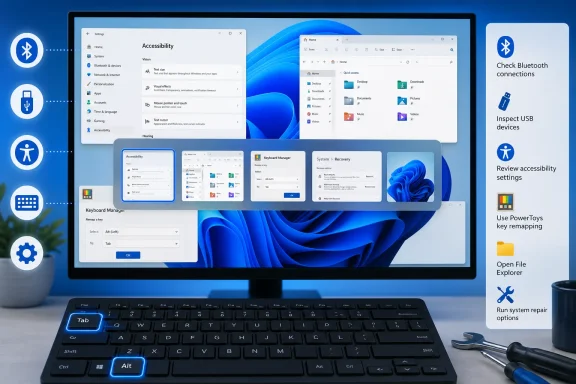
Alt+Tab not working in Windows 11 is usually caused by a keyboard problem, an accessibility or remapping feature intercepting the keys, or Multitasking settings changing what the switcher displays. This guide covers Windows 11 Home and Pro on laptops, desktop PCs, wired USB keyboards, Bluetooth keyboards, and supported Microsoft accessories.
First identify whether Alt+Tab is not opening at all or whether it opens with unexpected results.
For an immediate workaround, press Windows+Tab to open Task View, then select the window you need. Task View is separate from the Alt+Tab switcher, so it can still work while you diagnose the shortcut.
If Windows Explorer is not listed:
For a wired USB keyboard:
If you use Microsoft PowerToys:
For other apps:
If the app has no Repair or Reset option, close it fully from the notification area and Task Manager, then test. Uninstall it only if the test confirms it is involved.
If the problem started immediately after a driver update:
Warning: Do not close the Command Prompt window while System File Checker is running. Wait until verification reaches 100%.
Restart Windows after both commands finish, then test Alt+Tab with two or more open windows.
Warning: Keep the PC connected to power and the internet throughout this repair. Back up important files before any recovery procedure.
 Confirm what is failing
First identify whether Alt+Tab is not opening at all or whether it opens with unexpected results.- Open at least two normal application windows, such as File Explorer and Notepad.
- Hold down Alt.
- Press Tab once or repeatedly until the window you want is selected.
- Release Alt to bring that window forward.
- To cycle backward, hold Alt+Shift and press Tab.
For an immediate workaround, press Windows+Tab to open Task View, then select the window you need. Task View is separate from the Alt+Tab switcher, so it can still work while you diagnose the shortcut.
Set Alt+Tab to show the right windows
Windows 11 can show recent tabs from supported apps in Alt+Tab instead of only application windows. It can also limit switching to the current virtual desktop.- Select Start > Settings > System > Multitasking.
- Find Show tabs from apps when snapping or pressing Alt+Tab.
- Select Don’t show tabs if you want Alt+Tab to show windows only.
- Stay in Settings > System > Multitasking.
- Expand Desktops.
- Under Show all open windows when I press Alt+Tab, choose:
- On all desktops to include windows from every virtual desktop.
- Only on the desktop I’m using to limit switching to the current desktop.
- Go to Settings > System > Multitasking.
- Turn on Snap windows.
- Expand the Snap windows options.
- Enable the option that shows snapped windows when hovering taskbar apps, in Task View, and when pressing Alt+Tab.
Restart Windows Explorer
The Alt+Tab interface is part of the Windows shell. Restarting Windows Explorer refreshes the taskbar, desktop, Start menu, and window-switching interface without restarting the PC.- Press Ctrl+Shift+Esc to open Task Manager.
- Find Windows Explorer in the process list.
- Right-click Windows Explorer.
- Select Restart.
If Windows Explorer is not listed:
- In Task Manager, select Run new task from the top command bar. In some views, select File > Run new task.
- Type
explorer.exe. - Select OK or press Enter.
Check the keyboard before changing Windows
A failed Alt key, Tab key, wireless connection, keyboard mode, or docking station can make Alt+Tab appear to be a Windows problem.For a wired USB keyboard:
- Disconnect the keyboard.
- Connect it directly to another USB port on the PC.
- Avoid USB hubs, monitor USB ports, and docking stations while testing.
- Inspect the cable and the Alt and Tab keys for debris or physical damage.
- Test the keyboard on another computer if possible.
- Remove its USB receiver.
- Wait about 10 seconds.
- Reconnect it directly to the PC.
- Check or replace batteries, or charge the keyboard.
- Test with a different USB port.
- Select Start > Settings > Bluetooth & devices.
- Turn Bluetooth off, wait a few seconds, then turn it on again.
- If the keyboard still fails, select Devices.
- Find the keyboard, select More options, then choose Remove device.
- Confirm the removal.
- Select Add device and pair the keyboard again.
Turn off accessibility settings that alter key input
Sticky Keys lets Windows treat modifier keys such as Alt as if they can be pressed one at a time. Filter Keys can ignore brief or repeated keystrokes. Both are useful accessibility features, but either can change how a shortcut feels if enabled unintentionally.- Select Start > Settings > Accessibility > Keyboard.
- Under Sticky keys, turn the feature off for testing.
- Under Filter keys, turn the feature off for testing.
- Try Alt+Tab again.
- Pressing Shift five times toggles Sticky Keys.
- Holding the right Shift key for eight seconds toggles Filter Keys.
Remove shortcut remaps and software conflicts
Keyboard remapping tools, gaming utilities, macro software, remote-desktop clients, overlays, and manufacturer keyboard apps can intercept Alt or Tab before Windows receives the normal Alt+Tab combination.If you use Microsoft PowerToys:
- Open PowerToys Settings.
- Select Keyboard Manager.
- Turn off Enable Keyboard Manager temporarily, or close PowerToys completely.
- Check both Remap a key and Remap a shortcut for entries involving Alt, Tab, or Alt+Tab.
- Remove or correct any conflicting remap.
- Test Alt+Tab.
For other apps:
- Select Start > Settings > Apps > Installed apps.
- Look for keyboard managers, macro tools, overlay software, gaming utilities, remote-access software, or manufacturer peripheral software installed around the time the problem began.
- Select the app’s More options button.
- Use Advanced options > Repair if the app provides it.
- If repair does not help, use Reset if available.
If the app has no Repair or Reset option, close it fully from the notification area and Task Manager, then test. Uninstall it only if the test confirms it is involved.
Update or reinstall the keyboard driver
Windows normally installs keyboard drivers automatically. A driver refresh can help when the keyboard works inconsistently or the problem began after a driver update.- Right-click Start and select Device Manager.
- Expand Keyboards.
- Right-click the relevant keyboard device.
- Select Update driver.
- Select Search automatically for drivers.
- Restart the PC if Windows asks you to do so.
- In Device Manager, right-click the keyboard device.
- Select Uninstall device.
- Select Uninstall to confirm.
- Restart Windows through Start > Power > Restart.
If the problem started immediately after a driver update:
- In Device Manager, right-click the keyboard device and select Properties.
- Open the Driver tab.
- Select Roll Back Driver if the button is available.
- Choose a reason and confirm the rollback.
- Restart the computer.
Repair Windows system files
Use this step when Alt+Tab still fails across multiple keyboards, after a clean restart, or alongside other shell problems such as a missing taskbar or unreliable Start menu.- Search for Command Prompt.
- Right-click it and select Run as administrator.
- Approve the User Account Control prompt.
- Run the following command:
DISM.exe /Online /Cleanup-image /Restorehealth- Wait for it to complete.
- Then run:
sfc /scannowWarning: Do not close the Command Prompt window while System File Checker is running. Wait until verification reaches 100%.
Restart Windows after both commands finish, then test Alt+Tab with two or more open windows.
Use Windows recovery only when the fault is system-wide
If Alt+Tab stopped after a recent app, driver, or system change, System Restore can return Windows system files, drivers, and settings to an earlier restore point without removing personal files.- Press Windows+R.
- Type
rstrui.exe. - Press Enter.
- Select Next.
- Choose a restore point dated before Alt+Tab stopped working.
- Follow the prompts to restore and restart.
Warning: Keep the PC connected to power and the internet throughout this repair. Back up important files before any recovery procedure.
- Select Start > Settings > System > Recovery.
- Under Fix problems using Windows Update, select Reinstall now.
- Choose whether Windows may restart the PC automatically after installation.
- Select OK to begin.
- Restart when prompted if you did not allow an automatic restart.
References
- Primary source: Technobezz
Published: 2026-07-18T17:42:04.627000+00:00
Loading…
www.technobezz.com