

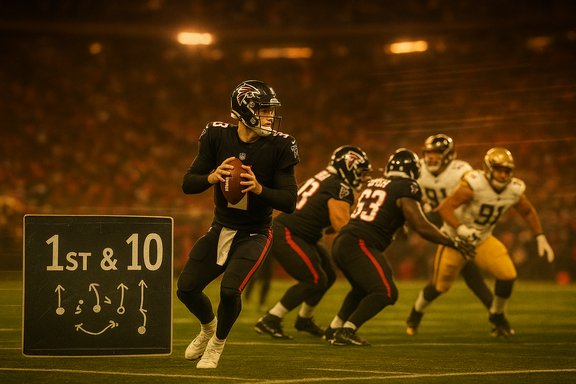
Fixing Atlanta’s offense begins with one stubborn truth: the Falcons win by converting early downs, and they lose when they don’t.
The Falcons’ offensive narrative this season has been written in the margins between first-and-10 and third-and-long. When Atlanta consistently gains yardage on first and second down the offense hums — drives lengthen, playcallers can mix, and explosive opportunities open. When early down efficiency collapses, the playbook tightens, pressure builds on the passer, and scoring becomes a sequence of high-variance gambles.
Recent team analysis and league-tracking metrics converge on the same point: first-down success and early-down efficiency are the fulcrum for Atlanta’s offense. The Falcons’ struggles in several games trace directly to poor early-down results — low yards-per-first-down play, negative plays that stall drives, and an inability to convert two short sets of downs into sustainable scoring sequences. Those failures force predictable third-down calling, which opponents can plan for, and ultimately depress the team’s points-per-drive.
This feature examines what “fixing first down” looks like in pragmatic detail: the measurable problems, the tape-level causes, the coaching levers available, and the realistic timeline to durable improvement. It also lays out a prioritized, coachable plan Falcons staff and personnel can implement immediately to turn first-down performance from a liability into an engine.
Early-down failure has cascading effects:
To translate: a sub-30% first/second-down success rate in a game typically produces three-and-outs and short drives; raising that number into the low-to-mid 40s flips field position, fourth-quarter options, and playcall balance in the Falcons’ favor.
Caution: these percentages and rankings are snapshots, and weekly variances are common across the league. Any diagnosis must account for opponent strength, game script, injuries, and scheduling. But the underlying causal link — early-down success enabling scoring — is robust across datasets.
Two tactical issues emerge:
Special teams and field position also matter: negative or neutral starting field position increases the penalty for failed early-down plays.
The path to durable improvement is straightforward in design though demanding in execution. It centers on:
Cautionary closing: early-season statistics are volatile, and opponent context matters. Improvement must be judged across multiple games and against varied defenses. But the directional case is strong: first-down success is the highest-leverage, lowest-regret intervention the Falcons can make to restore consistent offensive performance.
Source: Atlanta Falcons Nerdy Birds: Fixing the Falcons offense starts on first down
 Background / Overview
The Falcons’ offensive narrative this season has been written in the margins between first-and-10 and third-and-long. When Atlanta consistently gains yardage on first and second down the offense hums — drives lengthen, playcallers can mix, and explosive opportunities open. When early down efficiency collapses, the playbook tightens, pressure builds on the passer, and scoring becomes a sequence of high-variance gambles.Recent team analysis and league-tracking metrics converge on the same point: first-down success and early-down efficiency are the fulcrum for Atlanta’s offense. The Falcons’ struggles in several games trace directly to poor early-down results — low yards-per-first-down play, negative plays that stall drives, and an inability to convert two short sets of downs into sustainable scoring sequences. Those failures force predictable third-down calling, which opponents can plan for, and ultimately depress the team’s points-per-drive.
This feature examines what “fixing first down” looks like in pragmatic detail: the measurable problems, the tape-level causes, the coaching levers available, and the realistic timeline to durable improvement. It also lays out a prioritized, coachable plan Falcons staff and personnel can implement immediately to turn first-down performance from a liability into an engine.
The problem: Why first down matters more than most fans realize
First downs are not just box score noise
A drive that produces multiple first downs drastically raises its expected points. Across recent seasons the league trend has been explicit: teams that consistently convert early downs generate longer drives and higher points-per-drive. For the Falcons that relationship is particularly stark — games where Atlanta converts multiple first downs almost always correlate with sustained scoring and higher yards-per-play.Early-down failure has cascading effects:
- It creates frequent third-and-long, where conversion rates drop off precipitously.
- It forces predictable playcalling (more deep shots or high-risk passes), which increases turnover and sack likelihood.
- It shortens drives, increasing possessions for the opponent and reducing the Falcons’ window to exploit strengths like the run-pass complement.
What the numbers show right now
Across the samples analyzed, Atlanta’s early-down success rate has swung dramatically from game to game. Some matchups show the Falcons among the league leaders in early-down EPA or down-set conversion; other games reveal sudden dips into the 20–30% range on first-and-second downs. Those swings explain why the offense can look efficient and modern in one week and pedestrian in another.To translate: a sub-30% first/second-down success rate in a game typically produces three-and-outs and short drives; raising that number into the low-to-mid 40s flips field position, fourth-quarter options, and playcall balance in the Falcons’ favor.
Caution: these percentages and rankings are snapshots, and weekly variances are common across the league. Any diagnosis must account for opponent strength, game script, injuries, and scheduling. But the underlying causal link — early-down success enabling scoring — is robust across datasets.
Diagnosis: Film and metrics — what’s breaking on early downs
Offensive line issues on early downs
On tape, the most repeatable early-down failure modes are protection and gap-control misses. When the line fails to sustain combo blocks on inside runs or is late identifying stunts and blitzes, the result is negative plays or minimal gains on first attempts. Two specific technical patterns recur:- Combo blocks that fail to climb to the second level, leaving linebackers unengaged and runs bottled at the line.
- Communication lapses on slide protections and stunt recognition that shorten QB timing windows and convert planned timing concepts into pressured throws.
Playcalling and predictability
The Falcons have shown a strong commitment to establishing the run on early downs. That can be an advantage — when the run works, it resets the box and creates play-action value. But when blocker execution slips, defenses begin to load the box, forcing the Falcons into predictable passing situations or negative-run outcomes.Two tactical issues emerge:
- Not enough packaged concepts on first down — i.e., plays that give a genuine run/pass choice post-snap to exploit defensive reactions.
- Insufficient use of quick game and early rhythm passes to punish light boxes; teams that respect play-action are less likely to crowd the box.
Personnel and ball-handling
Explosive runs and chunk plays on early downs correlate with a few repeatable traits: decisive RB vision and decisive linemen finishing blocks. When backs hesitate or pass-catchers fail to convert routine targets, drives grind to a halt. Drops, missed blocks at the second level, and poor chip-and-release execution by backs reduce the offense’s velocity.Special teams and field position also matter: negative or neutral starting field position increases the penalty for failed early-down plays.
Strengths the Falcons can lean on
- A capable running back room that produces explosive early-down gains when lanes are created; these plays show that Atlanta’s base scheme can be effective.
- Quarterback timing on early-down structure in games where protection holds — the Falcons are able to generate positive passing EPA when the pocket lasts.
- Down-set conversion history: the team’s prior seasons have shown sustainable drive-extension metrics that can be re-attained if fundamentals are enforced.
Tactical playbook: Concrete steps to fix first down (coaching checklist)
- Prioritize protection clarity in practice
- Establish unambiguous pre-snap rules for slide vs. man-max protections.
- Rehearse stunt recognition and center-calls until they are muscle memory.
- Practice RB chip-and-release versus edge pressure in high reps.
- Expand first-down play packages to include true post-snap reads
- Install more RPOs and play-action/pass-surface pairs that punish light boxes.
- Add quick-hitting passing game (slants, quick outs, mesh concepts) specifically for first-down usage.
- Use motion and formation shifts to create leverage and force defensive communication errors.
- Rebuild run-game finishing mechanics
- Practice two-man combo blocks with climb-to-linebacker emphasis.
- Emphasize TE detachments and reach/angle blocks to prevent backside pursuit.
- Install drill progressions that prioritize the runner’s decisive read-to-seam, not extra lateral cuts.
- Convert contested-catch opportunities into routine wins
- Targeted hands and catch-mechanic sessions for receivers, focusing on contested environments.
- High-velocity catch drills that simulate early-down pressure and sideline ball security.
- Use data-informed game planning
- Chart opponent box rates and prioritize pass plays on first down when opponents show light boxes often.
- Identify defenders with poor pursuit angles and design early-down plays to exploit those tendencies.
- Rotate linemen proactively to manage wear and prevent late-season decline in early-down effectiveness.
Sequencing improvement: How to structure practice weeks
Tuesday — Repair and rewind
- Quick-film session on the previous week’s first-down failures with specific offensive-line callouts.
- Re-install pre-snap rules and center-line communication protocols.
Wednesday — Install and rehearse
- Introduce one first-down package (RPO or play-action pair) and run full-speed execution with live blitz/ stunt macros.
- Run combo-block finishing drills for the OL and TE room.
Thursday — Live reps and tempo script
- Fast-tempo walk-throughs of the first 10 planned plays for opening drives.
- Simulate the opponent’s most likely early-down edge pressures.
Friday — Situational polish
- Two-minute sandlot for goal-line and sustained-drive scenarios.
- Quick-hitting slot/inside routes versus zone to build QB-receiver timing.
Game week focus
- Ensure the first drive script includes at least two plays designed to punish opponent tendencies (e.g., quick pass into soft box, inside zone to backside cut, or bootleg to certain side).
Risks, tradeoffs, and what to avoid
- Overcomplicating protections: adding more options can create confusion. Simplicity for front five communication is essential.
- Becoming predictable with run-first identity: opponents will sell out to stop it if early down runs produce one-yard gains. Balance is non-negotiable.
- Investing too long in reactive personnel changes: rotating linemen or changes to the lineup should be backed by clear performance data and not made for appearance reasons alone.
- Relying on regression: some early-season statistical fluctuations will normalize; the Falcons must avoid assuming single-game successes are durable without repeatable proof.
Personnel considerations: who wins and who must adapt
Offensive line
- The OL is the engine of early-down success. Improving communication and finishing blocks should be top priority. Smaller adjustments to footwork and cut-off techniques often yield outsized gains.
Running backs
- When backs show decisive reads and finish through contact, the run game converts early downs into momentum. Emphasize downhill vision and decisiveness in rep work.
Quarterback and receivers
- The QB needs clean pockets and simplified reads in early-down packages; short-to-intermediate accuracy and timing are more valuable than occasional heroics.
- Receivers must limit drop variance; converting contested catches and securing YAC on early-down completions pays immediate dividends in drive continuation.
Play-caller and game planning
- The coordinator must resist overreacting to game script. Early-down philosophy should remain proactive: seek to establish rhythm and force opponents to adjust, rather than reacting exclusively to scoreboard pressure.
Measuring success: what to track week-to-week
- First- and second-down success rate (expressed as percentage of plays meeting success threshold).
- Down-set conversion rate (how often a set of downs yields another first down or TD).
- Early-down EPA per play (to see value, not just volume).
- Points-per-drive and drives with multiple first downs.
- Third-down distance distribution (fewer third-and-7+ is a leading indicator of early-down improvement).
- Rate of negative plays on early downs (target is a measurable decline).
Short-term vs. long-term timelines
Short-term (1–3 games):- Gains from simplification of protection and a focused first-down script can produce measurable improvements quickly.
- Expect modest bumps in third-down distance distribution and fewer three-and-outs if early downs trend up.
- Run-game finishing mechanics and receiver-handling work will show cumulative effects.
- If the line improves climb-to-linebacker blocking and receives consistent reps, rushing success on first down will stabilize.
- Sustained early-down efficiency enables more creative play-calling, improved red-zone outcomes, and higher points-per-drive.
- Organizational changes (depth upgrades, coaching hires) influence sustained gains but are not required for immediate improvement.
Final analysis and verdict
Atlanta’s offense is at an inflection point where incremental, detail-oriented corrections will yield outsized returns. The evidence is clear: when the Falcons succeed on first and second down they control tempo, shorten fields, and put themselves in games where playmakers — from the running backs to the passing targets — can operate in higher-value windows.The path to durable improvement is straightforward in design though demanding in execution. It centers on:
- Protection clarity — simplify pre-snap responsibilities and make communication frictionless.
- First-down play diversity — install true run/pass choices and quick-game options to punish defensive tendencies.
- Run-game finishing — make combo blocks finish consistently and train runners for decisive seam reads.
- Receiver fundamentals — reduce drop variance and turn contested catches into routine outcomes.
Cautionary closing: early-season statistics are volatile, and opponent context matters. Improvement must be judged across multiple games and against varied defenses. But the directional case is strong: first-down success is the highest-leverage, lowest-regret intervention the Falcons can make to restore consistent offensive performance.
Source: Atlanta Falcons Nerdy Birds: Fixing the Falcons offense starts on first down
