

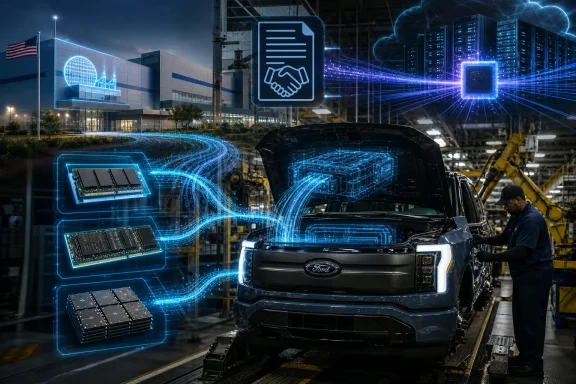
Ford and Micron announced on July 6, 2026, a long-term Strategic Customer Agreement to secure memory and storage supply for Ford’s next-generation vehicles, tying the automaker’s future production plans to Micron’s expanding U.S. automotive chip capacity. The deal, detailed by Micron and reported by Ford Authority, is not just another post-pandemic supply-chain press release. It is a signal that automakers now see memory as a strategic production constraint, not a commodity part to be bought in bulk when prices look friendly.
The timing matters. General Motors signed a similar agreement with Micron five days earlier, and Micron told investors in late June that it had completed 16 strategic customer agreements across data center, consumer, and automotive markets. That makes Ford’s agreement part of a larger shift: the semiconductor shortage taught Detroit that missing a cheap chip can idle a profitable vehicle line, and the AI boom is now teaching everyone else to fight for the same silicon.
For most of the modern auto industry, semiconductors were treated as the hidden plumbing of the vehicle business. Automakers obsessed over batteries, motors, paint shops, labor contracts, infotainment software, and emissions rules, while chips flowed through suppliers several tiers removed from the boardroom. The pandemic broke that illusion with a brutality that even the most spreadsheet-hardened executive could understand: no chip, no truck.
Ford’s agreement with Micron is best understood as a scar from that period. The company does not want to relive the weeks when nearly finished vehicles sat waiting for components that cost little individually but controlled billions of dollars in revenue collectively. Memory and storage are not the same as the microcontrollers that became infamous during the 2020–2022 shortage, but the lesson is the same: the smallest parts can wield the largest leverage.
Micron’s own framing is revealing. The company said the agreement is meant to strengthen long-term supply of memory and storage solutions for Ford’s next-generation vehicle production, and it tied the arrangement to capacity expansion for automotive customers, including advanced DRAM production at its Manassas, Virginia fab. That is not spot-market language. It is industrial-policy language.
Jim Farley’s quote in Micron’s announcement was equally blunt. Producing high-volume future vehicles in the United States, Ford’s CEO argued, will require a resilient supply chain. In other words, reshoring final assembly means less if critical electronic content remains hostage to distant capacity crunches, freight disruptions, or the purchasing power of faster-growing industries.
The old Detroit playbook optimized for scale, supplier pressure, and just-in-time discipline. The new one is beginning to look more like aviation, cloud infrastructure, and defense procurement: long-term commitments, engineering collaboration, and capacity reservation. That is not necessarily more efficient in the narrow accounting sense. It is more realistic in a world where memory has become contested infrastructure.
That matters for WindowsForum readers because the same market force touching vehicle supply chains is already visible in PCs, servers, GPUs, SSDs, and cloud pricing. High-bandwidth memory for AI accelerators does not simply add demand at the top end. It also absorbs manufacturing attention, capital, cleanroom space, and process-development focus that might otherwise support more conventional DRAM and NAND products.
Automotive memory has different requirements from data center memory. Cars need long qualification cycles, predictable supply windows, reliability over harsh temperature ranges, and parts that remain available long after consumer devices have moved on. That makes the industry particularly vulnerable when memory suppliers shift emphasis toward faster-turning, higher-margin segments.
Ford’s agreement is therefore a hedge against being crowded out. A future vehicle is no longer just a drivetrain wrapped in sheet metal; it is a rolling compute platform with cameras, radar, displays, connectivity, over-the-air update storage, driver-assistance systems, local AI workloads, and increasingly centralized vehicle architectures. Each of those trends increases the importance of DRAM, NAND, NOR flash, and embedded storage.
Micron’s GM announcement was more specific about the types of products involved, naming LPDRAM, NOR, and UFS NAND for GM’s future platforms. Ford’s announcement uses broader language, but the technical direction is the same. Automakers are not merely buying more chips; they are buying a claim on the memory hierarchy their next vehicle architectures will require.
This is where the story stops being a narrow Ford item and becomes a technology-industry story. AI has taught memory makers that they no longer need to behave like suppliers of cyclical commodity parts. Automakers, having suffered once from underestimating chips, are now accepting that supply assurance may cost money up front but cost less than idle factories later.
That is corporate language, but the meaning is fairly plain. Micron wants customers to commit earlier, longer, and more firmly. It wants the boom-and-bust memory cycle to look less like a roller coaster and more like a subscription business with industrial consequences.
In its prepared remarks, Micron said these agreements typically run five years, from calendar 2026 through the end of calendar 2030, while automotive agreements generally run three years. It also said the 16 signed agreements represent roughly 20 percent of its DRAM volume and about a third of its NAND volume over the period. Those are large enough numbers to matter, especially in an industry where marginal supply can swing pricing.
The company also described the agreements as take-or-pay arrangements with binding commitments to purchase specific volumes over a multi-year term. For Micron, this reduces the risk of building or reserving capacity only to watch customers disappear when prices fall. For customers, it reduces the risk of being last in line when prices rise or supply tightens.
The trade-off is obvious. Customers gain predictability, but they may sacrifice some opportunistic buying power. Suppliers gain financial visibility, but they must live up to the capacity and technology promises that made customers sign in the first place.
Ford is not a cloud hyperscaler, and it is not buying HBM for GPU clusters. But the fact that automotive companies are participating in this structure shows how far memory’s strategic status has spread. The car business is being pulled into a procurement model shaped by AI-era scarcity.
The auto industry has a long memory for political risk. Tariffs, export controls, pandemics, port bottlenecks, and geopolitical tension all now sit inside supply-chain planning. A domestic memory source does not eliminate those risks, but it gives Ford a stronger story to tell regulators, investors, workers, and customers: future U.S.-built vehicles need U.S.-anchored electronic supply.
Micron has described its Manassas expansion as part of its effort to support automotive customers with longer lifecycle products. The distinction matters because not every chip fab is useful to Detroit. Automotive supply is not only about leading-edge density; it is about continuity, qualification, and the ability to keep shipping the right component long after consumer electronics have moved on.
That is one reason automakers were hit so hard during the earlier semiconductor shortage. The industry relied on parts that were not glamorous enough to command the front of the capacity queue, yet were indispensable to vehicle completion. As vehicles become more software-defined, the risk shifts upward into more capable memory and storage components.
There is also an unavoidable public-relations layer here. Farley’s praise for Micron’s manufacturing commitment in America mirrors a broader corporate effort to frame supply deals as investments in resilience, skilled labor, and national capacity. That language will be familiar to anyone who has followed the CHIPS Act era, even when a specific announcement does not rest entirely on a single subsidy or factory ribbon-cutting.
The political edge does not make the supply challenge fake. It makes it more durable. Once a component becomes part of national resilience rhetoric, procurement decisions stop being invisible back-office choices and become part of a company’s strategic identity.
The shift toward centralized compute architectures also changes the memory profile. Instead of dozens of isolated electronic control units doing narrow tasks, automakers are moving toward more powerful domain controllers and vehicle computers. Those systems need more capable memory, and they need it qualified for automotive reliability rather than consumer replacement cycles.
For Ford, this has implications across product lines. A pickup, SUV, or commercial van that supports advanced driver assistance, fleet telemetry, over-the-air updates, and AI-assisted user experiences is no longer electronically simple just because its body style is traditional. The intelligence of the vehicle is migrating from optional luxury trim into the production baseline.
That creates a harsh planning problem. Vehicle platforms take years to develop, and the components selected for them must be available through long production runs and service tails. Memory markets, by contrast, can turn brutally within quarters. The mismatch between Detroit’s product clocks and the semiconductor industry’s capacity clocks is exactly what long-term agreements are designed to manage.
There is a Windows analogy here. PC builders and enterprise IT buyers know what happens when a memory generation gets squeezed by a new workload wave. Prices move, availability narrows, and procurement teams suddenly care about details that looked dull when supply was plentiful. Automakers are now operating in that same world, but with factory schedules, dealer inventories, and regulatory commitments attached.
Micron itself has been clear with investors that memory supply remains structurally constrained. The company said supply may improve gradually in 2028, but it did not claim to know when industry supply would fully catch up with demand. That is not the language of a company expecting near-term abundance.
Strategic customer agreements also introduce their own constraints. If a buyer commits to volumes and price bands, it gains planning confidence but loses some flexibility if demand shifts. If a supplier commits supply, it gains visibility but must navigate the operational risk of delivering across changing technology nodes and market conditions.
For Ford, the agreement should reduce the odds of being blindsided by a memory shortage in future platforms. It does not guarantee that every technology program lands on time, that every next-generation feature ships as planned, or that vehicle prices avoid the inflationary effects of expensive electronics. It is a mitigation strategy, not a magic shield.
For consumers, the near-term effect may be almost invisible. Nobody buying a future F-150, Bronco, Explorer, or Mustang Mach-E will see a “Micron SCA” line item on the window sticker. But if the agreement works, its value may show up in the absence of drama: fewer production gaps, fewer feature deletions, and fewer vehicles parked while waiting for a component that should never have become the bottleneck.
GM’s announcement emphasized long-term reliable supply for memory and storage platforms critical to vehicle production at scale, along with technical collaboration on future product definition and system-level optimization. Ford’s announcement is shorter on product specifics but similar in strategic intent. Both companies are telling the market that memory supply now belongs in the same conversation as batteries, motors, and software platforms.
That parallel matters because automakers tend to move cautiously when changing procurement models. They have spent decades squeezing suppliers, diversifying sources, and avoiding unnecessary dependence. Long-term strategic agreements with a named memory supplier mark a visible departure from treating semiconductors as interchangeable inputs buried inside the tiered supplier chain.
It also suggests that the industry’s memory needs are becoming differentiated. If GM wants collaboration on future memory technologies and Ford wants long-term support for next-generation production, they are not merely asking for a warehouse full of generic chips. They are asking suppliers to align roadmaps with vehicle architectures.
That alignment can be useful, but it can also deepen dependency. The more a vehicle platform is optimized around a particular class of memory or storage product, the harder it may be to swap suppliers quickly. Automakers will need to balance assurance against lock-in, especially when the technology path is evolving quickly.
Still, the direction is rational. The earlier semiconductor crisis punished companies for treating supply chains as cost centers. The AI-era memory squeeze is now rewarding companies that treat supply chains as strategic systems. GM moved, Ford followed, and other automakers will be watching.
PC enthusiasts already understand the emotional rhythm of memory markets: prices fall, builds get cheaper, capacity upgrades become easy, and then a new demand cycle changes everything. The difference in 2026 is that demand is not coming only from gamers, laptop buyers, or enterprise refreshes. It is coming from AI data centers, smartphones with local AI features, high-end PCs, industrial devices, robotics, and now increasingly intelligent vehicles.
That broader demand base may make the old memory cycle less forgiving. If suppliers can lock in long-term customers at robust margins, they may be less inclined to flood the market with excess capacity. If customers are willing to make binding commitments, spot buyers may face a thinner and more volatile remainder.
For sysadmins and IT buyers, the lesson is not that Ford’s deal will directly raise SSD prices next quarter. The lesson is that memory and storage planning deserves more attention in procurement cycles. When suppliers publicly say they lack line of sight to full supply-demand balance, buyers should not assume that last year’s upgrade math will hold.
For developers, the automotive angle is another reminder that software ambition has a hardware bill. Local AI, richer telemetry, smarter interfaces, and more autonomous behavior all consume memory, storage, bandwidth, and power. Whether the device is a laptop or a pickup truck, the software-defined future is only as cheap as the hardware substrate beneath it.
For security-minded readers, there is one more wrinkle. More local compute and storage in vehicles means more data retained at the edge, more update complexity, and more attack surface. Supply assurance helps get the parts into vehicles; it does not solve the long-term challenge of securing the systems those parts enable.
The agreement should be read through three lenses at once. It is an automotive supply-chain hedge, a semiconductor business-model shift, and a domestic manufacturing story. None of those lenses is sufficient by itself.
The timing matters. General Motors signed a similar agreement with Micron five days earlier, and Micron told investors in late June that it had completed 16 strategic customer agreements across data center, consumer, and automotive markets. That makes Ford’s agreement part of a larger shift: the semiconductor shortage taught Detroit that missing a cheap chip can idle a profitable vehicle line, and the AI boom is now teaching everyone else to fight for the same silicon.
 Detroit Learns That Memory Is the New Steel
For most of the modern auto industry, semiconductors were treated as the hidden plumbing of the vehicle business. Automakers obsessed over batteries, motors, paint shops, labor contracts, infotainment software, and emissions rules, while chips flowed through suppliers several tiers removed from the boardroom. The pandemic broke that illusion with a brutality that even the most spreadsheet-hardened executive could understand: no chip, no truck.Ford’s agreement with Micron is best understood as a scar from that period. The company does not want to relive the weeks when nearly finished vehicles sat waiting for components that cost little individually but controlled billions of dollars in revenue collectively. Memory and storage are not the same as the microcontrollers that became infamous during the 2020–2022 shortage, but the lesson is the same: the smallest parts can wield the largest leverage.
Micron’s own framing is revealing. The company said the agreement is meant to strengthen long-term supply of memory and storage solutions for Ford’s next-generation vehicle production, and it tied the arrangement to capacity expansion for automotive customers, including advanced DRAM production at its Manassas, Virginia fab. That is not spot-market language. It is industrial-policy language.
Jim Farley’s quote in Micron’s announcement was equally blunt. Producing high-volume future vehicles in the United States, Ford’s CEO argued, will require a resilient supply chain. In other words, reshoring final assembly means less if critical electronic content remains hostage to distant capacity crunches, freight disruptions, or the purchasing power of faster-growing industries.
The old Detroit playbook optimized for scale, supplier pressure, and just-in-time discipline. The new one is beginning to look more like aviation, cloud infrastructure, and defense procurement: long-term commitments, engineering collaboration, and capacity reservation. That is not necessarily more efficient in the narrow accounting sense. It is more realistic in a world where memory has become contested infrastructure.
The AI Boom Has Made Cars Compete With Data Centers
The uncomfortable backdrop for Ford is that the most aggressive buyer of memory is not the auto industry. It is AI infrastructure. Micron told investors during its fiscal third-quarter 2026 remarks that DRAM and NAND demand continued to exceed industry supply, driven heavily by data center growth and AI systems whose performance depends on memory bandwidth and capacity.That matters for WindowsForum readers because the same market force touching vehicle supply chains is already visible in PCs, servers, GPUs, SSDs, and cloud pricing. High-bandwidth memory for AI accelerators does not simply add demand at the top end. It also absorbs manufacturing attention, capital, cleanroom space, and process-development focus that might otherwise support more conventional DRAM and NAND products.
Automotive memory has different requirements from data center memory. Cars need long qualification cycles, predictable supply windows, reliability over harsh temperature ranges, and parts that remain available long after consumer devices have moved on. That makes the industry particularly vulnerable when memory suppliers shift emphasis toward faster-turning, higher-margin segments.
Ford’s agreement is therefore a hedge against being crowded out. A future vehicle is no longer just a drivetrain wrapped in sheet metal; it is a rolling compute platform with cameras, radar, displays, connectivity, over-the-air update storage, driver-assistance systems, local AI workloads, and increasingly centralized vehicle architectures. Each of those trends increases the importance of DRAM, NAND, NOR flash, and embedded storage.
Micron’s GM announcement was more specific about the types of products involved, naming LPDRAM, NOR, and UFS NAND for GM’s future platforms. Ford’s announcement uses broader language, but the technical direction is the same. Automakers are not merely buying more chips; they are buying a claim on the memory hierarchy their next vehicle architectures will require.
This is where the story stops being a narrow Ford item and becomes a technology-industry story. AI has taught memory makers that they no longer need to behave like suppliers of cyclical commodity parts. Automakers, having suffered once from underestimating chips, are now accepting that supply assurance may cost money up front but cost less than idle factories later.
Micron Turns Scarcity Into a Business Model
Micron’s recent investor materials make the Ford agreement look less like an isolated customer win and more like a deliberate transformation of the company’s economics. The company said it had signed 16 strategic customer agreements and described them as a new class of arrangements designed to provide customers with contracted supply assurance while improving Micron’s visibility and durability.That is corporate language, but the meaning is fairly plain. Micron wants customers to commit earlier, longer, and more firmly. It wants the boom-and-bust memory cycle to look less like a roller coaster and more like a subscription business with industrial consequences.
In its prepared remarks, Micron said these agreements typically run five years, from calendar 2026 through the end of calendar 2030, while automotive agreements generally run three years. It also said the 16 signed agreements represent roughly 20 percent of its DRAM volume and about a third of its NAND volume over the period. Those are large enough numbers to matter, especially in an industry where marginal supply can swing pricing.
The company also described the agreements as take-or-pay arrangements with binding commitments to purchase specific volumes over a multi-year term. For Micron, this reduces the risk of building or reserving capacity only to watch customers disappear when prices fall. For customers, it reduces the risk of being last in line when prices rise or supply tightens.
The trade-off is obvious. Customers gain predictability, but they may sacrifice some opportunistic buying power. Suppliers gain financial visibility, but they must live up to the capacity and technology promises that made customers sign in the first place.
Ford is not a cloud hyperscaler, and it is not buying HBM for GPU clusters. But the fact that automotive companies are participating in this structure shows how far memory’s strategic status has spread. The car business is being pulled into a procurement model shaped by AI-era scarcity.
The Manassas Fab Gives the Deal Its Political Edge
Micron’s Ford announcement repeatedly points toward U.S. manufacturing, especially the company’s Manassas, Virginia facility. That detail is not incidental. It gives the agreement a domestic supply-chain angle at a time when both automakers and chipmakers are trying to align commercial plans with American industrial policy.The auto industry has a long memory for political risk. Tariffs, export controls, pandemics, port bottlenecks, and geopolitical tension all now sit inside supply-chain planning. A domestic memory source does not eliminate those risks, but it gives Ford a stronger story to tell regulators, investors, workers, and customers: future U.S.-built vehicles need U.S.-anchored electronic supply.
Micron has described its Manassas expansion as part of its effort to support automotive customers with longer lifecycle products. The distinction matters because not every chip fab is useful to Detroit. Automotive supply is not only about leading-edge density; it is about continuity, qualification, and the ability to keep shipping the right component long after consumer electronics have moved on.
That is one reason automakers were hit so hard during the earlier semiconductor shortage. The industry relied on parts that were not glamorous enough to command the front of the capacity queue, yet were indispensable to vehicle completion. As vehicles become more software-defined, the risk shifts upward into more capable memory and storage components.
There is also an unavoidable public-relations layer here. Farley’s praise for Micron’s manufacturing commitment in America mirrors a broader corporate effort to frame supply deals as investments in resilience, skilled labor, and national capacity. That language will be familiar to anyone who has followed the CHIPS Act era, even when a specific announcement does not rest entirely on a single subsidy or factory ribbon-cutting.
The political edge does not make the supply challenge fake. It makes it more durable. Once a component becomes part of national resilience rhetoric, procurement decisions stop being invisible back-office choices and become part of a company’s strategic identity.
Next-Generation Vehicles Are Becoming Memory-Hungry Computers
The phrase “next-generation vehicle” can become an empty container if companies are allowed to pour every aspiration into it. In this case, however, the memory requirement is concrete. Modern vehicles are adding high-resolution displays, increasingly sophisticated driver-assistance stacks, richer infotainment systems, persistent connectivity, event logging, in-cabin sensing, and software platforms that need reliable local storage.The shift toward centralized compute architectures also changes the memory profile. Instead of dozens of isolated electronic control units doing narrow tasks, automakers are moving toward more powerful domain controllers and vehicle computers. Those systems need more capable memory, and they need it qualified for automotive reliability rather than consumer replacement cycles.
For Ford, this has implications across product lines. A pickup, SUV, or commercial van that supports advanced driver assistance, fleet telemetry, over-the-air updates, and AI-assisted user experiences is no longer electronically simple just because its body style is traditional. The intelligence of the vehicle is migrating from optional luxury trim into the production baseline.
That creates a harsh planning problem. Vehicle platforms take years to develop, and the components selected for them must be available through long production runs and service tails. Memory markets, by contrast, can turn brutally within quarters. The mismatch between Detroit’s product clocks and the semiconductor industry’s capacity clocks is exactly what long-term agreements are designed to manage.
There is a Windows analogy here. PC builders and enterprise IT buyers know what happens when a memory generation gets squeezed by a new workload wave. Prices move, availability narrows, and procurement teams suddenly care about details that looked dull when supply was plentiful. Automakers are now operating in that same world, but with factory schedules, dealer inventories, and regulatory commitments attached.
Supply Assurance Is Not the Same as Immunity
The risk in reading Ford’s Micron deal too optimistically is assuming that a long-term agreement makes shortages disappear. It does not. It allocates risk. It gives Ford a better seat in line, but it does not create infinite wafers, instant construction crews, or frictionless qualification cycles.Micron itself has been clear with investors that memory supply remains structurally constrained. The company said supply may improve gradually in 2028, but it did not claim to know when industry supply would fully catch up with demand. That is not the language of a company expecting near-term abundance.
Strategic customer agreements also introduce their own constraints. If a buyer commits to volumes and price bands, it gains planning confidence but loses some flexibility if demand shifts. If a supplier commits supply, it gains visibility but must navigate the operational risk of delivering across changing technology nodes and market conditions.
For Ford, the agreement should reduce the odds of being blindsided by a memory shortage in future platforms. It does not guarantee that every technology program lands on time, that every next-generation feature ships as planned, or that vehicle prices avoid the inflationary effects of expensive electronics. It is a mitigation strategy, not a magic shield.
For consumers, the near-term effect may be almost invisible. Nobody buying a future F-150, Bronco, Explorer, or Mustang Mach-E will see a “Micron SCA” line item on the window sticker. But if the agreement works, its value may show up in the absence of drama: fewer production gaps, fewer feature deletions, and fewer vehicles parked while waiting for a component that should never have become the bottleneck.
GM’s Matching Move Turns a Supplier Deal Into an Industry Signal
The fact that GM signed a similar agreement with Micron days before Ford is arguably the most important context. One automaker can be dismissed as locking down a supplier relationship. Two Detroit giants moving in the same direction in the same week looks like a sector-level adjustment.GM’s announcement emphasized long-term reliable supply for memory and storage platforms critical to vehicle production at scale, along with technical collaboration on future product definition and system-level optimization. Ford’s announcement is shorter on product specifics but similar in strategic intent. Both companies are telling the market that memory supply now belongs in the same conversation as batteries, motors, and software platforms.
That parallel matters because automakers tend to move cautiously when changing procurement models. They have spent decades squeezing suppliers, diversifying sources, and avoiding unnecessary dependence. Long-term strategic agreements with a named memory supplier mark a visible departure from treating semiconductors as interchangeable inputs buried inside the tiered supplier chain.
It also suggests that the industry’s memory needs are becoming differentiated. If GM wants collaboration on future memory technologies and Ford wants long-term support for next-generation production, they are not merely asking for a warehouse full of generic chips. They are asking suppliers to align roadmaps with vehicle architectures.
That alignment can be useful, but it can also deepen dependency. The more a vehicle platform is optimized around a particular class of memory or storage product, the harder it may be to swap suppliers quickly. Automakers will need to balance assurance against lock-in, especially when the technology path is evolving quickly.
Still, the direction is rational. The earlier semiconductor crisis punished companies for treating supply chains as cost centers. The AI-era memory squeeze is now rewarding companies that treat supply chains as strategic systems. GM moved, Ford followed, and other automakers will be watching.
The PC Industry Should Pay Attention
This story belongs on WindowsForum not because Ford is suddenly a PC OEM, but because the same memory economics run through cars, PCs, servers, and AI clusters. The endpoint may differ, but the supply base overlaps. When AI infrastructure pulls hard on advanced memory, everyone downstream feels the tension.PC enthusiasts already understand the emotional rhythm of memory markets: prices fall, builds get cheaper, capacity upgrades become easy, and then a new demand cycle changes everything. The difference in 2026 is that demand is not coming only from gamers, laptop buyers, or enterprise refreshes. It is coming from AI data centers, smartphones with local AI features, high-end PCs, industrial devices, robotics, and now increasingly intelligent vehicles.
That broader demand base may make the old memory cycle less forgiving. If suppliers can lock in long-term customers at robust margins, they may be less inclined to flood the market with excess capacity. If customers are willing to make binding commitments, spot buyers may face a thinner and more volatile remainder.
For sysadmins and IT buyers, the lesson is not that Ford’s deal will directly raise SSD prices next quarter. The lesson is that memory and storage planning deserves more attention in procurement cycles. When suppliers publicly say they lack line of sight to full supply-demand balance, buyers should not assume that last year’s upgrade math will hold.
For developers, the automotive angle is another reminder that software ambition has a hardware bill. Local AI, richer telemetry, smarter interfaces, and more autonomous behavior all consume memory, storage, bandwidth, and power. Whether the device is a laptop or a pickup truck, the software-defined future is only as cheap as the hardware substrate beneath it.
For security-minded readers, there is one more wrinkle. More local compute and storage in vehicles means more data retained at the edge, more update complexity, and more attack surface. Supply assurance helps get the parts into vehicles; it does not solve the long-term challenge of securing the systems those parts enable.
Ford’s Memory Bet Reveals the New Rules of Industrial Tech
The concrete details are easy to summarize, but the strategic implications are broader. Ford is reserving access to memory and storage because future vehicles need more of both, Micron is turning scarcity into long-term customer commitments, and AI demand has changed the negotiating power of the memory industry.The agreement should be read through three lenses at once. It is an automotive supply-chain hedge, a semiconductor business-model shift, and a domestic manufacturing story. None of those lenses is sufficient by itself.
- Ford’s agreement with Micron was announced on July 6, 2026, and is designed to support memory and storage supply for next-generation vehicle production.
- The deal follows a similar Micron agreement with General Motors announced on July 1, making Detroit’s interest in long-term memory supply look coordinated rather than accidental.
- Micron has said its broader set of 16 strategic customer agreements covers major portions of future DRAM and NAND volume and is intended to make its business more predictable.
- Automotive agreements generally run for shorter terms than Micron’s broader five-year arrangements, reflecting the sector’s specific lifecycle and qualification needs.
- The practical value for drivers may appear as steadier vehicle production and fewer electronics-related disruptions, not as a visible new feature.
- The broader warning for PC and IT buyers is that memory demand is now being shaped by AI, vehicles, and edge computing at the same time.
References
- Primary source: Ford Authority
Published: 2026-07-06T14:50:16.011271
Loading…
fordauthority.com - Related coverage: gamesradar.com
Loading…
www.gamesradar.com - Related coverage: investors.micron.com
Loading…
investors.micron.com - Related coverage: investing.com
Micron and Ford announce long-term memory supply agreement By Investing.com
Micron and Ford announce long-term memory supply agreementwww.investing.com - Related coverage: micron.com
Newsroom | Micron Technology Inc.
Latest press releases, new stories, and other breaking company news. Discover our Newsroom and find how Micron leads as a tech innovator.www.micron.com - Related coverage: streetinsider.com
Micron and Ford announce long-term memory supply agreement
Investing.com -- Micron Technology Inc and Ford Motor Company announced Monday a long-term strategic customer agreement to strengthen the supply of memory and storage solutions for Ford's next-generation vehicle...www.streetinsider.com
- Related coverage: thomasnet.com
- Related coverage: uk.investing.com
Micron and Ford announce long-term memory supply agreement By Investing.com
Micron and Ford announce long-term memory supply agreementuk.investing.com - Related coverage: micron.gcs-web.com
- Related coverage: ca.investing.com
Micron, Ford sign long-term memory supply agreement By Investing.com
Micron, Ford sign long-term memory supply agreementca.investing.com - Related coverage: quiverquant.com
Micron Technology and Ford Motor Company Announce Long-Term Strategic Customer Agreement to Strengthen Memory and Storage Supply for Next-Generation Vehicles | Quiver Quantitative
Micron Technology and Ford establish a strategic agreement to enhance memory supply for next-generation vehicles, supporting U.S. manufacturing.Quiver AI SummaryMicron Technology, Inc. has entered into a long-term Strategic Customer Agreement with Ford Motor Company to enhance the supply of...www.quiverquant.com - Related coverage: tomshardware.com
Micron inks long-term supply agreements worth $100 billion — says it has no idea when RAM crisis will end | Tom's Hardware
Large memory consumers commit to LTAs to secure supply.www.tomshardware.com