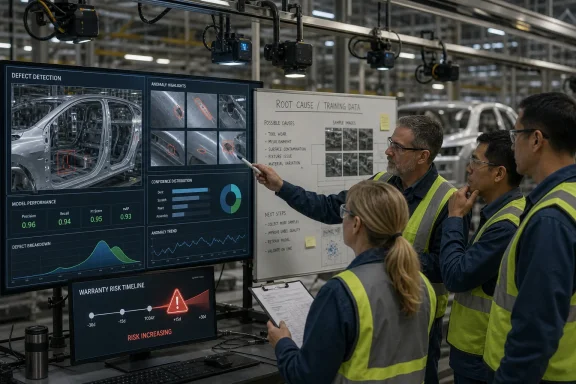
Ford has rehired roughly 350 veteran engineers over the past three years after automated quality systems and AI-assisted inspection tools failed to solve persistent vehicle defects, according to reports published in late June 2026. The reversal is not a retreat from AI so much as a public correction to one of the industry’s favorite assumptions: that expertise can be abstracted before it is understood. Ford’s lesson should sound familiar to anyone who has watched enterprise software, cloud automation, or Windows management tooling promise fewer humans and then quietly require better ones. The machine did not replace the graybeard; it made the graybeard newly strategic.
The tempting version of the Ford story is simple: management trusted AI, AI missed defects, and Ford brought back experienced humans to clean up the mess. That version is satisfying, especially in a year when almost every large company wants to tell investors that automation will do more work with fewer people. It is also incomplete.
Ford did not merely discover that cameras and models can miss things. It discovered that quality control is not a narrow visual-recognition problem. It is a system of habits, context, suspicion, memory, and feedback loops that experienced engineers build over decades. A veteran inspector does not just see a bad part; he or she often sees the supplier history, the tooling pattern, the production shortcut, and the downstream warranty claim before the defect has a name.
That kind of judgment is precisely what AI systems need in order to become useful. The irony is sharp: Ford appears to have reduced or underused the human expertise that could have made its automation better in the first place. Charles Poon, Ford’s vice president of vehicle hardware engineering, reportedly acknowledged that the company misjudged what the tools could do without the right data and expert input.
This is the recurring enterprise AI mistake. Companies treat data as if it were the same thing as institutional knowledge. It is not. Data can tell a model what happened; experienced people often know why it happened, when it matters, and when a familiar-looking case is actually different.
But manufacturing defects do not arrive as neatly labeled textbook examples. A misaligned panel, a questionable weld, a subtle finish problem, or a part that technically passes measurement but behaves badly in assembly can fall into the gap between what a model was trained to see and what an experienced technician knows to distrust. Thin or incomplete data makes that gap wider.
That is why Ford’s “gray beard” engineers matter. Their job is not simply to replace the cameras with eyeballs. Their job is to retrain the system, reframe the inspection process, and catch failure points before parts hit the plant floor. In that sense, Ford’s rehiring is less a repudiation of AI than a belated recognition that AI quality systems are only as strong as the human quality culture surrounding them.
The important word here is before. Ford executives have described a shift away from finding and fixing defects late toward preventing them earlier. That is the difference between automation as surveillance and automation as engineering. Surveillance tells you something went wrong. Engineering changes the process so the same thing is less likely to go wrong again.
That knowledge is hard to buy once it has been pushed out the door. It is also hard to reconstruct after the fact. Ford’s decision to bring back experienced engineers, including former employees and supplier specialists, suggests the company found that the missing layer was not merely labor capacity. It was interpretation.
This is where the story stops being only an automotive story. Every IT department has its own graybeards. They are the people who know why a “temporary” Group Policy object from 2017 still exists, why one factory workstation cannot be patched on the same schedule as the office fleet, why a vendor appliance breaks when TLS settings are hardened, and why a clean-looking endpoint management dashboard can still hide a bad operational assumption.
AI tools can help surface patterns in those environments. They can summarize logs, flag anomalies, draft scripts, and reduce the grind of triage. But if an organization has already hollowed out the people who understand the environment, the automation has less to learn from and fewer adults in the room when it is wrong.
But initial quality is not the same thing as long-term reliability, and Ford’s victory does not erase the lagging indicators still following the company. The automaker remains closely associated with a high recall count in the U.S. market, and executives have continued to discuss large warranty and material-cost pressures. Kumar Galhotra, Ford’s chief operating officer, has reportedly described recalls as a lagging indicator — which is true, but also convenient.
The charitable interpretation is that Ford’s quality system is improving faster than recall statistics can show. Cars already on the road reflect engineering and production decisions made years earlier. A better process today may not show up cleanly in recall data until later model years have aged into the fleet.
The less charitable interpretation is that the company has earned a good headline before it has fully earned back trust. Initial quality surveys capture early ownership problems, and early problems matter. They do not answer every question about durability, software behavior, parts longevity, or repair complexity.
Both interpretations can be true. Ford may have made a real operational improvement and still have years of reputational debt to pay down.
If software teams build detection tools without enough manufacturing context, the tools will optimize for what is visible rather than what is consequential. If hardware teams treat quality as something manufacturing will catch later, defects become more expensive. If supply chain teams are not looped into engineering lessons, the same supplier-side mistakes can repeat under different part numbers.
This is familiar terrain for Windows administrators. A security tool can generate accurate alerts and still fail operationally if the SOC, desktop team, identity team, and application owners do not share context. A patch management dashboard can show compliance while a business-critical line-of-business app remains one update away from an outage. Automation does not dissolve silos; sometimes it lets each silo move faster in the wrong direction.
Ford’s reported move toward mandatory quality meetings led by veteran engineers is therefore more important than it sounds. Meetings are not glamorous. They are also where tribal knowledge can become process knowledge, where one team’s near miss becomes another team’s design constraint, and where AI output can be challenged by people who know what the factory is actually doing.
That is not a sentimental defense of every legacy role. Some jobs will change, some tasks will disappear, and some forms of manual inspection are clearly better handled by machines. The problem is not automation itself. The problem is pretending that a model trained on incomplete signals can inherit decades of practical judgment by managerial declaration.
In Ford’s case, the veteran engineers appear to be doing three things at once. They are catching defects directly, training younger employees, and improving the AI systems that previously fell short. That is the hybrid model many enterprises will eventually settle into after the first wave of overpromising burns off.
It is also a more expensive model than the fantasy version. Keeping experts around while deploying AI means the savings are slower, the org chart is messier, and the return on investment depends on fewer dramatic headcount claims. But it is more likely to work, because it treats AI as part of a production system rather than a magic layer floating above it.
Each wave delivers something useful. Each wave also discovers that real environments are full of exceptions. There are old drivers, weird BIOS settings, remote users with broken VPN profiles, accounting macros that nobody wants to own, and industrial PCs running software whose vendor disappeared during the Obama administration.
The best administrators are not valuable because they click through consoles faster than everyone else. They are valuable because they know which clean-looking recommendation is dangerous. They know when a script should not be run globally, when an alert is noise, when a “deprecated” protocol is still attached to revenue, and when a vendor’s confidence is doing more work than its documentation.
That is the IT version of Ford’s quality problem. If AI is trained only on the official state of the environment, it will miss the lived state of the environment. The official state says the device is managed, patched, and compliant. The lived state says the device is attached to a label printer in a shipping department that will stop a warehouse if the next driver update goes sideways.
A quality engineer who merely reviews AI-flagged defects is useful. A quality engineer who helps decide what defects the AI should look for, what process changes should follow, and which false negatives are unacceptable is far more valuable. The same is true in security, systems administration, and software development.
Consider vulnerability management. An AI tool can rank exposures, summarize CVEs, and suggest remediation plans. But a senior admin knows which server supports payroll, which update has a history of breaking a vendor agent, and which “medium” vulnerability becomes critical because of a compensating control that only exists in a slide deck. Without that context, automation can produce confident nonsense at enterprise speed.
The danger is not that AI makes mistakes. People make mistakes, too. The danger is that AI can make plausible mistakes that are harder to challenge when leadership has already decided the tool represents modernization.
That gives AI advocates a better argument, though not the one some of them want. The argument is not “AI lets us get rid of expensive experts.” The argument is “AI lets scarce experts scale their judgment if we keep them close enough to teach the system.” That is a fundamentally different management posture.
It also changes the talent strategy. Instead of treating senior employees as cost centers whose knowledge can be scraped before departure, companies need to treat them as model trainers, process designers, and institutional memory carriers. That may require different incentives, different job descriptions, and a lot less magical thinking about knowledge transfer.
The firms that get this right will not be the ones with the most AI pilots. They will be the ones that build durable feedback loops between expert humans and automated systems. The firms that get it wrong will have dashboards full of green checks and customers discovering the red flags in production.
That is why Galhotra’s reported “lagging indicator” framing is both accurate and insufficient. Lagging indicators matter because customers live inside the lag. A family dealing with a recall notice, a dealer visit, or a stranded vehicle does not experience the company’s internal process improvement. They experience the product.
The same is true in IT. A security incident may reflect architectural decisions from years earlier, but the outage still happens today. A brittle Windows image may be the product of old shortcuts, but the help desk still absorbs the pain. A failed migration may trace back to undocumented dependencies, but users do not care that the dependency was created before the current admin team was hired.
Ford’s challenge is to convert early quality gains into a visible reduction in downstream pain. That will take time. It will also require resisting the next round of cost-cutting logic that says the system is now good enough to run with fewer experts.
Those are real benefits. A well-designed AI assistant can help an admin parse logs faster, draft a PowerShell command, summarize a change advisory, or compare policy settings. A security analyst can use AI to triage alerts and correlate signals that would otherwise take too long to inspect manually. Developers can move faster through boilerplate and tests.
But Ford’s experience warns against a subtle inversion. AI should not become the reason organizations stop cultivating the people who know whether the output makes sense. If anything, AI makes that expertise more important because it increases the volume of plausible recommendations.
For Microsoft and its ecosystem, this is a product design challenge as much as a management challenge. AI administration tools need transparent assumptions, conservative defaults, audit trails, rollback paths, and ways for experienced operators to encode local knowledge. A chatbot that can change settings is impressive. A chatbot that knows when not to change them is enterprise-grade.
That bill includes expert labor. It includes retraining. It includes process redesign. It includes meetings, governance, false-positive tuning, escalation rules, and the slow conversion of tribal knowledge into durable practice. It includes the humility to admit that a system can be technically sophisticated and operationally naive.
This is why executives often love AI more in slide decks than in production. In a slide deck, the tool replaces a process. In production, the tool becomes part of a process, and every bad assumption in the old process can become a bad assumption at machine scale.
Ford’s reported course correction is valuable because it exposes that hidden work. The 350 veteran engineers are not a nostalgic flourish. They are part of the infrastructure required to make automation useful. In a saner AI economy, that would be obvious. In the current one, it qualifies as news.
 Ford’s AI Problem Was Really a Knowledge Problem
The tempting version of the Ford story is simple: management trusted AI, AI missed defects, and Ford brought back experienced humans to clean up the mess. That version is satisfying, especially in a year when almost every large company wants to tell investors that automation will do more work with fewer people. It is also incomplete.Ford did not merely discover that cameras and models can miss things. It discovered that quality control is not a narrow visual-recognition problem. It is a system of habits, context, suspicion, memory, and feedback loops that experienced engineers build over decades. A veteran inspector does not just see a bad part; he or she often sees the supplier history, the tooling pattern, the production shortcut, and the downstream warranty claim before the defect has a name.
That kind of judgment is precisely what AI systems need in order to become useful. The irony is sharp: Ford appears to have reduced or underused the human expertise that could have made its automation better in the first place. Charles Poon, Ford’s vice president of vehicle hardware engineering, reportedly acknowledged that the company misjudged what the tools could do without the right data and expert input.
This is the recurring enterprise AI mistake. Companies treat data as if it were the same thing as institutional knowledge. It is not. Data can tell a model what happened; experienced people often know why it happened, when it matters, and when a familiar-looking case is actually different.
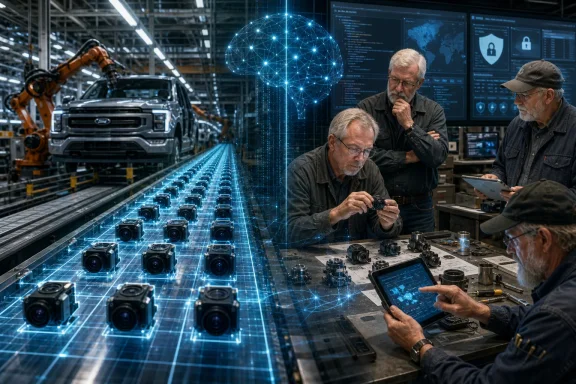
Nine Hundred Cameras Still Need Someone Who Knows Where to Look
Ford’s quality push included 900 AI-assisted cameras intended to catch problems earlier in the production process. On paper, that sounds like exactly the kind of task modern computer vision should handle. Cameras do not get tired, do not look away, and can scan more surfaces than a human team can plausibly inspect at scale.But manufacturing defects do not arrive as neatly labeled textbook examples. A misaligned panel, a questionable weld, a subtle finish problem, or a part that technically passes measurement but behaves badly in assembly can fall into the gap between what a model was trained to see and what an experienced technician knows to distrust. Thin or incomplete data makes that gap wider.
That is why Ford’s “gray beard” engineers matter. Their job is not simply to replace the cameras with eyeballs. Their job is to retrain the system, reframe the inspection process, and catch failure points before parts hit the plant floor. In that sense, Ford’s rehiring is less a repudiation of AI than a belated recognition that AI quality systems are only as strong as the human quality culture surrounding them.
The important word here is before. Ford executives have described a shift away from finding and fixing defects late toward preventing them earlier. That is the difference between automation as surveillance and automation as engineering. Surveillance tells you something went wrong. Engineering changes the process so the same thing is less likely to go wrong again.
The Graybeards Became the Missing Training Set
The phrase “gray beard” is easy to caricature, but in this case it captures a real industrial asset. Veteran engineers carry a kind of tacit knowledge that usually does not sit in a database, ticket queue, or neatly searchable PDF. They remember the weird edge cases, the supplier quirks, the design compromises, and the part families that look innocent until the wrong tolerance stack shows up.That knowledge is hard to buy once it has been pushed out the door. It is also hard to reconstruct after the fact. Ford’s decision to bring back experienced engineers, including former employees and supplier specialists, suggests the company found that the missing layer was not merely labor capacity. It was interpretation.
This is where the story stops being only an automotive story. Every IT department has its own graybeards. They are the people who know why a “temporary” Group Policy object from 2017 still exists, why one factory workstation cannot be patched on the same schedule as the office fleet, why a vendor appliance breaks when TLS settings are hardened, and why a clean-looking endpoint management dashboard can still hide a bad operational assumption.
AI tools can help surface patterns in those environments. They can summarize logs, flag anomalies, draft scripts, and reduce the grind of triage. But if an organization has already hollowed out the people who understand the environment, the automation has less to learn from and fewer adults in the room when it is wrong.
Initial Quality Is a Victory, Not an Acquittal
Ford’s latest J.D. Power Initial Quality Study result gives the company a credible turnaround story. The automaker ranked as the top mainstream brand in the 2026 survey, with models including the F-150, Super Duty, and Mustang reportedly leading their segments. That is a meaningful improvement for a company that has spent years fighting a reputation for recalls and expensive warranty problems.But initial quality is not the same thing as long-term reliability, and Ford’s victory does not erase the lagging indicators still following the company. The automaker remains closely associated with a high recall count in the U.S. market, and executives have continued to discuss large warranty and material-cost pressures. Kumar Galhotra, Ford’s chief operating officer, has reportedly described recalls as a lagging indicator — which is true, but also convenient.
The charitable interpretation is that Ford’s quality system is improving faster than recall statistics can show. Cars already on the road reflect engineering and production decisions made years earlier. A better process today may not show up cleanly in recall data until later model years have aged into the fleet.
The less charitable interpretation is that the company has earned a good headline before it has fully earned back trust. Initial quality surveys capture early ownership problems, and early problems matter. They do not answer every question about durability, software behavior, parts longevity, or repair complexity.
Both interpretations can be true. Ford may have made a real operational improvement and still have years of reputational debt to pay down.
The Real Failure Was Organizational, Not Algorithmic
Ford’s executives have also pointed to a deeper problem: teams across software, hardware, manufacturing, and supply chain were not always working together early enough. That diagnosis matters more than the camera count. AI rarely fails alone; it usually fails inside an organization that has given it a poorly shaped problem.If software teams build detection tools without enough manufacturing context, the tools will optimize for what is visible rather than what is consequential. If hardware teams treat quality as something manufacturing will catch later, defects become more expensive. If supply chain teams are not looped into engineering lessons, the same supplier-side mistakes can repeat under different part numbers.
This is familiar terrain for Windows administrators. A security tool can generate accurate alerts and still fail operationally if the SOC, desktop team, identity team, and application owners do not share context. A patch management dashboard can show compliance while a business-critical line-of-business app remains one update away from an outage. Automation does not dissolve silos; sometimes it lets each silo move faster in the wrong direction.
Ford’s reported move toward mandatory quality meetings led by veteran engineers is therefore more important than it sounds. Meetings are not glamorous. They are also where tribal knowledge can become process knowledge, where one team’s near miss becomes another team’s design constraint, and where AI output can be challenged by people who know what the factory is actually doing.
AI Works Better as an Apprentice Than as a Replacement
The Ford episode lands at an awkward moment for corporate AI rhetoric. Many executives still talk about AI as a substitute for human work, particularly expensive human work. The more durable model may be closer to apprenticeship: AI systems learn from experienced people, accelerate their reach, and take over repetitive detection only after the experts have taught the organization what good judgment looks like.That is not a sentimental defense of every legacy role. Some jobs will change, some tasks will disappear, and some forms of manual inspection are clearly better handled by machines. The problem is not automation itself. The problem is pretending that a model trained on incomplete signals can inherit decades of practical judgment by managerial declaration.
In Ford’s case, the veteran engineers appear to be doing three things at once. They are catching defects directly, training younger employees, and improving the AI systems that previously fell short. That is the hybrid model many enterprises will eventually settle into after the first wave of overpromising burns off.
It is also a more expensive model than the fantasy version. Keeping experts around while deploying AI means the savings are slower, the org chart is messier, and the return on investment depends on fewer dramatic headcount claims. But it is more likely to work, because it treats AI as part of a production system rather than a magic layer floating above it.
Windows Shops Have Seen This Movie Before
For WindowsForum readers, the story resonates because IT has been living through the same cycle for decades. Every few years, a new management layer promises to abstract away complexity. Imaging was going to simplify desktop deployment. MDM was going to make endpoint management clean and cloud-native. Zero Trust was going to replace perimeter thinking. AI copilots are now supposed to make administration conversational.Each wave delivers something useful. Each wave also discovers that real environments are full of exceptions. There are old drivers, weird BIOS settings, remote users with broken VPN profiles, accounting macros that nobody wants to own, and industrial PCs running software whose vendor disappeared during the Obama administration.
The best administrators are not valuable because they click through consoles faster than everyone else. They are valuable because they know which clean-looking recommendation is dangerous. They know when a script should not be run globally, when an alert is noise, when a “deprecated” protocol is still attached to revenue, and when a vendor’s confidence is doing more work than its documentation.
That is the IT version of Ford’s quality problem. If AI is trained only on the official state of the environment, it will miss the lived state of the environment. The official state says the device is managed, patched, and compliant. The lived state says the device is attached to a label printer in a shipping department that will stop a warehouse if the next driver update goes sideways.
The Human-in-the-Loop Cliché Finally Means Something
“Human in the loop” has become one of those phrases vendors use to make risky automation sound responsible. Too often, it means a person is technically present somewhere in the workflow, usually after the system has already framed the decision. Ford’s example suggests a stronger version: humans must be in the training loop, the design loop, the escalation loop, and the accountability loop.A quality engineer who merely reviews AI-flagged defects is useful. A quality engineer who helps decide what defects the AI should look for, what process changes should follow, and which false negatives are unacceptable is far more valuable. The same is true in security, systems administration, and software development.
Consider vulnerability management. An AI tool can rank exposures, summarize CVEs, and suggest remediation plans. But a senior admin knows which server supports payroll, which update has a history of breaking a vendor agent, and which “medium” vulnerability becomes critical because of a compensating control that only exists in a slide deck. Without that context, automation can produce confident nonsense at enterprise speed.
The danger is not that AI makes mistakes. People make mistakes, too. The danger is that AI can make plausible mistakes that are harder to challenge when leadership has already decided the tool represents modernization.
Ford’s Win Gives AI Advocates a Better Argument
There is a version of this story that anti-AI readers will enjoy too much: Ford tried automation, automation failed, humans saved the day. That is emotionally satisfying and strategically lazy. The more interesting outcome is that Ford’s reported rebound came from combining veteran expertise with AI rather than choosing one over the other.That gives AI advocates a better argument, though not the one some of them want. The argument is not “AI lets us get rid of expensive experts.” The argument is “AI lets scarce experts scale their judgment if we keep them close enough to teach the system.” That is a fundamentally different management posture.
It also changes the talent strategy. Instead of treating senior employees as cost centers whose knowledge can be scraped before departure, companies need to treat them as model trainers, process designers, and institutional memory carriers. That may require different incentives, different job descriptions, and a lot less magical thinking about knowledge transfer.
The firms that get this right will not be the ones with the most AI pilots. They will be the ones that build durable feedback loops between expert humans and automated systems. The firms that get it wrong will have dashboards full of green checks and customers discovering the red flags in production.
Recall Counts Are the Bill for Yesterday’s Decisions
Ford’s recall history remains the counterweight to the comeback narrative. A company can improve its incoming quality and still be haunted by older platforms, earlier supplier decisions, and design assumptions that looked acceptable at launch. Recalls are delayed invoices. They arrive after the engineering meeting is over, after the marketing campaign has moved on, and after customers have become unwilling beta testers.That is why Galhotra’s reported “lagging indicator” framing is both accurate and insufficient. Lagging indicators matter because customers live inside the lag. A family dealing with a recall notice, a dealer visit, or a stranded vehicle does not experience the company’s internal process improvement. They experience the product.
The same is true in IT. A security incident may reflect architectural decisions from years earlier, but the outage still happens today. A brittle Windows image may be the product of old shortcuts, but the help desk still absorbs the pain. A failed migration may trace back to undocumented dependencies, but users do not care that the dependency was created before the current admin team was hired.
Ford’s challenge is to convert early quality gains into a visible reduction in downstream pain. That will take time. It will also require resisting the next round of cost-cutting logic that says the system is now good enough to run with fewer experts.
The Lesson Detroit Is Teaching Redmond
The connection between Ford’s factory floor and the Windows ecosystem is not metaphorical fluff. Microsoft, PC OEMs, enterprise software vendors, and managed service providers are all pushing AI deeper into operational workflows. Copilots are being attached to admin consoles, security tools, code editors, productivity suites, and support systems. The pitch is speed, scale, and reduced toil.Those are real benefits. A well-designed AI assistant can help an admin parse logs faster, draft a PowerShell command, summarize a change advisory, or compare policy settings. A security analyst can use AI to triage alerts and correlate signals that would otherwise take too long to inspect manually. Developers can move faster through boilerplate and tests.
But Ford’s experience warns against a subtle inversion. AI should not become the reason organizations stop cultivating the people who know whether the output makes sense. If anything, AI makes that expertise more important because it increases the volume of plausible recommendations.
For Microsoft and its ecosystem, this is a product design challenge as much as a management challenge. AI administration tools need transparent assumptions, conservative defaults, audit trails, rollback paths, and ways for experienced operators to encode local knowledge. A chatbot that can change settings is impressive. A chatbot that knows when not to change them is enterprise-grade.
The Expensive Part of AI Is Not the Model
The public conversation about AI cost tends to focus on chips, cloud capacity, licensing, and energy. Those costs are real. But Ford’s story points to a different bill: the cost of operationalizing AI inside messy, physical, regulated, customer-facing systems.That bill includes expert labor. It includes retraining. It includes process redesign. It includes meetings, governance, false-positive tuning, escalation rules, and the slow conversion of tribal knowledge into durable practice. It includes the humility to admit that a system can be technically sophisticated and operationally naive.
This is why executives often love AI more in slide decks than in production. In a slide deck, the tool replaces a process. In production, the tool becomes part of a process, and every bad assumption in the old process can become a bad assumption at machine scale.
Ford’s reported course correction is valuable because it exposes that hidden work. The 350 veteran engineers are not a nostalgic flourish. They are part of the infrastructure required to make automation useful. In a saner AI economy, that would be obvious. In the current one, it qualifies as news.
The Blue Oval’s AI Detour Leaves a Map for Everyone Else
Ford’s quality turnaround is still a developing story, but the practical lessons are already visible. The company did not find salvation in pure automation or in pure human craft. It found progress by admitting that expert judgment had to be put back at the center of the system.- Ford’s rehiring of veteran engineers shows that AI quality control depends on the expertise used to train, challenge, and refine it.
- The company’s 900 AI-assisted cameras were not enough on their own because visual detection cannot replace deep manufacturing context.
- Ford’s top mainstream ranking in the 2026 J.D. Power Initial Quality Study is a real achievement, but it does not immediately erase recall and warranty concerns.
- The most important operational shift is Ford’s move from late defect detection toward earlier prevention across engineering, manufacturing, software, and supply chain teams.
- Windows administrators and IT leaders should treat the episode as a warning against deploying AI after hollowing out the institutional knowledge needed to supervise it.
- The durable enterprise model is not AI instead of experts, but AI trained by experts and constrained by accountable process.
References
- Primary source: qz.com
Published: 2026-06-30T13:30:19.081653
Ford rehires veteran engineers after AI quality control fails
The automaker hired 350 experienced specialists over three years to fix quality problems its automated systems couldn't solveqz.com - Independent coverage: CBT News
Published: 2026-06-30T12:30:19.085058
Ford rehires 350 veteran engineers after AI falls short
Ford rehired 350 veteran engineers after its AI quality tools and automated camera systems missed defects that experienced staff caught.www.cbtnews.com - Related coverage: tomsguide.com
Ford replaced hundreds of engineers with AI — now it's bringing them back after quality problems | Tom's Guide
Ford’s push to implement more AI into its infrastructure has seemingly fallen short, as the company has now rehired its veteran staff to improve its productswww.tomsguide.com - Related coverage: carscoops.com
Ford Went From Recall King To JD Power’s Top Mainstream Brand For Initial Quality | Carscoops
Ford had the best initial quality among mainstream brands in a new study and it ranked above Lexuswww.carscoops.com - Related coverage: computerworld.com
Disappointed with AI, Ford moves to re-hire 350 former workers – Computerworld
The automaker tried the technology for automated quality control, but it was unable to detect enough problems. www.computerworld.com
- Related coverage: thenextweb.com
Ford rehired 350 engineers to fix what its AI systems got wrong
Ford admitted its AI couldn't replace experienced engineers and rehired 350 veterans, then climbed to No 1 in JD Power's quality ranking for the first time in 16 years.thenextweb.com
- Related coverage: inews.zoombangla.com
Ford Rehires 350 Veteran Engineers After AI Quality Systems Fall Short Saving $1 Billion in 2026
Ford has rehired 350 experienced engineers after AI-driven quality inspection systems fell short, with the move expected to save theinews.zoombangla.com - Related coverage: news.bloomberglaw.com
Ford’s AI Hiccups Lead Carmaker to Rehire ‘Gray Beard’ Engineers
Ford Motor Co. took an unusually human approach to fixing its stubborn quality problems: It brought back what it calls “gray beard” engineers to help train younger staff and to reprogram the artificial intelligence tools that weren’t getting the job done.news.bloomberglaw.com
- Related coverage: fromtheroad.ford.com
- Related coverage: jaymaloneford.com
- Related coverage: memeburn.com
Ford AI Quality Control Failed, So It Rehired 350 Senior Engineers - Memeburn
Ford's AI quality control bet backfired badly. The automaker rehired 350 veteran engineers in 2026 — and just won its best JD Power ranking in 16 years. Here's the real story.memeburn.com - Related coverage: s205.q4cdn.com
</rdf:Alt> </dc:title> <dc:description> <rdf:Alt> <rdf:li xml:lang="x-default"/> </rdf:Alt> </dc:description> <dc:creator> <rdf:Seq> <rdf:li>Peake,
</rdf:Alt> </dc:description> <dc:creator> <rdf:Seq> <rdf:li>Peake, Daniel (D.)s205.q4cdn.com
- Related coverage: techregard.com
Ford Rehires 350 Veteran Engineers After AI Flaws Trigger Costly Recalls - Tech Regard
Ford Motor Company pivots back to human expertise, rehiring 350 veteran engineers after AI-driven automated quality inspection platforms..www.techregard.com - Related coverage: ford.com