

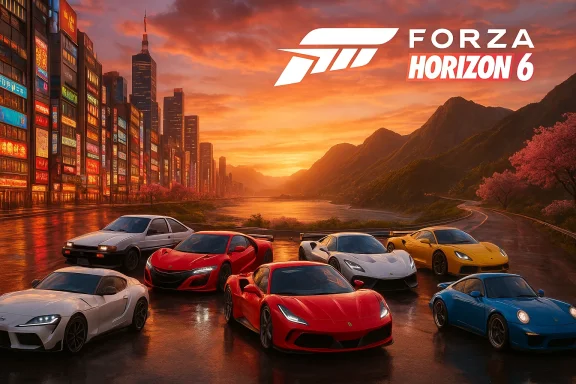
Forza Horizon 6’s long-awaited unveiling is a clear signal that Playground Games is doubling down on spectacle: a Japan-set open world, a confirmed launch on May 19, 2026 (with early access for Premium Edition buyers), inclusion on Xbox Game Pass at day one, and a headline claim of over 550 cars at launch — the largest single roster the franchise has ever offered.
Playground Games revealed Forza Horizon 6 during a January developer showcase, positioning the game as a return-to-roots Horizon festival set across a photoreal, Japan-inspired landscape. The studio says the new map is the largest in franchise history and features a mix of dense urban districts, mountainous backroads, coastal highways, and the sort of vertical variety that makes Japanese geography ideal for a driving playground. The game will release for Xbox Series X|S and PC on May 19, 2026, with a PlayStation 5 version planned for a later, post-launch window; Premium Edition buyers gain early access starting May 15. Two commercial points are already clear: Forza Horizon 6 will be available on Xbox Game Pass at launch, and Microsoft is offering a Premium Edition that bundles early access, VIP membership-type perks, car packs, and two premium expansions (the latter arriving post-launch). These decisions shape both the immediate accessibility of the game and expectations for Forza’s live-service roadmap.
However, ambition brings production complexity. Delivering balanced vehicle physics, equitable multiplayer, and a fair post-launch content strategy for a roster this large will be the studio’s greatest challenge. Monetization choices, DLC cadence, and platform parity will determine whether FH6 becomes a long-lived community hub or a short peak followed by fragmentation.
For now, the safe takeaways are clear: Forza Horizon 6 will be an immediately accessible, high-profile release with an enormous car roster and an ambitious Japan-based open world. Fans and collectors should temper early roster lists as “work-in-progress” until Playground publishes the official inventory and clarifies the DLC roadmap. Expect the next wave of updates to fill in the blanks — official car rosters, trim-year confirmations, and the first post-launch car packs — all of which will be decisive in judging whether FH6’s promise equals its delivery.
Bold names, marquee numbers, and the reveal’s principal promises have been verified with multiple reporting outlets and official developer statements; the community’s job now is to watch for the official roster drop, system requirement details, and the post-launch support plan that will ultimately determine the game’s longevity.
Source: Windows Central The complete Forza Horizon 6 car list (so far)
 Background / Overview
Playground Games revealed Forza Horizon 6 during a January developer showcase, positioning the game as a return-to-roots Horizon festival set across a photoreal, Japan-inspired landscape. The studio says the new map is the largest in franchise history and features a mix of dense urban districts, mountainous backroads, coastal highways, and the sort of vertical variety that makes Japanese geography ideal for a driving playground. The game will release for Xbox Series X|S and PC on May 19, 2026, with a PlayStation 5 version planned for a later, post-launch window; Premium Edition buyers gain early access starting May 15. Two commercial points are already clear: Forza Horizon 6 will be available on Xbox Game Pass at launch, and Microsoft is offering a Premium Edition that bundles early access, VIP membership-type perks, car packs, and two premium expansions (the latter arriving post-launch). These decisions shape both the immediate accessibility of the game and expectations for Forza’s live-service roadmap. What we know about the car list so far
Confirmed headline figures and scope
- Playground and promotional materials shown during the reveal emphasize “over 550 real‑world cars” at launch — a landmark number that eclipses previous Horizon launches. Multiple outlets and Xbox’s own messaging repeated the 550+ figure during the reveal window.
- The initial public car list is partial. Developers demonstrated gameplay and cinematic footage that showcased dozens of models, and outlets have compiled identification lists from the teaser and footage — but a full, official car roster has not been published yet by Playground Games. That means specific trims, model years, and special variants still require developer confirmation.
- A pre-order / Premium Edition incentive widely reported is the inclusion of a pre-tuned Ferrari J50 as a bonus vehicle. This appears in multiple reveal write-ups and pre-order blurbs and has been treated as a confirmed promotional vehicle for early purchasers.
Notable car identities spotted in reveal footage
Journalists and vehicle-spotters combing the reveal footage have identified a cross-section of cars spanning Japanese domestic market icons, modern hypercars, and European exotics. The early compilations — assembled from in-engine footage and promotional frames — include (but are not limited to):- Japanese classics and modern heroes: Toyota Corolla AE86, Toyota Supra RZ (A80/A90 family representations present), 2025 Toyota GR GT prototype, 2025 Toyota Land Cruiser J250, Toyota GR 86, Honda Civic (1st gen), Honda Civic Type R (FL5), Honda e, Honda NSX (1st and 2nd gen), Nissan Skyline R34, Nissan Silvia S15, Nissan GT-R Nismo, Nissan Z RZ34, Mitsubishi Lancer Evolution IX, Mazda MX-5 / Miata.
- Supercars and hypercars: Aston Martin Valkyrie, Koenigsegg Jesko, Lamborghini Essenza SCV12, Lamborghini Huracan STO, Ferrari FXX‑K, Lexus LFA, Mercedes‑AMG GTR, and several Porsche 911 variants (including Carrera S and GT3 RS).
- Australian muscle and classics (spotted in sequences): Holden Commodore SS and Holden Torana A9X — likely included as part of a global, enthusiast-driven car selection that historically favors region-specific classics.
How reliable is the early car list?
What’s verified
- The headline number (550+ cars) and the May 19, 2026 release window are carried in official developer messaging and repeated by multiple outlets — this is a verified claim. Forza Support and major press coverage corroborate Game Pass availability and the platform staggered release timeline (Xbox/PC first, PS5 later in 2026).
- The presence of Toyota’s GR GT prototype in reveal art and trailers was explicitly called out by developers and confirmed by automotive press that covered the reveal — it’s also visually prominent in the marketing frames. That makes Toyota a confirmed partner/feature in the marketing cycle.
What remains provisional or unverifiable
- Exact model years, trim levels, and the final list of all 550+ vehicles remain unverifiable until Playground releases a complete, authoritative car roster. Early lists assembled from teaser footage can misidentify similar silhouettes, and certain brief frames might show artists’ concept models rather than licensed, fully modeled vehicle variants. Treat early identification lists as robust guesses rather than final rosters.
- DLC car passes, post-launch car packs, and potential time-limited promotional vehicles (aside from Ferrari J50 pre-order bonus) have not been fully detailed and should be considered subject to change. Any monetization or car‑acquisition mechanics beyond what has been stated publicly (Game Pass availability and Premium Edition contents) are not yet confirmed.
The practical meaning of a 550+ car roster
Gameplay and player experience
A launch lineup of this scale has immediate gameplay implications. More cars means greater variety for:- Event and playlist design (drift, time attack, off-road, circuit, road races).
- Player progression and garage curation.
- Photo mode compositions and car collection goals.
Live service, community, and competitive balance
- Multiplayer balance becomes harder: with a massive roster, developers must either rely on class systems (PI, performance index) or strict matchmaking filters to keep racing fair.
- Community-created content and showrooms will thrive — the larger the pool of vehicles, the more niche cultures (drift cars, JDM classics, rally specials) can grow within the same game world.
- Forza’s ongoing playlist and seasonal mechanics will need to be carefully curated to ensure that newer, rarer cars don’t make older content irrelevant overnight.
Notable technical and design directions hinted at in the reveal
Japan as a setting: scale, photogrammetry, and cultural framing
Playground’s team emphasized on-site reference trips and photogrammetry capture to recreate Japan’s landscapes faithfully. The map reportedly includes large urban districts (a Tokyo-inspired city area several times the size of prior Horizon cities), mountain passes, coastal routes, and changing seasonal conditions — all of which introduce new technical demands for streaming geometry, LOD transitions, and occlusion systems. Expect server and streaming optimization to be a production focus ahead of launch.ForzaTech engine and audio fidelity
Forza’s engine pedigree — ForzaTech — continues to be a core strength for Playground. Developers called out improved audio capture processes (capturing in‑car and external sounds), which suggests more nuanced mechanical audio models and layered sound design. Accurate audio is instrumental in delivering different driving feels across varied cars, especially with classic JDM engines, turbocharged 90s icons, and modern EVs included in the roster.Garage systems arend meta-progression
Forza Horizon 6 appears to reframe progression around exploration and a new “Collection Journal” mechanic inspired by Japanese stamp-collecting traditions; this shifts emphasis toward discovery and personal curation rather than strictly linear career progression. The Estate system (large player-owned property) also suggests a deeper, long-term personalization meta that will give players reasons to return for seasonal and cosmetic updates.Strengths: what the reveal gets right
- Ambition and scope. A massive map combined with 550+ cars at launch is a strong commercial and technical statement. It signals that Playground intends FH6 to be the series’ showcase for scale and variety.
- Location choice. Japan offers an enormous variety of driving environments and an organically strong cultural tie to car enthusiasts globally — from kei cars and drift culture to hypercar showcases and legendary rally routes. A Japan setting is a strong match for a franchise focused on automotive culture.
- Accessibility and distribution. Inclusion on Xbox Game Pass from day one lowers the barrier to entry and should boost player counts early, which benefits social features and community-driven content. Early Premium access for committed buyers is standard but effectively managed as a staggered launch strategy.
- Audio and technical polish focus. Public emphasis on audio capture and photogrammetry indicates Playground is investing in fidelity that matters to both driving feel and immersion.
Risks and open questions
- Final inventory uncertainty. Trailer-driven lists inevitably miss or misidentify cars. Until Playground publishes an authoritative car roster, collectors and content creators should treat early lists as indicative rather than definitive. This raises expectations management challenges for the community.
- Multiplayer fairness and tuning. Balancing hundreds of vehicles across performance bands and handling models is a non-trivial task; mishandling could lead to meta-dominant cars in competitive modes, frustrating players who favor diversity or historical accuracy.
- Post-launch content cadence. A large launch roster raises expectations for continuous additions. Playground must commit to a steady DLC and events program without splitting the player base or making core features paywalled. The Premium Edition’s included expansions indicate a paid roadmap, but clarity on free vs. paid content cadence is still needed.
- Platform parity and PS5 timeline. While Xbox/PC day-one availability is confirmed, the delayed PS5 port introduces fragmentation risk for cross-platform communities. Timing and parity details for features and content on PS5 will matter to players on that platform.
- Server load and online stability. Large shared map features and social play (track sharing, large multiplayer sessions) can strain online services at launch. Playground will need robust scaling and fallback plans for early-weekend spikes.
What fans should watch next
- Official car roster release — the single most valuable update that will transition speculation to certainty.
- Details on the vehicle economy (how cars are acquired in-game, currency systems, microtransaction approach).
- Full technical specs and system requirements for PC (resolution, framerate goals, ray tracing if applicable).
- PS5 release window and whether PS5 will receive parity content or delayed features.
- Community events, car pack schedules, and the Premium Edition’s specific in-game items beyond the early access window.
Quick reference: key confirmed facts (verified)
- Release date: May 19, 2026 (Xbox Series X|S and PC); Premium Edition early access May 15, 2026.
- Launch platform availability: Xbox Series X|S and PC at launch; PlayStation 5 post-launch in 2026.
- Launch vehicle count: Over 550 cars at launch (developer and promotional messaging).
- Game Pass: Included at launch for Game Pass Ultimate and PC Game Pass subscribers.
- Pre-order / Bonus car: Ferrari J50 cited as a pre-order / pre-tuned bonus vehicle in early reporting.
Final analysis — why Forza Horizon 6 matters
Forza Horizon 6 is shaping up to be a defining entry in the series for three intertwined reasons: scale, cultural relevance, and accessibility. The Japan setting expands the franchise’s palette, enabling a blend of cityscapes and rural ribbon roads that align with broad fan tastes — from drift culture to high-speed circuits. A launch roster that promises 550+ cars reinforces Playground’s ambition to serve both collectors and competitive players.However, ambition brings production complexity. Delivering balanced vehicle physics, equitable multiplayer, and a fair post-launch content strategy for a roster this large will be the studio’s greatest challenge. Monetization choices, DLC cadence, and platform parity will determine whether FH6 becomes a long-lived community hub or a short peak followed by fragmentation.
For now, the safe takeaways are clear: Forza Horizon 6 will be an immediately accessible, high-profile release with an enormous car roster and an ambitious Japan-based open world. Fans and collectors should temper early roster lists as “work-in-progress” until Playground publishes the official inventory and clarifies the DLC roadmap. Expect the next wave of updates to fill in the blanks — official car rosters, trim-year confirmations, and the first post-launch car packs — all of which will be decisive in judging whether FH6’s promise equals its delivery.
Bold names, marquee numbers, and the reveal’s principal promises have been verified with multiple reporting outlets and official developer statements; the community’s job now is to watch for the official roster drop, system requirement details, and the post-launch support plan that will ultimately determine the game’s longevity.
Source: Windows Central The complete Forza Horizon 6 car list (so far)
