

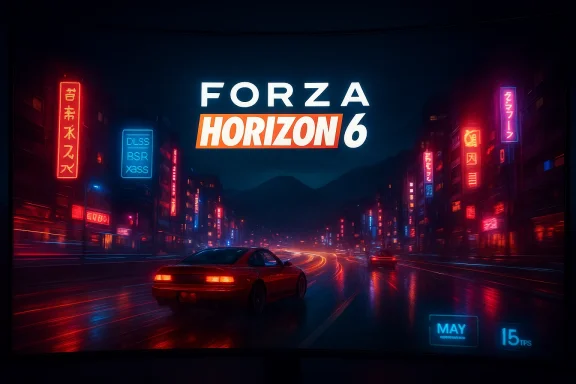
Forza Horizon 6’s PC specs are drawing attention for a simple reason: they are unusually modest for a modern open-world racing game that is being positioned as a visual showcase. The official launch timing is now clear as well, with Playground Games saying the game arrives on Xbox Series X|S and PC on May 19, 2026, with Premium Edition early access beginning on May 15. That combination of relatively low entry requirements, broad upscaling support, and a Japan setting makes this one of the most interesting PC racing releases in years.
The headline is not that Forza Horizon 6 will look good; it is that Microsoft and Playground Games seem determined to make it look good without locking out a huge portion of the PC audience. The published minimum spec reportedly starts as low as a GTX 1650, paired with 16 GB of RAM, which is striking when set against the scale and visual ambition expected from a next-generation Horizon entry. The recommended and extreme tiers step upward in the expected way, but the floor is what grabs attention because it suggests an unusually efficient rendering and asset pipeline. The official messaging also points to support for DLSS 4, FSR 3/4, XeSS 2.1, uncapped frame rates, ultra-wide monitors, and ray-traced reflections and global illumination.
That matters because Forza Horizon has always lived at the intersection of spectacle and accessibility. The series’ appeal depends on making a huge, explorable world feel instantly playable on a wide range of hardware, not just elite gaming rigs. If these requirements hold up in practice, Forza Horizon 6 could become a model for how to ship a premium AAA racer that still treats mainstream PC ownership as a first-class target rather than a compromise.
The early reaction to the specs is therefore about more than performance numbers. It speaks to the broader direction of Microsoft’s gaming strategy, which increasingly leans on scalability, cross-platform reach, and feature parity rather than gating experiences behind expensive hardware. Forza Horizon 6 is also coming to PS5 later in 2026, which makes the accessibility story even more commercially significant: this is not just a PC optimization story, but a multi-platform one.
Forza Horizon 5 reinforced that reputation by becoming a long-tail hit, but Forza Horizon 6 arrives at a more complicated moment for PC gaming. On one side, players expect ever-higher fidelity, more advanced lighting, and denser worlds. On the other, the market is increasingly sensitive to bloat, GPU pricing, and the sense that some studios are designing for a tiny fraction of the installed base. A racing game that can promise visual richness while keeping the minimum hardware reasonable is, in that context, an unusually strong proposition. It is also a reminder that good optimization still matters, even in an age dominated by upscalers and frame generation.
The Japan setting deepens the importance of the launch. Open-world racing games thrive when their environments are memorable enough to become part of the fantasy, and Japan has long been one of the most requested locales in the genre. The reveal of the 2025 GR GT Prototype and the 2025 Toyota Land Cruiser as showcase vehicles underscores the game’s attempt to combine fantasy, authenticity, and fan service in a single package. That is exactly the sort of branding that can turn a technical requirement sheet into a major talking point.
There is also a wider platform story unfolding. Microsoft is increasingly comfortable releasing major first-party titles on multiple storefronts and, in the case of Forza Horizon 6, even on PlayStation 5 later in the year. That makes the PC spec conversation more strategic than usual, because the company is no longer simply courting a core Xbox audience. It is trying to sell a shared ecosystem where the same game can run across console, PC, and subscription channels with minimal friction.
The recommended tier is more telling from a systems-design perspective. A Core i5-12400F / Ryzen 5 5600X and a RTX 3060 Ti / RX 6700 XT / Arc A580 target 1440p at 60+ fps, which is a sensible sweet spot for many PC gamers in 2026. That tells us Playground Games is not simply optimizing for minimum viability; it is trying to make the game feel genuinely smooth on hardware that many enthusiasts still own. The “extreme” tiers also suggest the game’s performance ceiling is high enough to justify heavyweight GPUs, especially when ray tracing enters the equation.
The fact that all presets are listed with a stable 60 fps expectation is another clue. Microsoft and Playground Games are not just publishing a requirements table; they are setting expectations about how the game should feel at each tier. That is a subtle but important distinction, because racing games magnify latency, stutter, and uneven animation more than many other genres. A visually dense game that still feels responsive is far more valuable than one that only looks impressive in screenshots.
Ray tracing is where the most interesting tradeoffs will emerge. The official feature list mentions detailed reflections and global illumination, which are exactly the kinds of effects that can elevate a racing game’s presentation without overwhelming the player with noise. Yet those same features also explain why the highest preset requires far more memory and a much stronger GPU. In a game built around speed, even small image-quality gains can feel substantial if they are implemented cleanly and tied to reflective surfaces, lighting transitions, and atmospheric depth.
Unlimited frame rate support is equally significant. Racing games can benefit enormously from higher refresh rates, especially for players using high-end monitors or steering-wheel setups. By leaving the cap off, Playground Games is effectively saying that the game should scale from couch-friendly 60 fps all the way to enthusiast-grade performance without forcing a single target. That flexibility is one reason the series remains so compelling on PC.
Modern open-world racing games are expensive in ways that are not always visible in headline specs. The game has to stream terrain, cars, traffic, ambient animation, weather effects, and audio assets without introducing hitches. Lowering the GPU minimum does not make those systems free; it simply means the engine has to be especially disciplined about memory usage, asset prioritization, and load behavior. If Forza Horizon 6 performs well on a GTX 1650 class card, that will say a lot about the engine team’s commitment to graceful degradation.
This is also where the handheld angle becomes meaningful. The game is reportedly compatible with Steam Deck and Xbox ROG Ally, which raises expectations that storage and memory behavior have been tuned with portable hardware in mind. If true, that broadens the audience far beyond desktop enthusiasts and suggests Microsoft wants Forza Horizon 6 to serve as a showcase for Windows gaming across form factors.
For PC users, this is part of a larger trend: Microsoft wants its major games to feel native across storefronts without giving one ecosystem all the strategic credit. Steam matters because it remains the default home for many PC players; the Microsoft Store matters because it preserves the company’s own distribution and Game Pass logic. The low requirements help here too, because they reduce the number of users who will bounce off the game at the hardware gate.
For Microsoft, this is also a strategic defense against fragmentation. If the same game can be played on console, PC, cloud, and eventually PS5, then the company can focus on service engagement rather than a single box sale. The open-ended PC requirements are part of that thesis: more devices means more reachable players, and more reachable players means a stronger case for the ecosystem.
It also pressures other open-world racing and driving franchises to think harder about their minimum specs. Players increasingly compare launch requirements before they compare review scores, and a headline-friendly low floor can become a marketing advantage all by itself. In practice, this may push studios to be more transparent about what their presets actually mean and how much of a game’s final look depends on upscaling versus native render resolution.
There is also a console angle. Because Forza Horizon 6 launches on Xbox and later on PS5, it becomes a cross-platform benchmark rather than a platform trophy. That means the critical question is no longer “Can it run on one ecosystem’s flagship box?” but “Can it preserve its feel everywhere?” That is a much harder, and much more commercially interesting, challenge.
For enthusiasts, the low baseline is interesting for a different reason: it suggests the game may be architected efficiently enough to reward high-end hardware rather than merely tolerate it. Racing games are often more sensitive to motion clarity, frame time stability, and input latency than to raw pixel count. That makes a well-optimized title especially satisfying because better hardware translates directly into a better driving feel, not just prettier screenshots.
That dual focus matters because racing games are among the few mainstream genres that can genuinely bridge the gap between console convenience and PC optimization culture. A player on a modest laptop and a sim-racing enthusiast on a multi-monitor rig can both enjoy the same franchise for different reasons. The more gracefully the game supports that spread, the stronger the franchise becomes as a platform asset.
The next few weeks will likely focus on deeper technical details, storefront readiness, and how the game behaves across the many combinations of GPUs, CPUs, and displays that PC gamers actually use. Microsoft will also want to keep the messaging tight around cross-play, accessibility, and the later PS5 launch, because the broader the reach, the more important stable performance becomes. In a crowded year for big releases, reliability may end up being the most valuable headline of all.
Source: Gagadget.com Forza Horizon 6: System Requirements and PC Version Features
 Overview
The headline is not that Forza Horizon 6 will look good; it is that Microsoft and Playground Games seem determined to make it look good without locking out a huge portion of the PC audience. The published minimum spec reportedly starts as low as a GTX 1650, paired with 16 GB of RAM, which is striking when set against the scale and visual ambition expected from a next-generation Horizon entry. The recommended and extreme tiers step upward in the expected way, but the floor is what grabs attention because it suggests an unusually efficient rendering and asset pipeline. The official messaging also points to support for DLSS 4, FSR 3/4, XeSS 2.1, uncapped frame rates, ultra-wide monitors, and ray-traced reflections and global illumination.That matters because Forza Horizon has always lived at the intersection of spectacle and accessibility. The series’ appeal depends on making a huge, explorable world feel instantly playable on a wide range of hardware, not just elite gaming rigs. If these requirements hold up in practice, Forza Horizon 6 could become a model for how to ship a premium AAA racer that still treats mainstream PC ownership as a first-class target rather than a compromise.
The early reaction to the specs is therefore about more than performance numbers. It speaks to the broader direction of Microsoft’s gaming strategy, which increasingly leans on scalability, cross-platform reach, and feature parity rather than gating experiences behind expensive hardware. Forza Horizon 6 is also coming to PS5 later in 2026, which makes the accessibility story even more commercially significant: this is not just a PC optimization story, but a multi-platform one.
Background
Forza Horizon as a brand has steadily shifted from being a side-road spinoff of Forza Motorsport into one of Xbox’s most recognizable system-level franchises. Over time, Playground Games has built a formula that blends open-world structure, car culture, social play, and high production values into something that sells on both emotional fantasy and technical polish. The series’ success has come from the fact that it is easy to start and difficult to exhaust, with a performance envelope that has always been more forgiving than many other showcase games. That history helps explain why Horizon entries are often used to demonstrate both new hardware and smarter optimization.Forza Horizon 5 reinforced that reputation by becoming a long-tail hit, but Forza Horizon 6 arrives at a more complicated moment for PC gaming. On one side, players expect ever-higher fidelity, more advanced lighting, and denser worlds. On the other, the market is increasingly sensitive to bloat, GPU pricing, and the sense that some studios are designing for a tiny fraction of the installed base. A racing game that can promise visual richness while keeping the minimum hardware reasonable is, in that context, an unusually strong proposition. It is also a reminder that good optimization still matters, even in an age dominated by upscalers and frame generation.
The Japan setting deepens the importance of the launch. Open-world racing games thrive when their environments are memorable enough to become part of the fantasy, and Japan has long been one of the most requested locales in the genre. The reveal of the 2025 GR GT Prototype and the 2025 Toyota Land Cruiser as showcase vehicles underscores the game’s attempt to combine fantasy, authenticity, and fan service in a single package. That is exactly the sort of branding that can turn a technical requirement sheet into a major talking point.
There is also a wider platform story unfolding. Microsoft is increasingly comfortable releasing major first-party titles on multiple storefronts and, in the case of Forza Horizon 6, even on PlayStation 5 later in the year. That makes the PC spec conversation more strategic than usual, because the company is no longer simply courting a core Xbox audience. It is trying to sell a shared ecosystem where the same game can run across console, PC, and subscription channels with minimal friction.
What the PC Requirements Actually Suggest
The minimum hardware tier is arguably the most revealing part of the announcement. A Core i5-8400 or Ryzen 5 1600, combined with a GTX 1650, RX 6500 XT, or Intel Arc A380, is not an embarrassing baseline anymore, but it is certainly lower than many players would expect from a 2026 showcase title. The 16 GB RAM floor is much more modern than the GPU requirement, which hints that memory pressure may be tied more to asset streaming and world density than raw shader load. In other words, the studio appears to be balancing visual ambition with a deliberate effort to keep the game playable on mass-market systems.The recommended tier is more telling from a systems-design perspective. A Core i5-12400F / Ryzen 5 5600X and a RTX 3060 Ti / RX 6700 XT / Arc A580 target 1440p at 60+ fps, which is a sensible sweet spot for many PC gamers in 2026. That tells us Playground Games is not simply optimizing for minimum viability; it is trying to make the game feel genuinely smooth on hardware that many enthusiasts still own. The “extreme” tiers also suggest the game’s performance ceiling is high enough to justify heavyweight GPUs, especially when ray tracing enters the equation.
Why the floor matters more than the ceiling
A game’s upper-end settings are often designed as a marketing tool, but the minimum requirements are a trust signal. If the floor is too high, players assume the studio is chasing benchmarks instead of experience. If the floor is too low but the game actually runs well, the studio earns a reputation for craftsmanship, and that reputation has value long after launch day. This is especially true for a racing game, where frame-time consistency matters almost as much as raw average frame rate.The fact that all presets are listed with a stable 60 fps expectation is another clue. Microsoft and Playground Games are not just publishing a requirements table; they are setting expectations about how the game should feel at each tier. That is a subtle but important distinction, because racing games magnify latency, stutter, and uneven animation more than many other genres. A visually dense game that still feels responsive is far more valuable than one that only looks impressive in screenshots.
- The minimum GPU class is closer to midrange mainstream than elite enthusiast territory.
- 16 GB RAM is now the real baseline for a modern AAA open-world game.
- The recommended spec points to 1440p as the “real” target for serious PC players.
- The extreme presets imply a meaningful visual upgrade path for high-end rigs.
- Stable 60 fps remains the performance philosophy, not raw benchmark chasing.
Graphics, Upscaling, and Ray Tracing
The inclusion of DLSS 4, FSR 3/4, and XeSS 2.1 is not a throwaway feature list. It signals that the game is being built with modern performance augmentation in mind from the start, rather than retrofitting support after launch. That is good news for both high-end and midrange players, because it gives the engine multiple routes to deliver good frame rates without making one vendor’s hardware the default winner.Ray tracing is where the most interesting tradeoffs will emerge. The official feature list mentions detailed reflections and global illumination, which are exactly the kinds of effects that can elevate a racing game’s presentation without overwhelming the player with noise. Yet those same features also explain why the highest preset requires far more memory and a much stronger GPU. In a game built around speed, even small image-quality gains can feel substantial if they are implemented cleanly and tied to reflective surfaces, lighting transitions, and atmospheric depth.
Upscaling as a design assumption
Forza Horizon 6 appears to assume that upscaling is part of normal play, not a fallback for broken performance. That is an important distinction because it means the studio can target a high internal visual bar while still shipping a game that is tractable on a broad hardware range. It also reflects the PC market as it actually exists in 2026: not every player is on a bleeding-edge GPU, but many are willing to use modern reconstruction tools if image quality stays strong.Unlimited frame rate support is equally significant. Racing games can benefit enormously from higher refresh rates, especially for players using high-end monitors or steering-wheel setups. By leaving the cap off, Playground Games is effectively saying that the game should scale from couch-friendly 60 fps all the way to enthusiast-grade performance without forcing a single target. That flexibility is one reason the series remains so compelling on PC.
- DLSS 4, FSR 3/4, and XeSS 2.1 broaden the hardware base.
- Ray tracing is present, but clearly reserved for the upper end of the experience.
- Unlimited frame rate support favors high-refresh and sim-racing setups.
- Ultra-wide monitor support helps the game feel like a premium PC release.
- The technical stack suggests long-term support for modern GPUs, not a one-vendor showcase.
Memory, Storage, and the Practical Cost of Open Worlds
The 16 GB minimum RAM figure is unremarkable on its face, but it is more revealing when paired with the estimated install footprint. The source material notes that SSD space was not specified, though a figure around 150 GB is a reasonable expectation for a game of this scale. That is where the “low requirements” story starts to become more nuanced: even if the CPU and GPU bar is approachable, the storage burden may still be substantial.Modern open-world racing games are expensive in ways that are not always visible in headline specs. The game has to stream terrain, cars, traffic, ambient animation, weather effects, and audio assets without introducing hitches. Lowering the GPU minimum does not make those systems free; it simply means the engine has to be especially disciplined about memory usage, asset prioritization, and load behavior. If Forza Horizon 6 performs well on a GTX 1650 class card, that will say a lot about the engine team’s commitment to graceful degradation.
Why storage still matters
The SSD requirement is not just about load times. In a game built around seamless travel, a slow storage subsystem can affect everything from texture streaming to world traversal smoothness. If the final install footprint ends up near the rumored 150 GB range, players on smaller drives will need to manage their library carefully, especially on gaming laptops and handheld PCs. That is a cost of modern fidelity that a low GPU requirement does not erase.This is also where the handheld angle becomes meaningful. The game is reportedly compatible with Steam Deck and Xbox ROG Ally, which raises expectations that storage and memory behavior have been tuned with portable hardware in mind. If true, that broadens the audience far beyond desktop enthusiasts and suggests Microsoft wants Forza Horizon 6 to serve as a showcase for Windows gaming across form factors.
- SSD usage is likely essential for a stable open-world experience.
- Storage size could matter more than the GPU floor for many players.
- Portable PCs will feel the install burden faster than desktops will.
- Streaming efficiency may be the hidden hero of the optimization effort.
- The game’s real engineering challenge is likely data movement, not just rendering.
Platform Reach and Microsoft’s Strategy
The release plan tells its own story. Forza Horizon 6 is coming to Xbox Series X|S, PC via Steam and Microsoft Store, and later to PlayStation 5. That kind of reach would have looked unusual for a first-party Xbox racing game a few years ago, but it now fits Microsoft’s broader multiplatform posture. By making the game accessible in more places, Microsoft reduces the risk that a strong hardware story gets buried behind platform exclusivity.For PC users, this is part of a larger trend: Microsoft wants its major games to feel native across storefronts without giving one ecosystem all the strategic credit. Steam matters because it remains the default home for many PC players; the Microsoft Store matters because it preserves the company’s own distribution and Game Pass logic. The low requirements help here too, because they reduce the number of users who will bounce off the game at the hardware gate.
Game Pass, ownership, and the value proposition
Game Pass remains one of the most powerful parts of Microsoft’s gaming pitch. According to the official FAQ, Game Pass Ultimate and PC Game Pass members can access Forza Horizon 6 at no additional cost on May 19, with the Premium Upgrade unlocking early access on May 15. That packaging makes the PC spec discussion even more important, because a subscription game that runs broadly well is easier to recommend than one that only shines on expensive hardware.For Microsoft, this is also a strategic defense against fragmentation. If the same game can be played on console, PC, cloud, and eventually PS5, then the company can focus on service engagement rather than a single box sale. The open-ended PC requirements are part of that thesis: more devices means more reachable players, and more reachable players means a stronger case for the ecosystem.
- Steam availability ensures maximum PC visibility.
- Microsoft Store support preserves first-party ecosystem control.
- Game Pass lowers the cost of trial for hesitant players.
- PS5 support broadens the franchise beyond the traditional Xbox base.
- Broad hardware compatibility strengthens the subscription strategy.
Competitive Implications
The most obvious competitor implication is that Forza Horizon 6 raises the bar for accessibility in premium racing games. If Playground Games can deliver a stunning open-world racer that is comfortable on a GTX 1650 class system, then rivals cannot easily argue that visual ambition requires punishing hardware demands. That shifts the conversation away from raw fidelity at any cost and toward engineering quality, image reconstruction, and frame pacing.It also pressures other open-world racing and driving franchises to think harder about their minimum specs. Players increasingly compare launch requirements before they compare review scores, and a headline-friendly low floor can become a marketing advantage all by itself. In practice, this may push studios to be more transparent about what their presets actually mean and how much of a game’s final look depends on upscaling versus native render resolution.
Rivals will feel the benchmark effect
For developers, the lesson is not that every game should target GTX 1650 users. It is that optimization still sells. The market rewards games that feel technically considerate, especially when the product is a mass-market blockbuster rather than a niche simulator. A smoother, more inclusive release can turn into stronger word of mouth, better streamability, and a healthier long tail on PC storefronts.There is also a console angle. Because Forza Horizon 6 launches on Xbox and later on PS5, it becomes a cross-platform benchmark rather than a platform trophy. That means the critical question is no longer “Can it run on one ecosystem’s flagship box?” but “Can it preserve its feel everywhere?” That is a much harder, and much more commercially interesting, challenge.
- Other racing games may face pressure to lower their entry barrier.
- Publishers will need to explain their spec tables more clearly.
- Upscaling quality may become a primary differentiator.
- Cross-platform parity will matter more than platform exclusivity.
- Technical optimization can now function as a marketing claim.
Why the Low Specs Matter for Different Players
For mainstream PC owners, the requirements are reassuring because they imply the game is not built only for the latest expensive GPU tier. If your system is a few years old, the message is that you may still be in the conversation, especially if you are willing to use upscaling or tune settings thoughtfully. That is a very different emotional pitch from the usual “upgrade now or stay home” posture that haunts many AAA PC launches.For enthusiasts, the low baseline is interesting for a different reason: it suggests the game may be architected efficiently enough to reward high-end hardware rather than merely tolerate it. Racing games are often more sensitive to motion clarity, frame time stability, and input latency than to raw pixel count. That makes a well-optimized title especially satisfying because better hardware translates directly into a better driving feel, not just prettier screenshots.
Consumer vs. enthusiast expectations
Casual players will mostly care whether the game launches smoothly, looks sharp enough, and does not force a hardware upgrade. Enthusiasts will care whether the game scales cleanly at 120 fps, behaves properly on ultra-wide displays, and integrates well with steering wheels and high-end controllers. The feature list suggests Microsoft is trying to satisfy both audiences without making one feel like an afterthought.That dual focus matters because racing games are among the few mainstream genres that can genuinely bridge the gap between console convenience and PC optimization culture. A player on a modest laptop and a sim-racing enthusiast on a multi-monitor rig can both enjoy the same franchise for different reasons. The more gracefully the game supports that spread, the stronger the franchise becomes as a platform asset.
- Mainstream buyers benefit from a lower upgrade hurdle.
- Enthusiasts benefit if the game scales cleanly at high refresh rates.
- Wheel and controller support widens the player base.
- Ultra-wide and handheld support make the PC version feel more complete.
- Broad accessibility can improve community size and multiplayer health.
Strengths and Opportunities
Forza Horizon 6 is shaping up to have a rare combination: a strong visual identity, a familiar and beloved franchise structure, and a PC requirements sheet that suggests real discipline rather than brute-force rendering. The biggest opportunity is that this could become the rare blockbuster that looks like a next-gen showcase while still respecting the installed base. If that happens, Microsoft will have a powerful example for future first-party releases.- Approachable minimum specs widen the audience immediately.
- Japan as a setting gives the game a distinct cultural and visual hook.
- Multi-storefront PC release improves visibility and convenience.
- Game Pass inclusion strengthens value perception.
- Upscaling support future-proofs the title across GPU generations.
- Ray tracing options give premium rigs a reason to upgrade settings.
- Handheld compatibility broadens relevance beyond desktop enthusiasts.
Risks and Concerns
The danger is that the spec sheet may create expectations the final build cannot quite meet. Low minimums are great marketing, but if the game relies heavily on aggressive upscaling, dynamic resolution, or selective preset compromises, players could feel the promise was oversold. There is also the simple reality that open-world games can look very different from screenshots once the camera starts moving at speed.- The final game could lean too heavily on upscaling to hit targets.
- Storage demands may still be high even if GPU needs are modest.
- Steam Deck and handheld support may be more limited than implied.
- Ray tracing could become a sharp divide between presets.
- Launch-day bugs or streaming hitches could undermine the goodwill of the specs.
- Ultra-wide and high-refresh support may vary in polish.
- Cross-platform shipping can sometimes dilute platform-specific optimization.
Looking Ahead
The real test begins when players get their hands on the game, because PC requirements only matter if the actual experience matches the promise. If Forza Horizon 6 really does run well on older mainstream hardware while still looking spectacular on high-end rigs, it will immediately earn a reputation as one of the more technically thoughtful AAA releases of 2026. That reputation could matter just as much as review scores in sustaining momentum after launch.The next few weeks will likely focus on deeper technical details, storefront readiness, and how the game behaves across the many combinations of GPUs, CPUs, and displays that PC gamers actually use. Microsoft will also want to keep the messaging tight around cross-play, accessibility, and the later PS5 launch, because the broader the reach, the more important stable performance becomes. In a crowded year for big releases, reliability may end up being the most valuable headline of all.
- Final benchmark tests on retail hardware
- SSD and install-size confirmation
- Handheld performance on Steam Deck and ROG Ally
- Launch-day ray tracing behavior versus standard presets
- Multiplayer stability and cross-platform feature parity
Source: Gagadget.com Forza Horizon 6: System Requirements and PC Version Features
Last edited:
