

Playground Games has published the PC requirements for Forza Horizon 6 ahead of its May 19, 2026 launch on Xbox Series X|S and Windows PC, confirming a Japan-set entry that scales from 1080p low settings on older midrange hardware to 4K ray-traced play on modern enthusiast GPUs. The spec sheet is less shocking than it is revealing: this is a showcase game designed for the current Xbox generation, but not one that abandons the broad PC audience that made Forza Horizon 5 a long-tail hit. The catch is that the best-looking version of Japan will belong to players with fast storage, current upscalers, and a graphics card built for the post-RT era.
The headline is simple: Forza Horizon 6 is going to Japan, and Playground is treating the PC version as a first-class release rather than a console port with a settings menu stapled on top. That matters because Forza Horizon has become one of Microsoft’s most visible arguments for Xbox as an ecosystem rather than a box under the television.
The requirements reflect that balancing act. Minimum specs call for an Intel Core i5-8400 or AMD Ryzen 5 1600, 16GB of RAM, an SSD, and a GPU in the neighborhood of a GeForce GTX 1650, Radeon RX 6500 XT, or Intel Arc A380-class card. That target is 1080p at 60 frames per second on the Low preset, which is modest by 2026 standards but not trivial for laptops and older desktops still hanging around from the Windows 10 boom years.
Recommended specs move the game into what now counts as the sensible enthusiast middle: a Core i5-12400F or Ryzen 5 5600X, 16GB of RAM, an SSD, and a GeForce RTX 3060 Ti, Radeon RX 6700 XT, or Intel Arc A580-class GPU. Playground says that tier targets High settings at 1440p and 60-plus frames per second.
The top end is where the spec sheet stops being merely practical and starts explaining the technology stack. Extreme settings at 4K and 60-plus frames per second call for a Core i7-12700K or Ryzen 7 7700X, 24GB of RAM, an NVMe SSD, and a GeForce RTX 4070 Ti or Radeon RX 7900 XT. Switch on the Extreme Ray Tracing preset, and the requirement climbs to 32GB of RAM and a GeForce RTX 5070 Ti or Radeon RX 9070 XT-class GPU, with the target described as 4K upscaled at 60-plus frames per second.
That word “upscaled” is doing a lot of work. It signals that even Microsoft’s premier racing spectacle is no longer pretending native 4K with heavy ray tracing is the default path forward. The modern PC version is being built around reconstruction, frame pacing, and scalable effects, not a single brute-force resolution number.
A Forza Horizon map is not just a static backdrop. It is a streaming problem running at highway velocity, with terrain, traffic, foliage, city geometry, audio, weather, and event logic all arriving fast enough that the player never feels the world assembling around them. Japan raises the visual stakes because dense urban roads, mountain passes, neon-lit districts, rural scenery, and seasonal transitions all invite the kind of asset variety that punishes slow storage.
This is where PC gaming’s long tail becomes awkward. Plenty of Windows machines can still boot a game from a mechanical drive, and older PCs may even meet the CPU and GPU floor. But Forza Horizon 6 is drawing a hard line: if your system storage is still anchored in the hard-drive era, you are outside the intended experience.
That is not just a graphics preference. It is a design constraint. Developers can build faster worlds when they no longer have to accommodate seek times and slow random reads, and Forza Horizon 6 appears to be using that freedom. For WindowsForum readers, the practical advice is blunt: if you are upgrading for this game, the first purchase should not necessarily be a GPU. It may be a decent SSD and enough free space to keep Windows, shader caches, and the game from fighting each other.
For a Microsoft-published game in 2026, that is a careful compromise. Windows 11 is the company’s strategic platform, but PC Game Pass and Steam still run across a massive Windows 10 base. Excluding Windows 10 outright would be cleaner from a marketing perspective and messier from a sales perspective.
The 22H2 floor also suggests Playground wants a predictable baseline for graphics APIs, drivers, input support, and security components. That matters more than it used to. Modern games are increasingly entangled with shader compilation behavior, anti-cheat systems, Microsoft Store plumbing, Xbox services, HDR handling, controller firmware, and GPU driver branches.
In other words, “Windows 10 supported” does not mean “that old install you have not serviced since 2021 is fine.” It means a reasonably current Windows installation with current drivers and storage to match. For sysadmins and power users who maintain gaming PCs with the same discipline they bring to workstations, that will sound obvious. For everyone else, it is probably the hidden requirement behind the requirement.
That is a sign of where high-end PC gaming has settled. Ray tracing is no longer a bonus setting added for screenshots and benchmark charts. It is increasingly a design layer, especially in games that lean on reflective surfaces, dramatic lighting, nighttime scenes, wet roads, showroom interiors, and dense environmental detail.
A Japan-set Forza Horizon is practically built for this. Mountain roads at sunrise, city streets under rain, glossy car paint reflecting lanterns and skyline light, tunnels, glass storefronts, and urban night driving all reward better lighting. The franchise has always been about the car as an object of desire; ray tracing helps sell that object.
But the requirements also make clear that ray tracing still has a cost. The Extreme Ray Tracing tier jumps to 32GB of RAM and GPUs from a newer, more expensive performance class than the non-RT Extreme recommendation. Playground is not saying that ray tracing is free. It is saying the game has a path for players who want it and the hardware to pay for it.
That distinction matters. Too many PC spec sheets blur the line between “playable,” “pretty,” and “marketing screenshot.” Here, the division is fairly explicit. Low gets you into Japan at 1080p. Recommended gets you the mainstream high-refresh 1440p experience. Extreme gets you 4K without the full ray-tracing burden. Extreme Ray Tracing is the no-apologies showcase mode.
Upscaling has moved from defensive compromise to default performance strategy. In older conversations, players treated it as a way to make weak hardware survive. In 2026, it is how expensive hardware runs heavy lighting, dense worlds, high refresh rates, and 4K displays without collapsing under the weight of native rendering.
That changes how we should read the Extreme Ray Tracing target. “4K upscaled at 60-plus FPS” is not an admission of failure. It is the modern high-end contract: render smart, reconstruct well, keep input latency controlled, and spend the saved performance budget on effects that players actually notice.
The vendor spread also matters for Windows handhelds and midrange PCs. Intel’s Arc cards are named in the lower and recommended tiers, and XeSS support gives those systems a more credible path than raw raster performance alone. AMD’s FSR support keeps Radeon users in the same conversation, while DLSS remains the premium option for Nvidia owners if image quality and frame generation behave as expected.
There is still a risk here. PC gamers have become less forgiving of shader stutter, bad frame pacing, and reconstruction artifacts than they were when upscalers were novel. If Forza Horizon 6 leans heavily on these technologies, the implementation has to be excellent. A racing game gives players endless horizontal motion, fine road detail, dense foliage, and rapid camera transitions — exactly the kind of material that can expose temporal instability.
A game like this is a memory pressure machine. It is moving through a large map at speed, juggling textures, geometry, world state, audio, vehicle detail, multiplayer systems, and operating-system overhead. Add browser tabs, RGB utilities, capture tools, Discord, overlays, and GPU control panels, and the old 8GB gaming PC has nowhere left to hide.
The more revealing jump is from 24GB at Extreme to 32GB at Extreme Ray Tracing. That suggests the heaviest lighting and asset combinations are not just GPU-bound. They also need more system memory headroom to avoid paging, hitching, or asset churn.
This is one reason the requirements feel more mature than sensational. Playground is not inflating every tier for drama. It leaves recommended play at 16GB, which remains a huge installed base. But it also acknowledges that the best PC version is moving into 32GB territory, especially for players who expect high-resolution textures, ray tracing, and multitasking to coexist.
For Windows enthusiasts, that is a familiar pattern. The game itself may be the reason you notice the ceiling, but the upgrade pays dividends elsewhere. In 2026, a 32GB gaming PC is no longer an extravagance; it is the sensible configuration for anyone who wants to keep a machine for several more years.
Japan offers Playground an unusually broad palette. There are dense cityscapes, expressways, coastal roads, narrow mountain passes, rural villages, autumn forests, snowy peaks, and the cultural weight of Japanese domestic car culture. It is exactly the kind of setting that can make a Forza Horizon game feel fresh after Australia, Britain, and Mexico.
But that variety comes with technical expectations. Players will expect Tokyo-inspired urban density, touge roads that reward precision, weather and lighting that turn asphalt into a mirror, and car models that hold up under photo mode scrutiny. The better the fantasy, the heavier the asset streaming, lighting, and CPU scheduling burden becomes.
The spec sheet hints at those ambitions without saying them outright. SSD across the board. NVMe at the high end. Ray-traced reflections and global illumination. Ultrawide support. Uncapped frame rates. Modern upscalers from all three GPU vendors. This is not a minimal sequel with a new map. It is a platform showcase pretending to be a road trip.
That is good news if Playground delivers. It is also why the launch matters for Microsoft beyond the usual sales chart. Forza Horizon 6 is arriving in a moment when Xbox is trying to prove that its games can be everywhere without feeling generic anywhere.
The last few years have turned handheld PCs from a niche curiosity into a real platform category. Steam Deck established the expectation that big PC games should at least be considered for portable play. Windows handhelds then complicated the picture by offering broader compatibility, higher performance ceilings, and a messier operating-system experience.
A racing game is a natural fit for handheld sessions. The structure of Forza Horizon — short events, open-world cruising, collectibles, seasonal tasks, quick races — works well in 15-minute bursts. But the technical challenge is steep because open-world streaming and stable frame pacing matter even more on a small screen where dips feel immediate.
The minimum spec gives us a clue about the likely handheld target. If Low at 1080p and 60 FPS is possible on GTX 1650-class hardware, then lower resolutions with upscaling and carefully tuned settings could make portable play viable. The experience will depend on shader compilation, memory bandwidth, power profiles, and how gracefully the game scales CPU load.
This is where Windows itself becomes part of the story. On Steam Deck, the question is compatibility and translation. On Windows handhelds, the question is usability, driver maturity, and whether the OS gets out of the way. Forza Horizon 6 may become another informal benchmark for whether Microsoft’s gaming ecosystem can serve devices that are neither traditional consoles nor traditional PCs.
But uncapped frame rates also expose sloppy ports. If a game’s simulation, streaming, animation, or menus behave unpredictably above console targets, PC players will find out immediately. The Forza series has historically been strong on PC performance relative to many big-budget releases, but the broader industry has taught players not to take that for granted.
A good PC racing game needs more than a benchmark number. It needs consistent frame pacing, robust shader compilation, clean HDR behavior, flexible input mapping, support for wheels and controllers, reliable ultrawide presentation, and graphics options that explain themselves without requiring a forum archaeology project.
The good news is that Forza Horizon has a built-in advantage: it has long treated smoothness as central to the experience. The bad news is that the bar has risen. Players with 144Hz and 240Hz displays will not judge the PC version by whether it can run. They will judge it by whether it can stay fluid while tearing through a dense city at night in the rain with ray tracing, upscaling, overlays, and online systems active.
That is why the recommended tier may be the most important one. RTX 3060 Ti and RX 6700 XT owners represent a large group of serious PC players who are not buying a new GPU for every blockbuster. If they get a clean 1440p experience, Playground will have threaded the needle. If they feel pushed down to compromised settings, the conversation will sour quickly.
The PC specs therefore sit inside a broader strategic pivot. Microsoft is no longer using every first-party game solely to sell Xbox hardware. It is using its biggest franchises to sell software, subscriptions, storefront presence, and ecosystem reach. Forza Horizon 6 launching first on Xbox and PC still preserves a window of platform advantage, but the planned PS5 release changes the emotional framing.
For Windows players, this is mostly upside. PC remains inside the day-one circle, not an afterthought. Game Pass and Steam both matter. The PC version gets the advanced rendering features and hardware scalability that make the platform feel distinct.
For Xbox console loyalists, the picture is more complicated. Forza Horizon used to be one of the clearest reasons to own Xbox hardware. If the series is now timed rather than permanently exclusive, the value proposition shifts from “only here” to “best integrated here first.” That is a harder argument, but it may be the only sustainable one in a market where development budgets are high and platform walls are lower than they used to be.
This is why the PC release has to be polished. If Microsoft is going to sell Xbox as an ecosystem, Windows is not the secondary platform. It is one of the main stages. A poor PC launch would not just annoy Steam reviewers; it would undercut the very strategy Microsoft is trying to normalize.
Preloads, storefront packaging, entitlement systems, anti-tamper choices, early access windows, driver readiness, streaming embargoes, and multiplayer services all collide in the final week. A console launch has its own complexity, but PC adds more surfaces where something can go wrong.
That matters because the conversation around a major PC game can be set before launch day. If players see leaks, bans, broken preloads, stutter reports, or confusing access rules, the technical spec sheet becomes only part of the story. Trust becomes the scarce resource.
Playground and Microsoft have reason to be strict if unauthorized builds are circulating. Online economies, progression systems, leaderboards, and multiplayer features can all be damaged by early tampering. But enforcement also has to be precise and well communicated, because overreach or confusion can create its own backlash.
For legitimate buyers, the practical takeaway is simple: wait for the official unlock, update your drivers, clear space on an SSD, and avoid anything that looks like a leaked executable or unofficial workaround. In 2026, launch-week impatience can collide with account-level consequences very quickly.
The old model of PC scalability was mostly about resolution and texture quality. The new model is about storage speed, memory headroom, reconstruction technology, ray-tracing budgets, handheld profiles, ultrawide displays, shader behavior, and service integration. A game is no longer simply “optimized” or “unoptimized.” It is a negotiation among hardware generations, vendor technologies, and player expectations.
That negotiation is visible in every tier. The minimum spec keeps older six-core-era CPUs and entry GPUs alive, but only with 16GB of RAM and SSD storage. The recommended spec honors the 1440p mainstream, where many enthusiasts actually play. The Extreme tiers acknowledge that the cutting edge now depends on upscaling and that ray tracing remains expensive enough to deserve its own category.
This is also why PC specs have become more honest and more confusing at the same time. A line like “4K upscaled at 60-plus FPS” is more useful than a vague “Ultra” badge, but it requires players to understand what kind of 4K is being discussed. A GPU recommendation means less without knowing whether DLSS, FSR, XeSS, frame generation, or dynamic resolution is part of the target.
For sysadmins and IT-minded readers, there is another lesson: gaming PCs increasingly resemble specialized workstations. Storage class matters. Memory capacity matters. Driver branches matter. Display topology matters. Background software matters. The difference between a smooth launch and a miserable evening can be a BIOS setting, a stale GPU driver, or an overfull SSD.
Most players should think in terms of their display. If you are on a 1080p monitor, the minimum and lower-middle hardware classes may be enough, especially if you are comfortable reducing settings. If you are on 1440p, the recommended tier is the meaningful target. If you are on 4K, you are already in the land of compromise unless your GPU is recent and your expectations are calibrated around upscaling.
The CPU requirements are also worth reading carefully. The minimum i5-8400 and Ryzen 5 1600 are old but capable enough to keep the floor open. The recommended i5-12400F and Ryzen 5 5600X point to strong modern six-core performance as the sweet spot. The Extreme tiers move to higher-end chips, but not absurd workstation CPUs, which suggests the game is demanding without being ridiculously CPU-bound.
If your system is lopsided, this is the moment to fix the imbalance. A powerful GPU paired with 16GB of crowded RAM and a cheap SATA SSD may not deliver the experience you expect. A good CPU with an old 4GB graphics card will run out of visual ambition quickly. A fast NVMe drive will not make a weak GPU render ray tracing.
The most rational upgrade path is the least glamorous: 32GB of RAM if you want longevity, a good NVMe SSD if you do not already have one, and a GPU appropriate to your monitor rather than your ego. Forza Horizon 6 looks built to reward balanced PCs more than benchmark vanity builds.
Source: Game Informer Forza Horizon 6: Here Are The Full PC Specs And Requirements
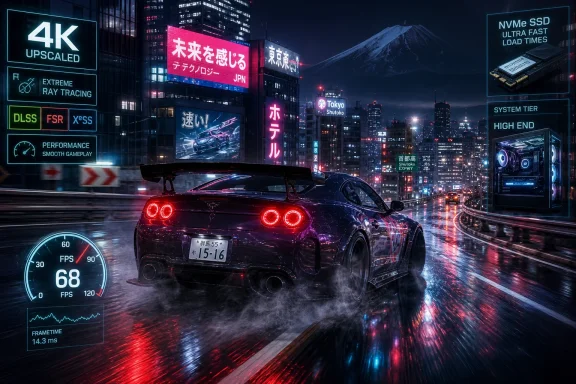 Playground Builds a Flagship That Still Has to Run Everywhere
The headline is simple: Forza Horizon 6 is going to Japan, and Playground is treating the PC version as a first-class release rather than a console port with a settings menu stapled on top. That matters because Forza Horizon has become one of Microsoft’s most visible arguments for Xbox as an ecosystem rather than a box under the television.The requirements reflect that balancing act. Minimum specs call for an Intel Core i5-8400 or AMD Ryzen 5 1600, 16GB of RAM, an SSD, and a GPU in the neighborhood of a GeForce GTX 1650, Radeon RX 6500 XT, or Intel Arc A380-class card. That target is 1080p at 60 frames per second on the Low preset, which is modest by 2026 standards but not trivial for laptops and older desktops still hanging around from the Windows 10 boom years.
Recommended specs move the game into what now counts as the sensible enthusiast middle: a Core i5-12400F or Ryzen 5 5600X, 16GB of RAM, an SSD, and a GeForce RTX 3060 Ti, Radeon RX 6700 XT, or Intel Arc A580-class GPU. Playground says that tier targets High settings at 1440p and 60-plus frames per second.
The top end is where the spec sheet stops being merely practical and starts explaining the technology stack. Extreme settings at 4K and 60-plus frames per second call for a Core i7-12700K or Ryzen 7 7700X, 24GB of RAM, an NVMe SSD, and a GeForce RTX 4070 Ti or Radeon RX 7900 XT. Switch on the Extreme Ray Tracing preset, and the requirement climbs to 32GB of RAM and a GeForce RTX 5070 Ti or Radeon RX 9070 XT-class GPU, with the target described as 4K upscaled at 60-plus frames per second.
That word “upscaled” is doing a lot of work. It signals that even Microsoft’s premier racing spectacle is no longer pretending native 4K with heavy ray tracing is the default path forward. The modern PC version is being built around reconstruction, frame pacing, and scalable effects, not a single brute-force resolution number.
The Real Minimum Spec Is the End of the Hard Drive Era
The least surprising line on the requirements list may be the most important one: SSD storage is mandatory across every tier, with NVMe specified for the Extreme presets. That is now normal for big-budget games, but it lands especially hard in an open-world racer where the fantasy depends on uninterrupted speed.A Forza Horizon map is not just a static backdrop. It is a streaming problem running at highway velocity, with terrain, traffic, foliage, city geometry, audio, weather, and event logic all arriving fast enough that the player never feels the world assembling around them. Japan raises the visual stakes because dense urban roads, mountain passes, neon-lit districts, rural scenery, and seasonal transitions all invite the kind of asset variety that punishes slow storage.
This is where PC gaming’s long tail becomes awkward. Plenty of Windows machines can still boot a game from a mechanical drive, and older PCs may even meet the CPU and GPU floor. But Forza Horizon 6 is drawing a hard line: if your system storage is still anchored in the hard-drive era, you are outside the intended experience.
That is not just a graphics preference. It is a design constraint. Developers can build faster worlds when they no longer have to accommodate seek times and slow random reads, and Forza Horizon 6 appears to be using that freedom. For WindowsForum readers, the practical advice is blunt: if you are upgrading for this game, the first purchase should not necessarily be a GPU. It may be a decent SSD and enough free space to keep Windows, shader caches, and the game from fighting each other.
Windows 10 Survives, But Only at the Modern Edge
The OS requirement is also telling. Playground lists Windows 10 or Windows 11, but only at version 22H2 or newer. That keeps Windows 10 players in the tent, but it does not pretend that every old install is welcome.For a Microsoft-published game in 2026, that is a careful compromise. Windows 11 is the company’s strategic platform, but PC Game Pass and Steam still run across a massive Windows 10 base. Excluding Windows 10 outright would be cleaner from a marketing perspective and messier from a sales perspective.
The 22H2 floor also suggests Playground wants a predictable baseline for graphics APIs, drivers, input support, and security components. That matters more than it used to. Modern games are increasingly entangled with shader compilation behavior, anti-cheat systems, Microsoft Store plumbing, Xbox services, HDR handling, controller firmware, and GPU driver branches.
In other words, “Windows 10 supported” does not mean “that old install you have not serviced since 2021 is fine.” It means a reasonably current Windows installation with current drivers and storage to match. For sysadmins and power users who maintain gaming PCs with the same discipline they bring to workstations, that will sound obvious. For everyone else, it is probably the hidden requirement behind the requirement.
The GPU Ladder Shows How Normal Ray Tracing Has Become
The most interesting part of the spec sheet is not that ray tracing exists. It is that ray-traced reflections and global illumination are presented as part of the PC feature set, with a dedicated Extreme Ray Tracing tier rather than a vague “ultra” flourish.That is a sign of where high-end PC gaming has settled. Ray tracing is no longer a bonus setting added for screenshots and benchmark charts. It is increasingly a design layer, especially in games that lean on reflective surfaces, dramatic lighting, nighttime scenes, wet roads, showroom interiors, and dense environmental detail.
A Japan-set Forza Horizon is practically built for this. Mountain roads at sunrise, city streets under rain, glossy car paint reflecting lanterns and skyline light, tunnels, glass storefronts, and urban night driving all reward better lighting. The franchise has always been about the car as an object of desire; ray tracing helps sell that object.
But the requirements also make clear that ray tracing still has a cost. The Extreme Ray Tracing tier jumps to 32GB of RAM and GPUs from a newer, more expensive performance class than the non-RT Extreme recommendation. Playground is not saying that ray tracing is free. It is saying the game has a path for players who want it and the hardware to pay for it.
That distinction matters. Too many PC spec sheets blur the line between “playable,” “pretty,” and “marketing screenshot.” Here, the division is fairly explicit. Low gets you into Japan at 1080p. Recommended gets you the mainstream high-refresh 1440p experience. Extreme gets you 4K without the full ray-tracing burden. Extreme Ray Tracing is the no-apologies showcase mode.
Upscaling Is No Longer a Side Feature
The PC feature list includes Nvidia DLSS 4, AMD FSR 3 and 4, and Intel XeSS 2.1 support. That breadth is important because it suggests Playground is not tying the PC version’s future to a single vendor’s reconstruction stack.Upscaling has moved from defensive compromise to default performance strategy. In older conversations, players treated it as a way to make weak hardware survive. In 2026, it is how expensive hardware runs heavy lighting, dense worlds, high refresh rates, and 4K displays without collapsing under the weight of native rendering.
That changes how we should read the Extreme Ray Tracing target. “4K upscaled at 60-plus FPS” is not an admission of failure. It is the modern high-end contract: render smart, reconstruct well, keep input latency controlled, and spend the saved performance budget on effects that players actually notice.
The vendor spread also matters for Windows handhelds and midrange PCs. Intel’s Arc cards are named in the lower and recommended tiers, and XeSS support gives those systems a more credible path than raw raster performance alone. AMD’s FSR support keeps Radeon users in the same conversation, while DLSS remains the premium option for Nvidia owners if image quality and frame generation behave as expected.
There is still a risk here. PC gamers have become less forgiving of shader stutter, bad frame pacing, and reconstruction artifacts than they were when upscalers were novel. If Forza Horizon 6 leans heavily on these technologies, the implementation has to be excellent. A racing game gives players endless horizontal motion, fine road detail, dense foliage, and rapid camera transitions — exactly the kind of material that can expose temporal instability.
The 16GB Baseline Is Now the Price of Admission
For years, 16GB of system RAM was the comfortable recommendation for PC gaming. In Forza Horizon 6, it is the minimum. That may provoke grumbling, but it should not surprise anyone watching modern open-world development.A game like this is a memory pressure machine. It is moving through a large map at speed, juggling textures, geometry, world state, audio, vehicle detail, multiplayer systems, and operating-system overhead. Add browser tabs, RGB utilities, capture tools, Discord, overlays, and GPU control panels, and the old 8GB gaming PC has nowhere left to hide.
The more revealing jump is from 24GB at Extreme to 32GB at Extreme Ray Tracing. That suggests the heaviest lighting and asset combinations are not just GPU-bound. They also need more system memory headroom to avoid paging, hitching, or asset churn.
This is one reason the requirements feel more mature than sensational. Playground is not inflating every tier for drama. It leaves recommended play at 16GB, which remains a huge installed base. But it also acknowledges that the best PC version is moving into 32GB territory, especially for players who expect high-resolution textures, ray tracing, and multitasking to coexist.
For Windows enthusiasts, that is a familiar pattern. The game itself may be the reason you notice the ceiling, but the upgrade pays dividends elsewhere. In 2026, a 32GB gaming PC is no longer an extravagance; it is the sensible configuration for anyone who wants to keep a machine for several more years.
Japan Is Not Just a Backdrop, It Is a Stress Test
The setting is the emotional center of the announcement because Japan has been the most requested Horizon location for years. It is also the reason the PC requirements deserve more attention than a normal pre-launch checklist.Japan offers Playground an unusually broad palette. There are dense cityscapes, expressways, coastal roads, narrow mountain passes, rural villages, autumn forests, snowy peaks, and the cultural weight of Japanese domestic car culture. It is exactly the kind of setting that can make a Forza Horizon game feel fresh after Australia, Britain, and Mexico.
But that variety comes with technical expectations. Players will expect Tokyo-inspired urban density, touge roads that reward precision, weather and lighting that turn asphalt into a mirror, and car models that hold up under photo mode scrutiny. The better the fantasy, the heavier the asset streaming, lighting, and CPU scheduling burden becomes.
The spec sheet hints at those ambitions without saying them outright. SSD across the board. NVMe at the high end. Ray-traced reflections and global illumination. Ultrawide support. Uncapped frame rates. Modern upscalers from all three GPU vendors. This is not a minimal sequel with a new map. It is a platform showcase pretending to be a road trip.
That is good news if Playground delivers. It is also why the launch matters for Microsoft beyond the usual sales chart. Forza Horizon 6 is arriving in a moment when Xbox is trying to prove that its games can be everywhere without feeling generic anywhere.
The PC Version Is Also a Handheld Test
One of the more intriguing claims in the feature list is support for Steam Deck and Xbox ROG Ally-class handhelds. That does not mean handheld users should expect the same experience as a desktop running a 4070 Ti. It does mean Microsoft and Playground know where the PC gaming audience is moving.The last few years have turned handheld PCs from a niche curiosity into a real platform category. Steam Deck established the expectation that big PC games should at least be considered for portable play. Windows handhelds then complicated the picture by offering broader compatibility, higher performance ceilings, and a messier operating-system experience.
A racing game is a natural fit for handheld sessions. The structure of Forza Horizon — short events, open-world cruising, collectibles, seasonal tasks, quick races — works well in 15-minute bursts. But the technical challenge is steep because open-world streaming and stable frame pacing matter even more on a small screen where dips feel immediate.
The minimum spec gives us a clue about the likely handheld target. If Low at 1080p and 60 FPS is possible on GTX 1650-class hardware, then lower resolutions with upscaling and carefully tuned settings could make portable play viable. The experience will depend on shader compilation, memory bandwidth, power profiles, and how gracefully the game scales CPU load.
This is where Windows itself becomes part of the story. On Steam Deck, the question is compatibility and translation. On Windows handhelds, the question is usability, driver maturity, and whether the OS gets out of the way. Forza Horizon 6 may become another informal benchmark for whether Microsoft’s gaming ecosystem can serve devices that are neither traditional consoles nor traditional PCs.
Uncapped Frames Are a Promise and a Liability
Playground’s PC feature list includes high uncapped frame rates, which is exactly what competitive and enthusiast PC players want to hear. A racing game benefits enormously from smooth frame delivery, not merely high average frame rates. The difference between 60 FPS and 120 FPS can be felt in steering response, cornering confidence, and the way speed reads visually.But uncapped frame rates also expose sloppy ports. If a game’s simulation, streaming, animation, or menus behave unpredictably above console targets, PC players will find out immediately. The Forza series has historically been strong on PC performance relative to many big-budget releases, but the broader industry has taught players not to take that for granted.
A good PC racing game needs more than a benchmark number. It needs consistent frame pacing, robust shader compilation, clean HDR behavior, flexible input mapping, support for wheels and controllers, reliable ultrawide presentation, and graphics options that explain themselves without requiring a forum archaeology project.
The good news is that Forza Horizon has a built-in advantage: it has long treated smoothness as central to the experience. The bad news is that the bar has risen. Players with 144Hz and 240Hz displays will not judge the PC version by whether it can run. They will judge it by whether it can stay fluid while tearing through a dense city at night in the rain with ray tracing, upscaling, overlays, and online systems active.
That is why the recommended tier may be the most important one. RTX 3060 Ti and RX 6700 XT owners represent a large group of serious PC players who are not buying a new GPU for every blockbuster. If they get a clean 1440p experience, Playground will have threaded the needle. If they feel pushed down to compromised settings, the conversation will sour quickly.
The PS5 Version Changes the Xbox Meaning of Launch
The May 19 launch is for Xbox Series X|S and PC, with a PlayStation 5 version expected later in 2026. That fact would have sounded strange in the old console-war grammar of Forza. Now it is part of Microsoft’s new normal.The PC specs therefore sit inside a broader strategic pivot. Microsoft is no longer using every first-party game solely to sell Xbox hardware. It is using its biggest franchises to sell software, subscriptions, storefront presence, and ecosystem reach. Forza Horizon 6 launching first on Xbox and PC still preserves a window of platform advantage, but the planned PS5 release changes the emotional framing.
For Windows players, this is mostly upside. PC remains inside the day-one circle, not an afterthought. Game Pass and Steam both matter. The PC version gets the advanced rendering features and hardware scalability that make the platform feel distinct.
For Xbox console loyalists, the picture is more complicated. Forza Horizon used to be one of the clearest reasons to own Xbox hardware. If the series is now timed rather than permanently exclusive, the value proposition shifts from “only here” to “best integrated here first.” That is a harder argument, but it may be the only sustainable one in a market where development budgets are high and platform walls are lower than they used to be.
This is why the PC release has to be polished. If Microsoft is going to sell Xbox as an ecosystem, Windows is not the secondary platform. It is one of the main stages. A poor PC launch would not just annoy Steam reviewers; it would undercut the very strategy Microsoft is trying to normalize.
The Leak Drama Is a Reminder That PC Launches Are Operational Events
The days before release have reportedly already included leak concerns and enforcement warnings around unauthorized access to early builds. That kind of drama is not new for high-profile PC games, but it is a useful reminder that launching on PC is not simply a technical act. It is an operational one.Preloads, storefront packaging, entitlement systems, anti-tamper choices, early access windows, driver readiness, streaming embargoes, and multiplayer services all collide in the final week. A console launch has its own complexity, but PC adds more surfaces where something can go wrong.
That matters because the conversation around a major PC game can be set before launch day. If players see leaks, bans, broken preloads, stutter reports, or confusing access rules, the technical spec sheet becomes only part of the story. Trust becomes the scarce resource.
Playground and Microsoft have reason to be strict if unauthorized builds are circulating. Online economies, progression systems, leaderboards, and multiplayer features can all be damaged by early tampering. But enforcement also has to be precise and well communicated, because overreach or confusion can create its own backlash.
For legitimate buyers, the practical takeaway is simple: wait for the official unlock, update your drivers, clear space on an SSD, and avoid anything that looks like a leaked executable or unofficial workaround. In 2026, launch-week impatience can collide with account-level consequences very quickly.
The Spec Sheet Says More About 2026 PC Gaming Than One Racing Game
Read narrowly, the Forza Horizon 6 requirements tell you whether your PC can run a pretty racing game. Read more broadly, they describe the current state of big-budget Windows gaming.The old model of PC scalability was mostly about resolution and texture quality. The new model is about storage speed, memory headroom, reconstruction technology, ray-tracing budgets, handheld profiles, ultrawide displays, shader behavior, and service integration. A game is no longer simply “optimized” or “unoptimized.” It is a negotiation among hardware generations, vendor technologies, and player expectations.
That negotiation is visible in every tier. The minimum spec keeps older six-core-era CPUs and entry GPUs alive, but only with 16GB of RAM and SSD storage. The recommended spec honors the 1440p mainstream, where many enthusiasts actually play. The Extreme tiers acknowledge that the cutting edge now depends on upscaling and that ray tracing remains expensive enough to deserve its own category.
This is also why PC specs have become more honest and more confusing at the same time. A line like “4K upscaled at 60-plus FPS” is more useful than a vague “Ultra” badge, but it requires players to understand what kind of 4K is being discussed. A GPU recommendation means less without knowing whether DLSS, FSR, XeSS, frame generation, or dynamic resolution is part of the target.
For sysadmins and IT-minded readers, there is another lesson: gaming PCs increasingly resemble specialized workstations. Storage class matters. Memory capacity matters. Driver branches matter. Display topology matters. Background software matters. The difference between a smooth launch and a miserable evening can be a BIOS setting, a stale GPU driver, or an overfull SSD.
The Sensible Upgrade Path Runs Through Balance, Not Bragging Rights
The temptation with a game like Forza Horizon 6 is to look straight at the Extreme Ray Tracing tier and assume that is the real requirement. It is not. It is the aspirational tier, and Playground has done players a favor by labeling it as such.Most players should think in terms of their display. If you are on a 1080p monitor, the minimum and lower-middle hardware classes may be enough, especially if you are comfortable reducing settings. If you are on 1440p, the recommended tier is the meaningful target. If you are on 4K, you are already in the land of compromise unless your GPU is recent and your expectations are calibrated around upscaling.
The CPU requirements are also worth reading carefully. The minimum i5-8400 and Ryzen 5 1600 are old but capable enough to keep the floor open. The recommended i5-12400F and Ryzen 5 5600X point to strong modern six-core performance as the sweet spot. The Extreme tiers move to higher-end chips, but not absurd workstation CPUs, which suggests the game is demanding without being ridiculously CPU-bound.
If your system is lopsided, this is the moment to fix the imbalance. A powerful GPU paired with 16GB of crowded RAM and a cheap SATA SSD may not deliver the experience you expect. A good CPU with an old 4GB graphics card will run out of visual ambition quickly. A fast NVMe drive will not make a weak GPU render ray tracing.
The most rational upgrade path is the least glamorous: 32GB of RAM if you want longevity, a good NVMe SSD if you do not already have one, and a GPU appropriate to your monitor rather than your ego. Forza Horizon 6 looks built to reward balanced PCs more than benchmark vanity builds.
The Road to Japan Has a Very Specific Toll Booth
The clearest lesson from Playground’s requirements is that Forza Horizon 6 is inclusive at the bottom, ambitious at the top, and unapologetically modern everywhere in between. It will let older gaming PCs through the gate, but it will not drag hard drives, 8GB memory configurations, or neglected Windows installs along for the ride.- Players targeting 1080p at 60 FPS can start from the minimum tier, but they should expect Low settings and should treat SSD storage and 16GB of RAM as non-negotiable.
- Players targeting 1440p should view the RTX 3060 Ti, RX 6700 XT, or Arc A580-class recommendation as the real mainstream bar for a satisfying High preset experience.
- Players targeting 4K should assume upscaling is part of the design, not an emergency fallback, especially once ray tracing enters the picture.
- Players who want the Extreme Ray Tracing preset should plan around 32GB of RAM, NVMe storage, and a current high-end GPU rather than expecting older flagship cards to brute-force the workload.
- Windows 10 users are still supported, but only on modern 22H2-era installations, which makes system maintenance part of the launch checklist.
- Handheld support could become one of the game’s most interesting PC stories, but it will depend on tuning, frame pacing, and how gracefully the engine scales below desktop power budgets.
Source: Game Informer Forza Horizon 6: Here Are The Full PC Specs And Requirements
