

Schneiderer Electric has confirmed that a long‑standing Intel microarchitectural side‑channel vulnerability can affect certain EcoStruxure™ Foxboro DCS configurations and has issued remediation and mitigation guidance for operators; affected installations should prioritize either migrating to the vendor’s supported hardware and software builds or applying layered mitigations — including BIOS/microcode and OS updates, network isolation, and strict physical access controls — to reduce the risk of local information disclosure and related operational impact.
EcoStruxure Foxboro DCS is Schneider Electric’s fault‑tolerant distributed control system used in heavy process environments and critical infrastructure. The product family — formerly marketed as Foxboro Evo and I/A Series — often runs on validated server and workstation hardware and is deeply embedded in energy, chemical, water/wastewater, and manufacturing operations worldwide. Schneider Electric published a security notification in December 2025 describing exposure to an Intel‑disclosed microarchitectural data sampling issue (one of the Microarchitectural Data Sampling / MDS family) that can allow an authenticated local user to extract sensitive information via a side channel. This advisory is part of a broader set of coordinated industrial control systems (ICS) advisories and vendor security notifications that have been published over the last 18 months. CISA and national cyber centers have republished or summarized the Schneider notices as part of routine ICS advisories, underscoring the importance of applying vendor fixes and following defense‑in‑depth recommendations.
Source: CISA Schneider Electric EcoStruxure Foxboro DCS | CISA
 Background / Overview
EcoStruxure Foxboro DCS is Schneider Electric’s fault‑tolerant distributed control system used in heavy process environments and critical infrastructure. The product family — formerly marketed as Foxboro Evo and I/A Series — often runs on validated server and workstation hardware and is deeply embedded in energy, chemical, water/wastewater, and manufacturing operations worldwide. Schneider Electric published a security notification in December 2025 describing exposure to an Intel‑disclosed microarchitectural data sampling issue (one of the Microarchitectural Data Sampling / MDS family) that can allow an authenticated local user to extract sensitive information via a side channel. This advisory is part of a broader set of coordinated industrial control systems (ICS) advisories and vendor security notifications that have been published over the last 18 months. CISA and national cyber centers have republished or summarized the Schneider notices as part of routine ICS advisories, underscoring the importance of applying vendor fixes and following defense‑in‑depth recommendations. What the vulnerability actually is (technical summary)
The Intel microarchitectural context
The root issue belongs to the family of speculative‑execution side‑channel vulnerabilities documented by Intel and by security researchers under the Microarchitectural Data Sampling umbrella. One discrete entry in this family, tracked as CVE‑2018‑12130 (a Fill‑Buffer or related MDS variant), describes how speculative execution can cause microarchitectural buffers to leak data that can be observed by a local, authenticated attacker under specific conditions. Exploits require local code execution or access to a machine where attacker‑controlled code runs alongside target processes, and they rely on timing/analysis techniques to reconstruct ephemeral microarchitectural state.How that maps to Foxboro DCS
Schneider Electric’s advisory states that certain Foxboro DCS virtualization server and workstation models (example model identifiers cited in the vendor notice) were deployed on platforms whose CPU families or firmware may be susceptible to the documented Intel issue. In those Foxboro DCS configurations, an authenticated local user could — in theory — leverage a side‑channel to glean sensitive information that would otherwise be inaccessible, which in coordination with other weaknesses could lead to broader operational compromise. The vendor’s notification maps affected product families and prescribes hardware migration and firmware/BIOS and OS patching as the primary remediation path.Affected products and versions (what to look for)
- EcoStruxure™ Foxboro DCS Virtualization Server models identified by the vendor (legacy V91 line and similar).
- EcoStruxure™ Foxboro DCS Standard Workstations (legacy H92 and like PC configurations).
- EcoStruxure Foxboro DCS Advisor may be separately affected by underlying Windows Server components such as WSUS; Schneider published an Advisor‑specific notification with distinct remediation for WSUS‑related risks.
Risk and Exploitability — what this means in practice
- Attack vector: local, authenticated access. These are not remote RCE vulnerabilities in the Foxboro DCS core as described; rather, they are microarchitectural side channels that require some form of code execution or local user presence on the affected machine. This reduces the mass exploitation risk but raises insider threat and supply‑chain risk concerns.
- Impact: exposure of sensitive information (CWE‑200). Depending on the environment, leaked data could include cryptographic keys, cached credentials, or process memory that enables later privilege escalation or unauthorized control actions. Schneider’s advisory flags the potential for a loss of system functionality or unauthorized access to system functions if complementary weaknesses are present.
- Exploit complexity: non‑trivial. Successful exploitation requires a capable attacker with local code execution and the ability to perform microarchitectural analysis. That said, sophisticated threat actors and certain insider scenarios have historically been able to weaponize these classes of flaws. Public mitigations and microcode patches exist, but thorough remediation requires coordinated firmware, OS, and application updates.
- Known exploitation: as of the vendor notices and CISA republishing, there are no broadly public reports of mass active exploitation of Foxboro DCS specifically via this Intel CVE. Nevertheless, ICS operators must treat the advisory as credible because the affected systems operate in high‑value environments where targeted attacks could be highly consequential. Flagging uncertainty: if you need absolute confirmation about observed exploit activity in your estate, perform local telemetry and forensic hunting; vendor advisories do not always track or report exploitation telemetry beyond what customers submit.
Vendor remediation and recommended actions
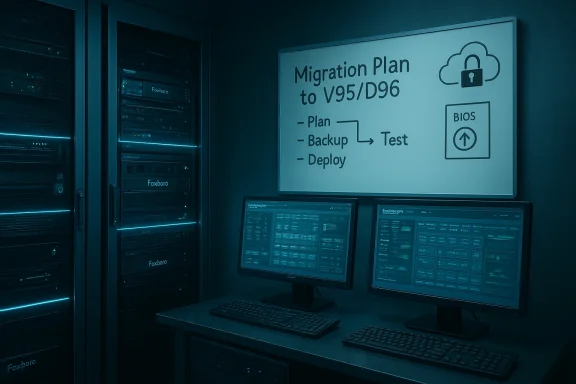
Schneider Electric’s preferred remediation path is migration to supported hardware and OS images: upgrade to the latest Foxboro server platform (vendor reference V95) and to supported workstations (for example Dell D96‑configured workstations, or the vendor‑approved equivalents). Schneider instructs customers to contact their Service Representative or Global Customer Support to plan migration to new hardware and validated builds. Where immediate migration is not practical, Schneider and CISA recommend the following mitigations:- Apply the latest BIOS / microcode / firmware updates published by your hardware vendor (these often include Intel microcode fixes). Microcode updates are mandatory to reduce the microarchitectural leakage surfaces.
- Keep the host operating system fully patched (Windows Server and workstation updates) — Microsoft has published guidance and mitigation guidance for the Microarchitectural Data Sampling family and related speculative execution issues.
- Isolate and segregate OT and control networks: place Foxboro DCS servers and workstations behind internal firewalls, and separate them from corporate or Internet‑facing networks.
- Enforce least‑privilege local accounts and remove all unnecessary local user accounts from engineering workstations and servers.
- Use application allowlisting, robust endpoint detection, and strict change control for any code or scripts that may run on DCS hosts.
- Limit physical access to DCS hardware and place engineering workstations in locked cabinets or secured rooms.
Step‑by‑step remediation checklist (priority order)
- Inventory: identify all Foxboro DCS servers, workstations, and Advisor instances, recording exact model, CPU family, BIOS and OS versions, and physical location.
- Contact Schneider Electric Support: open a ticket to confirm whether each identified system appears on the vendor’s affected list and to request the vendor‑approved migration path or hotfix procedure.
- Obtain microcode/BIOS fixes from the hardware OEM and validate them in a test lab before deployment. Apply microcode updates (firmware) and reboot hosts per OEM guidance.
- Apply OS security patches and vendor hotfixes (Schneider patches for Foxboro components where offered). Reboot during planned maintenance windows.
- If migration to V95/D96 (or vendor‑recommended hardware) is planned, schedule phased migrations with Schneider field services to preserve availability and support validated images.
- Implement immediate network mitigations for systems that cannot be patched quickly: block unnecessary inbound ports, restrict lateral movement with internal firewalls, and disable non‑essential services such as WSUS roles on Advisor hosts if they are not required.
- Monitor and hunt: enable logging, collect baseline performance and memory telemetry, and scan for indicators of compromise. Escalate to vendor incident response if suspicious artifacts are found.
Defense‑in‑depth: practical recommendations for Windows and OT administrators
- Harden engineering workstations: treat engineering workstations as high‑value assets and apply the same level of hardening you’d use for domain controllers — disable unnecessary services, apply application control, and restrict administrative tool usage.
- Network segmentation and egress control: enforce strict ACLs that prevent user workstations or internet‑connected systems from initiating connections to control network hosts. Where remote access is required, prefer tightly managed jump hosts, secure VPNs with multi‑factor authentication, and time‑bound access.
- Supply‑chain and patch orchestration: coordinate microcode/firmware updates with mapping to vendor‑certified OS and DCS patch levels. Don’t apply firmware or OS updates in isolation on production control hosts without validation in a representative test environment.
- Software whitelist and least privilege: employ allow‑listing solutions to prevent unapproved binaries/scripts from running on DCS hosts and ensure service accounts run with the minimum privileges required.
- Physical controls and personnel management: lock cabinets, restrict badge access, and audit physical access logs — microarchitectural side channels are only exploitable when an attacker already has local code execution or physical proximity to the target.
Migration considerations and lifecycle planning
Upgrading a DCS is a high‑risk, high‑impact project that must balance safety, availability, and security. Schneider’s modernization and migration programs are designed to migrate control logic and I/O without wholesale process disruption, but they require planning and vendor coordination. When planning migration:- Conduct a full risk assessment to identify which controllers, historian servers, and workstations need immediate replacement versus which can be stabilized via mitigation.
- Validate backups and recovery plans before any hardware or firmware changes. DCS migrations often involve re‑imaging and revalidation of control components.
- Engage Schneider field services for migration to V95/D96 or equivalent vendor‑validated platforms to ensure the new images include the necessary microcode, OS, and application hardening.
Cross‑referencing the facts (who says what)
- Schneider Electric published SEVD‑2025‑343‑01 and SEVD‑2025‑343‑02 documents describing the Foxboro DCS exposure to an Intel‑disclosed microarchitectural issue and the Advisor WSUS exposure; Schneider’s notices recommend hardware migration and microcode/OS patching.
- CISA republished and summarized Schneider’s advisories in its ICS advisory collection and urged operators to apply vendor guidance and defend ICS assets with segmentation and hardening. CISA’s listing of EcoStruxure‑related advisories reinforces the scope and priority of the fixes.
- Intel’s public advisories and Microsoft’s mitigation guidance explain that microarchitectural vulnerabilities like the Microarchitectural Data Sampling family require coordinated microcode and software patches to be mitigated effectively. Microsoft KB guidance includes Windows Server update notes and general mitigation strategies to protect Windows instances hosting ICS components.
- National cyber centers and independent ICS security reporters have echoed the vendor and CISA guidance and added operational context on WSUS and other supporting software stacks that can introduce remote exposure even if core DCS components require local access for exploitation. This underscores why operators must patch the full stack (hardware, firmware, OS, application).
Notable strengths and potential risks — critical analysis
Strengths (what Schneider and the ecosystem are doing right)
- Transparent, coordinated disclosures: Schneider’s vendor notifications and CISA’s ICS advisories provide actionable guidance in a timely manner, assisting operators in prioritizing remediation across high‑impact environments.
- Clear remediation path: the vendor recommends hardware migration to supported server/workstation platforms and provides hotfixes for some software builds; coordinated microcode and OS guidance from Intel and Microsoft is available. This multi‑vendor coordination is essential givare nature of the vulnerability.
- Emphasis on defense‑in‑depth: Schneider and CISA reiterate network isolation, physical security, and least‑privilege — proven operational controls that reduce the attack surface even when perfect patching is not immediately possible.
Risks and gaps (what organizations must watch)
- Operational disruption versus security: migrating control hardware and applying microcode/firmware updates can require reboots and planned downtime — a difficult proposition for 24/7 industrial processes. This creates windows where operators may be reluctant to apply fixes promptly.
- Dependence on accurate inventories: many facilities lack complete hardware and firmware inventories for OT assets. Without exact model/BIOS/CPU mapping, operators may fail to identify all affected systems.
- Underestimated supporting software risk: the Advisor/WSUS example illustrates how supporting IT software (WSUS, IIS, etc. can introduce severe remote risk to OT systems. Operators must treat the supporting Windows stack as part of the threat model, not as “external” infrastructure.
- Unverified exploitation telemetry: vendor advisories often do not publish whether they have observed exploitation in the wild; the absence of public exploitation data does not equal safety, particularly against targeted adversaries. Organizations must assume targeted attacks are possible and act accordingly.
Practical recommendations for Windows admins in ICS environments
- Maintain a cross‑functional patch governance process that includes OT and IT stakeholders; schedule firmware/OS testing windows and require rollback plans.
- Inventory Windows Server roles (WSUS, IIS) used by Foxboro components and ensure those roles are patched and monitored; if WSUS is required for OT, apply Microsoft’s out‑of‑band fixes and validate WSUS content integrity.
- Treat vendor notifications as change‑control inputs: any Schneider patch or migration should be tested on a staging replica of the process environment before production rollout.
- Use EDR and application allow‑listing on engineering workstations; collect process and kernel telemetry to detect anomalous local‑access activity that could presage exploitation attempts.
Unverifiable claims and caveats
- Public proof‑of‑concept (PoC) availability and observed exploitation specific to Foxboro DCS for CVE‑2018‑12130 were not documented in Schneider’s public notification; customers should treat this as an advisory for potential exposure and rely on internal telemetry for confirmation. This article flags that the vendor and national authorities did not publish evidence of widespread exploitation at the time of their advisories.
- Some third‑party write‑ups and forum summaries exist and offer useful operational perspectives, but their details can vary; always cross‑reference public reporting with Schneider’s official security notifications and CISA advisories before implementing changes.
Conclusion
Schneider Electric’s EcoStruxure Foxboro DCS advisory tied to Intel’s microarchitectural disclosure is a reminder that industrial control system security is inherently multidisciplinary: hardware microcode, operating system updates, application hardening, network architecture, and physical security all matter. The vendor has provided a clear remediation path — migrate to supported hardware (V95/D96 or vendor‑approved equivalents) and apply microcode/firmware and OS updates — while CISA and national cyber centers reinforce the need for defense‑in‑depth. Operators should act on three immediate priorities: inventory and discovery, microcode/OS patching where feasible, and implementation of network and physical mitigations while planning vendor‑assisted migrations for unsupported hardware. Acting early and methodically will reduce operational risk and improve long‑term resilience for these critical control systems.Source: CISA Schneider Electric EcoStruxure Foxboro DCS | CISA
