

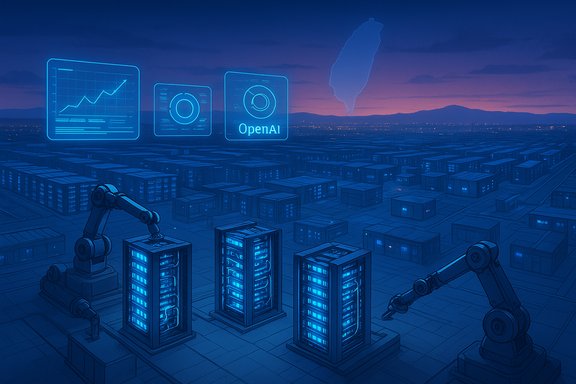
Foxconn is in talks with OpenAI to co-develop next‑generation AI data centers — a development that could reshape Taiwan’s infrastructure role in the global AI compute race while navigating the legal and commercial constraints of OpenAI’s deep ties with Microsoft.
Foxconn (Hon Hai Precision Industry) confirmed discussions with OpenAI during recent investor briefings, with chairman Young Liu saying the companies have been speaking about data center cooperation and promised more details at Hon Hai Tech Day on November 21. This announcement comes against the backdrop of two intersecting industry forces:
The Foxconn–OpenAI conversation is far from a simple vendor contract; it is an early indicator of how the next wave of AI compute will be provisioned — blending hyperscaler platforms, sovereign industrial players, and specialized suppliers into a global, multi‑partner compute fabric. The announcement highlights Taiwan’s rising strategic importance in the AI supply chain, points to near‑term commercial complexity driven by Microsoft’s contract with OpenAI, and underscores the practical engineering and regulatory hurdles that will determine how quickly this next chapter in AI infrastructure can scale.
Source: parameter.io Foxconn, OpenAI in Talks for Next-Gen Data Centers as Microsoft Agreement Looms - Parameter
 Background / Overview
Foxconn (Hon Hai Precision Industry) confirmed discussions with OpenAI during recent investor briefings, with chairman Young Liu saying the companies have been speaking about data center cooperation and promised more details at Hon Hai Tech Day on November 21. This announcement comes against the backdrop of two intersecting industry forces:- OpenAI’s rapid expansion of compute requirements and its strategic pivot toward a multi‑cloud, multi‑partner infrastructure program known as “Stargate.”
- Foxconn’s transformation from a contract electronics assembler to a major AI‑server manufacturer and cloud‑infrastructure investor, including a company filing to procure significant compute equipment in 2025–26.
Why this matters now
AI model development has shifted the bottleneck from algorithms toward raw compute, power, and cooling capacity. That creates enormous demand for purpose‑built data centers — the kind OpenAI is pursuing under Stargate — and opens opportunities for companies with scale manufacturing capacity and systems expertise to move up the value chain.- OpenAI’s Stargate program has ambitious scale: initial commitments and partnerships with Oracle, SoftBank and others aim to deliver gigawatts of capacity across multiple U.S. campuses and a multi‑hundred‑billion‑dollar investment profile. The program’s architecture intentionally spreads compute across partners to avoid single‑vendor bottlenecks.
- Foxconn is already reshaping its business mix: cloud & networking products (AI servers) now represent a significantly larger share of revenue, and the company has announced procurement plans to build major compute clusters in Taiwan tied to GPU partners. Official filings and market reports point to a high‑double‑digit increase in server rack shipments and a procurement authorization for new AI compute equipment.
- Manufacturing scale and supply‑chain control for rack integration and system assembly.
- Local engineering, rapid prototyping and the ability to co‑deploy hardware designs optimized for OpenAI workloads.
- Potentially faster, closer co‑location options in Asia — a region critical to global GPU supply chains and semiconductor assembly.
- Transform factory, server and thermal expertise into recurring infrastructure revenue.
- Anchor high‑margin AI server manufacturing with long‑term operational partnerships.
- Drive a higher margin, services‑oriented business alongside hardware sales.
What the Microsoft agreement means — the legal shadow
Foxconn’s possible collaboration with OpenAI must navigate a complex contractual landscape. Microsoft’s renamed and restructured long‑term arrangement with OpenAI carries three practical constraints that matter for any third‑party infrastructure partner:- API and product distribution exclusivity: Microsoft has publicly stated that the OpenAI API surface remains exclusive to Azure for the duration specified in their agreement; Microsoft also retains broad commercial access to OpenAI IP for integration into Microsoft products.
- Preferential commercial windows and IP terms: Recent public summaries and contractual disclosures indicate extended IP access and multi‑year Azure consumption commitments that preserve Microsoft’s privileged position for many commercial endpoints. Some industry reports cite IP windows extending into the early 2030s for certain model/product rights, though the precise legal wording is partly confidential.
- Right of first refusal (ROFR) and compute guardrails: The updated commercial architecture replaces absolute exclusivity with a ROFR mechanism and carve‑outs that allow OpenAI to build additional capacity with third parties primarily for research and training, provided Microsoft’s contractual prerogatives are respected.
Taiwan as a strategic compute hub
Foxconn’s AI ambitions also reflect a broader national trend: Taiwan is rapidly scaling capacity across semiconductors, power systems and specialized data center services.- Foxconn has publicly reported a substantial quarter‑over‑quarter increase in AI server rack shipments — figures cited in Taiwanese press and company briefings indicate rack shipments surged roughly 300% in a recent quarter, with AI server revenue reaching NT$1 trillion over the first nine months of the year. Those figures underscore how quickly Foxconn’s cloud & networking business has become central to group revenue.
- The company has board‑approved procurement plans for AI compute equipment amounting to NT$420 billion (reported in Chinese numeric shorthand as 420億元, equivalent to NT$42.0 billion / roughly US$1.4 billion), to be spent between December 2025 and December 2026. Taiwan market media and company filings corroborate this authorization.
- Local ecosystem players — from Taiwan’s EPC contractors to power and thermal specialists like Delta Electronics — are aggressively productizing solutions for high‑density AI loads. Delta’s AI Data Center Microgrid Solution, announced at Energy Taiwan 2025, includes solid‑state transformers with claimed efficiency up to 98.5%, highlighting a push toward more energy‑efficient and resilient on‑site power architectures.
Technical and operational contours of a Foxconn–OpenAI collaboration
If Foxconn and OpenAI move from talks to pilots, expect the partnership to address several technical dimensions:- Rack and chassis co‑design for optimal GPU density and liquid cooling integration, using the latest NVIDIA GB200/Blackwell‑class hardware and potential AMD or custom accelerators where OpenAI desires heterogeneity.
- Power delivery upgrades, potentially leveraging high‑voltage DC / 800 VDC architectures and SST (solid‑state transformer) tech to reduce conversion losses and lower PUE (power usage effectiveness). Delta and other Taiwanese vendors are already pitching microgrid and DC‑coupling solutions aimed at AI center workloads.
- Supply chain synchronization: Foxconn’s manufacturing strength could accelerate rack assembly, QA cycles, and rapid field upgrades — a clear advantage when chips, switch silicon, and power hardware must be tightly integrated.
- Hybrid hosting models: given Microsoft’s contractual rights, an early Foxconn role is likely to focus on research/training capacity and private or co‑located compute clusters, while Azure continues to handle public API endpoints and many enterprise inference workloads.
Business implications and market dynamics
- For hyperscalers and cloud vendors, Foxconn’s entry into operations or managed infrastructure heightens competition for specialized AI capacity. Oracle and SoftBank’s participation in Stargate shows hyperscalers are already courting vertically integrated partners.
- For chipmakers and GPU suppliers, a Foxconn partnership could secure additional demand for large GPU shipments and provide a predictable assembly partner to convert GPUs into serviceable racks and systems. Nvidia already collaborates with Foxconn on server factories and GB200 system builds.
- For enterprises and governments, multi‑partner compute fabrics create options but also complicate procurement. API exclusivity on Azure for certain OpenAI products means cloud procurement choices will depend heavily on which OpenAI services a buyer needs to run and where regulatory constraints apply.
Risks, constraints and open questions
- Commercial constraints from the Microsoft‑OpenAI agreement
The revised Microsoft–OpenAI architecture leaves Microsoft with durable commercial privileges (API distribution, IP arrangements and preferential consumption commitments). Any Foxconn deployment must be engineered to avoid violating contractual exclusivities or stepping on Microsoft’s commercial channels. That limits the scope and modalities of early Foxconn involvement and increases transaction complexity. - Energy and grid constraints
Large AI campuses demand gigawatts of power. Even with microgrid and SST innovation, regional grid capacity, permitting, and long‑lead transmission upgrades present a practical bottleneck. Stargate and hyperscaler projects have needed aggressive utility coordination and backup generation to sustain 24/7 high‑density operation. Taiwanese projects will face similar constraints as they scale. - Geopolitics and supply‑chain concentration
Taiwan’s central role in chips and assembly makes it attractive for compute projects — but also exposes deployments to geopolitical risk. Companies and governments will weigh the benefits of Taiwanese integration against concerns about regional stability and export controls. This risk factor could shape where OpenAI elects to place different parts of its workload (training vs inference vs storage). - Legal and regulatory scrutiny
As OpenAI scales compute and commercial footprint, antitrust and national security scrutiny is likely to increase — particularly where exclusive API channels and massive cloud consumption commitments converge. Microsoft’s and OpenAI’s contractual arrangements have already drawn regulatory and public attention. Any new partnerships will be evaluated in that context. - Execution complexity and timing
Building and commissioning megawatt‑scale AI halls is a multi‑year, capital‑intensive operation requiring coordination among utilities, equipment vendors, cooling specialists, EPC contractors and local governments. Foxconn’s manufacturing scale reduces the risk of hardware supply delays, but site permitting, grid upgrades, and chipset availability (GPU delivery timelines) remain scheduling risks.
What this means for Windows users, enterprises and the broader cloud market
- Short term: Microsoft Azure will continue to be the primary channel for many OpenAI API products; enterprises relying on Azure OpenAI Service should expect continuity and prioritized performance. At the same time, OpenAI’s diversification lowers single‑vendor compute risk and could, over time, improve global availability and pricing dynamics for very high‑volume customers.
- Medium term: A Foxconn‑OpenAI tie could accelerate localized compute availability in Asia, enabling regional enterprise customers to run larger research and training jobs closer to GPU sources and local engineering resources. That benefits industries that need low latency and localized data governance.
- Long term: If Foxconn successfully expands from OEM to operator/partner, it could become a template for other manufacturing giants to vertically integrate into cloud infrastructure — reshaping how compute capacity is provisioned, financed and operated globally.
Strengths and strategic positives
- Manufacturing and systems scale: Foxconn’s core competence in large‑scale assembly and supply‑chain logistics shortens lead times for rack and system production at hyperscale.
- Local ecosystem advantages: Taiwan’s power‑electronics, cooling and semiconductor ecosystem — exemplified by companies like Delta — is primed to deliver innovations optimized for high‑density AI centers.
- Diversified compute fabric for OpenAI: Bringing in trusted industrial partners like Foxconn supports OpenAI’s multi‑cloud strategy, reduces vendor concentration risk, and accelerates capacity scale.
Bottom line and practical takeaways
- The Foxconn–OpenAI talks are credible and timely; they reflect both Foxconn’s strategic pivot toward AI infrastructure and OpenAI’s need to diversify compute capacity. Taiwanese and international reporting, along with company comments, corroborate the core facts announced by Hon Hai’s chairman.
- Microsoft’s contractual position with OpenAI creates guardrails, not absolute barriers. Expect any Foxconn engagement to be negotiated with those guardrails in mind and to focus initially on research, training or regionally scoped compute rather than Azure‑hosted API delivery.
- The technical and energy challenges are solvable but significant. Delta’s microgrid and SST announcements signal a rapid gear‑up in Taiwanese power infrastructure for AI, but scaling to many gigawatts remains an engineering and regulatory program that takes time.
- Investors and industry watchers should watch Hon Hai Tech Day on November 21 for concrete terms. Until then, public statements are directional: they confirm intent and capability, but not final contractual structure or exact operational roles. Any headline monetary or contractual numbers should be cross‑checked against company filings or the definitive agreements when released.
Recommended monitoring checklist (practical next steps)
- Review Hon Hai Tech Day disclosures (Nov 21) for formal announcements about scope, locations, and contractual structure.
- Watch Microsoft and OpenAI public statements for clarifications on API exclusivity windows and whether any specific carve‑outs are being negotiated for Foxconn‑hosted workloads.
- Track Taiwan Ministry and local utility announcements regarding grid upgrades, permitting timelines, and incentives tied to AI infrastructure rollouts.
- Follow hardware supply chains (NVIDIA/AMD deliveries) and local EPC announcements to assess deployment timelines and capability match to OpenAI workloads.
The Foxconn–OpenAI conversation is far from a simple vendor contract; it is an early indicator of how the next wave of AI compute will be provisioned — blending hyperscaler platforms, sovereign industrial players, and specialized suppliers into a global, multi‑partner compute fabric. The announcement highlights Taiwan’s rising strategic importance in the AI supply chain, points to near‑term commercial complexity driven by Microsoft’s contract with OpenAI, and underscores the practical engineering and regulatory hurdles that will determine how quickly this next chapter in AI infrastructure can scale.
Source: parameter.io Foxconn, OpenAI in Talks for Next-Gen Data Centers as Microsoft Agreement Looms - Parameter
