

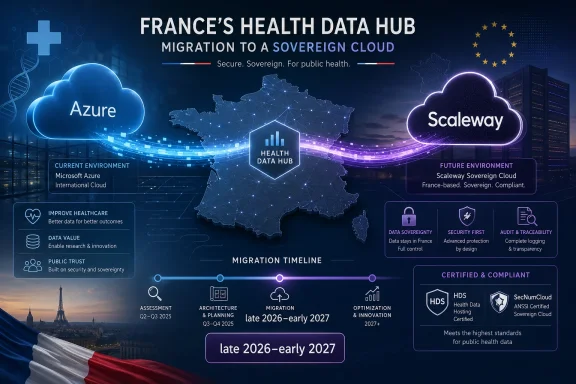
France’s decision to move the Health Data Hub from Microsoft Azure to Scaleway is more than a cloud procurement story; it is a test case for whether European digital sovereignty can survive contact with real infrastructure, real workloads, and real public-sector risk. The French platform sits at the intersection of medical research, national health records, artificial intelligence, privacy law, and geopolitical anxiety over dependence on U.S. technology providers. By choosing a French cloud operator owned by Iliad Group, Paris is sending a message that sensitive public data should be governed not only by encryption and contracts, but also by jurisdiction, industrial policy, and strategic autonomy. The migration, expected to land around late 2026 or early 2027, will be watched closely by governments, regulators, Microsoft customers, open-source advocates, and cloud buyers across Europe.
The French Health Data Hub, also known as the Health Data Platform, was created to make health data more usable for research and innovation. Its purpose is straightforward in theory: give approved researchers a secure way to work with large, longitudinal health datasets that can reveal patterns in disease, treatment outcomes, public health trends, and system performance. In practice, it has always been politically charged because health data is among the most sensitive categories of personal information a government can process.
When Microsoft Azure was selected in 2019 to host the platform, the decision immediately drew scrutiny. Critics objected not simply to Microsoft’s technical capabilities, but to the absence of a competitive tender and the legal exposure created by using a U.S.-based provider for a French public health asset. The controversy became a defining example of the gap between Europe’s regulatory ambitions and its dependence on American hyperscale cloud infrastructure.
That gap widened after debates around the U.S. CLOUD Act, transatlantic data transfers, GDPR enforcement, and the ability of foreign authorities to compel access to data held by companies under their jurisdiction. Even if data sits in European data centers, the nationality and legal obligations of the cloud provider can become part of the threat model. For health records, that distinction is not academic; it goes directly to public trust.
Scaleway’s selection reflects years of mounting pressure to align public-sector hosting with French and European sovereignty requirements. The company has HDS certification, is pursuing SecNumCloud qualification, and has invested in data-management and AI capabilities, including through its acquisition of Saagie. The question now is whether a sovereign cloud provider can deliver the same operational maturity, scalability, and developer experience that made Azure attractive in the first place.
The value of the Health Data Hub lies in combining scale with controlled access. Researchers do not merely need storage; they need a secure analytical environment where data can be prepared, queried, linked, and audited. If the platform works well, France could accelerate evidence-based medicine while keeping sensitive records within a highly regulated framework.
Key reasons the platform matters include:
This distinction matters because sovereignty debates are often misunderstood as arguments against security. They are really arguments about control. Encryption, contractual clauses, regional data residency, and access logging are important, but they do not fully answer questions about whose courts, laws, and geopolitical interests may ultimately apply.
For Microsoft, the episode shows how technical excellence may no longer be enough in highly sensitive public-sector markets. The company has invested heavily in European data boundary initiatives and sovereign cloud partnerships, but the Health Data Hub controversy demonstrates that some governments want more than local storage. They want providers whose ownership, governance, operations, and legal obligations are anchored inside Europe.
A simplified timeline helps explain the pressure:
The company’s HDS certification is crucial because French law requires certified hosting for health data. Its path toward SecNumCloud qualification is equally significant because that label has become a benchmark for clouds handling sensitive public data. SecNumCloud is not merely a badge; it represents a more demanding view of operational control, legal insulation, and resilience.
Scaleway’s broader strategy also includes data orchestration and AI capabilities. Its acquisition of Saagie, a French DataOps specialist, points to a future where the company wants to support not only storage and compute, but also the lifecycle of data preparation, quality assurance, workflow automation, and analytics. In health research, those layers may be just as important as raw infrastructure.
Scaleway’s opportunity can be summarized in three themes:
This is part of a broader European trend. Germany’s Schleswig-Holstein has moved aggressively toward open-source software and away from Microsoft products in parts of its administration. Denmark has also explored reducing dependence on Microsoft Office through LibreOffice adoption. These projects differ from the Health Data Hub migration, but they share a common logic: public institutions increasingly view vendor concentration as a governance risk.
The new procurement mindset includes several linked concerns:
This does not automatically mean abandoning hyperscalers. For many workloads, Azure, AWS, and Google Cloud remain difficult to beat on tooling, global reach, ecosystem depth, and managed services. But the Health Data Hub case will encourage more organizations to classify workloads by sovereignty sensitivity and design multi-cloud strategies accordingly.
A practical enterprise approach might include:
Moving to a French cloud provider may reassure some citizens that their data is less exposed to foreign jurisdiction. But sovereignty alone is not the same as consent, transparency, or accountability. Citizens will still want to know who can access datasets, for what purposes, under what safeguards, and with what penalties for misuse.
Public trust will depend on several factors:
Microsoft has tried to address these concerns through regional data commitments and sovereign cloud models. The challenge is that sovereignty is not only about where data is stored. It is also about corporate control, operational dependency, legal compulsion, and trust in a geopolitical environment that has become more volatile.
European competitors such as Scaleway, OVHcloud, STACKIT, and others may benefit from this shift. They do not need to match hyperscalers feature-for-feature across every service to win sovereignty-sensitive workloads. They need to be good enough, compliant enough, transparent enough, and operationally reliable enough for specific regulated use cases.
For the cloud market, the emerging pattern looks like this:
This is where Scaleway’s DataOps ambitions become relevant. Data orchestration, quality checks, lineage tracking, secure workspaces, and reproducible pipelines are essential if researchers are to work efficiently. The acquisition of Saagie suggests Scaleway understands that the value chain extends above infrastructure into workflow management and data preparation.
Healthcare AI adds several technical requirements:
The most difficult work may involve application dependencies and data-processing workflows built around Azure services. If the Health Data Hub relied on Azure-native components, equivalents must be rebuilt, replaced, or re-architected. That process can expose assumptions hidden inside years of operational practice.
A prudent migration sequence would include:
The Health Data Hub contract therefore acts as a demand signal. It tells the market that sovereign cloud requirements can translate into real revenue. That matters because European cloud providers need flagship customers to justify deeper investment in security, performance, AI infrastructure, documentation, support, and developer ecosystems.
This policy signal may influence:
The second area to watch is certification. Scaleway’s HDS status gives it the required foundation for health data hosting, while SecNumCloud progress will be central to the broader sovereignty argument. If the qualification path advances smoothly, the company’s credibility in sensitive public-sector workloads will increase substantially.
Several indicators will reveal whether this becomes a turning point or a one-off case:
France’s move from Microsoft Azure to Scaleway is not the end of the sovereignty debate; it is the point where the debate becomes operational. The Health Data Hub will test whether Europe can combine privacy, research ambition, AI readiness, and industrial independence without compromising reliability. If Scaleway delivers, the project could become a reference case for sovereign cloud adoption across the continent. If it stumbles, critics will argue that political autonomy still depends on technical maturity — and that Europe must invest faster, deeper, and more consistently if it wants control over the digital systems that increasingly define public life.
Source: VoIP Review Scaleway Boosts EU Data Sovereignty, French Health Data Shift | VoIP Review
 Overview
The French Health Data Hub, also known as the Health Data Platform, was created to make health data more usable for research and innovation. Its purpose is straightforward in theory: give approved researchers a secure way to work with large, longitudinal health datasets that can reveal patterns in disease, treatment outcomes, public health trends, and system performance. In practice, it has always been politically charged because health data is among the most sensitive categories of personal information a government can process.When Microsoft Azure was selected in 2019 to host the platform, the decision immediately drew scrutiny. Critics objected not simply to Microsoft’s technical capabilities, but to the absence of a competitive tender and the legal exposure created by using a U.S.-based provider for a French public health asset. The controversy became a defining example of the gap between Europe’s regulatory ambitions and its dependence on American hyperscale cloud infrastructure.
That gap widened after debates around the U.S. CLOUD Act, transatlantic data transfers, GDPR enforcement, and the ability of foreign authorities to compel access to data held by companies under their jurisdiction. Even if data sits in European data centers, the nationality and legal obligations of the cloud provider can become part of the threat model. For health records, that distinction is not academic; it goes directly to public trust.
Scaleway’s selection reflects years of mounting pressure to align public-sector hosting with French and European sovereignty requirements. The company has HDS certification, is pursuing SecNumCloud qualification, and has invested in data-management and AI capabilities, including through its acquisition of Saagie. The question now is whether a sovereign cloud provider can deliver the same operational maturity, scalability, and developer experience that made Azure attractive in the first place.
Why the Health Data Hub Matters
The Health Data Hub is not a routine database migration. It is designed to support secondary use of health data, meaning the use of existing medical and administrative records for research, public policy, innovation, and potentially AI development. That makes it a strategic national asset rather than a back-office IT system.A platform for medical research
The platform is expected to host or provide access to major health datasets, including a copy of the National Health Data System, widely known by its French acronym SNDS. That system contains extensive information linked to reimbursements, hospital activity, prescriptions, and care pathways. Properly governed, this kind of data can help researchers detect long-term treatment effects, identify gaps in care, and support more efficient public health decisions.The value of the Health Data Hub lies in combining scale with controlled access. Researchers do not merely need storage; they need a secure analytical environment where data can be prepared, queried, linked, and audited. If the platform works well, France could accelerate evidence-based medicine while keeping sensitive records within a highly regulated framework.
Key reasons the platform matters include:
- Population-scale insight into treatment patterns and health outcomes
- Faster research workflows for approved public and private projects
- Better AI training environments for health-related models
- Improved public health surveillance across large datasets
- Stronger European research capacity without defaulting to foreign platforms
The Microsoft Azure Controversy
Microsoft’s original role in the Health Data Hub became controversial because it embodied Europe’s cloud dilemma. Azure offered proven scale, mature tooling, and global operational experience. Yet the provider’s American legal exposure created concerns that were difficult to resolve with technical safeguards alone.Jurisdiction became the issue
The central criticism was not that Microsoft lacked security expertise. On the contrary, Azure is among the most heavily certified cloud platforms in the world. The problem was that public authorities and privacy advocates questioned whether sensitive French health data should be hosted by a company potentially subject to non-European legal demands.This distinction matters because sovereignty debates are often misunderstood as arguments against security. They are really arguments about control. Encryption, contractual clauses, regional data residency, and access logging are important, but they do not fully answer questions about whose courts, laws, and geopolitical interests may ultimately apply.
For Microsoft, the episode shows how technical excellence may no longer be enough in highly sensitive public-sector markets. The company has invested heavily in European data boundary initiatives and sovereign cloud partnerships, but the Health Data Hub controversy demonstrates that some governments want more than local storage. They want providers whose ownership, governance, operations, and legal obligations are anchored inside Europe.
A simplified timeline helps explain the pressure:
- 2019: Microsoft Azure is selected to host the Health Data Hub.
- 2020 onward: COVID-era urgency increases demand for health data access, while legal and privacy objections intensify.
- 2024: French sovereignty requirements for sensitive data become more explicit.
- 2026: Scaleway is selected as the future host after a competitive process.
- Late 2026 to early 2027: The migration is expected to become operational.
Scaleway’s Moment
For Scaleway, the Health Data Hub contract is a marquee win. The company, part of Iliad Group, has spent years positioning itself as a European alternative to hyperscalers. This deal gives it one of the most visible sovereign cloud mandates in the French public sector.From infrastructure provider to strategic platform
Scaleway is not simply offering commodity hosting. The selection process reportedly involved hundreds of technical criteria covering security, resilience, performance, scalability, and operational autonomy. That is important because health research workloads require more than virtual machines; they require controlled environments, data pipelines, access governance, storage reliability, and compute resources that can handle analytical and AI-driven demand.The company’s HDS certification is crucial because French law requires certified hosting for health data. Its path toward SecNumCloud qualification is equally significant because that label has become a benchmark for clouds handling sensitive public data. SecNumCloud is not merely a badge; it represents a more demanding view of operational control, legal insulation, and resilience.
Scaleway’s broader strategy also includes data orchestration and AI capabilities. Its acquisition of Saagie, a French DataOps specialist, points to a future where the company wants to support not only storage and compute, but also the lifecycle of data preparation, quality assurance, workflow automation, and analytics. In health research, those layers may be just as important as raw infrastructure.
Scaleway’s opportunity can be summarized in three themes:
- Sovereignty: keeping critical health workloads under European jurisdiction
- Capability: proving that European cloud can handle complex public datasets
- Ecosystem growth: encouraging researchers, startups, and public agencies to build around sovereign infrastructure
Data Sovereignty Becomes Practical
For years, digital sovereignty sounded like a political abstraction. Governments talked about autonomy, resilience, and strategic independence, while public agencies continued buying familiar U.S. software and cloud services. The Health Data Hub decision marks a shift from rhetoric to implementation.Sovereignty is moving into procurement
Public procurement is where sovereignty becomes real. It is easy to declare that sensitive data should remain under European control; it is harder to specify requirements, evaluate suppliers, migrate workloads, train teams, and maintain service quality. France’s choice of Scaleway indicates that sovereignty criteria are now becoming decisive in cloud tenders.This is part of a broader European trend. Germany’s Schleswig-Holstein has moved aggressively toward open-source software and away from Microsoft products in parts of its administration. Denmark has also explored reducing dependence on Microsoft Office through LibreOffice adoption. These projects differ from the Health Data Hub migration, but they share a common logic: public institutions increasingly view vendor concentration as a governance risk.
The new procurement mindset includes several linked concerns:
- Legal exposure to non-EU laws and government access requests
- Vendor lock-in that limits bargaining power and technical flexibility
- Cost escalation from long-term subscription dependency
- Operational resilience if geopolitical relations deteriorate
- Local industrial capacity in cloud, cybersecurity, and open-source ecosystems
Enterprise Lessons Beyond Government
Private enterprises should not dismiss the Health Data Hub decision as a public-sector anomaly. The same sovereignty pressures are beginning to influence banks, insurers, hospitals, pharmaceutical companies, telecoms, and critical infrastructure operators. In regulated markets, cloud architecture is now a board-level risk discussion.Compliance is becoming architectural
Enterprises have traditionally treated cloud compliance as a matter of contracts, audits, encryption settings, and data residency. That approach is no longer sufficient in every case. Companies handling sensitive data now need to consider provider nationality, subcontractor chains, administrative access paths, support operations, and exposure to foreign legal regimes.This does not automatically mean abandoning hyperscalers. For many workloads, Azure, AWS, and Google Cloud remain difficult to beat on tooling, global reach, ecosystem depth, and managed services. But the Health Data Hub case will encourage more organizations to classify workloads by sovereignty sensitivity and design multi-cloud strategies accordingly.
A practical enterprise approach might include:
- Mapping datasets by sensitivity, jurisdiction, and regulatory exposure
- Separating workloads that require sovereign hosting from general workloads
- Testing portability across cloud-native and open-source technologies
- Reviewing contractual access controls for administrators and support teams
- Building exit plans before lock-in becomes operationally irreversible
Consumer Impact and Public Trust
Most French citizens will never interact directly with the cloud infrastructure behind the Health Data Hub. Yet the decision affects them because it shapes how their medical data may be used, protected, and governed. Public trust is essential if governments want to unlock the value of health data without triggering backlash.Health data requires legitimacy
Health records are different from ordinary administrative data. They can reveal chronic illness, reproductive history, psychiatric treatment, genetic risk, disability, prescriptions, hospitalizations, and family-related medical patterns. Even when data is pseudonymized, the sensitivity remains high because re-identification risks and misuse concerns cannot be dismissed casually.Moving to a French cloud provider may reassure some citizens that their data is less exposed to foreign jurisdiction. But sovereignty alone is not the same as consent, transparency, or accountability. Citizens will still want to know who can access datasets, for what purposes, under what safeguards, and with what penalties for misuse.
Public trust will depend on several factors:
- Clear governance rules for research access and data reuse
- Strong audit trails showing who accessed what and why
- Meaningful oversight by regulators and independent bodies
- Plain-language communication about risks and safeguards
- Visible sanctions if organizations abuse access privileges
Microsoft and the Competitive Cloud Market
The Health Data Hub loss is symbolically painful for Microsoft, even if it does not materially alter Azure’s global business. Microsoft remains deeply embedded in European enterprises through Windows, Microsoft 365, Azure, Teams, Entra ID, Power Platform, GitHub, and security products. But symbolic losses matter when they shape procurement norms.Hyperscalers face a sovereignty ceiling
The competitive implication is that U.S. hyperscalers may increasingly face a ceiling in sensitive European public-sector workloads. They can still compete strongly in commercial markets and less sensitive government functions, but contracts involving health, defense, identity, and law enforcement may demand sovereignty guarantees that are hard for American-owned firms to provide alone.Microsoft has tried to address these concerns through regional data commitments and sovereign cloud models. The challenge is that sovereignty is not only about where data is stored. It is also about corporate control, operational dependency, legal compulsion, and trust in a geopolitical environment that has become more volatile.
European competitors such as Scaleway, OVHcloud, STACKIT, and others may benefit from this shift. They do not need to match hyperscalers feature-for-feature across every service to win sovereignty-sensitive workloads. They need to be good enough, compliant enough, transparent enough, and operationally reliable enough for specific regulated use cases.
For the cloud market, the emerging pattern looks like this:
- Hyperscalers dominate broad enterprise platforms and advanced managed services
- European providers gain traction in sensitive sovereign workloads
- Hybrid architectures become more common for regulated organizations
- Open-source tools gain strategic value as portability layers
- Compliance labels become competitive differentiators
AI, Health Research, and DataOps
The Health Data Hub migration arrives as healthcare AI becomes a central policy and investment priority. Large datasets are essential for training, evaluating, and validating models that can support diagnosis, hospital operations, drug discovery, epidemiology, and public health planning. That makes the hosting layer strategically important.Data usability is the hidden challenge
The hardest part of health AI is often not the model. It is the data. Health datasets are fragmented, messy, inconsistently coded, legally constrained, and shaped by decades of institutional processes. A platform that merely stores data without making it usable will not deliver the research acceleration policymakers expect.This is where Scaleway’s DataOps ambitions become relevant. Data orchestration, quality checks, lineage tracking, secure workspaces, and reproducible pipelines are essential if researchers are to work efficiently. The acquisition of Saagie suggests Scaleway understands that the value chain extends above infrastructure into workflow management and data preparation.
Healthcare AI adds several technical requirements:
- High-performance storage for large structured and unstructured datasets
- Controlled compute environments for approved research teams
- GPU and accelerator access for model training and inference
- Data lineage tools to track transformations and research outputs
- Privacy-preserving techniques such as pseudonymization and secure enclaves
Migration Complexity and Operational Risk
Moving a major health data platform from Azure to Scaleway will be technically demanding. Cloud migrations are often presented as policy decisions, but the real difficulty lies in dependencies, data pipelines, identity systems, security controls, testing regimes, and operational continuity. In this case, the sensitivity of the data magnifies every risk.The migration must be boring by design
A successful migration should not produce dramatic headlines. It should be deliberate, staged, heavily tested, and almost invisible to approved users. That means parallel environments, validation checks, access-control replication, performance benchmarking, and rollback planning.The most difficult work may involve application dependencies and data-processing workflows built around Azure services. If the Health Data Hub relied on Azure-native components, equivalents must be rebuilt, replaced, or re-architected. That process can expose assumptions hidden inside years of operational practice.
A prudent migration sequence would include:
- Inventory all datasets, workloads, access paths, and service dependencies.
- Build a sovereign target architecture with equivalent or improved controls.
- Run parallel validation environments for performance and security testing.
- Migrate lower-risk workloads before sensitive production datasets.
- Conduct independent audits before full operational cutover.
- Maintain rollback and incident-response plans throughout the transition.
The European Policy Signal
France’s decision lands in a Europe that is increasingly skeptical of concentrated dependence on foreign technology platforms. The issue is not limited to cloud hosting. It extends to office suites, messaging, identity, cybersecurity, operating systems, AI models, app stores, chips, and undersea cables.Sovereignty is becoming industrial policy
The European Union has spent years using regulation to shape digital markets. GDPR, the Digital Markets Act, the Digital Services Act, NIS2, and cloud certification debates all reflect a desire to assert European rules over digital infrastructure. But regulation alone does not create alternatives. Governments must also buy from, invest in, and help mature European providers.The Health Data Hub contract therefore acts as a demand signal. It tells the market that sovereign cloud requirements can translate into real revenue. That matters because European cloud providers need flagship customers to justify deeper investment in security, performance, AI infrastructure, documentation, support, and developer ecosystems.
This policy signal may influence:
- National cloud strategies in other EU member states
- Public-sector procurement frameworks for sensitive workloads
- Funding for European cloud and AI infrastructure
- Certification schemes such as SecNumCloud and related EU efforts
- Enterprise risk models for regulated data hosting
Strengths and Opportunities
The Scaleway decision creates a rare convergence of policy, technology, and market opportunity. If executed well, it could strengthen France’s position in health research, provide a reference architecture for sovereign cloud adoption, and give European providers a credible success story in a sector where trust is paramount.- Stronger jurisdictional control over sensitive French health data and related processing environments
- Greater public confidence if governance, transparency, and auditability improve alongside the hosting change
- A flagship win for European cloud, helping Scaleway compete beyond commodity infrastructure
- Improved research workflows if DataOps capabilities make complex health datasets easier to use responsibly
- Reduced strategic dependence on a small group of U.S. hyperscale providers for critical public infrastructure
- A model for regulated enterprises seeking to classify workloads by sovereignty and compliance risk
- Momentum for open standards that can improve portability and reduce long-term lock-in
Risks and Concerns
The same decision also carries serious risks. Sovereignty does not automatically deliver better security, better performance, lower costs, or smoother operations. A European provider must meet the same practical demands that made hyperscalers attractive: uptime, tooling, support, scalability, developer experience, and rapid innovation.- Migration disruption could affect approved research workflows if cutover planning is weak
- Feature gaps may emerge if Azure-native services lack equivalent sovereign alternatives
- AI infrastructure pressure could test Scaleway’s ability to provide competitive compute at scale
- Compliance complexity may increase if certification requirements evolve during the migration window
- Political expectations could outpace engineering reality and create unrealistic timelines
- Vendor concentration may simply shift if public agencies replace one dependency with another
- Public trust could erode if citizens see sovereignty branding without meaningful transparency
What to Watch Next
The most important milestone will be the practical migration plan. Observers should look for details on which services move first, how access controls are validated, whether independent audits are published, and how researchers experience the transition. The late 2026 to early 2027 timeline is ambitious enough to signal urgency, but long enough to require disciplined project governance.The second area to watch is certification. Scaleway’s HDS status gives it the required foundation for health data hosting, while SecNumCloud progress will be central to the broader sovereignty argument. If the qualification path advances smoothly, the company’s credibility in sensitive public-sector workloads will increase substantially.
Several indicators will reveal whether this becomes a turning point or a one-off case:
- Publication of detailed migration milestones and assurance processes
- Evidence of researcher adoption on the new platform without major friction
- Expansion of sovereign cloud tenders in health, justice, defense, and public administration
- New partnerships around healthcare AI using French or European infrastructure
- Competitive responses from Microsoft and other hyperscalers offering stronger European sovereignty models
France’s move from Microsoft Azure to Scaleway is not the end of the sovereignty debate; it is the point where the debate becomes operational. The Health Data Hub will test whether Europe can combine privacy, research ambition, AI readiness, and industrial independence without compromising reliability. If Scaleway delivers, the project could become a reference case for sovereign cloud adoption across the continent. If it stumbles, critics will argue that political autonomy still depends on technical maturity — and that Europe must invest faster, deeper, and more consistently if it wants control over the digital systems that increasingly define public life.
Source: VoIP Review Scaleway Boosts EU Data Sovereignty, French Health Data Shift | VoIP Review
