

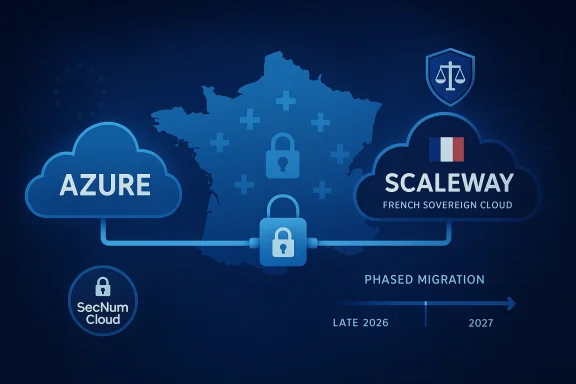
France’s decision to move the Health Data Hub from Microsoft to Scaleway is more than a vendor switch. It is a political, legal, and strategic signal that digital sovereignty has become a hard procurement requirement in one of Europe’s most sensitive data environments. The transition, expected to complete between late 2026 and early 2027, marks a clear break with the long-running compromise that kept French health data on Microsoft Azure despite years of criticism, litigation, and policy pressure.
The Health Data Hub was created to centralize and make better use of health information generated across France’s medical system, including data used for research and public-health analysis. From the beginning, though, its technical hosting arrangements became a proxy battle over whether a national repository of sensitive records could safely sit on infrastructure controlled by a U.S.-headquartered vendor. That dispute escalated quickly because the stakes were obvious: this is not ordinary enterprise data, but information tied to millions of citizens and governed by some of the strictest privacy expectations in Europe.
The original selection of Microsoft Azure in 2019 was always controversial. Critics argued that France had picked a hyperscale platform before proving that a truly sovereign alternative was ready, and the issue did not fade with time. Even when the data remained physically in Europe, opponents pointed to the problem of jurisdiction, not geography: a U.S. company can still be subject to American legal demands, which is exactly the concern that kept the debate alive.
France’s own institutions reinforced the tension rather than resolving it. Microsoft had obtained French health-data hosting credentials, and Microsoft has since reiterated that it holds the relevant HDS certification for health data in France. But certification alone did not settle the political argument, because the French sovereign-cloud debate is about more than encryption or datacenter location; it is about whether the operator can be compelled, directly or indirectly, by foreign law.
That is where SecNumCloud entered the picture. The French cybersecurity framework became the benchmark for a trust model that could satisfy public-sector and sensitive-workload requirements, and official ANSSI guidance has continued to recommend qualified SecNumCloud providers for sensitive cloud-hosted systems. The standard matters because it is designed to restrict exposure not only to technical attack paths, but also to extraterritorial legal risk.
The latest decision therefore reflects a long policy arc rather than a sudden change of heart. French authorities have spent years arguing that sensitive workloads should migrate toward French or European providers that can pass higher sovereignty thresholds. The move to Scaleway shows that the government is now willing to operationalize that principle rather than simply repeat it in speeches.
The timing is just as important as the vendor. Reuters-linked coverage and French industry reporting indicate that the migration is not instantaneous, with the transition window stretching toward the end of 2026 and possibly into early 2027. That phased timeline suggests the government wants to avoid service interruption and preserve continuity for research, public-health analytics, and system interoperability. This is the kind of migration that fails if it is treated like a branding exercise instead of an infrastructure program.
The move also indicates that France may now believe the sovereign-cloud market is mature enough to carry more critical national workloads. That is a notable change from the earlier era, when authorities repeatedly suggested there was no viable alternative and therefore tolerated Azure as a temporary compromise. What changed is not just technology; it is the balance between risk tolerance and political urgency.
The legal battles mattered because they showed the issue would not disappear through technical reassurance alone. French courts and regulators examined whether the data was at risk of transfer abroad, while critics emphasized the possibility that foreign authorities could request access under laws such as the CLOUD Act. Even where courts accepted that the data was stored in France, the sovereignty debate persisted because the underlying operator still mattered.
The French answer has been to move from data residency to data sovereignty. Residency answers where the bits live, but sovereignty asks who can control the environment, who can legally compel disclosures, and whether the platform can remain insulated from external jurisdictional pressure. That distinction is exactly why SecNumCloud has become so politically charged.
What makes SecNumCloud powerful is that it combines security with legal and organizational constraints. That means the hosting model is scrutinized not only for encryption and access control, but also for governance, support processes, administrative control, and the degree to which non-European legal hooks remain in the stack. In practical terms, it tries to make sovereignty enforceable rather than aspirational.
This also explains why the move to a French cloud provider carries more weight than a simple migration to any EU-based host. France is not just seeking European geography; it is seeking a trust model that can survive political scrutiny and potential legal challenge. For sensitive health data, that distinction is increasingly non-negotiable. (technical-regulation-information-system.ec.europa.eu)
Microsoft’s challenge here is not just one contract. It is the broader implication that European governments may increasingly view U.S. hyperscalers as appropriate for some workloads but politically unacceptable for others. That leaves Microsoft in a paradoxical position: indispensable for many enterprise use cases, yet vulnerable in categories where sovereignty is treated as a hard requirement rather than a preference.
The delay also highlights a strategic cost for large vendors: once a procurement issue becomes symbolic, the path back is hard. Even when a hyperscaler offers stronger security engineering, better tooling, or more mature global services, the political narrative can still overpower the technical argument. France has now shown that narrative can become policy.
For consumers, the benefit is indirect but important. Most people will never interact with the Health Data Hub’s infrastructure, yet the platform affects how quickly data can support research, how confidently authorities can deploy analytics, and how much trust citizens place in the system. If the transition is executed well, the public may simply experience a better sense that sensitive data is being handled under French rules rather than foreign uncertainty.
This is also where open-source compatibility becomes strategically useful. Sovereign-cloud buyers often want portability, reduced lock-in, and easier migration away from any single vendor. A provider that can combine French hosting, EU legal alignment, and ecosystem openness may be better placed to capture the next wave of public-sector contracts than one that simply offers lower unit prices. Control, not just cost, is becoming the product.
This trend is partly driven by the belief that digital infrastructure should reflect national or European public-policy goals. It is also shaped by the practical reality that governments increasingly see cloud dependence as a supply-chain risk. Once public services, health records, identity systems, and internal communications are deeply embedded in a vendor’s ecosystem, the switching cost becomes not just financial but constitutional in flavor.
At the same time, sovereignty has limits. Europe still relies heavily on American software, chips, and cloud ecosystems, and removing one dependency does not eliminate the others. The real question is whether governments can reduce strategic vulnerability enough to justify the added complexity, not whether they can achieve perfect independence overnight. Perfect sovereignty is an ideal; workable sovereignty is the policy target.
That is why the long transition window matters. A phased migration gives administrators time to test workloads, validate performance, and prove that the new environment meets public-sector expectations without disrupting ongoing use cases. It also reduces the chance that the move becomes a symbolic headline instead of a durable infrastructure change.
There is also a resilience question. If France wants sovereign infrastructure, it must ensure the new environment is not only politically acceptable but operationally resilient enough to withstand service peaks, security incidents, and future scaling needs. In other words, the new architecture must be good enough technically to avoid becoming a policy regret.
More broadly, the decision could help normalize the idea that governments may prefer domestic or certified-European providers for high-value workloads, even when hyperscalers remain available. That is a meaningful shift in market psychology. It tells procurement teams that sovereignty is not a theoretical constraint; it is a purchase criterion.
There is also a chance that sovereignty rhetoric oversells what any cloud provider can guarantee. Even a SecNumCloud-qualified platform does not magically eliminate every legal, technical, or supply-chain risk. The honest version of sovereignty is risk reduction, not risk deletion.
Another concern is fragmentation. If each European state defines sovereignty differently, vendors may face a patchwork of certifications and procurement rules that raise costs and slow innovation. That can help local providers in the short term, but it may also make cross-border digital cooperation harder just when Europe wants more interoperability.
The deeper question is whether this becomes a one-off win or part of a broader structural change. France has already signaled, through repeated policy pressure and legal scrutiny, that it wants sensitive national data on infrastructure more tightly aligned with its sovereignty requirements. If that position hardens into a procurement norm, the effect on cloud competition in Europe could be profound.
Source: Latest news from Azerbaijan France drops Microsoft, picks Scaleway for health data | News.az
 Background
The Health Data Hub was created to centralize and make better use of health information generated across France’s medical system, including data used for research and public-health analysis. From the beginning, though, its technical hosting arrangements became a proxy battle over whether a national repository of sensitive records could safely sit on infrastructure controlled by a U.S.-headquartered vendor. That dispute escalated quickly because the stakes were obvious: this is not ordinary enterprise data, but information tied to millions of citizens and governed by some of the strictest privacy expectations in Europe.The original selection of Microsoft Azure in 2019 was always controversial. Critics argued that France had picked a hyperscale platform before proving that a truly sovereign alternative was ready, and the issue did not fade with time. Even when the data remained physically in Europe, opponents pointed to the problem of jurisdiction, not geography: a U.S. company can still be subject to American legal demands, which is exactly the concern that kept the debate alive.
France’s own institutions reinforced the tension rather than resolving it. Microsoft had obtained French health-data hosting credentials, and Microsoft has since reiterated that it holds the relevant HDS certification for health data in France. But certification alone did not settle the political argument, because the French sovereign-cloud debate is about more than encryption or datacenter location; it is about whether the operator can be compelled, directly or indirectly, by foreign law.
That is where SecNumCloud entered the picture. The French cybersecurity framework became the benchmark for a trust model that could satisfy public-sector and sensitive-workload requirements, and official ANSSI guidance has continued to recommend qualified SecNumCloud providers for sensitive cloud-hosted systems. The standard matters because it is designed to restrict exposure not only to technical attack paths, but also to extraterritorial legal risk.
The latest decision therefore reflects a long policy arc rather than a sudden change of heart. French authorities have spent years arguing that sensitive workloads should migrate toward French or European providers that can pass higher sovereignty thresholds. The move to Scaleway shows that the government is now willing to operationalize that principle rather than simply repeat it in speeches.
Why Scaleway, and Why Now
Selecting Scaleway is significant because it gives France a domestic provider with enough scale, brand recognition, and technical credibility to host a national health platform. Scaleway is a subsidiary of Iliad and has positioned itself aggressively around sovereign cloud, open-source compatibility, and French control over infrastructure. In other words, it is not just a local reseller; it is part of the French cloud ecosystem that policymakers have been trying to strengthen.The timing is just as important as the vendor. Reuters-linked coverage and French industry reporting indicate that the migration is not instantaneous, with the transition window stretching toward the end of 2026 and possibly into early 2027. That phased timeline suggests the government wants to avoid service interruption and preserve continuity for research, public-health analytics, and system interoperability. This is the kind of migration that fails if it is treated like a branding exercise instead of an infrastructure program.
The procurement logic
A health-data platform is not a vanity cloud project. It needs stable storage, access controls, auditing, and the ability to support highly sensitive workloads without sacrificing usability for researchers and clinicians. Choosing a domestic provider can reduce legal exposure and improve political legitimacy, but it also raises the bar for operational discipline because the platform will be judged against the reliability of the hyperscalers it replaces.The move also indicates that France may now believe the sovereign-cloud market is mature enough to carry more critical national workloads. That is a notable change from the earlier era, when authorities repeatedly suggested there was no viable alternative and therefore tolerated Azure as a temporary compromise. What changed is not just technology; it is the balance between risk tolerance and political urgency.
- Domestic control now outweighs the convenience of a global hyperscaler.
- Jurisdictional exposure has become a first-order procurement criterion.
- Migration planning matters as much as the destination provider.
- Political symbolism is inseparable from technical architecture.
- Sovereign-cloud maturity is being tested in a real national system.
The Health Data Hub Controversy
The controversy around the Health Data Hub has always been about trust. The platform was intended to accelerate medical research and data-driven policy, yet its public legitimacy was weakened the moment it became associated with a foreign cloud provider whose parent company sits under U.S. law. For critics, that made the repository a standing example of how Europe can build digital systems that are technically advanced but strategically exposed.The legal battles mattered because they showed the issue would not disappear through technical reassurance alone. French courts and regulators examined whether the data was at risk of transfer abroad, while critics emphasized the possibility that foreign authorities could request access under laws such as the CLOUD Act. Even where courts accepted that the data was stored in France, the sovereignty debate persisted because the underlying operator still mattered.
From compliance to sovereignty
This is where European cloud politics has evolved. In the early stages, the discussion often centered on compliance: Was the provider certified? Were the servers in Europe? Did the contract meet privacy rules? Over time, those questions proved insufficient, because they did not eliminate the possibility that foreign law could reach into the operating model.The French answer has been to move from data residency to data sovereignty. Residency answers where the bits live, but sovereignty asks who can control the environment, who can legally compel disclosures, and whether the platform can remain insulated from external jurisdictional pressure. That distinction is exactly why SecNumCloud has become so politically charged.
- The debate is no longer just about where data is stored.
- It is about who can compel access.
- It is about how much operational dependency remains on non-European firms.
- It is about whether a country can claim meaningful control over critical infrastructure.
- It is about whether compliance is enough when strategic autonomy is at stake.
What SecNumCloud Changes
SecNumCloud is central to understanding why this switch matters. ANSSI’s framework is not merely a badge; it embodies a higher sovereignty bar that public bodies increasingly use to judge whether a cloud service is fit for sensitive workloads. Official ANSSI guidance recommends qualified SecNumCloud providers for hosting sensitive information systems in the public cloud, and European regulatory language continues to reference protections against access by third-country authorities.What makes SecNumCloud powerful is that it combines security with legal and organizational constraints. That means the hosting model is scrutinized not only for encryption and access control, but also for governance, support processes, administrative control, and the degree to which non-European legal hooks remain in the stack. In practical terms, it tries to make sovereignty enforceable rather than aspirational.
Why certification alone isn’t enough
A common misunderstanding is that if a provider has a certificate, the sovereignty problem disappears. It does not. Certification can strengthen confidence, but the Health Data Hub debate showed that political and legal sensitivity can persist even when the technical box is checked, especially if the provider remains exposed to non-European jurisdiction. That is why the French government appears to be privileging structure over assurances.This also explains why the move to a French cloud provider carries more weight than a simple migration to any EU-based host. France is not just seeking European geography; it is seeking a trust model that can survive political scrutiny and potential legal challenge. For sensitive health data, that distinction is increasingly non-negotiable. (technical-regulation-information-system.ec.europa.eu)
- Security controls matter, but they are only part of the story.
- Governance independence is now a procurement requirement.
- Legal insulation is as important as physical location.
- Third-country access risk is a strategic issue, not a theoretical one.
- Trusted-cloud certification is becoming a market differentiator.
Microsoft’s Position and the Cost of Delay
Microsoft’s role in this story is complicated. On the one hand, the company has long argued that it can meet French health-data requirements and that it holds the relevant certifications for hosting sensitive health workloads in France. On the other hand, the very fact that the Health Data Hub is now moving away from Azure shows that certifications were never enough to settle the political debate.Microsoft’s challenge here is not just one contract. It is the broader implication that European governments may increasingly view U.S. hyperscalers as appropriate for some workloads but politically unacceptable for others. That leaves Microsoft in a paradoxical position: indispensable for many enterprise use cases, yet vulnerable in categories where sovereignty is treated as a hard requirement rather than a preference.
A warning to hyperscalers
The French move should worry not only Microsoft but also Amazon Web Services and Google Cloud. If a major national data platform concludes that domestic or sovereign providers are worth the operational trade-offs, then other public-sector buyers in Europe will notice. This is especially true in healthcare, justice, defense, and other regulated sectors where perceived jurisdictional risk can matter almost as much as actual risk.The delay also highlights a strategic cost for large vendors: once a procurement issue becomes symbolic, the path back is hard. Even when a hyperscaler offers stronger security engineering, better tooling, or more mature global services, the political narrative can still overpower the technical argument. France has now shown that narrative can become policy.
- Microsoft retains capability credibility.
- But it loses political inevitability.
- Azure remains strong for many enterprises.
- Yet sovereign workloads may drift away.
- Reputation risk is now a procurement variable.
Enterprise and Consumer Implications
For enterprises, the French decision reinforces a larger European lesson: cloud architecture is no longer only about price and performance. In regulated sectors, the question is increasingly whether the provider can support a legal and governance model that survives scrutiny from regulators, procurement officers, and elected officials. That means more demand for sovereign-cloud offerings, more hybrid architectures, and more contract language about control, auditability, and exit rights.For consumers, the benefit is indirect but important. Most people will never interact with the Health Data Hub’s infrastructure, yet the platform affects how quickly data can support research, how confidently authorities can deploy analytics, and how much trust citizens place in the system. If the transition is executed well, the public may simply experience a better sense that sensitive data is being handled under French rules rather than foreign uncertainty.
Why this matters beyond healthcare
The broader market implication is that sovereign cloud is no longer a niche debate for policy papers. It is becoming a commercial category with real revenue potential and a growing set of reference customers. If France can move a national health platform onto a domestic provider, the same pattern could spread to ministries, regional authorities, hospitals, and even private-sector firms that work with public data.This is also where open-source compatibility becomes strategically useful. Sovereign-cloud buyers often want portability, reduced lock-in, and easier migration away from any single vendor. A provider that can combine French hosting, EU legal alignment, and ecosystem openness may be better placed to capture the next wave of public-sector contracts than one that simply offers lower unit prices. Control, not just cost, is becoming the product.
- Enterprise buyers will demand more exit flexibility.
- Public agencies will want clearer jurisdictional guarantees.
- Health and education workloads may prioritize sovereign certifications.
- Consumer trust will depend on visible governance, not invisible infrastructure.
- Open standards may become a competitive advantage.
The European Sovereignty Trend
France is not acting in isolation. Across Europe, governments are taking a harder line on dependency on U.S. software and cloud firms, and the French move fits that pattern. Germany’s Schleswig-Holstein has been migrating away from Microsoft products, while Denmark has been moving parts of its public sector toward open-source alternatives. Those examples differ in scope, but they point in the same direction: strategic autonomy is becoming a procurement theme, not just a political slogan.This trend is partly driven by the belief that digital infrastructure should reflect national or European public-policy goals. It is also shaped by the practical reality that governments increasingly see cloud dependence as a supply-chain risk. Once public services, health records, identity systems, and internal communications are deeply embedded in a vendor’s ecosystem, the switching cost becomes not just financial but constitutional in flavor.
Competitors on the European side
The implications for European cloud rivals are substantial. Providers such as OVHcloud, Scaleway, and others now have a clearer narrative: they are not merely “local alternatives,” but potential guardians of legal and strategic autonomy. That narrative can be a powerful differentiator when public buyers are trying to balance innovation with sovereignty.At the same time, sovereignty has limits. Europe still relies heavily on American software, chips, and cloud ecosystems, and removing one dependency does not eliminate the others. The real question is whether governments can reduce strategic vulnerability enough to justify the added complexity, not whether they can achieve perfect independence overnight. Perfect sovereignty is an ideal; workable sovereignty is the policy target.
- France is setting a template for sensitive data hosting.
- Germany and Denmark are already exploring similar moves.
- European cloud providers gain credibility from each public-sector win.
- Vendor diversification becomes a strategic objective.
- Complete independence remains unlikely, but meaningful autonomy is possible.
Operational Challenges in the Migration
Moving the Health Data Hub off Azure is not a simple copy-and-paste exercise. Large platforms accumulate dependencies over years: identity systems, analytics pipelines, backup routines, monitoring, permissions, and vendor-specific integrations. If the migration is rushed, the country could trade a sovereignty problem for an availability problem, which would be a bad bargain in a platform that supports health research and policy decisions.That is why the long transition window matters. A phased migration gives administrators time to test workloads, validate performance, and prove that the new environment meets public-sector expectations without disrupting ongoing use cases. It also reduces the chance that the move becomes a symbolic headline instead of a durable infrastructure change.
The hidden work
The hardest tasks may be invisible to the public. Data migration, compliance validation, access control redesign, and operational change management are the unglamorous pieces that determine whether a sovereign-cloud project succeeds. In many cases, the real obstacle is not technology but governance: who owns what, who approves changes, and who bears responsibility when systems behave unexpectedly.There is also a resilience question. If France wants sovereign infrastructure, it must ensure the new environment is not only politically acceptable but operationally resilient enough to withstand service peaks, security incidents, and future scaling needs. In other words, the new architecture must be good enough technically to avoid becoming a policy regret.
- Legacy dependencies can slow migration.
- Access control must be rebuilt carefully.
- Testing and rollback planning are essential.
- Compliance reviews can lengthen timelines.
- Operational resilience must match political ambition.
Strengths and Opportunities
The strongest case for the move is that it aligns infrastructure with public-policy goals. France now has a chance to make its most sensitive health-data platform consistent with the sovereignty principles it has been articulating for years, and that alone is a major credibility gain. It also gives Scaleway a high-profile reference account that could accelerate broader adoption of French sovereign-cloud services.More broadly, the decision could help normalize the idea that governments may prefer domestic or certified-European providers for high-value workloads, even when hyperscalers remain available. That is a meaningful shift in market psychology. It tells procurement teams that sovereignty is not a theoretical constraint; it is a purchase criterion.
- Political legitimacy for the Health Data Hub improves.
- Scaleway gains a flagship national client.
- French cloud ecosystems receive a credibility boost.
- Sovereign-cloud buying criteria become more concrete.
- Other ministries may follow the same path.
- Vendor diversity improves resilience.
- European strategic autonomy gains a visible proof point.
Risks and Concerns
The main risk is that sovereignty expectations can outrun real-world operational readiness. A domestic host may satisfy the legal and political narrative, but if the migration introduces instability, delays, or performance degradation, the public will blame the policy even if the strategy is sound. The Health Data Hub cannot afford a migration that is symbolically successful but operationally brittle.There is also a chance that sovereignty rhetoric oversells what any cloud provider can guarantee. Even a SecNumCloud-qualified platform does not magically eliminate every legal, technical, or supply-chain risk. The honest version of sovereignty is risk reduction, not risk deletion.
Another concern is fragmentation. If each European state defines sovereignty differently, vendors may face a patchwork of certifications and procurement rules that raise costs and slow innovation. That can help local providers in the short term, but it may also make cross-border digital cooperation harder just when Europe wants more interoperability.
- Migration complexity could create service disruptions.
- Sovereignty claims may outpace technical reality.
- Certification is not the same as absolute immunity.
- Fragmentation may raise compliance costs.
- Cross-border interoperability could suffer.
- Domestic providers still need scale and resilience.
- Political expectations may exceed what the platform can deliver.
Looking Ahead
The next phase will be judged less by the announcement than by execution. If France completes the transition on schedule and without incident, the Health Data Hub will become a reference case for sovereign-cloud procurement across Europe. If the project slips or proves difficult to operate, opponents of sovereign-cloud strategies will use it as evidence that hyperscaler dependence remains the safer route.The deeper question is whether this becomes a one-off win or part of a broader structural change. France has already signaled, through repeated policy pressure and legal scrutiny, that it wants sensitive national data on infrastructure more tightly aligned with its sovereignty requirements. If that position hardens into a procurement norm, the effect on cloud competition in Europe could be profound.
What to watch
- Whether the migration stays on the late-2026 to early-2027 schedule.
- Whether Scaleway can deliver SecNumCloud-aligned hosting at national scale.
- Whether other French ministries adopt the same sovereign-cloud default.
- Whether Microsoft and other hyperscalers respond with more jurisdictionally insulated offerings.
- Whether Europe moves toward a more unified definition of cloud sovereignty.
Source: Latest news from Azerbaijan France drops Microsoft, picks Scaleway for health data | News.az
