

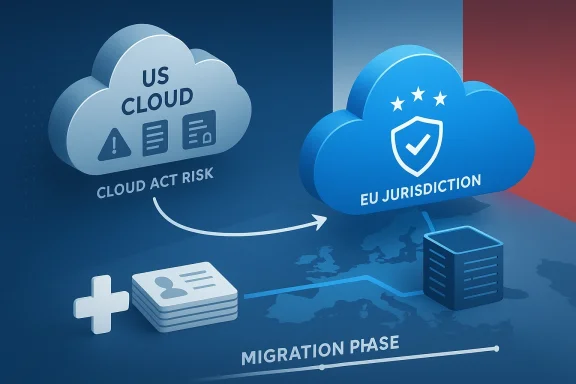
France’s decision to move the Health Data Hub away from Microsoft Azure and onto Scaleway, the cloud arm of Iliad, is more than a vendor swap. It is a strategic repatriation of one of the country’s most sensitive public data platforms, and a signal that European governments are becoming less willing to rely on U.S. cloud providers for critical workloads. Reuters reported the change on April 23, 2026, and Scaleway confirmed it the same day, saying it had been selected after a rigorous process to host the platform and a copy of the National Health Data System database.
The move closes a chapter that has been politically and legally fraught for years. France’s health data infrastructure has long sat at the center of sovereignty debates, privacy concerns, and transatlantic tension over cloud jurisdiction, especially in light of U.S. legal reach and Europe’s push for digital autonomy. The selection of Scaleway gives Paris a domestically anchored alternative, but it also raises practical questions about migration complexity, operational resilience, and whether a sovereign cloud can match hyperscaler scale without compromising usability.
France’s Health Data Hub was created in 2019 to consolidate and make use of health data for research, policy, and innovation. Over time, however, the platform became a symbol of a deeper European dilemma: how to build modern digital public infrastructure without handing control of the underlying stack to foreign cloud vendors. The issue was never just about cost or convenience; it was about trust, legal exposure, and the ability of the state to govern data on its own terms.
The original Microsoft arrangement drew criticism because U.S.-based cloud providers may be subject to domestic legal requests that can, at least in theory, create conflicts with European data protection expectations. In Europe, this concern is often framed around sovereignty, but the practical stakes are easier to understand: if a government or hospital system cannot confidently assert where data is stored, who can access it, and under which laws it is governed, the cloud becomes a political problem as much as a technical one. Scaleway has explicitly framed its pitch around keeping data in Europe and away from the Cloud Act’s extraterritorial reach.
The timing matters. Europe has spent the last several years trying to develop a more credible sovereign cloud ecosystem, with France often taking a leading role in both policy and procurement. That includes the push for trusted cloud labels, stricter certification models, and the growing willingness of public institutions to prefer domestic or European providers when the data is sensitive enough to justify the trade-off. Scaleway’s selection fits squarely into that broader pattern.
What makes this case noteworthy is that the Health Data Hub is not a small test bed. It is intended to serve as a central platform for research and innovation, with datasets that can involve millions of citizens. Scaleway said the environment will host health databases, including a copy of the main database of the National Health Data System, and that the platform is designed to streamline access for stakeholders in health research and innovation. That is a big workload, not a symbolic one.
In other words, the decision is not simply “France chose a French cloud.” It is France making a statement about what kinds of workloads should be governed by domestic infrastructure, even if that choice comes with performance, ecosystem, and procurement implications. The question now is whether this becomes a one-off migration or a template for a much wider public-sector shift.
That uncertainty was magnified by the scale of the data involved. Health datasets are not ordinary enterprise files; they can include highly personal medical histories, longitudinal records, and research material that becomes more sensitive when combined. Once a public platform reaches that level of criticality, the tolerance for perceived jurisdictional risk drops sharply.
Still, sovereignty is not free. It often means accepting a narrower ecosystem, fewer global services, and a greater burden on public buyers to manage portability and continuity. That is the trade-off at the heart of the cloud debate: independence may be more politically comfortable, but it can be technically and commercially harder to execute well.
Key implications of the Microsoft phase:
Those criteria matter because they hint at the real nature of the competition. A sovereign cloud bid cannot win on patriotism alone. It has to prove that it can support large, sensitive datasets, maintain operational continuity, and offer a credible roadmap for certifications such as SecNumCloud. Scaleway said it already holds HDS certification and is advancing toward that higher-trust qualification.
The broader lesson is that the cloud market is splitting into two distinct procurement lanes. One lane is optimized for scale, service breadth, and global integration. The other is optimized for sovereignty, compliance, transparency, and reversibility. Public health data increasingly belongs in the second lane.
Scaleway’s advantages in this context:
That combination is hard to get right. Health platforms need to balance access and restriction, performance and privacy, flexibility and auditability. If the new stack becomes too restrictive, researchers and public agencies may find it cumbersome. If it becomes too permissive, the platform risks undermining the very sovereignty case that justified the move.
The Health Data Hub also sits inside a wider European research environment. Its relevance extends beyond France because cross-border research projects increasingly depend on interoperable, trusted infrastructure. That means the platform must serve national goals while remaining usable in collaborative European contexts.
Important platform requirements include:
Moving a health data platform away from Microsoft also means disentangling assumptions baked into the old environment. That can include identity and access patterns, data tooling, monitoring, compliance reporting, and application dependencies. The closer the platform has been integrated with a hyperscaler’s native services, the more painstaking the reverse engineering becomes. That is where sovereignty gets expensive.
For public agencies, the real test is reversibility. If the new environment proves that France can move critical data out of a hyperscaler without sacrificing reliability, it strengthens the entire sovereign-cloud narrative. If it struggles, skeptics will argue that autonomy remains a policy aspiration rather than an operational reality.
Migration priorities:
For the public sector, the move may become a reference case. Health ministries, tax authorities, defense-adjacent agencies, and research institutions across Europe will watch whether France can execute this migration cleanly. If the answer is yes, procurement teams elsewhere may feel emboldened to demand similar arrangements.
That does not mean hyperscalers are out of the picture. It means their dominance in the most sensitive public workloads is no longer inevitable. They will likely respond by deepening sovereign offerings, expanding local partnerships, and emphasizing compliance frameworks designed to narrow the political gap.
The enterprise signal is clear:
This is especially relevant because sovereign-cloud competition is no longer theoretical. Europe has been trying to create a market where hyperscalers can still participate, but only under conditions that preserve local control and legal clarity. France’s decision shows that such conditions can now force a change in provider, not just an overlay of compliance language.
European providers, meanwhile, now have proof that a sovereign pitch can win on substance. That matters for credibility with procurement officers, regulators, and CIOs who need to justify decisions not only in technical terms but also in political ones. Scaleway’s win is therefore a competitive asset far beyond the immediate contract.
Competitive takeaways:
The thesis is that digital infrastructure should be designed so the state can preserve control over data without sacrificing modern cloud capabilities. That sounds straightforward, but the practical challenge is enormous because sovereign clouds must still compete on security, scale, developer experience, and cost control. Sovereignty only matters if the platform is good enough to use.
That matters beyond France. Any country trying to modernize sensitive public systems now has a live example of how sovereignty can be operationalized through vendor selection. Whether they copy France or refine the model, the precedent is real.
Sovereign cloud principles now under scrutiny:
This is why the deal extends beyond the Health Data Hub. It reinforces the idea that public procurement can be used as a tool of strategic development, not just administration. France has long been one of Europe’s more assertive advocates of digital sovereignty, and this contract is a concrete example of that posture.
There is also a signaling effect for startups and research institutions. When the state chooses a domestic provider for a flagship health platform, it tells the market that European cloud is not just a fallback. It is increasingly a first-choice option for the right workload.
Policy and ecosystem effects:
The longer-term question is whether this becomes a blueprint for other ministries and EU member states. Public-sector cloud buying is often slow and conservative, but successful reference projects can reshape expectations surprisingly quickly. If Scaleway proves reliable at this scale, more governments may decide that sovereignty is worth the engineering effort.
Key indicators to watch:
Source: Reuters https://www.reuters.com/world/europ...aleway-repatriate-health-data-hub-2026-04-23/
The move closes a chapter that has been politically and legally fraught for years. France’s health data infrastructure has long sat at the center of sovereignty debates, privacy concerns, and transatlantic tension over cloud jurisdiction, especially in light of U.S. legal reach and Europe’s push for digital autonomy. The selection of Scaleway gives Paris a domestically anchored alternative, but it also raises practical questions about migration complexity, operational resilience, and whether a sovereign cloud can match hyperscaler scale without compromising usability.
 Background
France’s Health Data Hub was created in 2019 to consolidate and make use of health data for research, policy, and innovation. Over time, however, the platform became a symbol of a deeper European dilemma: how to build modern digital public infrastructure without handing control of the underlying stack to foreign cloud vendors. The issue was never just about cost or convenience; it was about trust, legal exposure, and the ability of the state to govern data on its own terms.The original Microsoft arrangement drew criticism because U.S.-based cloud providers may be subject to domestic legal requests that can, at least in theory, create conflicts with European data protection expectations. In Europe, this concern is often framed around sovereignty, but the practical stakes are easier to understand: if a government or hospital system cannot confidently assert where data is stored, who can access it, and under which laws it is governed, the cloud becomes a political problem as much as a technical one. Scaleway has explicitly framed its pitch around keeping data in Europe and away from the Cloud Act’s extraterritorial reach.
The timing matters. Europe has spent the last several years trying to develop a more credible sovereign cloud ecosystem, with France often taking a leading role in both policy and procurement. That includes the push for trusted cloud labels, stricter certification models, and the growing willingness of public institutions to prefer domestic or European providers when the data is sensitive enough to justify the trade-off. Scaleway’s selection fits squarely into that broader pattern.
What makes this case noteworthy is that the Health Data Hub is not a small test bed. It is intended to serve as a central platform for research and innovation, with datasets that can involve millions of citizens. Scaleway said the environment will host health databases, including a copy of the main database of the National Health Data System, and that the platform is designed to streamline access for stakeholders in health research and innovation. That is a big workload, not a symbolic one.
In other words, the decision is not simply “France chose a French cloud.” It is France making a statement about what kinds of workloads should be governed by domestic infrastructure, even if that choice comes with performance, ecosystem, and procurement implications. The question now is whether this becomes a one-off migration or a template for a much wider public-sector shift.
Why the Microsoft Era Became Unsustainable
Microsoft’s role in the Health Data Hub was always controversial because it sat at the intersection of law, technology, and public policy. For many French observers, the central issue was not that Microsoft was incapable of running the platform, but that any American cloud provider introduces structural uncertainty when the data is highly sensitive and the political climate is increasingly skeptical of foreign control.That uncertainty was magnified by the scale of the data involved. Health datasets are not ordinary enterprise files; they can include highly personal medical histories, longitudinal records, and research material that becomes more sensitive when combined. Once a public platform reaches that level of criticality, the tolerance for perceived jurisdictional risk drops sharply.
The sovereignty argument
The sovereign cloud argument is often dismissed as political rhetoric, but in this case it is also a procurement logic. If the government believes that mission-critical health data should remain in a provider that is legally and operationally embedded in Europe, then a French provider like Scaleway is a cleaner fit than a U.S. hyperscaler. Scaleway’s own positioning emphasizes European infrastructure, open standards, and freedom from extraterritorial constraints.Still, sovereignty is not free. It often means accepting a narrower ecosystem, fewer global services, and a greater burden on public buyers to manage portability and continuity. That is the trade-off at the heart of the cloud debate: independence may be more politically comfortable, but it can be technically and commercially harder to execute well.
Key implications of the Microsoft phase:
- Legal risk drove the political debate more than technical dissatisfaction.
- Public trust mattered as much as uptime or features.
- Sovereignty became a procurement requirement rather than a slogan.
- European alternatives matured enough to win a real mission-critical contract.
- Path dependency made the migration more sensitive than a normal cloud rebid.
Why Scaleway Won
Scaleway’s selection is significant because it suggests that European cloud providers are no longer being treated as symbolic backup options. Reuters reported that the company was chosen to replace Microsoft, while Scaleway said the selection followed a “particularly rigorous” process covering more than 350 technical criteria, including security, resilience, performance, and scale.Those criteria matter because they hint at the real nature of the competition. A sovereign cloud bid cannot win on patriotism alone. It has to prove that it can support large, sensitive datasets, maintain operational continuity, and offer a credible roadmap for certifications such as SecNumCloud. Scaleway said it already holds HDS certification and is advancing toward that higher-trust qualification.
What the decision says about the market
This is also a market signal to rivals. OVHcloud, Orange, and other European infrastructure providers have spent years arguing that public-sector workloads should move toward domestic or EU-based clouds. France’s choice of Scaleway suggests those arguments are finally winning in cases where sovereignty concerns are intense enough to outweigh the convenience of hyperscaler lock-in.The broader lesson is that the cloud market is splitting into two distinct procurement lanes. One lane is optimized for scale, service breadth, and global integration. The other is optimized for sovereignty, compliance, transparency, and reversibility. Public health data increasingly belongs in the second lane.
Scaleway’s advantages in this context:
- European operational footprint
- HDS certification for health data hosting
- A stated path toward SecNumCloud
- Emphasis on reversibility and open standards
- Alignment with France’s sovereignty agenda
What the Health Data Hub Actually Needs
The Health Data Hub is not merely a storage bucket. It is a platform intended to enable research, secondary data use, and innovation across health and life sciences. Scaleway’s announcement says the new setup should make this data “truly actionable,” which is an important clue: the challenge is not just secure hosting, but enabling analysis, collaboration, and controlled access at scale.That combination is hard to get right. Health platforms need to balance access and restriction, performance and privacy, flexibility and auditability. If the new stack becomes too restrictive, researchers and public agencies may find it cumbersome. If it becomes too permissive, the platform risks undermining the very sovereignty case that justified the move.
Operational demands
The public-facing promise is that the new platform will streamline access for health research and innovation. In practice, that means tooling for data ingestion, governance, analytics, identity management, logging, and segmentation will matter just as much as raw compute. Moving data is easy; rebuilding workflows around it is not.The Health Data Hub also sits inside a wider European research environment. Its relevance extends beyond France because cross-border research projects increasingly depend on interoperable, trusted infrastructure. That means the platform must serve national goals while remaining usable in collaborative European contexts.
Important platform requirements include:
- Secure researcher access controls
- Strong audit logging
- Data segmentation and governance
- Scalable analytics infrastructure
- Reversible migration architecture
- Clear interoperability with European research efforts
The Migration Challenge
A migration like this is never just a cutover. It is a phased operational transformation that has to preserve continuity, validate data integrity, and avoid disrupting researchers who depend on the platform. Scaleway itself described the transition as the start of an operational phase, which suggests that the hardest work is still ahead.Moving a health data platform away from Microsoft also means disentangling assumptions baked into the old environment. That can include identity and access patterns, data tooling, monitoring, compliance reporting, and application dependencies. The closer the platform has been integrated with a hyperscaler’s native services, the more painstaking the reverse engineering becomes. That is where sovereignty gets expensive.
What must happen next
The sequencing will matter more than the announcement. A rushed migration could create data quality issues, service interruptions, or compliance gaps. A slower, staged migration may look less dramatic, but it is much more likely to protect research continuity and stakeholder confidence.For public agencies, the real test is reversibility. If the new environment proves that France can move critical data out of a hyperscaler without sacrificing reliability, it strengthens the entire sovereign-cloud narrative. If it struggles, skeptics will argue that autonomy remains a policy aspiration rather than an operational reality.
Migration priorities:
- Validate data integrity across all datasets.
- Recreate access controls and audit trails.
- Confirm performance under research workloads.
- Test disaster recovery and resilience.
- Train administrators and user communities.
- Establish rollback and contingency plans.
Enterprise and Public-Sector Implications
For enterprises, the lesson is subtle but important: public institutions are increasingly willing to pay for sovereignty where data sensitivity justifies it. That creates pressure on cloud vendors to offer more transparent governance, better locality guarantees, and stronger assurances around legal exposure. It also creates an opening for European providers to win workloads that once would have defaulted to the largest global platforms.For the public sector, the move may become a reference case. Health ministries, tax authorities, defense-adjacent agencies, and research institutions across Europe will watch whether France can execute this migration cleanly. If the answer is yes, procurement teams elsewhere may feel emboldened to demand similar arrangements.
A new procurement mindset
The shift also reveals a changing definition of value. In the old model, cloud buying often centered on scale, service breadth, and developer convenience. In the new model, trust, jurisdiction, and reversibility can outrank feature count, especially when the workload is public and politically sensitive.That does not mean hyperscalers are out of the picture. It means their dominance in the most sensitive public workloads is no longer inevitable. They will likely respond by deepening sovereign offerings, expanding local partnerships, and emphasizing compliance frameworks designed to narrow the political gap.
The enterprise signal is clear:
- Sovereignty is becoming a buying criterion.
- Vendor locality can outweigh raw feature advantage.
- Public-sector standards may spill into private procurement.
- Compliance architecture is now a competitive differentiator.
- European cloud ecosystems are gaining strategic credibility.
Competitive Fallout for Microsoft and U.S. Hyperscalers
Microsoft loses more than a contract here. It loses a visible reference point in a highly symbolic market: the hosting of national health data in one of Europe’s most influential countries. That may not materially alter Microsoft’s global cloud revenue on its own, but it matters because public-sector trust is cumulative and reputational.This is especially relevant because sovereign-cloud competition is no longer theoretical. Europe has been trying to create a market where hyperscalers can still participate, but only under conditions that preserve local control and legal clarity. France’s decision shows that such conditions can now force a change in provider, not just an overlay of compliance language.
How rivals may respond
Microsoft and other U.S. cloud providers will likely keep investing in local cloud regions, certification programs, and partner-led sovereign offerings. But the challenge is structural: no amount of regional branding fully erases the fact that the parent company sits under U.S. jurisdiction. For some buyers, that remains the decisive issue.European providers, meanwhile, now have proof that a sovereign pitch can win on substance. That matters for credibility with procurement officers, regulators, and CIOs who need to justify decisions not only in technical terms but also in political ones. Scaleway’s win is therefore a competitive asset far beyond the immediate contract.
Competitive takeaways:
- Hyperscaler dominance is not guaranteed in sensitive public workloads.
- Sovereign cloud providers can win on compliance plus capability.
- Local legal positioning is becoming a differentiator.
- Public procurement can reshape cloud market expectations.
- Political trust is now a measurable commercial advantage.
The Sovereign Cloud Thesis
The term sovereign cloud has sometimes been overused, but this case gives it real substance. It is not a branding exercise; it is a procurement response to legal uncertainty, data sensitivity, and strategic independence. Scaleway has built its pitch around European infrastructure, open standards, and reduced exposure to extraterritorial rules, which aligns neatly with France’s current policy direction.The thesis is that digital infrastructure should be designed so the state can preserve control over data without sacrificing modern cloud capabilities. That sounds straightforward, but the practical challenge is enormous because sovereign clouds must still compete on security, scale, developer experience, and cost control. Sovereignty only matters if the platform is good enough to use.
From slogan to system design
The most important part of this announcement may be the emphasis on criteria, certification, and operational control. That suggests sovereign cloud is maturing from an abstract political ideal into a set of measurable engineering requirements. If that trend continues, the market will start to reward providers that can prove reversibility, locality, and legal clarity rather than merely claim them.That matters beyond France. Any country trying to modernize sensitive public systems now has a live example of how sovereignty can be operationalized through vendor selection. Whether they copy France or refine the model, the precedent is real.
Sovereign cloud principles now under scrutiny:
- Local jurisdiction over critical data
- Certifiable security controls
- Reversible architectures
- Transparent operational ownership
- Practical performance under public workloads
- Compatibility with research collaboration
The French Tech and Policy Signal
For France, this is also a domestic industrial policy story. Choosing Scaleway supports a French cloud provider with European ambitions and gives the state a chance to back a local technology stack in a domain that matters politically. That creates a feedback loop: public demand helps local vendors grow, and stronger local vendors make future sovereignty goals more realistic.This is why the deal extends beyond the Health Data Hub. It reinforces the idea that public procurement can be used as a tool of strategic development, not just administration. France has long been one of Europe’s more assertive advocates of digital sovereignty, and this contract is a concrete example of that posture.
Broader ecosystem impact
A win like this also helps validate adjacent sectors. Certification providers, system integrators, security teams, data platform engineers, and compliance specialists all benefit when sovereign-cloud adoption moves from theory into practice. That ecosystem effect may prove more durable than any single headline contract.There is also a signaling effect for startups and research institutions. When the state chooses a domestic provider for a flagship health platform, it tells the market that European cloud is not just a fallback. It is increasingly a first-choice option for the right workload.
Policy and ecosystem effects:
- Strengthens France’s digital sovereignty narrative
- Supports domestic cloud industrial development
- Encourages ecosystem investment in compliance and migration
- Gives public buyers a stronger precedent
- Increases confidence in European cloud alternatives
Strengths and Opportunities
This decision has a rare combination of political clarity and operational ambition. It is not merely a gesture toward autonomy; it is a chance to prove that a European cloud provider can host a mission-critical health platform at national scale. If executed well, the move could become a model for other sensitive public workloads across Europe.- Data sovereignty is now backed by an actual migration plan.
- Scaleway gains a flagship reference case in public health.
- France reduces dependence on a U.S. hyperscaler for sensitive data.
- European procurement gets a real-world success story.
- Compliance and certification become marketable strengths.
- Research collaboration may benefit from a platform designed around local trust.
- The sovereign cloud market gains credibility beyond rhetoric.
Risks and Concerns
The biggest risk is that the symbolism of the decision outpaces the mechanics of execution. A health data migration this sensitive can stumble on governance, tooling, integration, or service continuity, and any disruption would quickly become a political issue as well as a technical one. That would be especially damaging because the entire rationale rests on trust.- Migration complexity could lead to delays or data-handling errors.
- Performance gaps versus hyperscalers could frustrate users.
- Certification timelines may not align perfectly with operational needs.
- Ecosystem limitations could constrain advanced analytics or AI use cases.
- Cost transparency may not fully offset the burden of transition.
- Political expectations could exceed what the platform can deliver immediately.
- Vendor concentration simply shifts from one dependency to another unless reversibility is maintained.
Looking Ahead
The next phase is execution, not announcement. Watch for migration milestones, certification progress, and any signs that researchers or agencies encounter friction in the new environment. If those pieces fall into place, France will have done more than change providers; it will have demonstrated that sovereign cloud is operationally viable for one of the most sensitive categories of public data.The longer-term question is whether this becomes a blueprint for other ministries and EU member states. Public-sector cloud buying is often slow and conservative, but successful reference projects can reshape expectations surprisingly quickly. If Scaleway proves reliable at this scale, more governments may decide that sovereignty is worth the engineering effort.
Key indicators to watch:
- Certification and compliance milestones
- Migration pace and service continuity
- Research community adoption
- Any expansion to additional public datasets
- Competitive responses from Microsoft and other hyperscalers
- Similar procurement decisions in other EU countries
Source: Reuters https://www.reuters.com/world/europ...aleway-repatriate-health-data-hub-2026-04-23/
