

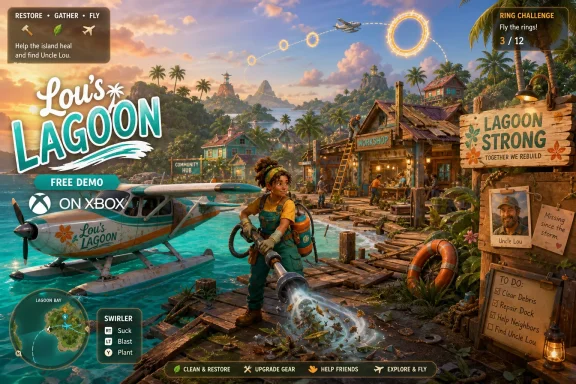
Microsoft has listed a free Xbox demo for Lou’s Lagoon, letting players sample the opening act of Tiny Roar’s tropical seaplane adventure ahead of its planned 2026 launch across Xbox, PlayStation, PC, and Nintendo Switch. The demo is not just a sampler; it is a positioning statement. It frames Lou’s Lagoon as the kind of cozy game that wants to be more than furniture placement and soft lighting, with flight, salvage, repair work, and a family mystery stitched into the loop.
The pitch is disarmingly simple: a distress call, a storm-hit island, and an absent Uncle Lou. But the more interesting story is how this demo arrives on Xbox at a moment when the cozy genre is maturing from pastoral routine into something more mechanically elastic. Lou’s Lagoon is selling calm, yes, but it is also selling movement — a seaplane, a vacuum tool, a set of damaged communities, and the promise that restoration can be an adventure rather than a checklist.
The Xbox listing for the Lou’s Lagoon Demo is built around the game’s opening act. Players arrive on Lou’s Island after answering a sudden distress call from Uncle Lou, only to find the local paradise damaged by a storm and Lou himself missing. That is the classic cozy-game inciting incident: trouble has arrived, but it has arrived in a world designed to be repaired rather than conquered.
What makes the Xbox demo notable is not that it exists. Steam demos have become a routine part of indie marketing, especially around festivals and wishlist campaigns. The more meaningful signal is that Xbox is getting a hands-on slice for a game whose identity depends on feel: the lift of a seaplane, the cadence of scavenging, and the rhythm between exploration and rebuilding.
That matters because Lou’s Lagoon is not pitching itself as a pure farm-life sim. It borrows some of the genre’s familiar emotional grammar — a relative’s legacy, a small community in need, a colorful cast, a personalizable avatar — but wraps it around island-hopping and vehicle traversal. If the seaplane feels limp, the whole promise collapses. If it feels good, the demo becomes a better argument than any trailer.
The listing also makes a careful promise about scope. This is not a sprawling beta or an open-ended early build. It is the opening act, with Lou’s Island as the proving ground. Players meet locals, help repair a storm-damaged community hub, gather scrap and plants with the Swirler, try ring challenges in the air, customize a character, and receive a reward for reaching the end.
That is a smart demo shape. It gives Xbox players a beginning, a tool, a vehicle, a social space, and a small completion incentive. In other words, it tests the whole loop without pretending to be the whole game.
That movement is the game’s most important differentiator. A tropical archipelago is not merely a background aesthetic if the player can fly between islands, trace routes, and master ring challenges. It becomes a structure for curiosity. The airplane turns distance into play.
The Xbox store description for the full game points to a broader Limbo Archipelago, with distinct communities and islands beyond the demo’s first location. That larger map is essential to the fantasy. A cozy game can survive repetition if its routines feel grounding, but an exploration game needs the horizon to keep making promises.
The demo’s decision to begin after a storm is equally practical. Storm damage gives the world a reason to be disordered without making it hostile in the traditional action-game sense. It creates mess, need, and purpose. Scrap is not just loot; it is evidence that something happened and an invitation to fix it.
There is a tonal tightrope here. A missing family member and damaged communities can easily feel too heavy for a game marketed with colorful islands and gentle reconstruction. But cozy games have long been more melancholy than their branding suggests. The genre is full of dead grandparents, abandoned towns, ecological collapse, and lonely neighbors. Its trick is not avoiding sadness; it is making sadness actionable.
A vacuum tool also changes the fantasy of gathering. It suggests suction, sweep, and momentum rather than slow foraging. That sounds small, but in a game built around restoration, the moment-to-moment feel of cleanup can become the difference between soothing and tedious.
The full game’s store description refers to the Swirler 2000 as a multi-tool used to collect resources, repair buildings, craft goods, and help communities recover. That puts Lou’s Lagoon closer to the “tool as identity” school of cozy design. Like a watering can in a farming sim or a scanner in a survival game, the Swirler is not just equipment. It is the way the player understands the world.
The risk is that a tool like this can become too frictionless. If gathering is effortless, crafting can feel weightless. If gathering is too manual, the island paradise becomes a chore board. The demo’s opening act is therefore an important calibration point, because players will learn quickly whether the Swirler makes the world feel alive or merely hoovers it into inventory.
The storm-damaged community hub is a sensible first target. Repairing a central location gives the demo a visible before-and-after arc, which cozy games need. Progress in this genre is often architectural: a broken thing becomes whole, an empty place gains use, and the player receives emotional confirmation that the loop matters.
That is a natural fit for a game like this. Cozy games are often consumed in small rituals: half an hour before bed, a few deliveries after work, a cleanup session while listening to a podcast. Cross-device continuity can matter more here than raw graphical spectacle.
For WindowsForum readers, the PC angle is not incidental. The game is already visible in the PC ecosystem through Steam, and the Xbox listing makes Microsoft’s store part of that platform story. If Lou’s Lagoon becomes a true buy-once, play-across-Xbox-and-PC release, it lands squarely in the modern Windows gaming pattern Microsoft has spent years encouraging.
That does not mean the Microsoft Store version will automatically be the preferred one for every player. Steam remains the default home for many PC indie audiences because of its community features, refund habits, controller layer, and wishlist culture. But Xbox Play Anywhere is one of Microsoft’s few genuinely compelling counterweights, especially for households that straddle a living-room Xbox and a Windows gaming handheld or laptop.
The demo may also serve as a discovery tool inside the Xbox ecosystem. Indie games can disappear quickly in subscription and storefront churn, and a free demo lowers the barrier for players who might not wishlist a cozy seaplane game on description alone. For a smaller title, that moment of “just try it” visibility can be decisive.
Lou’s Lagoon understands that. The seaplane is the silhouette. Even before a player remembers the character names or island factions, the image is legible: a small aircraft moving between tropical communities, hauling resources, following clues, and turning the sky into connective tissue.
This is why the demo’s ring challenges matter. They are not merely side activities; they are a statement that flying is meant to be mastered, not just watched. If the plane exists only as a fast-travel animation with minor steering, the premise weakens. If it becomes a skillful, satisfying traversal system, Lou’s Lagoon gains a durable identity.
The challenge is to keep flight from overpowering the quiet work. A game about rebuilding communities needs pauses, conversations, workbenches, and local texture. Too much aerial spectacle could make the islands feel like pit stops. Too little could make the plane feel like a gimmick.
The best version of Lou’s Lagoon is one where each system feeds the others. Flying should make exploration feel wide. Gathering should make repair feel earned. Repair should make communities feel more alive. Communities should give the player reasons to fly again.
That loop is easy to describe and difficult to tune. The demo gives Xbox players an early chance to see whether Tiny Roar has found the right tempo.
The Xbox listing is careful to call out a special reward for players who finish the demo. That is a minor but clever nudge. It gives completion-minded players a reason not to bounce after the first flight, and it subtly frames the demo as a contained episode rather than a disposable excerpt.
The bigger trust question is how representative the opening act will be. Cozy games can front-load charm and reveal grind later. Conversely, they can start slowly and bloom only after a dozen systems interlock. A good demo has to compress enough of the long-term appeal without flattening the progression curve.
By focusing on Lou’s Island, the demo seems to prioritize onboarding over breadth. Players learn the premise, meet locals, restore a hub, gather materials, fly the plane, and customize their avatar. That is the correct order for a game whose systems could otherwise sound like a pile of genre tags.
It also lets Tiny Roar test the emotional hook. Uncle Lou’s disappearance is the mystery, but the player’s attachment will depend on how the islanders talk, how the world reacts to repair, and whether the game can make its communities feel like more than vendors with dialogue bubbles.
That layered rollout can be exhausting, but it is also pragmatic. Smaller games need time to accumulate wishlists, press coverage, creator interest, and platform awareness. A demo on Xbox is one more layer in that accumulation strategy.
There is a slightly unusual tension in the Japanese Microsoft Store source for the demo, because the listing is localized while the game’s cozy-island premise has a broadly international tone. That is increasingly normal for indie releases. A game can be built by a European studio, published through multiple partners, marketed on Steam, featured on console blogs, and discovered through a Japanese Xbox storefront by English-speaking players.
The store metadata also matters because it defines expectations before players ever launch the build. When Microsoft’s listing says the demo includes the opening act, storm repairs, ring challenges, character customization, and an end reward, it creates a checklist players will use to judge the download. Store copy is no longer just flavor. It is a contract.
For Xbox, demos like this help soften a storefront that has often been judged more by blockbuster availability than by indie curation. Microsoft has spent years talking about meeting players where they are; the more practical version of that strategy is making sure smaller games have surfaces where they can be tried, not merely purchased.
That distinction matters for Windows users. Microsoft’s gaming strategy increasingly treats Windows as part of the Xbox surface area, not a separate island. When an indie game supports Xbox consoles, PC, cloud saves, achievements, and potentially Play Anywhere, it participates in that blurred ecosystem.
The upside for players is convenience. The downside is fragmentation. A PC user may have to choose between Steam’s social and library gravity, the Microsoft Store’s Xbox integration, or a console version that may offer better living-room simplicity. For some games, that choice is trivial. For cozy games built around long-term progress, it is more consequential.
Save portability is especially important. Nobody wants to rebuild an island twice because they bought the wrong version first. If the Xbox ecosystem version preserves progress cleanly between console and PC, that becomes a real feature rather than a bullet on a store page.
Performance expectations should be modest but not ignored. Cozy visuals can hide surprisingly demanding open-world streaming, especially with flight. A seaplane changes what the engine must load and display. The final PC and console builds will need to make the archipelago feel seamless without asking players to forgive stutter in the very moments designed to feel freeing.
Lou’s Lagoon has several systems that could either harmonize or collide. There is flight, collection, crafting, repair, character customization, island exploration, gadget upgrades, and a mystery arc. Each one is familiar. The value is in the integration.
Character customization, for example, is often treated as a surface feature. But in a game about arriving in a community and slowly making a place feel like home, the avatar matters. Players need to feel present in the island world, not just as a cursor completing jobs.
Likewise, the seaplane customization described for the full game could become more than cosmetic if it affects routes, handling, or cargo decisions. Even if it remains mostly visual, it reinforces the idea that the plane is a companion object — the cozy equivalent of a horse, truck, or spaceship.
The mystery of Uncle Lou’s disappearance is the narrative spine. It gives the game forward motion beyond “make number go up.” The trick will be pacing that mystery without turning every island into a breadcrumb dispenser. Cozy mysteries work best when the world is interesting even before the answer arrives.
The opening act structure gives Tiny Roar a fair shot. Arriving after a storm is immediate. The missing uncle gives motivation. The damaged hub gives a concrete project. The Swirler gives the player something to do with their hands. The seaplane gives the player something to dream about.
That sequence also avoids the slowest version of cozy onboarding, where players spend an hour learning menus before the game’s identity appears. A demo cannot afford that. It needs to show the signature mechanic early and let the rest of the loop orbit around it.
For Xbox players browsing free demos, Lou’s Lagoon may look like a low-risk diversion. For the developer and publisher, it is higher stakes. This is the moment where the game stops being key art, trailer music, and wishlist text, and becomes a controller in someone’s hands.
That is where cozy games either become habits or evaporate. The genre’s best entries do not simply charm players; they make players imagine returning tomorrow.
The pitch is disarmingly simple: a distress call, a storm-hit island, and an absent Uncle Lou. But the more interesting story is how this demo arrives on Xbox at a moment when the cozy genre is maturing from pastoral routine into something more mechanically elastic. Lou’s Lagoon is selling calm, yes, but it is also selling movement — a seaplane, a vacuum tool, a set of damaged communities, and the promise that restoration can be an adventure rather than a checklist.
 Microsoft’s Storefront Turns a Cozy Game Into an Xbox Test Flight
The Xbox listing for the Lou’s Lagoon Demo is built around the game’s opening act. Players arrive on Lou’s Island after answering a sudden distress call from Uncle Lou, only to find the local paradise damaged by a storm and Lou himself missing. That is the classic cozy-game inciting incident: trouble has arrived, but it has arrived in a world designed to be repaired rather than conquered.What makes the Xbox demo notable is not that it exists. Steam demos have become a routine part of indie marketing, especially around festivals and wishlist campaigns. The more meaningful signal is that Xbox is getting a hands-on slice for a game whose identity depends on feel: the lift of a seaplane, the cadence of scavenging, and the rhythm between exploration and rebuilding.
That matters because Lou’s Lagoon is not pitching itself as a pure farm-life sim. It borrows some of the genre’s familiar emotional grammar — a relative’s legacy, a small community in need, a colorful cast, a personalizable avatar — but wraps it around island-hopping and vehicle traversal. If the seaplane feels limp, the whole promise collapses. If it feels good, the demo becomes a better argument than any trailer.
The listing also makes a careful promise about scope. This is not a sprawling beta or an open-ended early build. It is the opening act, with Lou’s Island as the proving ground. Players meet locals, help repair a storm-damaged community hub, gather scrap and plants with the Swirler, try ring challenges in the air, customize a character, and receive a reward for reaching the end.
That is a smart demo shape. It gives Xbox players a beginning, a tool, a vehicle, a social space, and a small completion incentive. In other words, it tests the whole loop without pretending to be the whole game.
The Missing Uncle Is the Hook, but the Seaplane Is the Thesis
Cozy games often begin with inheritance. A farm, a house, a shop, a workshop, a town obligation: the player receives a life they did not build and is invited to make it livable. Lou’s Lagoon uses Uncle Lou in that tradition, but the seaplane changes the emotional geometry. You are not simply settling down; you are being asked to move.That movement is the game’s most important differentiator. A tropical archipelago is not merely a background aesthetic if the player can fly between islands, trace routes, and master ring challenges. It becomes a structure for curiosity. The airplane turns distance into play.
The Xbox store description for the full game points to a broader Limbo Archipelago, with distinct communities and islands beyond the demo’s first location. That larger map is essential to the fantasy. A cozy game can survive repetition if its routines feel grounding, but an exploration game needs the horizon to keep making promises.
The demo’s decision to begin after a storm is equally practical. Storm damage gives the world a reason to be disordered without making it hostile in the traditional action-game sense. It creates mess, need, and purpose. Scrap is not just loot; it is evidence that something happened and an invitation to fix it.
There is a tonal tightrope here. A missing family member and damaged communities can easily feel too heavy for a game marketed with colorful islands and gentle reconstruction. But cozy games have long been more melancholy than their branding suggests. The genre is full of dead grandparents, abandoned towns, ecological collapse, and lonely neighbors. Its trick is not avoiding sadness; it is making sadness actionable.
The Swirler Makes Cleanup the Core Verb
The Swirler, described in the demo as a vacuum-powered tool for collecting scrap, native plants, and other materials, is doing a lot of design work. It gives the player a tactile way to interact with debris and resources, and it helps avoid one of the genre’s duller habits: bending down to pick up a hundred separate objects.A vacuum tool also changes the fantasy of gathering. It suggests suction, sweep, and momentum rather than slow foraging. That sounds small, but in a game built around restoration, the moment-to-moment feel of cleanup can become the difference between soothing and tedious.
The full game’s store description refers to the Swirler 2000 as a multi-tool used to collect resources, repair buildings, craft goods, and help communities recover. That puts Lou’s Lagoon closer to the “tool as identity” school of cozy design. Like a watering can in a farming sim or a scanner in a survival game, the Swirler is not just equipment. It is the way the player understands the world.
The risk is that a tool like this can become too frictionless. If gathering is effortless, crafting can feel weightless. If gathering is too manual, the island paradise becomes a chore board. The demo’s opening act is therefore an important calibration point, because players will learn quickly whether the Swirler makes the world feel alive or merely hoovers it into inventory.
The storm-damaged community hub is a sensible first target. Repairing a central location gives the demo a visible before-and-after arc, which cozy games need. Progress in this genre is often architectural: a broken thing becomes whole, an empty place gains use, and the player receives emotional confirmation that the loop matters.
Xbox Play Anywhere Would Make the Cozy Loop More Portable
The broader Xbox pitch for Lou’s Lagoon includes Xbox One, Xbox Series X|S, and PC support, with the full listing also pointing to cloud saves and Xbox achievements. Reporting around the console announcement has indicated Xbox Play Anywhere support, which would allow players to move between console and PC while keeping progress intact if implemented as advertised.That is a natural fit for a game like this. Cozy games are often consumed in small rituals: half an hour before bed, a few deliveries after work, a cleanup session while listening to a podcast. Cross-device continuity can matter more here than raw graphical spectacle.
For WindowsForum readers, the PC angle is not incidental. The game is already visible in the PC ecosystem through Steam, and the Xbox listing makes Microsoft’s store part of that platform story. If Lou’s Lagoon becomes a true buy-once, play-across-Xbox-and-PC release, it lands squarely in the modern Windows gaming pattern Microsoft has spent years encouraging.
That does not mean the Microsoft Store version will automatically be the preferred one for every player. Steam remains the default home for many PC indie audiences because of its community features, refund habits, controller layer, and wishlist culture. But Xbox Play Anywhere is one of Microsoft’s few genuinely compelling counterweights, especially for households that straddle a living-room Xbox and a Windows gaming handheld or laptop.
The demo may also serve as a discovery tool inside the Xbox ecosystem. Indie games can disappear quickly in subscription and storefront churn, and a free demo lowers the barrier for players who might not wishlist a cozy seaplane game on description alone. For a smaller title, that moment of “just try it” visibility can be decisive.
Cozy Games Are Growing Wings Because the Farm Got Crowded
The cozy genre has spent the past decade expanding from farming into workshops, cafés, potion shops, mail routes, witch academies, fishing villages, and tiny islands full of resource loops. The result is abundance, but also sameness. A game now needs a sharper mechanical silhouette to stand out.Lou’s Lagoon understands that. The seaplane is the silhouette. Even before a player remembers the character names or island factions, the image is legible: a small aircraft moving between tropical communities, hauling resources, following clues, and turning the sky into connective tissue.
This is why the demo’s ring challenges matter. They are not merely side activities; they are a statement that flying is meant to be mastered, not just watched. If the plane exists only as a fast-travel animation with minor steering, the premise weakens. If it becomes a skillful, satisfying traversal system, Lou’s Lagoon gains a durable identity.
The challenge is to keep flight from overpowering the quiet work. A game about rebuilding communities needs pauses, conversations, workbenches, and local texture. Too much aerial spectacle could make the islands feel like pit stops. Too little could make the plane feel like a gimmick.
The best version of Lou’s Lagoon is one where each system feeds the others. Flying should make exploration feel wide. Gathering should make repair feel earned. Repair should make communities feel more alive. Communities should give the player reasons to fly again.
That loop is easy to describe and difficult to tune. The demo gives Xbox players an early chance to see whether Tiny Roar has found the right tempo.
The Demo’s Real Job Is Trust
A demo is not only marketing; it is a trust exercise. The developer says, in effect, that the first hour is strong enough to put in players’ hands before release. For an indie game selling mood and mechanics, that confidence is useful.The Xbox listing is careful to call out a special reward for players who finish the demo. That is a minor but clever nudge. It gives completion-minded players a reason not to bounce after the first flight, and it subtly frames the demo as a contained episode rather than a disposable excerpt.
The bigger trust question is how representative the opening act will be. Cozy games can front-load charm and reveal grind later. Conversely, they can start slowly and bloom only after a dozen systems interlock. A good demo has to compress enough of the long-term appeal without flattening the progression curve.
By focusing on Lou’s Island, the demo seems to prioritize onboarding over breadth. Players learn the premise, meet locals, restore a hub, gather materials, fly the plane, and customize their avatar. That is the correct order for a game whose systems could otherwise sound like a pile of genre tags.
It also lets Tiny Roar test the emotional hook. Uncle Lou’s disappearance is the mystery, but the player’s attachment will depend on how the islanders talk, how the world reacts to repair, and whether the game can make its communities feel like more than vendors with dialogue bubbles.
The Microsoft Store Listing Shows How Indies Now Launch in Layers
The path for an indie game in 2026 is rarely a single reveal followed by a release date. It is a long chain of storefront pages, demos, festival beats, console announcements, publisher updates, trailers, and social clips. Lou’s Lagoon has followed that modern pattern, appearing first as a PC-facing project and now widening its console footprint.That layered rollout can be exhausting, but it is also pragmatic. Smaller games need time to accumulate wishlists, press coverage, creator interest, and platform awareness. A demo on Xbox is one more layer in that accumulation strategy.
There is a slightly unusual tension in the Japanese Microsoft Store source for the demo, because the listing is localized while the game’s cozy-island premise has a broadly international tone. That is increasingly normal for indie releases. A game can be built by a European studio, published through multiple partners, marketed on Steam, featured on console blogs, and discovered through a Japanese Xbox storefront by English-speaking players.
The store metadata also matters because it defines expectations before players ever launch the build. When Microsoft’s listing says the demo includes the opening act, storm repairs, ring challenges, character customization, and an end reward, it creates a checklist players will use to judge the download. Store copy is no longer just flavor. It is a contract.
For Xbox, demos like this help soften a storefront that has often been judged more by blockbuster availability than by indie curation. Microsoft has spent years talking about meeting players where they are; the more practical version of that strategy is making sure smaller games have surfaces where they can be tried, not merely purchased.
The Windows Angle Is Bigger Than Another Store Icon
For PC players, Lou’s Lagoon sits at the intersection of Steam culture and Xbox’s cross-device ambitions. The demo’s presence on Xbox does not erase the Steam demo’s earlier availability, nor does it guarantee parity across every platform. But it does signal that the game is being prepared as a multi-platform release rather than a niche PC-only curiosity.That distinction matters for Windows users. Microsoft’s gaming strategy increasingly treats Windows as part of the Xbox surface area, not a separate island. When an indie game supports Xbox consoles, PC, cloud saves, achievements, and potentially Play Anywhere, it participates in that blurred ecosystem.
The upside for players is convenience. The downside is fragmentation. A PC user may have to choose between Steam’s social and library gravity, the Microsoft Store’s Xbox integration, or a console version that may offer better living-room simplicity. For some games, that choice is trivial. For cozy games built around long-term progress, it is more consequential.
Save portability is especially important. Nobody wants to rebuild an island twice because they bought the wrong version first. If the Xbox ecosystem version preserves progress cleanly between console and PC, that becomes a real feature rather than a bullet on a store page.
Performance expectations should be modest but not ignored. Cozy visuals can hide surprisingly demanding open-world streaming, especially with flight. A seaplane changes what the engine must load and display. The final PC and console builds will need to make the archipelago feel seamless without asking players to forgive stutter in the very moments designed to feel freeing.
A Gentle Game Still Needs Sharp Systems
The danger for any cozy adventure is that “relaxing” becomes an excuse for imprecision. Players will forgive low stakes; they will not forgive mushy controls, unclear objectives, or crafting systems that bury simple goals under inventory noise. Comfort is not the opposite of design rigor.Lou’s Lagoon has several systems that could either harmonize or collide. There is flight, collection, crafting, repair, character customization, island exploration, gadget upgrades, and a mystery arc. Each one is familiar. The value is in the integration.
Character customization, for example, is often treated as a surface feature. But in a game about arriving in a community and slowly making a place feel like home, the avatar matters. Players need to feel present in the island world, not just as a cursor completing jobs.
Likewise, the seaplane customization described for the full game could become more than cosmetic if it affects routes, handling, or cargo decisions. Even if it remains mostly visual, it reinforces the idea that the plane is a companion object — the cozy equivalent of a horse, truck, or spaceship.
The mystery of Uncle Lou’s disappearance is the narrative spine. It gives the game forward motion beyond “make number go up.” The trick will be pacing that mystery without turning every island into a breadcrumb dispenser. Cozy mysteries work best when the world is interesting even before the answer arrives.
The Xbox Demo Is a Small Download With a Large Burden
The demo has to answer three questions quickly. Does flight feel good? Does cleanup feel satisfying? Does the island feel worth saving? If the answer to any of those is no, the game’s cheerful store copy will not help much.The opening act structure gives Tiny Roar a fair shot. Arriving after a storm is immediate. The missing uncle gives motivation. The damaged hub gives a concrete project. The Swirler gives the player something to do with their hands. The seaplane gives the player something to dream about.
That sequence also avoids the slowest version of cozy onboarding, where players spend an hour learning menus before the game’s identity appears. A demo cannot afford that. It needs to show the signature mechanic early and let the rest of the loop orbit around it.
For Xbox players browsing free demos, Lou’s Lagoon may look like a low-risk diversion. For the developer and publisher, it is higher stakes. This is the moment where the game stops being key art, trailer music, and wishlist text, and becomes a controller in someone’s hands.
That is where cozy games either become habits or evaporate. The genre’s best entries do not simply charm players; they make players imagine returning tomorrow.
The Archipelago’s Flight Plan Is Now Visible
The most concrete read on the Lou’s Lagoon demo is that it is designed to prove the full game’s central loop before asking players to buy into the whole archipelago. The Xbox version gives Microsoft’s audience a chance to test the feel of the seaplane, the Swirler, and the restoration loop ahead of release.- The demo covers the opening act, beginning with the player answering Uncle Lou’s distress call and arriving on a storm-damaged Lou’s Island.
- The playable slice includes community repair, resource collection, crafting-adjacent cleanup, character customization, seaplane flight, and aerial ring challenges.
- The full game is planned as a 2026 multi-platform release from developer Tiny Roar and publisher Megabit Publishing, with Xbox, PlayStation, PC, and Nintendo Switch in the announced platform mix.
- The Xbox ecosystem angle matters because cloud saves, achievements, PC support, and reported Play Anywhere support could make the Microsoft Store version more attractive to players who move between console and Windows.
- The demo’s success will depend less on its premise than on the feel of its core verbs: flying, gathering, rebuilding, and moving through a community that reacts meaningfully to repair.
References
- Primary source: Microsoft
Published: 2026-06-04T08:42:07.361973
Loading…
www.microsoft.com - Related coverage: xbox.com
Loading…
www.xbox.com - Related coverage: thexboxhub.com
Loading…
www.thexboxhub.com - Related coverage: blog.playstation.com
Loading…
blog.playstation.com - Related coverage: news.xbox.com
Loading…
news.xbox.com
