

Microsoft’s DTECH 2026 messaging is blunt: the utility sector is past the era of proof‑of‑concepts and into a phase where AI, unified IT/OT data, and partner-driven architectures must deliver repeatable operational outcomes — not pilots. Across the show floor and Microsoft‑led sessions, the narrative coalesced around three tightly linked priorities: build trusted, governed data foundations that span IT and OT; embed agent‑enabled AI into operator workflows with clear human oversight; and industrialize security and resilience so grid modernization doesn’t expand the attack surface. Those priorities were reinforced by a wave of partner announcements — from OT security to EAM modernization and edge connectors — that translate the conference rhetoric into concrete, vendor‑backed patterns utilities can adopt now. y DTECH’s timing matters
Electrification, distributed energy resources (DERs), and concentrated, inflexible new loads are changing grid dynamics faster than traditional planning cycles can adapt. Distribution networks now host bidirectional flows, inverter‑based resources, and aggregated customer‑side assets that can collectively produce system‑level impacts. That complexity raises the bar for real‑time situational awareness, orchestration, and cybersecurity — and it makes daily resilience an operational requirement rather than an afterthought. Independent industry analyses underscore these pressures: distribution modernization and DER integration increase data volume and cycle times, pushing utilities toward real‑time control and edge analytics as practical necessities.
At DTECH 2026, Microsoft framed the conversation around turning these macro trends into executable program objectives: unify scattered data, scale AI across cross‑functional use cases, and pair automation with rigorous governance so operators can trust and act on AI outputs in regulated, safety‑critical environments. That framing maps directly to what utilities report as their biggest barriers to scaling AI: fragmented data, uneven governance, lengthy procurement and integration cycles, and the nle value quickly.
Cross‑checking this with industry deployments shows the pattern: GE Vernova’s GridOS Data Fabric is now supported on Azure to bridge OT and enterprise datasets, while Hitachi is combining Ellipse EAM with Microsoft Fabric, Dynamics 365, Copilot, and Foundry to create integrated asset lifecycle solutions — both concrete moves toward the kind of unified data stacks Microsoft describes. These vendor steps are evidence that the architecture Microsoft proposes is being adopted by major grid vendors, not just described as theory.
These announcements matter because they reduce integration risk: when major vendors support a common cloud and AI foundation, utilities can move faster from pilots to repeatable, auditable deployments.
If properly executed, the next chapter of grid modernization will be defined not by flashy pilots but by measurable improvements in reliability, affordability, and workforce productivity. That outcome depends on one simple but hard truth: treating data trust, human oversight, and security as design constraints, not optional features.
Source: Microsoft Moving AI from pilots to production for modern utilities - Microsoft Industry Blogs
Electrification, distributed energy resources (DERs), and concentrated, inflexible new loads are changing grid dynamics faster than traditional planning cycles can adapt. Distribution networks now host bidirectional flows, inverter‑based resources, and aggregated customer‑side assets that can collectively produce system‑level impacts. That complexity raises the bar for real‑time situational awareness, orchestration, and cybersecurity — and it makes daily resilience an operational requirement rather than an afterthought. Independent industry analyses underscore these pressures: distribution modernization and DER integration increase data volume and cycle times, pushing utilities toward real‑time control and edge analytics as practical necessities.
At DTECH 2026, Microsoft framed the conversation around turning these macro trends into executable program objectives: unify scattered data, scale AI across cross‑functional use cases, and pair automation with rigorous governance so operators can trust and act on AI outputs in regulated, safety‑critical environments. That framing maps directly to what utilities report as their biggest barriers to scaling AI: fragmented data, uneven governance, lengthy procurement and integration cycles, and the nle value quickly.
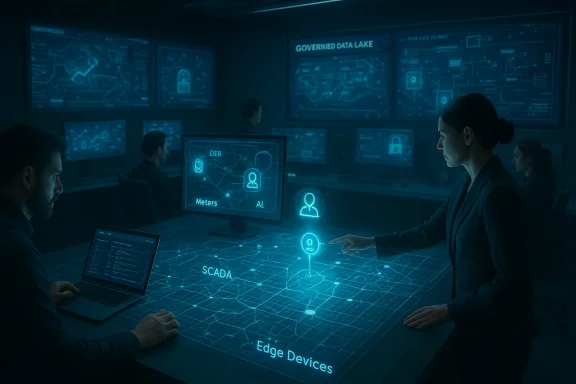 Trusted data foundations: the non‑sexy but essential priority
The problem: inconsistent definitions, latency, and trust gaps
Utilities generate telemetry, SCADA logs, outage records, imagery, work‑order histories, customer data, and third‑party datasets. In many organizations these reside in stovepiped systems with inconsistent schemas and governance, creating multiple “single sources of truth.” The result: conflicting dashboards, slow analyses, and AI models that perform well in pilots but fail in production because data lineage, latency, and access controls differ across zones of the enterprise. Deloitte and market analysts document how DER proliferation and electrification increase the need for a unified data approach — not just for analytics but for real‑time operational control.Microsoft’s technical play and independent verification
Microsoft is positioning Microsoft Fabric, OneLake, and Copilot connectors as the scaffolding for a governed, enterprise‑scale data foundation that supports analytics and agentic workflows. Fabric unifies ingestion, transformation, storage, and analytics; Copilot connectors extend trusted enterprise data into natural‑language assistants while preserving permissions and governance. Microsoft’s documentation spells out how Copilot connectors can operate as synced or federated sources, enabling either indexed searches or real‑time queries while preserving source‑system ACLs and authentication. These are critical features for utilities that cannot duplicate sensitive OT telemetry into unsecured indexes.Cross‑checking this with industry deployments shows the pattern: GE Vernova’s GridOS Data Fabric is now supported on Azure to bridge OT and enterprise datasets, while Hitachi is combining Ellipse EAM with Microsoft Fabric, Dynamics 365, Copilot, and Foundry to create integrated asset lifecycle solutions — both concrete moves toward the kind of unified data stacks Microsoft describes. These vendor steps are evidence that the architecture Microsoft proposes is being adopted by major grid vendors, not just described as theory.
Practical implications for utilities
- Without consistent semantics and governance, models can contradict operator judgment and be ignored.
- Federated connectors and role‑based access let Copilot‑style assistants surface answers while respecting operations‑grade access controls.
- Investing in a single governed data lake + catalog + model lifecycle reduces duplicated effort across engineering, operations, and field teams.
From siloed AI to agentic operations: what “agent‑enabled” really means
Moving beyond narrow use cases
At DTECH, the phrase “agent‑enabled workflows” described systems that can manage multi‑step processes across domains — for example, detect an outage risk signal, prioritize the likely cause, propose corrective switching sequences, generate a work order, and pre‑stage crews — while keeping humans in thtical steps. The idea is not autonomous grid control without oversight; it’s agentic assistance that shortens the path from signal to reliable action. Microsoft and partners emphasized explainability, traceability, and auditable trails as core requirements for operator acceptance.How to assess agent‑enabled systems
When evaluating vendor claims, utilities should benchmark agents against these criteria:- Data grounding: Does the agent reference authoritative, auditable datasets?
- Explainability: Can it explain recommendations in operator terms and cite the data that drove them?
- Human‑in‑the‑loop controls: Are there enforced approval gates for safety‑critical actions?
- Model lifecycle: Is there observable model versioning, rollback, and performance monitoring?
- Latency and locality: Can the agent operate under edge constraints or degraded networks?
Partner announcements at DTECH and why they matter
DTECH 2026 wasn’t just talk: several partners announced integrations that move vendor products onto Azure and into Microsoft’s AI stack. These are practical enablers for the productionization the industry needs.Dragos — OT security integrated with Microsoft Sentinel
Dragos announced expanded collaboration with Microsoft to deploy the Dragos Platform on Azure and integrate OT telemetry and threat intelligence into Microsoft Sentinel. This integration promises unified IT/OT security operations, OT‑specific detection signals in Sentinel, and streamlined procurement via Microsoft Marketplace — a step that lowers the friction for operational security at scale. For utilities, OT‑native threat detection paired with enterprise SIEM is essential as connectivity increases.GE Vernova — GridOS Data Fabric on Azure
GE Vernova is supporting GridOS Data Fabric on Azure to federate OT and IT datasets for grid orchestration. This aligns with the unified data foundation strategy: it’s a vendor offering that targets the precise gap utilities face between real‑time OT systems and enterprise analytics. Utilities that adopt GridOS on Azure can reduce bespoke integration work and accelerate analytics deployment across planning and operations.Hitachi — Ellipse EAM + Microsoft stack
Hitachi Energy is reinventing Ellipse EAM by incorporating Microsoft Dynamics 365, Fabric, Microsoft 365 Copilot, and Foundry. The combined solution focuses on lifecycle‑aware asset and workforce management that connects procurement, finance, and maintenance workflows — enabling predictive maintenance and better capital program decisions. For asset‑intensive utilities, this reduces emergency repairs and improves long‑term reliability.Itron — IEOS Connector for Microsoft 365 Copilot
Itron’s IEOS Connector for Microsoft 365 Copilot grounds Copilot in grid‑edge data from meter data management and operations optimizer systems. This connector enables natural‑language queries against consumption patterns, outage history, transformer associations, and other grid‑edge data — a practical way to put trusted telemetry into operator and field workflows without breaking governance. The manufacturer also plans to distribute these solutions via Microsoft Marketplace.Schneider Electric — One Digital Grid Platform integration
Schneider Electric’s One Digital Grid Platform is explicitly designed to integrate with cloud and AI platforms to shorten the path from prediction to action. Schneider’s platform combined with Microsoft capabilities promises prebuilt patterns for planning, asset management, and operations orchestration — another example of vendors moving from bespoke integrations to reusable reference architectures.These announcements matter because they reduce integration risk: when major vendors support a common cloud and AI foundation, utilities can move faster from pilots to repeatable, auditable deployments.
Security and resilience: the non‑negotiable layer
The attack surface grows with connectivity
As AI and cloud extend deeper into OT, security is no longer a sidebar. Microsoft and partners repeatedly emphasized identity and access management, monitoring, and consistent governance across cloud, edge, and on‑premises stacks. Dragos’ integration into Sentinel and federated connector models that respect ACLs are direct responses to this reality: visibility and enforcement must be unified, not patched. Utilities must treat operational security and resilience as engineering design constraints for modernization programs.Resilience engineering for AI workflows
Resilience means multiple things in this context: the ability to operate under partial network failure, clear human fallback procedures when agents fail, and auditable decision trails for regulators. Utilities should require:- Fail‑safe modes where agents raise recommended actions but do not execute without human approval.
- On‑device or edge inference where latency or sovereignty requires local reasoning.
- Continuous monitoring for model drift and performance degradation, with automated rollback controls.
A practical roadmap: turning pilots into production (an operational playbook)
Utilities that have wrestled with dozens of pilots will recognize these steps as both pragmatic and necessary. Below is a condensed, operational playbook that takes the conference themes into actionable steps.- Inventory and classify datasets (telemetry, GIS, work orders, customer records). Prioritize authoritative sources for each domain and document latency requirements.
- Build a governed data lake and catalog (OneLake/Microsoft Fabric or equivalent) with enforced sensitivity labels, lineage, and role‑based access. Validate with Copilot connector patterns (synced vs federated) for each dataset.
- Select cross‑domain pilot(s) that require integrated data (outage readiness, capacity planning, or major event response). Ensure pilots include operational acceptance criteria (time to decision, reduced crew hours, fewer emergency repairs).
- Implement model lifecycle management (catalog, versioning, observability) with a deployment pipeline and rollback strategy (Foundry or similar). Simulate degraded networks and explainability requirements for operator acceptance.
- Integrate OT security and detection capabilities (e.g., Dragos on Azure + Sentinel) and require red‑team validation for any agent that touches operational processes.
- Pilot agent workflows in a controlled operational environment with a human‑in‑the‑loop policy and audit trails. Extend to field crews through edge connectors that preserve ACLs (Itron IEOS + Copilot connector example).
- Measure and report outcomes in regulatory and executive formats: reliability metrics, time to restore, crew utilization, avoided emergency repairs, and ROI on capital programs.
- Codify reusable patterns into reference architectures and push them into procurement templates and partner catalogs to avoid bespoke rebuilds.
Risks, trade‑offs, and governance
Vendor lock‑in vs. standardization
Adopting a single cloud and companion partner architecture accelerates delivery, but it raises valid concerns about vendor lock‑in. Utilities should balance faster outcomes with modular, standards‑based designs that preserve the ability to swap components — for example, using open data schemas, published APIs, and federation patterns rather than deep proprietary bindings.Data sovereignty and regulatory complexity
Large utilities and transmission organizations operate under multi‑jurisdictional oversight. Pilot data replication strategies that work in a test lab can run afoul of data residency or critical infrastructure regulations when scaled. Utilities must include legal and regulator stakeholders early and verify federated connector behaviors and data residency attributes for each deployment. Recent regionally focused MoUs show customers are explicitly seeking sovereign controls for industrial AI deployments.Cyber risk of expanded connectivity
More integration between IT and OT means a larger, more complex attack surface. Bringing OT telemetry into enterprise services should be accompanied by OT‑aware threat detection, segmented networks, and rigorous change management. Dragos’ Azure integration is a helpful example of how vendor and cloud capabilities can reduce friction in deploying OT security at scale, but it doesn’t replace utility operational security engineering.Workforce and cultural change
Operators and field crews are rightly cautious about handing control to algorithms. The most durable programs pair agents with operator training, clear guardrails, and a gradual approach where AI augments, not replaces, trusted human practices. Acceptance metrics should include operator confidence and adoption rates as much as pure technical accuracy.Critical assessment: strengths and limits of the DTECH story
Notable strengths
- The shift from pilots to “industrialized patterns” is realistic and necessary. Vendors moving to Azure and packaging domain solutions (GridOS on Azure, Ellipse + Microsoft stack, IEOS Copilot connector) materially lower integration barriers and speed time to value.
- Microsoft’s investment in governed data tooling (Fabric, OneLake, Copilot connectors) addresses a foundational barrier that routinely stalls AI production in utilities. When properly implemented, these tools can deliver the lineage, access control, and lifecycle features operators require.
- The explicit emphasis on OT‑aware security (Dragos + Sentinel) is the right posture for critical infrastructure modernization. Security architectures that follow the Microsoft + Dragos approach give utilities a pragmatic way to unify detection and response.
Potential weaknesses and open questions
- Technology is only one part of the problem. Procurement cycles, regulatory approvals, and legacy asset replacement timelines still limit how fast utilities can realize full production impacts. Independent market research shows that digital investments face interoperability and regulatory frictions that aren’t solved by vendor announcements alone.
- The promise of agentic operations hinges on trust and explainability. Many current agent prototypes are not yet mature on explainability and rollback controls in chaotic, real‑world events. Utilities must insist on operator‑facing explainability and full audit trails before live deployment.
- There is a real risk of uneven adoption: large, welll move faster, potentially widening capability gaps with smaller distribution utilities. Programs to share reference architectures, funding, and managed services will be necessary to avoid fragmentation.
What utilities should ask vendors and partners — a short checklist
- How do you guarantee data lineage, sensitivity labeling, and role‑based access when connecting OT sources? Provide technical proof points for federated vs. indexed connectors.
- Show the model lifecycle: Where are models cataloged, how are versions managed, and what rollback procedures exist in production?
- Demonstrate explainability and operator workflows with a live scenario: how does the agent recommend actions, and how can operators reject, modify, and audit them?
- Provide OT‑specific security integrations and red‑team results that include patching strategies and emergency rollback plans.
- Supply a modular reference architecture and migration path so we avoid long‑term lock‑in while still accelerating outcomes.
Conclusion: execution, not novelty
DTECH 2026’s message was practical: the grid is evolving into a real‑time, hybrid IT/OT environment and what utilities need now are reproducible engineering patterns that turn pilots into governed, auditable production systems. Microsoft’s stack — Fabric, Copilot connectors, Foundry — combined with partner integrations from Dragos, GE Vernova, Hitachi, Itron, and Schneider Electric, creates a blueprint that can accelerate that transition. But the technology alone won’t guarantee success. Utilities must pair platform choices with disciplined data governance, OT‑aware security, operator‑centric design, and regulator‑ready documentation.If properly executed, the next chapter of grid modernization will be defined not by flashy pilots but by measurable improvements in reliability, affordability, and workforce productivity. That outcome depends on one simple but hard truth: treating data trust, human oversight, and security as design constraints, not optional features.
Source: Microsoft Moving AI from pilots to production for modern utilities - Microsoft Industry Blogs
