

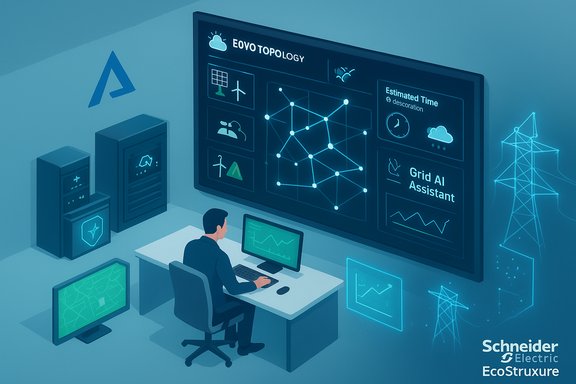
Schneider Electric’s One Digital Grid Platform arrives as a pragmatic attempt to stitch planning, operations and asset management into a single, AI-enabled fabric that promises faster outage recovery, better distributed energy resource (DER) integration and a stepped path to grid modernization without ripping out existing infrastructure. The company unveiled the platform during a series of events in 2025 and positions it as a modular, hybrid-cloud product built on its EcoStruxure portfolio — notably EcoStruxure ADMS, DERMS and ArcFM — with first-party AI features such as an Estimated Time of Restoration (ETR), a Grid AI Assistant and AI-based network model tuning, and with Microsoft Azure used as the hybrid-cloud foundation.
Modern distribution grids are being stretched on three fronts at once: the sheer increase in load driven by electrification and AI data centres, the proliferation of DERs that shift power flows unpredictably, and a step-change in customer expectations for timely outage information and transparency. Schneider Electric frames One Digital Grid as a response to these combined pressures: a single platform that can host planning tools, operational decision support, asset lifecycle workflows and customer-facing communications in a modular architecture that scales from on-premises control rooms to cloud-hosted analytics. The company’s launch materials and distributed press coverage describe the platform as available globally and built to interoperate with third‑party systems while leaning on Azure for hybrid-cloud scale and security. Schneider’s narrative also references quantified business outcomes — substantial ROI and time-savings — drawn from a Forrester Consulting study cited in Schneider’s announcement. Those figures are prominent in company messaging but are vendor‑cited and should be treated as directional until the underlying Forrester report is reviewed by prospective buyers.
Strengths of this approach:
Schneider Electric’s One Digital Grid Platform is a signal of where industry tooling is headed: modular, AI-augmented, and hybrid-cloud native. The innovation is less about a single novel algorithm than about packaging operationally relevant AI into workflows utilities already rely on — and making a credible path to cloud-scale analytics while recognising that the grid’s physical realities demand careful, conservative deployment. The platform’s success will be measured in regained minutes of uptime, more accurate customer communications, and clear operating-cost reductions verified by independent audits — not just in press-release percentages. Utilities that treat the launch as an invitation to disciplined pilots rather than a turnkey miracle are the ones most likely to convert Schneider’s engineering claims into reliable, day-to-day value.
Source: Techzine Global Schneider Electric launches One Digital Grid Platform for grid management
 Background / Overview
Modern distribution grids are being stretched on three fronts at once: the sheer increase in load driven by electrification and AI data centres, the proliferation of DERs that shift power flows unpredictably, and a step-change in customer expectations for timely outage information and transparency. Schneider Electric frames One Digital Grid as a response to these combined pressures: a single platform that can host planning tools, operational decision support, asset lifecycle workflows and customer-facing communications in a modular architecture that scales from on-premises control rooms to cloud-hosted analytics. The company’s launch materials and distributed press coverage describe the platform as available globally and built to interoperate with third‑party systems while leaning on Azure for hybrid-cloud scale and security. Schneider’s narrative also references quantified business outcomes — substantial ROI and time-savings — drawn from a Forrester Consulting study cited in Schneider’s announcement. Those figures are prominent in company messaging but are vendor‑cited and should be treated as directional until the underlying Forrester report is reviewed by prospective buyers. What One Digital Grid Platform claims to deliver
Core capabilities at a glance
- Integrated planning + operations + asset management in a modular system that leverages existing EcoStruxure software building blocks (ADMS, DERMS, ArcFM).
- Estimated Time of Restoration (ETR): AI-driven restoration time forecasts that combine grid telemetry, weather forecasts, crew availability and outage history to produce and refine customer-facing restoration estimates.
- Grid AI Assistant: Embedded AI to assist operators in real-time troubleshooting and workflow optimization within ADMS.
- AI-based Network Model Tuning: Algorithms that compare mapping, operational and customer-meter data to detect and reconcile inconsistencies between a grid’s digital model and the physical network.
- Hybrid cloud foundation on Microsoft Azure: Use of Azure services including Azure OpenAI Service, Defender for IoT, Sentinel and Azure Arc to deliver cloud scale, managed AI and cybersecurity.
Why modularity matters
The platform’s modular design is positioned to let utilities pick and choose capabilities — for example, using ADMS and ETR first, then adding DERMS orchestration or advanced asset performance modules later — which is a practical approach for utilities that cannot afford large brownfield revolutions. Numerous industry deployments have shown the value of stepwise modernization when legacy SCADA, GIS and field asset registers are widely heterogeneous. This modular approach is the same practical pattern many utilities have chosen when bringing cloud-native analytics to OT environments.How the platform is built — technical anatomy and integration points
EcoStruxure lineage: ADMS, DERMS, ArcFM
One Digital Grid builds on Schneider Electric’s long-standing EcoStruxure portfolio. That matters because ADMS (Advanced Distribution Management System) and DERMS (Distributed Energy Resource Management System) are already embedded in many utilities’ operational toolsets; packaging them into a coherent platform reduces the friction of integration and helps preserve prior investments. EcoStruxure ArcFM provides GIS and asset mapping capabilities that feed topology and asset metadata into operational models.Cloud + on-prem hybrid model on Microsoft Azure
The platform is offered on a hybrid architecture that allows critical, latency-sensitive elements to remain on premises while scaling analytic workloads, machine learning pipelines and non‑real‑time services in Azure. Schneider lists integrations with Azure OpenAI Service for model-hosted capabilities, Defender for IoT and Sentinel for cybersecurity, plus Azure Arc for hybrid management — an architecture consistent with many industrial-IT designs that must balance latency, data residency and security. Microsoft has publicly endorsed collaborations with Schneider in this space.Real-time data paths and AI
Delivering accurate ETRs and operator assistance requires fast telemetry ingestion, reliable topology and crew logistics feeds, and robust weather and outage-history models. Schneider says ETR fuses grid telemetry, weather forecasts and crew availability, then continuously refines estimates. Those are plausible inputs; however, the runtime performance and latency tolerances required to support control-room decisions — especially during large storm events — depend heavily on a utility’s network design, the quality of asset metadata and the maturity of field crew management systems. Utilities should therefore evaluate end‑to‑end ingestion latencies, p95 prediction windows and retraining cadences during procurement.What’s new vs. what’s proven
Schneider’s One Digital Grid Platform is not a single, monolithic product built from scratch. Instead, it is a productized consolidation of existing EcoStruxure capabilities plus AI-enabled overlays and a formalized Azure deployment path. That makes the immediate commercial pitch credible: utilities can get AI-enhanced features without wholesale replacement of core OSS/IT systems.Strengths of this approach:
- Faster time-to-value by reusing proven ADMS/DERMS capabilities and adding AI modules rather than redesigning operations from first principles.
- Hybrid deployment flexibility that acknowledges both the latency requirements of control-room operations and the scalability advantages of cloud-hosted analytics.
- Vendor ecosystem and partner reach—Microsoft collaboration gives the platform a clear enterprise cloud route and access to managed AI services.
Critical analysis — strengths, plausibility and immediate value
1) Operational realism: measurable but conditional benefits
Schneider quotes Forrester-derived outcomes (e.g., 184% ROI; $62M in benefits, $40M net gain, 16-month payback) and operational gains (reduced outage penalties, operator time savings, faster crew resolution). Those are meaningful signals that ADMS-led modernization can pay dividends — but they are vendor-cited and conditioned on use-case selection, scale, and baseline maturity. Utilities should obtain the Forrester analysis and compare its assumptions (sample size, baseline costs, scope of automation) against their own telemetry and cost structure before assuming equivalent returns.2) AI’s practical gains — ETR and troubleshooting
AI can synthesize weather, telemetry and crew logistics to deliver better ETRs and to surface likely fault locations faster. When well‑engineered and guarded with human oversight, this reduces customer-call volumes and helps customer communications teams deliver targeted updates. That said, AI output quality is only as good as the inputs: poor asset models, stale GIS data or incomplete outage telemetry will degrade ETR accuracy and can harm public trust when restoration times miss expectations. Independent industry projects show AI helps when data quality is high and governance is strong.3) Interoperability and brownfield constraints
A credible selling point is that One Digital Grid is modular and claims not to require a full systems rip-and-replace. In practice, integration work with legacy SCADA historians, multiple GIS versions, field crew dispatch systems, and fixed‑protocol RTUs remains nontrivial. Expect substantial systems-engineering work to normalize tags, reconcile naming conventions, and construct a reliable “single source of truth” for topology. Successful pilots from other vendors stress the need for a rigorous data harmonization phase before AI delivers consistent results.4) Cybersecurity posture
Running hybrid OT/IT workloads invites a wide attack surface. Schneider’s integration with Azure Defender for IoT, Sentinel and Azure Arc is intended to provide layered defenses and visibility, but these tools must be configured and maintained by the utility’s security teams. Outages or misconfigurations stemming from cyber incidents are precisely the kinds of events the platform aims to mitigate — so cybersecurity is a gating factor for production deployment. Independent industry guidance recommends strict network segmentation, zero‑trust for OT management endpoints and continuous security validation when cloud and on‑premises controls interact.Risks, unknowns and practical limits
- Data quality and model accuracy: AI-based features like ETR and network model tuning are sensitive to incomplete or incorrect GIS and meter-level data. Model tuning can surface discrepancies, but resolving them requires coordinated field audits and data governance programs.
- Vendor and cloud dependency: Heavy reliance on a single vendor stack (EcoStruxure + Azure + Azure OpenAI) creates risks of lock-in and concentrated failure modes. Utilities should demand portability clauses, clear exit paths and data escape plans in contracts.
- Operational safety and human oversight: Automated recommendations must remain advisory for any action that could compromise safety or regulatory compliance. Human‑in‑the‑loop controls and sign-off workflows are non-negotiable.
- Latency and real-time control boundaries: Certain control‑loop decisions cannot tolerate cloud round-trips. Understanding which parts of ADMS should remain local vs. cloud is essential. Hybrid architectures help, but design discipline is required.
- Regulatory and procurement complexity: Public utilities and cooperatives may face procurement rules, data‑sovereignty constraints and audit requirements that complicate managed cloud deployments. Legal and procurement teams must be involved early.
- Claims verification: Publicly repeated ROI figures and performance percentages are persuasive marketing — but they must be validated through audits, PoV pilots and contractual SLAs as part of vendor selection.
What utilities should ask before committing
- Ask for a clear breakdown of the Forrester ROI study assumptions (sample size, baseline, time horizon). Treat the study as a conversation starter, not a closing argument.
- Request an architecture diagram that shows which control-plane functions remain on-premises, which run in Azure, and what the failover behavior is under connectivity loss.
- Require an interoperable data escape and portability plan — specify formats, export frequency and timelines for decommissioning.
- Insist on a pilot scope that includes real outage scenarios, measurement of ETR accuracy, and operator UX testing. Use measurable KPIs (MTTR, customer update accuracy, false positives/negatives).
- Validate integration with existing GIS and crew management systems; demand a remediation plan and cost estimate for data‑cleaning tasks.
- Define security SLAs and independent penetration‑test obligations, including OT segmentation verification and third‑party attestation.
Implementation path: recommended sequencing
- Phase 1: Proof of value (PoV) on a contained feeder or service area that has reasonably complete GIS and crew-logging data. Measure baseline MTTR and ETR accuracy.
- Phase 2: Extend to a city or county operation with higher customer density and varied DER penetration; integrate DERMS workflows.
- Phase 3: Roll out customer engagement features (ETR messaging, web portals) once ETR performance meets agreed tolerance levels.
- Phase 4: Mature asset performance and lifecycle modules with predictive maintenance loops and closed‑loop automation under strict human‑in‑the‑loop governance.
- Map data sources, tag names and retention policies.
- Run automated data-quality checks and fix top-20 discrepancies.
- Deploy a sandbox instance on Azure with telemetry replay tooling.
- Run ETR and Grid AI Assistant in advisory mode for 90 days.
- Compare AI estimates to actual restoration times and iterate.
Commercial and market context
Schneider timed this launch amid broad market signals: hyperscaler and enterprise demand for AI compute is pressuring local grids and raising the stakes for grid modernization. Recent coverage has emphasized the growth of data‑centre energy demand and the need for utilities to plan for large incremental loads — a contextual driver for solutions like One Digital Grid. In short, vendors and utilities face a moment where digital operational improvements are important both for resilience and for enabling new loads. Schneider’s positioning also benefits from third‑party analyst recognition in 2025 that placed the vendor at or near the top of rankings for grid digitalization technology; those rankings reflect adoption and product breadth but are not a substitute for fit-for-purpose technical due diligence.Governance, people and skills — a frequently overlooked cost
Technology alone does not assure improved reliability. The organizational change required to realize AI-augmented operations is substantial:- New cross-functional roles (data engineers, OT security leads, AI validation owners).
- Operator training on AI‑augmented workflows and emergency procedures.
- Formal governance for model lifecycle: versioning, rollback, performance monitoring and bias checks.
Final verdict — practical promise, conditional payoff
Schneider Electric’s One Digital Grid Platform is a defensible market move: it packages proven EcoStruxure building blocks together with targeted AI features and an Azure-based hybrid deployment model that utilities can consume incrementally. For utilities searching for an operational path to integrate DERs, improve outage communications, and accelerate grid modernization, the platform provides a pragmatic vendor-backed package that reduces the need for immediate, large-scale infrastructure replacements. However, the actual payoff will depend entirely on three controllable factors:- Data quality and model grounding: Without accurate GIS, meter and crew-data feeds, AI features will underperform.
- Clear procurement and governance terms: Avoid opaque ROI claims by insisting on measurable PoV deliverables and contractual SLAs.
- Security and operational boundaries: Ensure hybrid design respects latency and safety constraints and that cybersecurity controls are independently validated.
Schneider Electric’s One Digital Grid Platform is a signal of where industry tooling is headed: modular, AI-augmented, and hybrid-cloud native. The innovation is less about a single novel algorithm than about packaging operationally relevant AI into workflows utilities already rely on — and making a credible path to cloud-scale analytics while recognising that the grid’s physical realities demand careful, conservative deployment. The platform’s success will be measured in regained minutes of uptime, more accurate customer communications, and clear operating-cost reductions verified by independent audits — not just in press-release percentages. Utilities that treat the launch as an invitation to disciplined pilots rather than a turnkey miracle are the ones most likely to convert Schneider’s engineering claims into reliable, day-to-day value.
Source: Techzine Global Schneider Electric launches One Digital Grid Platform for grid management
