

AMD has officially pushed FSR “Redstone” into the wild as part of the AMD Software: Adrenalin Edition 25.12.1 driver package, delivering a consolidated, machine-learning-powered suite that bundles upscaling, frame generation, ray-tracing denoising, and a future radiance-caching system — but the update is gated to RDNA 4 (Radeon RX 9000) hardware, leaving older Radeon owners with only legacy fallbacks for now.
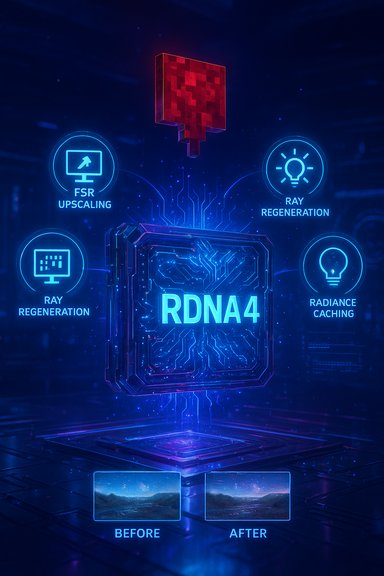
AMD’s FidelityFX Super Resolution (FSR) has been through a handful of iterations — analytical temporal upscalers, optical-flow–based frame generation and the short-lived FSR 4 announcement earlier in the year — but Redstone is best read as a reorganization and expansion rather than an entirely new product. AMD folded earlier version numbering into a single umbrella, calling the overall ML-driven framework FSR “Redstone”, while renaming the previously announced FSR 4 to FSR Upscaling to make room in the ecosystem for multiple ML-powered modules. This consolidation aims to present a more coherent developer API and feature set: Redstone now explicitly includes FSR Upscaling, FSR Frame Generation, FSR Ray Regeneration, and FSR Radiance Caching, with an SDK and driver-level integration to make those modules available to game teams and PC users. AMD’s official launch notes and product pages frame Redstone as an all-in-one ML toolbox for modern game rendering.
That said, momentum will be determined by two real-world measures: how quickly studios implement Redstone in a meaningful way, and whether AMD opens more flexible fallbacks for the large installed base of non-RDNA 4 cards. The former depends on developer resources and the SDK’s ergonomics; the latter is partly a business decision about where AMD wants to invest engineering effort for legacy hardware. Early signs are promising in quality, but the ecosystem strategy will determine how impactful Redstone becomes for the majority of gamers.
Caveat: vendor marketing numbers and early driver reports should be treated with caution. Expect iterative improvements — driver updates, SDK polishing, and broader developer adoption — over the coming months. If AMD can broaden device support or rapidly grow the native Redstone-enabled game catalog, Redstone has the technical credibility to significantly narrow the ML features gap with competitors.
Source: Windows Central https://www.windowscentral.com/hardware/amd/amd-fsr-redstone-release/
 Background: how FSR evolved into Redstone
AMD’s FidelityFX Super Resolution (FSR) has been through a handful of iterations — analytical temporal upscalers, optical-flow–based frame generation and the short-lived FSR 4 announcement earlier in the year — but Redstone is best read as a reorganization and expansion rather than an entirely new product. AMD folded earlier version numbering into a single umbrella, calling the overall ML-driven framework FSR “Redstone”, while renaming the previously announced FSR 4 to FSR Upscaling to make room in the ecosystem for multiple ML-powered modules. This consolidation aims to present a more coherent developer API and feature set: Redstone now explicitly includes FSR Upscaling, FSR Frame Generation, FSR Ray Regeneration, and FSR Radiance Caching, with an SDK and driver-level integration to make those modules available to game teams and PC users. AMD’s official launch notes and product pages frame Redstone as an all-in-one ML toolbox for modern game rendering. What’s in FSR Redstone (the components explained)
FSR Upscaling (formerly FSR 4)
FSR Upscaling is the ML-driven upscaler AMD previewed earlier in the year. It uses AMD-trained neural models and leverages low-precision numeric formats to reconstruct high-quality frames from lower-resolution renders, improving perceived detail while reducing the GPU cost of native resolution rendering.- Intended benefits: higher frame rates at near-native image quality.
- Implementation: driver- and game-integrated models; can be enabled either natively in games or via AMD Software’s upscaling wrapper where supported.
- Notes: AMD rebranded this from “FSR 4” to “FSR Upscaling” under the Redstone banner.
FSR Frame Generation
FSR Frame Generation is a neural-frame interpolation system that predicts and inserts synthetic frames to increase fluidity and frame rate. The model is trained to better handle motion, depth and temporal consistency than AMD’s older analytical frame-generation approaches.- At launch, AMD claims the ML frame gen has significantly improved over prior FSR frame interpolation, delivering cleaner motion and fewer artifacts.
- Hardware dependence: ML-powered frame generation in Redstone requires RDNA 4 hardware for the full feature set; older cards receive a fallback “analytical” interpolation where implemented.
FSR Ray Regeneration
Ray Regeneration is AMD’s ML-based ray-tracing denoiser: it attempts to infer full ray-traced results from sparse ray samples, cleaning noise and restoring fine ray-traced detail at lower rendering cost.- Real-world debut: The earliest shipping example of Ray Regeneration is in Call of Duty: Black Ops 7, where AMD and the developer collaborated to ship the feature on RX 9000 hardware.
- Scope: At launch Ray Regeneration is game-specific and limited; more titles may adopt it later.
FSR Radiance Caching (coming in 2026)
Radiance Caching is the Redstone feature aimed at efficient neural-driven global illumination: the engine learns and predicts how light propagates through a scene, offering a way to accelerate GI-heavy rendering. AMD positions Radiance Caching as a developer-facing system that will be adopted in stages and is expected to appear more broadly in 2026.- Status: announced but not widely implemented at launch. AMD’s roadmap indicates developer rollout next year.
Compatibility and hardware requirements — the cold facts
The most consequential practical detail for PC owners is that the full, ML-accelerated Redstone suite is exclusive to RDNA 4 (Radeon RX 9000-series) GPUs at launch. AMD’s driver and product pages explicitly restrict Redstone’s ML acceleration to RDNA 4 silicon, with fallback options (often the older FSR 3 analytical methods) provided for earlier Radeon families. If you own an RX 6000 or RX 7000 series card, you will largely be limited to those fallbacks or to game-native non-ML variants until — and unless — AMD expands support. Why the restriction? RDNA 4 introduces dedicated AI/matrix acceleration pipelines, support for low-precision floating formats such as FP8 (and BF8 variants), structured sparsity, and enhanced WMMA-like matrix operations that dramatically improve inference throughput. Those on-die math pipelines are designed to accelerate the neural networks Redstone relies on; older RDNA generations lack the same dedicated hardware perf characteristics, which is why AMD set RDNA 4 as the minimum for Redstone’s ML features. Multiple hardware deep-dives confirm FP8 and AI-matrix support are central RDNA 4 attributes.Drivers, SDK and the rollout: what shipped and how to enable it
- Distribution: Redstone shipped as part of Adrenalin Edition 25.12.1, published in early December 2025. The official release notes call out support for FSR Redstone and list fixes/known issues to be aware of.
- SDK: AMD published a Redstone SDK for developers in parallel, aiming to give devs both the tools and documentation to implement the features natively or to adopt AMD’s driver-side wrappers where appropriate.
- Activation: Some games will include native toggles for Redstone features; others can be enabled through AMD Software when driver-provided wrappers are available. Expect variation from title to title.
Early performance and quality: how Redstone stacks up vs. the competition
Independent outlets and reviewers who had early access to RDNA 4 hardware reported that Redstone’s ML frame generation represents a tangible quality uplift compared with AMD’s older frame-gen approaches. PC Gamer’s early testing on an RX 9070 XT noted that ML-based frame generation brings AMD’s implementation closer to NVIDIA’s DLSS Frame Generation in perceptual quality; it still lacks some DLSS features such as extreme 3x/4x synthetic frame multipliers, but the gap has narrowed. Ray Regeneration in titles that support it (notably Call of Duty: Black Ops 7 at launch) showed appreciable denoising and recovered detail compared with path-traced scenes without ML denoising, although the feature set is limited until more developers implement it. Multiple outlets noted that the gains are real where supported, but the net effect on adoption will hinge on how quickly game developers integrate Redstone holistically. AMD has also published performance claims — for example, demos that showed multi-fold FPS improvements when combining upscaling with frame interpolation and Radeon Anti-Lag — but those numbers are vendor marketing data and should be treated cautiously until independently validated by broad testing across games and hardware. NotebookCheck and TechSpot pointed out AMD’s internal figures while also urging independent benchmarking.Game support and adoption at launch
AMD states that more than 200 games support at least one Redstone feature (this includes older FSR versions and analytical fallbacks), while 32 games were confirmed to support FSR Frame Generation specifically at launch. The initial Frame Generation list includes a mix of AAA and indie titles such as Arc Raiders, Call of Duty: Black Ops 7, Cyberpunk 2077, F1 25, God of War Ragnarök, and Hogwarts Legacy (some with native FSR Upscaling and others via driver-side implementations). That 32-title figure was reported by game-lists and media coverage at launch. Two practical takeaways:- “Support” can mean very different things — native integration with ML models, driver-provided wrappers, or simple compatibility with older analytical FSR methods. Expect variance in quality and toggles across titles.
- The Frame Generation list at launch is relatively small compared with the entire game ecosystem; broad uptake will depend on developer appetite and the ease of integrating the new SDK.
Developer perspective: ease of integration and the SDK story
AMD’s Redstone SDK purports to simplify integration by exposing modular APIs for each Redstone capability. The theory is that developers can adopt one or more components as needed — upscaling, frame gen, ray regeneration, or radiance caching — rather than rewriting pipelines around a monolithic system.- Benefit: modular design lowers the barrier for studios that want incremental ROI (for example, adding denoising first, then frame gen later).
- Risk: every engine and renderer is different; consistent quality across hundreds of titles requires time, engineering resources, and test coverage.
Technical analysis: why RDNA 4 matters, and what AMD is betting on
Redstone’s reliance on RDNA 4 ML acceleration is a deliberate architectural bet. RDNA 4 brings:- Dedicated AI/matrix pipelines with improved WMMA (wave matrix multiply-accumulate) support.
- Native support for low-precision floating formats such as FP8 and BF8, enabling faster neural inference with acceptable accuracy trade-offs.
- Structured sparsity and optimized dense-matrix throughput that increase inference efficiency compared with previous RDNA generations.
Strengths: what AMD got right
- Consolidation and clarity: Redstone simplifies AMD’s messaging by grouping ML features into a single brand and modular SDK, making it easier for developers and users to understand what each capability does.
- Meaningful quality uplift: Early hands-on tests show Redstone’s frame generation and ray-regeneration approaches materially improve visuals where implemented, narrowing the gap with NVIDIA’s DLSS ecosystem.
- Future-facing architecture: Tying Redstone to RDNA 4’s ML pipelines allows AMD to deliver higher throughput and better model fidelity across multiple features, aligning hardware and software roadmaps.
Risks and weaknesses: the practical downsides
- Fragmented availability: Locking ML Redstone features to RDNA 4 at launch leaves the large installed base of RX 6000 and RX 7000 owners with fallbacks or no access to key features — a consumer friction point that could slow visible adoption.
- Confusing naming and messaging: AMD’s rebranding (dropping version numbers, renaming FSR 4 to FSR Upscaling, and putting everything under “Redstone”) has created short-term confusion among users, publications and even some developers. Clearer documentation and outreach will be required.
- Limited launch titles for full ML features: While 200+ games claim some form of FSR/Redstone support, only about 30–32 titles support the new ML Frame Generation at launch; the practical payoff for most gamers remains limited until more titles adopt Redstone natively.
- Marketing vs. independent reality: AMD’s vendor claims of multi-fold FPS boosts in certain scenarios are useful signals, but they’re marketing figures. Independent testers must validate those numbers across real-world playlists and hardware to understand the real average gains.
Practical advice for Radeon owners (actionable checklist)
- If you own a Radeon RX 9000 (RDNA 4) GPU:
- Update to AMD Software: Adrenalin Edition 25.12.1 to access Redstone features where supported.
- Check individual game settings and AMD’s supported-game lists to enable FSR Upscaling, Frame Generation, or Ray Regeneration as appropriate.
- Expect ongoing driver updates; monitor release notes for fixes and optimizations.
- If you own an RX 6000 / RX 7000 (RDNA 2/3) GPU:
- Recognize that full Redstone ML features are not officially supported; you will typically get analytical fallbacks (FSR 3.x) where implemented.
- Avoid unsupported DLL mods on production machines — community hacks may exist but are unsupported and can be unstable.
- For developers:
- Evaluate Redstone SDK integration if your engine roadmap includes upscaling, frame gen, or ray-traced denoising — but budget QA time to tune ML models per-game.
- Consider staged adoption: adopt one Redstone module first (e.g., denoising) and expand as you validate quality and perf.
Bigger picture: where Redstone fits in the GPU battle
Redstone is AMD’s clearest push yet to address the ML-led features that NVIDIA has been shipping for several generations. By integrating ML at multiple rendering stages and tying it to hardware acceleration in RDNA 4, AMD has a credible strategy: build GPUs with ML pipelines, expose a modular SDK, and co-engineer high-profile titles to show the payoff.That said, momentum will be determined by two real-world measures: how quickly studios implement Redstone in a meaningful way, and whether AMD opens more flexible fallbacks for the large installed base of non-RDNA 4 cards. The former depends on developer resources and the SDK’s ergonomics; the latter is partly a business decision about where AMD wants to invest engineering effort for legacy hardware. Early signs are promising in quality, but the ecosystem strategy will determine how impactful Redstone becomes for the majority of gamers.
Final verdict: solid step, not a finished race
FSR Redstone is a substantive, technically sensible consolidation of AMD’s ML ambitions in graphics: it combines upscaling, frame generation, ray-tracing denoising and a future radiance cache under a single developer framework and pairs that with RDNA 4 hardware tuned for inference acceleration. Where Redstone is supported natively — for example, Frame Generation on RX 9070 XT or Ray Regeneration in Call of Duty: Black Ops 7 — reviewers and early testers see real, tangible visual and performance benefits. However, the launch is imperfect. Locking most ML features to RDNA 4 at debut fragments the user base, and the launch game list for full ML Frame Generation is small. Vendor performance claims look attractive on paper but require broad, independent verification across titles. For Radeon RX 9000 owners, Redstone is a meaningful upgrade to explore; for everyone else, it’s a clear sign of the direction AMD is heading — but not yet a universal solution.Caveat: vendor marketing numbers and early driver reports should be treated with caution. Expect iterative improvements — driver updates, SDK polishing, and broader developer adoption — over the coming months. If AMD can broaden device support or rapidly grow the native Redstone-enabled game catalog, Redstone has the technical credibility to significantly narrow the ML features gap with competitors.
Source: Windows Central https://www.windowscentral.com/hardware/amd/amd-fsr-redstone-release/
