

India’s food regulator has quietly — and decisively — raised the bar on compliance, forcing food businesses, importers and marketers to rethink testing, labelling and supply‑chain controls all at once.
The Food Safety and Standards Authority of India (FSSAI) has stepped up enforcement across several fronts: faster turnaround on laboratory reports for imported consignments, a push to adopt internationally recognised analysis methods, clarified classifications for honey that exceed hydroxymethylfurfural (HMF) thresholds, and a draft amendment that would formalise standard drink labelling while tightening wine definitions. These actions arrive alongside an intensifying regulatory environment where retail sampling, targeted show‑cause notices and monetary penalties are no longer rare exceptions but a predictable part of compliance risk for packaged‑food firms. Recent penalty orders against a major dairy company illustrate that “fit for consumption” is not synonymous with being “within prescribed standards” — a distinction with tangible commercial and reputational consequences.
This feature breaks down what’s changed, what businesses must do now, the practical impacts on imports and retail, and how marketing and creator ecosystems (including AI‑driven social content) must adapt to stay compliant and competitive.
Why this matters: Imported consignments — especially bulk commodities, ingredients and high‑value processed foods — may now be stopped, sampled and adjudicated on a faster cycle. That compresses the time importers have to verify third‑party lab findings, arrange re‑testing, or present chain‑of‑custody evidence before administrative orders are issued. The practical consequence is a heightened premium on pre‑shipment testing, accredited lab partnerships and transparent sample traceability.
Evidence of the regulator’s tougher posture is already visible in retail‑level sampling and penalties; regulators are levying fines where numeric specifications fall short even when products are “fit for consumption.” This shift signals that compliance budgets must prioritise technical QA capacity, not just defensive PR.
Note on verification: the Storyboard18 clarification provided with the user’s materials summarises FSSAI’s position. Where documents or lab reports are not attached, firms should treat the headline as a policy statement but validate test‑method details and classification guidance against the regulator’s formal orders or technical circulars before relying on it for corrective action. (If the specific FSSAI circular is required for legal or audit use, obtain the gazetted text or the regulator’s technical guidance directly. [Caution: users asked to supply primary FSSAI circulars where exact numeric thresholds or method references are needed.]
Key implications:
Practical takeaways from that case:
Important caveat: the specific staff accounts and company statements referenced in the Storyboard18 article on layoffs were part of the user’s uploaded materials; however, the searchable dataset available did not contain the full text of that particular piece for independent verification. Treat the anecdotal workforce claims as editorial reportage that should be corroborated with direct company statements or court filings before being relied upon in a compliance audit or negotiation. (If a verified copy of the Storyboard18 article is available, include it in compliance records. [Flagged for verification.]
Best practices for using AI tools safely:
For food businesses the prescription is straightforward: treat technical compliance as a strategic function, not an afterthought. Build lab partnerships, harden traceability, impose marketing gating, and document every claim. For creators and marketers, the era of instant AI content requires stronger human governance and auditable approval trails. The upshot for consumers is likely better clarity and safer products; the upshot for businesses is an operational test of whether they can convert good intentions into verifiable, repeatable practice.
(Where specific legal texts, technical circulars, or the exact Storyboard18 articles are required for audit or legal use — for example, the formal FSSAI circular on import test methods, the detailed honey HMF guidance, or the Good Glamm staff reportage — obtain the official gazette notification or authenticated article PDFs and attach them to the compliance dossier. Several items summarised here were drawn from the Storyboard18 material provided and internal regulatory analyses available in the uploaded files; readers seeking verbatim regulatory language should consult the FSSAI notices or the full Storyboard18 pieces for the primary text.
Source: Storyboard18 FSSAI tightens food import testing norms; new rules mandate faster lab reports, global-standard analysis methods
Source: Storyboard18 FSSAI clarifies: Honey exceeding HMF limit to be classified as ‘substandard,’ not ‘unsafe’
Source: Storyboard18 FSSAI proposes mandatory labeling for standard drinks, updates wine definitions in draft amendment
Source: Storyboard18 https://www.storyboard18.com/amp/ho...glamm-staff-relieved-to-be-laid-off-83716.htm
Source: Storyboard18 How to create viral reels and posts with AI tools - A step-by-step guide for Indian creators
 Background
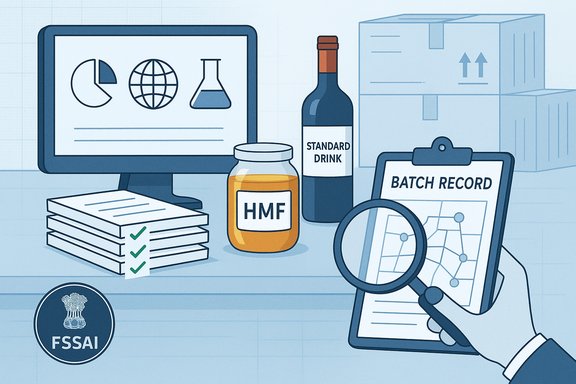
The Food Safety and Standards Authority of India (FSSAI) has stepped up enforcement across several fronts: faster turnaround on laboratory reports for imported consignments, a push to adopt internationally recognised analysis methods, clarified classifications for honey that exceed hydroxymethylfurfural (HMF) thresholds, and a draft amendment that would formalise standard drink labelling while tightening wine definitions. These actions arrive alongside an intensifying regulatory environment where retail sampling, targeted show‑cause notices and monetary penalties are no longer rare exceptions but a predictable part of compliance risk for packaged‑food firms. Recent penalty orders against a major dairy company illustrate that “fit for consumption” is not synonymous with being “within prescribed standards” — a distinction with tangible commercial and reputational consequences.This feature breaks down what’s changed, what businesses must do now, the practical impacts on imports and retail, and how marketing and creator ecosystems (including AI‑driven social content) must adapt to stay compliant and competitive.
What changed: the new enforcement landscape
Faster lab reports and global‑standard analysis
FSSAI’s moves include stricter testing protocols for imports that emphasise speed and internationally accepted analytical methods. The regulator is pushing for shorter laboratory turnaround times and the use of globally recognised test methods, narrowing the window for disputes based on method variance and increasing the regulatory weight of lab results in enforcement actions.Why this matters: Imported consignments — especially bulk commodities, ingredients and high‑value processed foods — may now be stopped, sampled and adjudicated on a faster cycle. That compresses the time importers have to verify third‑party lab findings, arrange re‑testing, or present chain‑of‑custody evidence before administrative orders are issued. The practical consequence is a heightened premium on pre‑shipment testing, accredited lab partnerships and transparent sample traceability.
Evidence of the regulator’s tougher posture is already visible in retail‑level sampling and penalties; regulators are levying fines where numeric specifications fall short even when products are “fit for consumption.” This shift signals that compliance budgets must prioritise technical QA capacity, not just defensive PR.
Clarifying “sub‑standard” vs “unsafe”: the HMF/honey note
FSSAI has clarified the classification for honey that exceeds the HMF limit: such honey is to be treated as “sub‑standard” rather than automatically “unsafe.” That legal and technical distinction matters because the remedial pathway, penalty scale and consumer‑safety messaging differ sharply between the two categories.- Sub‑standard = fails to meet prescribed quality or compositional standards but is not necessarily a health hazard.
- Unsafe/adulterated = poses a health risk or contains prohibited contaminants.
Note on verification: the Storyboard18 clarification provided with the user’s materials summarises FSSAI’s position. Where documents or lab reports are not attached, firms should treat the headline as a policy statement but validate test‑method details and classification guidance against the regulator’s formal orders or technical circulars before relying on it for corrective action. (If the specific FSSAI circular is required for legal or audit use, obtain the gazetted text or the regulator’s technical guidance directly. [Caution: users asked to supply primary FSSAI circulars where exact numeric thresholds or method references are needed.]
Draft amendment: standard‑drink labelling and wine definitions
FSSAI’s draft amendment proposes to make labelling of standard drinks mandatory and to update legal definitions for wine categories. The intent is to improve consumer clarity on alcohol strength and serving size, align wine labelling with accepted descriptors, and prevent misleading claims that confuse consumers and regulators.Key implications:
- Producers and importers of alcoholic beverages will likely need to display standard‑drink information on packaging and point‑of‑sale materials.
- Wine makers may see shifts in definition‑driven packaging claims (e.g., varietal or strength thresholds), forcing packaging reprints or product reformulation.
- Retailers and e‑commerce platforms must refresh compliance checks and product metadata to avoid downstream enforcement or removal from listings.
On the ground: enforcement in action (the Parag Milk Foods case)
A recent enforcement episode underlines the regulator’s new posture: a well‑known dairy company received two penalty orders totalling Rs 6.14 lakh after retail samples were judged fit for human consumption but below prescribed standards. The orders were issued under Section 51 of the Food Safety and Standards Act, which covers sub‑standard food. The company characterised the payments as immaterial financially but reserved the right to appeal — a typical posture when firms face technical, not safety, findings.Practical takeaways from that case:
- Retail sampling is real and can trigger administrative penalties even when products aren’t hazardous.
- Section 51 orders focus on specification conformity (fat/moisture/protein levels, HMF or preserve limits), not necessarily microbial safety.
- The reputational fallout and retailer responses (audits, temporary delisting) often exceed direct financial exposure.
What companies must do now: practical compliance playbook
The regulatory squeeze is both technical and procedural. Below is a practical, prioritised checklist to move from reactive to defensive/proactive posture.1. Strengthen pre‑shipment and inbound testing
- Use accredited, internationally recognised labs for pre‑shipment analysis.
- Adopt harmonised test methods (ISO/ICMS/other recognised methods) where appropriate to reduce methodological disputes.
- For high‑risk SKUs, require dual‑lab sign‑offs before shipping.
2. Shorten internal response cycles
- Map the end‑to‑end sample chain of custody (collection time, handler, storage, testing lab).
- Pre‑assign legal and technical points of contact for rapid appeal dossiers.
- Maintain a templated technical rebuttal package (chain‑of‑custody docs, production batch record, in‑house QC results).
3. Label and claim audit
- Conduct a full claims inventory across products and channels.
- Require documentary evidence for every nutrition or superiority claim (supplier COAs, lab reports, validated test methods).
- Train marketing teams on regulatory red flags and implement legal sign‑off gates.
4. Lab relationships and capacity planning
- Build long‑term relationships with multiple accredited labs; do not rely on single‑lab arrangements.
- Reserve lab slots during peak import seasons and factor turnaround time into procurement calendars.
5. Retail and e‑commerce readiness
- Maintain batch‑level traceability and recall maps that link physical batches to SKU barcodes and distribution nodes.
- Pre‑prepare consumer and retailer communication templates to manage perception quickly when a technical non‑conformity is flagged.
6. Crisis playbook
- Spell out triggers for corrective labelling, product holds, or voluntary recalls.
- Keep a communications playbook that distinguishes “safety” messaging from “specification” messaging to avoid unnecessary panic.
Business risks and operational side‑effects
FSSAI’s tighter posture brings clear benefits for consumer protection and marketplace clarity, but it also introduces real operational friction and costs.- Certification bottlenecks and lab backlogs — If demand for accredited testing surges, labs may become backlogged, delaying imports and product launches.
- Cost burden on smaller firms — Fixed testing and documentation costs hit MSMEs disproportionately; absent series‑testing allowances or subsidised lab access, market concentration could increase.
- Reputational damage — A “sub‑standard” designation can be as damaging in consumer perception as a safety finding; proactive communications and rapid corrective action plans are essential.
- Legal uncertainty and timeline risk — Where draft amendments or media reports cite dates, firms must rely on the gazetted legal text and official circulars for exact compliance deadlines. Treat media timelines as prompts for readiness, not as definitive legal schedules.
Marketing, social media and creators: the compliance angle
Packaging and claims are only half the story; the other important axis is how brands talk about products online. Regulators are increasingly policing outcome claims, health assertions and absolute comparative statements. For marketers and creators, that has three immediate consequences:- Advertising and influencer scripts must be pre‑cleared for factual accuracy and documentary support.
- Claims like “100% natural,” “clinically proven” or numeric superiority must be backed by verifiable lab data.
- Rapid, AI‑driven content creation (e.g., short‑form reels and clips) must include a human governance gate to avoid accidentally amplifying unverified claims.
People and culture: workforce stories and industry morale
Media coverage in the same dossier collection highlights workforce stress in consumer and beauty startups — a reminder that regulatory pressure, rapid scaling, and tight margins frequently collide with labour dynamics. Reports of staff saying they felt “stressed, underpaid, overworked” after layoffs point to a deeper ecosystem issue: operational risk is not only technical and legal, it is human. Poor morale can exacerbate compliance lapses because corner‑cutting, insufficient documentation or hurried QC are more likely under chronic staffing stress.Important caveat: the specific staff accounts and company statements referenced in the Storyboard18 article on layoffs were part of the user’s uploaded materials; however, the searchable dataset available did not contain the full text of that particular piece for independent verification. Treat the anecdotal workforce claims as editorial reportage that should be corroborated with direct company statements or court filings before being relied upon in a compliance audit or negotiation. (If a verified copy of the Storyboard18 article is available, include it in compliance records. [Flagged for verification.]
How AI tools can help — and where they can hurt
AI content tools are practical for rapid social content, labelling templates and consumer Q&A automation. The Clipchamp + Copilot ecosystem shows how fast an organisation can create and localise video content, captions, and voiceovers — valuable for retailer training or consumer education. But the same tools increase the speed of distribution for claims that might not have been properly vetted.Best practices for using AI tools safely:
- Require a pre‑publish compliance checklist inside the content workflow (fact checks, COA links, legal sign‑off).
- Keep an auditable record of final prompt inputs and model outputs as part of the campaign archive.
- Use enterprise plans with data‑usage guarantees and tenant isolation where proprietary or regulated information is involved.
Final analysis — strengths, weaknesses and what to watch
Strengths of the regulator’s approach:- Aligning test methods to international norms reduces methodological disputes and harmonises import control.
- Faster lab reporting closes loopholes where aged or variable test methods could be used to delay enforcement.
- Clarifying classifications (e.g., honey HMF) helps regulators apply proportionate sanctions rather than binary safety escalations.
- Lab capacity constraints and the cost burden risk concentrating trade among larger players unless procedural relief (series‑testing, transitional allowances) is formally adopted.
- Rapid enforcement without widely available technical guidance or a transparent lab accreditation ramp may produce friction, delays and contested orders.
- Reputation damage from sub‑standard findings can outsize the direct monetary penalties.
- Official gazette notifications, circulars and the regulator’s technical guidance on accepted analysis methods.
- Announcements on lab accreditation capacity expansion, series‑testing rules, and transitional allowances for imports.
- Retailer and e‑commerce platform responses (stock audits, delistings, stricter vendor onboarding).
- Any court decisions interpreting Section 51 fines and what they mean for the boundary between “unsafe” and “sub‑standard.”
Conclusion
FSSAI’s recent actions raise the compliance bar for every node of the food system: importers, manufacturers, marketers and retailers. The regulator’s choice to emphasise internationally recognised test methods and faster reporting—as well as clarifications on classifications like honey HMF and draft rules for standard‑drink labelling—creates a sharper enforcement environment that rewards rigorous QA, clear documentation and cross‑functional coordination.For food businesses the prescription is straightforward: treat technical compliance as a strategic function, not an afterthought. Build lab partnerships, harden traceability, impose marketing gating, and document every claim. For creators and marketers, the era of instant AI content requires stronger human governance and auditable approval trails. The upshot for consumers is likely better clarity and safer products; the upshot for businesses is an operational test of whether they can convert good intentions into verifiable, repeatable practice.
(Where specific legal texts, technical circulars, or the exact Storyboard18 articles are required for audit or legal use — for example, the formal FSSAI circular on import test methods, the detailed honey HMF guidance, or the Good Glamm staff reportage — obtain the official gazette notification or authenticated article PDFs and attach them to the compliance dossier. Several items summarised here were drawn from the Storyboard18 material provided and internal regulatory analyses available in the uploaded files; readers seeking verbatim regulatory language should consult the FSSAI notices or the full Storyboard18 pieces for the primary text.
Source: Storyboard18 FSSAI tightens food import testing norms; new rules mandate faster lab reports, global-standard analysis methods
Source: Storyboard18 FSSAI clarifies: Honey exceeding HMF limit to be classified as ‘substandard,’ not ‘unsafe’
Source: Storyboard18 FSSAI proposes mandatory labeling for standard drinks, updates wine definitions in draft amendment
Source: Storyboard18 https://www.storyboard18.com/amp/ho...glamm-staff-relieved-to-be-laid-off-83716.htm
Source: Storyboard18 How to create viral reels and posts with AI tools - A step-by-step guide for Indian creators
