

Japan’s Fujikura is being swept up in the AI infrastructure boom — and the company’s public statements and corporate actions make clear it’s racing to expand capacity even as customers and governments line up for fibre optic supplies that underpin the global data‑centre buildout.
Fujikura, founded in 1885, is one of the world’s oldest and largest makers of optical fibre and cable systems. The company’s products — thin, high‑density optical fibres, ribbon cable and related connectivity components — are core building blocks for modern hyperscale data centres and for the high‑capacity networking required by large language models and other AI workloads. That market has become intensely capital‑hungry: big cloud providers are committing to multi‑year build programmes and long‑dated supplier relationships, which in turn pushes demand for high‑quality fibre and cable. In late 2025 the U.S.–Japan investment framework announced by the White House included a pledge of “up to $20 billion” for optical‑fibre cables involving Fujikura as a named participant — part of a much larger set of commitments tied to energy, data‑centre power systems and AI infrastructure. That announcement crystallised a high‑visibility commercial opportunity for Fujikura while also signalling deeper geopolitical and industrial policy forces pushing supply‑chain realignment.
For IT leaders and infrastructure planners, the takeaway is practical: treat fibre and cabling as long‑lead, strategic procurements and design networks with supply flexibility in mind. For investors, the message is measured: Fujikura is a plausible winner in the AI supply chain, but execution and timing — not slogans — will determine whether market expectations are met.
Source: Silicon UK Major Japan Cable Maker Unable To Keep Up With AI Demand
 Background
Fujikura, founded in 1885, is one of the world’s oldest and largest makers of optical fibre and cable systems. The company’s products — thin, high‑density optical fibres, ribbon cable and related connectivity components — are core building blocks for modern hyperscale data centres and for the high‑capacity networking required by large language models and other AI workloads. That market has become intensely capital‑hungry: big cloud providers are committing to multi‑year build programmes and long‑dated supplier relationships, which in turn pushes demand for high‑quality fibre and cable. In late 2025 the U.S.–Japan investment framework announced by the White House included a pledge of “up to $20 billion” for optical‑fibre cables involving Fujikura as a named participant — part of a much larger set of commitments tied to energy, data‑centre power systems and AI infrastructure. That announcement crystallised a high‑visibility commercial opportunity for Fujikura while also signalling deeper geopolitical and industrial policy forces pushing supply‑chain realignment. What Fujikura says — capacity, investment and timelines
Capacity shortfall is public and acknowledged
Fujikura’s management has publicly acknowledged that demand from data centres and AI customers is stretching existing production capacity. In investor Q&A material and reporting from the company’s results conference, management describes a pragmatic, staged approach: boost output at current plants, secure fibre from external suppliers while building a next‑generation factory, and consider additional capital rounds to accelerate capacity expansion. Those remarks point to an important reality: even with new factories planned, ramping high‑precision fibre manufacturing takes years (design, permits, equipment, qualification), so interim supply gaps are likely.The new Sakura plant and the larger investment picture
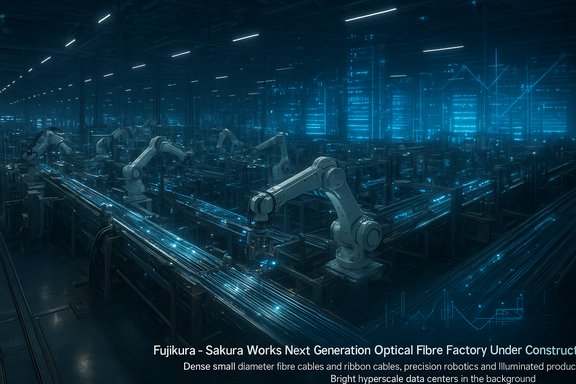
Fujikura announced a large capital investment for a next‑generation optical fibre and SWR® factory located at its Sakura Works, with a planned investment in the region of ¥45 billion and operations targeted in later fiscal years. The company has also reported production increases at existing facilities and a strategy to augment output through contractual buying from global fibre suppliers while the new plant is built and commissioned. Those moves are designed to preserve customer deliveries but clearly signal that organic expansion alone will not close the gap immediately.Financing and investor conversations
Fujikura’s CEO and senior management have said further capital expenditure will be “necessary” to keep pace with AI‑related demand and that talks are underway for additional investment rounds. That language — public, deliberate and investor‑focused — indicates the company is preparing for a multi‑year capital cycle that may require outside financing, partner commitments or reinvested earnings to fund factory construction, new production lines and supply‑chain buffer inventories. The timeline for any government‑linked procurement — such as the $20bn programme flagged in the White House memo — is not fully defined and may be spread over years, so Fujikura needs flexible financing options to avoid underbuilding or overcommitting.Why optical fibre matters to AI infrastructure
- Optical fibre is the high‑bandwidth, low‑latency backbone for inter‑rack, intra‑campus and cross‑region networking in hyperscale data centres.
- AI training and inference at the frontier require enormous internal and inter‑site traffic to move tensors, model checkpoints and storage layers; network oversubscription or underprovisioned fibre can be a hard bottleneck.
- Modern high‑density cables (small‑diameter, multi‑core ribbon designs) are preferred because they simplify cable management in narrow data‑centre ducts and reduce the physical footprint of massive interconnects.
Market reaction and share‑price moves — a mixed picture
News coverage over the past 12–24 months has highlighted dramatic share‑price gains for Fujikura, but the magnitude reported varies across outlets and time windows. Some reports chronicled a strong surge in 2024–2025 as investors searched for AI supply‑chain winners; other reporting places the 2025 gain in the range of 150–200% year‑to‑date. Statements that the stock has jumped “1,400% over the past two years” appear to be inconsistent with public price history and cannot be corroborated with mainstream exchanges and financial reporting; more conservative, verified figures show large but not quadruple‑fold returns. Readers and investors should therefore treat hyper‑bolic percentage figures cautiously and focus on audited share‑price charts and exchange filings for precise performance measures.How Fujikura is responding operationally
Short term — squeeze more from existing plants
- Increase production through shift extensions, yield optimisation and selective process improvements.
- Outsource specific fibre draws to qualified suppliers to meet urgent demand while keeping critical high‑density product lines in‑house.
- Prioritise customer deliveries for strategic hyperscalers and critical contracts.
Medium term — plant builds and product upgrades
- The Sakura Works next‑generation plant (¥45bn) is part of Fujikura’s roadmap to supply high fibre‑count, small‑diameter products at scale. That project is planned with modernised equipment and digital manufacturing techniques to push throughput and quality while reducing the unit cost of production. Commissioning and ramping are multi‑year efforts; Fujikura’s schedule targets the latter half of the decade.
Strategic partnerships and capital
- Public commitments and government‑level procurement frameworks (such as the Japan–U.S. investment package) create both opportunity and complexity: they can underpin large order books but may also impose delivery and domestic‑content expectations that change route‑to‑market strategies.
- The company’s language about new funding rounds suggests it is open to external capital and strategic partnerships — a sensible approach when the industrial cycle requires heavy capex and rapid scale‑up.
Strengths: Why Fujikura is well positioned
- Deep technical heritage: Fujikura pioneered optical fibre delivery in Japan and maintains product and process know‑how for advanced, high‑density ribbon cable and SWR® technologies that are well suited to hyperscale racks.
- Global footprint: through subsidiaries like AFL and regional manufacturing expansions, Fujikura can shift production capacity and localise deliveries to meet customer and regulatory needs.
- Customer base: established relationships with large technology customers give Fujikura visibility into multi‑year demand and improve the economics of big capex projects when long‑dated purchase commitments can be secured.
Risks and unresolved challenges
1) Timing mismatch: factories take time
Even with committed capital, building and qualifying a new high‑precision fibre plant is not instantaneous. Permitting, equipment procurement, engineering and customer acceptance testing can add months or years to the timeline, meaning demand can outrun capacity for an extended period. Fujikura’s own investor Q&A acknowledges uncertainty in meeting short‑term 20–30% growth assumptions while the new facility ramps.2) Supply‑chain concentration and geopolitical friction
Optical‑fibre raw materials, specialty preforms and some advanced manufacturing components come from a concentrated set of suppliers. At the same time, governments are increasingly linking industrial deals to national security and domestic‑content rules, which complicates supplier choices and can increase costs and lead times for firms operating across borders. The White House investment framework that includes Fujikura illustrates how industrial policy can create very large, fast-moving procurement opportunities — but it can also create expectations for local content and traceability that require investment and coordination.3) Competitive alternatives and price pressure
Several global suppliers (including regionally strong European and North American manufacturers) are also accelerating fibre investments. Hyperscalers and large commercial customers can play vendors off against each other or push for volume discounts and long payment terms, compressing margins for suppliers who must still fund heavy capital outlays. Short‑term buy‑ins from alternative suppliers can blunt Fujikura’s ability to capitalise on demand if customers take an opportunistic multi‑vendor approach.4) Overreliance on a single demand driver
The AI infrastructure boom is a powerful demand driver, but it could evolve: changes in model architecture (more efficient networks, sparsity, quantisation), shifts in hyperscaler procurement strategy (greater vertical integration or custom silicon reducing data‑transfer needs), or a temporary slowdown in AI build cycles would materially alter long‑run demand projections. Suppliers must avoid a binary bet on one demand scenario. Forum analyses and industry trackers repeatedly flag the execution risk of “build first, monetise later” strategies in infrastructure markets; Fujikura’s balanced approach (short‑term procurement + medium‑term plant builds) seeks to mitigate but cannot eliminate that exposure.Practical implications for IT and data‑centre planners
- Procurement teams should include lead‑times for fibre and cable in project schedules and insist on delivery milestones and contingency options.
- Network architects should design with modularity and path diversity to allow substitution of cable vendors and to keep operational flexibility when deliveries slip.
- Where national‑level procurement programmes are in play, expect paperwork and localisation clauses that affect vendor selection, cost and timing.
What to watch next
- Concrete contract milestones and delivery schedules tied to the White House / Japan investment package — these will translate headline project numbers into near‑term revenue flow for suppliers.
- Fujikura’s financing moves: whether the company raises partner equity, issues bonds, or secures off‑take financing to speed up plant builds. Continued references to “talks for additional rounds of investment” will be meaningful to investors and customers.
- Year‑over‑year production numbers and inventory disclosures in Fujikura’s quarterly filings — the company’s guidance on production volumes will be the clearest signal of whether the company can materially expand supply before demand outpaces it.
- Competitive supply announcements from other major fibre makers and regional expansions that could relieve or intensify supply pressure in specific markets.
Balanced assessment
Fujikura is the right kind of company to benefit from the AI build cycle: deep IP, the right product profile for dense data‑centre cabling and strong, long‑standing customer relationships. The White House’s inclusion of Fujikura in a multi‑billion‑dollar industrial investment framework elevates the opportunity — and the expectations — around the company’s short‑ and medium‑term performance. At the same time, the operational reality of ramping precision manufacturing at scale, the potential for geopolitical and domestic‑content complexities, and the uneven reporting on share‑price performance counsel caution.- Strengths: technical leadership, global footprint, existing customer contracts and a clear public roadmap to expand capacity.
- Risks: timing mismatches, financing needs, supply‑chain concentration and the danger of inflated investor narratives about share‑price upside that are not uniformly supported by public data.
Recommendations for stakeholders
- For enterprise IT and procurement teams: build flexibility into procurement timelines and budgets; include multiple fibre vendors in sourcing matrices; insist on contractual delivery milestones and penalties to hedge ramp risk.
- For hyperscalers and system integrators: negotiate staged off‑takers and early‑access supply arrangements that include options to source from multiple qualified manufacturers, and consider financing models that align supplier capex with long‑dated purchase commitments.
- For investors and analysts: focus on hard milestones — plant construction permits, equipment purchase orders, production ramp metrics and firm customer off‑take agreements — rather than headline percentages for stock gains, which can be inconsistent across reporting windows.
Conclusion
Fujikura stands at the intersection of industrial policy, hyperscaler procurement and the capital‑intensive build cycle for AI infrastructure. The company’s public plans — a ¥45bn next‑generation plant, short‑term supply augmentation and calls for additional funding rounds — make commercial sense in the context of multi‑year data‑centre expansion. But building and financing physical capacity is hard, and the short‑term mismatch between hyperscaler demand and factory ramps is the core challenge.For IT leaders and infrastructure planners, the takeaway is practical: treat fibre and cabling as long‑lead, strategic procurements and design networks with supply flexibility in mind. For investors, the message is measured: Fujikura is a plausible winner in the AI supply chain, but execution and timing — not slogans — will determine whether market expectations are met.
Source: Silicon UK Major Japan Cable Maker Unable To Keep Up With AI Demand
