

Samsung’s Galaxy S26 series pushes the company deeper into magnetic accessories in 2026, but Galaxy phones still lack the built-in rear magnets Apple introduced with the iPhone 12 series in 2020, leaving buyers dependent on a compatible magnetic case before chargers, wallets, grips, battery packs, or car mounts will work properly. That dependency is the defining weakness of Samsung’s ecosystem. The accessories can materially improve daily use, but only after the owner assembles a compatibility chain in which the phone, case, camera layout, charger, and attachment all cooperate. Samsung has joined the magnetic-accessory market without yet making magnetism an intrinsic part of the Galaxy phone.
That distinction matters more than the marketing language suggests. A magnetic charger that snaps into alignment, a battery that rides on the phone, or a wallet that detaches on demand can make a handset feel less like a sealed appliance and more like a modular computer—but on Galaxy hardware, the case remains both the enabling component and a possible point of failure.
Apple’s 2020 introduction of MagSafe accessories with the iPhone 12 series established a simple consumer expectation: the phone itself provides the magnetic foundation, and compatible accessories attach directly or through an appropriate case. Samsung entered this market more cautiously with the Galaxy S25 series and expanded the catalog around the Galaxy S26 series, yet the central hardware decision remains unchanged.
Galaxy phones still do not place magnets inside the glass back in the way iPhones do. As SlashGear notes in its survey of essential Samsung accessories, owners must first put the phone in a magnetic case before they can expect the attachment system to function.
That makes the case more than protection. It becomes an adapter layer between the handset and every magnetic product attached to it.
The difference is easy to dismiss because a large portion of premium-phone owners use cases anyway. But “most people use a case” is not the same as “the case should be mandatory for a major accessory platform.” A standard protective cover is chosen according to grip, thickness, color, drop protection, and appearance; a magnetic Galaxy case must also carry a correctly positioned ring strong enough to hold accessories and aligned well enough for wireless charging.
Samsung has therefore transferred part of the system’s engineering burden from the phone to a removable shell. If that shell is well designed, the arrangement can feel seamless. If its ring is misplaced, its magnets are weak, or its geometry clashes with an accessory, the entire experience degrades—even though neither the phone nor the attachment is necessarily defective.
This is why Galaxy magnetic compatibility cannot be treated as a simple yes-or-no specification. The meaningful question is not merely whether an accessory is “MagSafe compatible” or intended for magnetic charging. It is whether the complete stack works: the specific Galaxy phone, its case, the accessory’s dimensions, the magnetic alignment, and, for charging products, the supported power profile.
The Galaxy S26 generation also gives customers more first-party case choices than the Galaxy S25 launch did. As reported by 9to5Google, Samsung expanded its magnetic case lineup after complaints that earlier designs could feel cheap, fit poorly, or provide weak magnetic attachment.
The newer options reportedly improve materials and magnetic strength. That should reduce one of the risks of a case-mediated platform: the possibility that users buy an accessory carrying the right compatibility language but receive an unsatisfactory physical connection.
Yet better cases do not resolve the architectural limitation. A Galaxy owner who wants a thin nonmagnetic cover, a specialized rugged case, or no case at all remains outside the ecosystem. If magnets were built into the handset, compatible case makers could design around a known magnetic reference point; without them, each case must recreate the mechanism.
The result is a platform that appears broad when viewed through Samsung’s catalog but becomes conditional at the point of purchase. Every accessory implicitly carries a prerequisite: provided that the phone is wearing the right case.
That is a weaker proposition than native magnetic hardware because the case market is fragmented. Samsung controls its own cases, but it does not control the precision, materials, magnetic strength, thickness, or camera clearance of every third-party product sold with magnetic branding.
2025 — Samsung enters the magnetic-accessory market around the Galaxy S25 series, relying on magnet-equipped cases rather than magnets built into the phones.
2026 — The Galaxy S26 series pushes Samsung’s accessory catalog forward, with more first-party magnetic cases and attachments, but still without magnets inside the glass back.
The most important item is also the least glamorous: the magnetic case. Without it, the remaining products are either unusable or must depend on an additional ring adapter attached to another case or directly to the phone’s exterior.
This inversion is revealing. In Apple’s model, the phone is the platform and the case is optional equipment. In Samsung’s implementation, the case is the platform and the phone is the device being adapted.
The distinction also explains why buying the correct case deserves more attention than buying the accessory itself. A consumer might spend considerable time comparing a battery pack’s capacity, a mount’s cooling system, or a wallet’s material while treating the case as a cosmetic afterthought. For Galaxy phones, that ordering is backwards.
That sounds straightforward, but alignment affects more than whether an attachment looks centered. A charger must place its coil correctly relative to the phone’s receiving hardware, while a wallet, grip, or battery pack must sit securely without being forced upward by the camera housing.
SlashGear argues that the official case’s main advantage is precision. According to its report, poorly positioned rings in unofficial cases can weaken the connection and cause accessories to perform unreliably.
The official case is not automatically the only viable choice. Third-party manufacturers may offer stronger protection, thinner construction, different materials, or better-designed camera clearance. But a Galaxy owner should evaluate a magnetic case as an active compatibility component, not merely as molded plastic with a metal circle added to the back.
The case’s surface also affects the experience. A highly grippy silicone finish can make the phone easier to hold when a heavy battery is attached, but it can also attract lint or resist sliding into a pocket. A thin shell may preserve the handset’s shape yet provide less impact protection or allow a large accessory to feel top-heavy.
There is no universal best design because the case must satisfy competing roles. It has to protect the phone, preserve wireless performance, hold accessories, clear the cameras, remain comfortable, and avoid becoming unnecessarily bulky. Samsung’s decision not to integrate magnets means buyers cannot separate those decisions as cleanly as they could with a native system.
Samsung’s battery pack snaps onto the magnetic case and begins charging without a cable running to the handset. SlashGear reports that it also incorporates a kickstand and can power one device magnetically while serving another through a wired connection.
That is a meaningful improvement in mobility. A commuter can attach the pack without managing a short cable; a traveler can keep the handset and battery together as one object; and a user watching video can deploy the stand while the phone charges.
The trade-off is efficiency. SlashGear reports mixed early reactions, including complaints about slower-than-expected charging and warmth during prolonged use. Those are not unusual concerns for wireless power, but the magnetic format makes them more noticeable because the battery sits directly against the phone.
Wireless charging also changes what “portable” means. The user eliminates a cable but adds a slab to the back of the handset, increasing weight and thickness at the moment the phone may already be under heavy use. Navigation, video, games, camera activity, and weak cellular coverage can all increase power demand while the battery pack is trying to replenish the device.
Samsung’s pack reportedly provides faster charging through its wired port than it does through the magnetic connection. That reinforces the correct way to understand the product: it is optimized for convenience, not necessarily maximum charging speed.
The magnetic battery is therefore best used as a range extender. It can delay the point at which the owner must find an outlet, preserve access to the phone during a long day, or provide a controlled top-up while traveling. Anyone seeking the fastest possible recovery from a low battery may still prefer a wired charger.
SlashGear highlights the ESR OmniLock Qi2.2 Car Mount because it combines magnetic wireless charging with an adjustable arm and active cooling. The cooling feature is not decorative when the phone is running navigation, maintaining a bright display, communicating with cellular networks, and sitting near a sun-heated windshield.
The mount illustrates why advertised charger output and actual phone performance are not interchangeable. The accessory may be capable of supplying one level of power while a particular Galaxy model accepts less. The fact table’s broader warning remains the essential buying rule: not every Galaxy phone charges at the same speed with magnetic equipment.
That limitation is easy to overlook in retail listings. Buyers often see a prominent maximum figure and assume it describes the result they will receive. In reality, the effective speed depends on the handset, case, charger, alignment, temperature, power adapter, and operating conditions.
A mount can still be worthwhile even if the phone does not reach the accessory’s maximum output. Navigation is a sustained load, and merely slowing or reversing battery drain may be sufficient for many journeys. The mistake is purchasing on the basis of a single charging number without checking the rest of the chain.
Physical compatibility matters just as much. The mount must hold the combined weight of the handset and case over bumps, permit a useful viewing angle, and avoid placing controls or vents in awkward positions. A case with weak magnets can undermine an otherwise competent mount.
For IT departments managing vehicles, the implication is that the case and mount should be tested as a pair. Standardizing only the handset does not standardize the experience if employees use different magnetic cases.
SlashGear describes the product as a removable grip and kickstand that supports both portrait and landscape positioning. Its detachability is the central advantage over adhesive grips, which can become awkward around wireless chargers or remain stuck to the phone after the user no longer needs them.
This modularity is what makes magnetic accessories feel transformative despite their apparent simplicity. A phone can move from a slim pocketable configuration to a supported video screen, handheld camera, navigation display, or charging surface without clips, clamps, or adhesives.
The grip also exposes an important difference between circular and rectangular accessories. A compact attachment centered on the magnetic ring has a better chance of clearing a large camera assembly. A broad wallet or power bank is more likely to extend into the camera area.
WIRED’s testing of Galaxy S26 cases and accessories found that a grip could work where many wallets and power banks did not. According to the publication, square and rectangular attachments were more likely to encounter the Galaxy S26 camera bump.
That finding complicates generic compatibility claims. An accessory can be magnetically compatible in the abstract and still be physically unsuitable for the phone because it cannot lie flat. A strong magnetic ring cannot overcome a camera housing that occupies the same space as the accessory’s upper edge.
The safest buying approach is to look for evidence involving the exact phone and case combination. A demonstration on an iPhone proves little about clearance on a Galaxy, and a demonstration on one Galaxy size may not settle compatibility with another.
That independence is a practical improvement over wallet cases. A conventional folio forces the owner to carry the cards whenever the case is installed and often adds bulk around the entire handset. A detachable wallet lets the user decide when the extra thickness is justified.
The magnetic model also allows the phone to move between roles. The wallet can come off when the device is placed on a charger, attached to a car mount, or fitted with a grip. In theory, this is exactly the kind of modular behavior that makes an accessory ecosystem valuable.
In practice, the wallet may be the product most vulnerable to Samsung’s camera geometry. WIRED reported difficulty with many magnetic wallets on the Galaxy S26 lineup because rectangular accessories could collide with the camera bump. If the wallet cannot sit flat, its magnetic hold may be weaker or less stable than expected.
Samsung’s own support guidance for the Galaxy S25 generation also warns that incompatible magnetic wallets or grips can obstruct the camera or produce unwanted optical effects. The company further cautions that uncertified magnetic accessories may affect functions such as camera autofocus, stabilization, directional sensing, wireless charging, or near-field communication.
Those warnings do not mean magnetic wallets are inherently unsafe or dysfunctional. They mean shoppers should reject the assumption that a circular compatibility logo guarantees complete mechanical and electronic compatibility.
Cards create another reason for care. Samsung’s official case information warns that magnetic products should be kept away from items affected by magnetism. Users should follow the guidance issued by card providers and device manufacturers rather than assuming every card or credential is equally tolerant.
A wallet works best when it is treated as a detachable accessory rather than permanent storage. Remove it before wireless charging, verify that it does not obstruct the camera, and test whether it remains secure during ordinary pocketing and handling.
That shorthand can be useful, but it encourages consumers to collapse three separate questions into one: Will the accessory stick? Will it charge? Will it charge at the expected speed?
For a Galaxy phone, those answers may differ. An Apple MagSafe charger only works with Samsung phones through certain cases, according to SlashGear’s summary. A grip may attach successfully even though a charger using a similar magnetic ring does not deliver the desired charging behavior.
An accessory may also attach strongly yet interfere with the camera layout. Conversely, a charger may supply power while holding the phone less securely than expected because the case’s ring is weak or slightly misplaced.
This is why “MagSafe compatible” should be viewed as the beginning of an investigation, not the conclusion. Galaxy owners need to distinguish magnetic attachment, wireless-power compatibility, physical clearance, and charging speed.
The same caution applies to ring adapters. SlashGear notes that an adapter can provide magnetic attachment without requiring a new case, but an adhesive ring adds another alignment variable. If it is placed incorrectly, it may reduce charging efficiency or position accessories too close to the camera.
A well-designed magnetic case generally offers a cleaner implementation because the ring is fixed during manufacturing. But even then, case quality and accessory geometry remain decisive.
Certification cannot guarantee that every attachment will suit every workflow. It can, however, reduce uncertainty around alignment, materials, magnetic behavior, and interference.
Samsung’s own Galaxy S26 case documentation acknowledges that magnetic attachments may affect camera autofocus, the compass, wireless charging, and near-field communication. That caveat is significant because it comes from the company selling the enabling case, not merely from a dissatisfied customer or competing accessory vendor.
The practical lesson is not to avoid the ecosystem. It is to treat attachable magnetic equipment as equipment that can change how the phone behaves.
A grip may be harmless during ordinary use but should be removed if it affects a sensor-dependent application. A wallet should come off when using wireless charging or contactless functions if problems occur. A mount should be tested with navigation and the camera rather than judged only by whether the phone sticks to it.
This resembles peripheral qualification on a PC. A connector’s shape does not prove that every device, driver, power requirement, and workflow will cooperate. Magnetic alignment is the physical connector; the rest of the compatibility stack still requires validation.
But the customer must curate that kit more carefully than an iPhone owner whose phone supplies the native magnetic base. The Galaxy user is effectively assembling a small hardware ecosystem from components that may have been designed around different assumptions.
The safest order of purchase begins with the case. Once the magnetic foundation is known, the user can evaluate attachments according to strength, dimensions, charging support, and camera clearance.
It is also sensible to buy according to a real workflow rather than collecting attachments because they are magnetically compatible. A commuter may benefit most from a battery pack; a delivery driver from a cooled car mount; a frequent traveler from a detachable wallet; and a heavy camera user from a compact grip that does not crowd the lenses.
The case requirement makes experimentation more expensive because changing the foundation may change how every attachment fits. A user who replaces an official case with a rugged third-party model might find that the same wallet now sits too close to the camera or that the car mount’s hold feels different.
That interdependence is Samsung’s unresolved problem. The catalog has expanded, but the experience remains less portable than the marketing suggests.
That distinction matters more than the marketing language suggests. A magnetic charger that snaps into alignment, a battery that rides on the phone, or a wallet that detaches on demand can make a handset feel less like a sealed appliance and more like a modular computer—but on Galaxy hardware, the case remains both the enabling component and a possible point of failure.
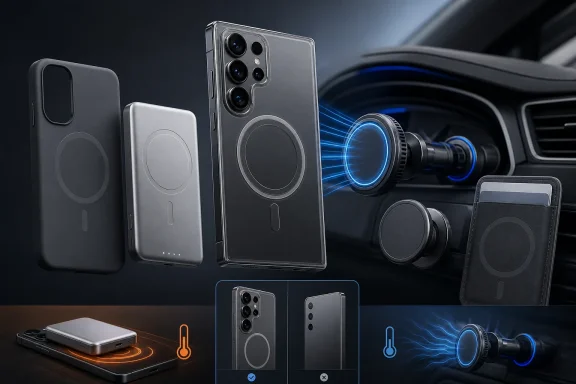 Samsung Built an Ecosystem Around the Part It Left Out
Apple’s 2020 introduction of MagSafe accessories with the iPhone 12 series established a simple consumer expectation: the phone itself provides the magnetic foundation, and compatible accessories attach directly or through an appropriate case. Samsung entered this market more cautiously with the Galaxy S25 series and expanded the catalog around the Galaxy S26 series, yet the central hardware decision remains unchanged.Galaxy phones still do not place magnets inside the glass back in the way iPhones do. As SlashGear notes in its survey of essential Samsung accessories, owners must first put the phone in a magnetic case before they can expect the attachment system to function.
That makes the case more than protection. It becomes an adapter layer between the handset and every magnetic product attached to it.
The difference is easy to dismiss because a large portion of premium-phone owners use cases anyway. But “most people use a case” is not the same as “the case should be mandatory for a major accessory platform.” A standard protective cover is chosen according to grip, thickness, color, drop protection, and appearance; a magnetic Galaxy case must also carry a correctly positioned ring strong enough to hold accessories and aligned well enough for wireless charging.
Samsung has therefore transferred part of the system’s engineering burden from the phone to a removable shell. If that shell is well designed, the arrangement can feel seamless. If its ring is misplaced, its magnets are weak, or its geometry clashes with an accessory, the entire experience degrades—even though neither the phone nor the attachment is necessarily defective.
This is why Galaxy magnetic compatibility cannot be treated as a simple yes-or-no specification. The meaningful question is not merely whether an accessory is “MagSafe compatible” or intended for magnetic charging. It is whether the complete stack works: the specific Galaxy phone, its case, the accessory’s dimensions, the magnetic alignment, and, for charging products, the supported power profile.
The Galaxy S26 Advances the Catalog, Not the Architecture
Samsung’s progress is real. Its official Galaxy S26 Silicone Magnet Case uses built-in magnets to align the phone for wireless charging and to hold compatible grips, battery packs, chargers, ring holders, wallets, and car mounts. That is a credible accessory platform rather than a single-purpose charging trick.The Galaxy S26 generation also gives customers more first-party case choices than the Galaxy S25 launch did. As reported by 9to5Google, Samsung expanded its magnetic case lineup after complaints that earlier designs could feel cheap, fit poorly, or provide weak magnetic attachment.
The newer options reportedly improve materials and magnetic strength. That should reduce one of the risks of a case-mediated platform: the possibility that users buy an accessory carrying the right compatibility language but receive an unsatisfactory physical connection.
Yet better cases do not resolve the architectural limitation. A Galaxy owner who wants a thin nonmagnetic cover, a specialized rugged case, or no case at all remains outside the ecosystem. If magnets were built into the handset, compatible case makers could design around a known magnetic reference point; without them, each case must recreate the mechanism.
The result is a platform that appears broad when viewed through Samsung’s catalog but becomes conditional at the point of purchase. Every accessory implicitly carries a prerequisite: provided that the phone is wearing the right case.
That is a weaker proposition than native magnetic hardware because the case market is fragmented. Samsung controls its own cases, but it does not control the precision, materials, magnetic strength, thickness, or camera clearance of every third-party product sold with magnetic branding.
Timeline
2020 — Apple introduces MagSafe accessories with the iPhone 12 series, making magnets part of the phone-centered accessory model.2025 — Samsung enters the magnetic-accessory market around the Galaxy S25 series, relying on magnet-equipped cases rather than magnets built into the phones.
2026 — The Galaxy S26 series pushes Samsung’s accessory catalog forward, with more first-party magnetic cases and attachments, but still without magnets inside the glass back.
Five Accessories Reveal Both the Promise and the Friction
SlashGear’s selection of five essential products captures the practical range of the Galaxy magnetic ecosystem. Together, the products cover the core uses that make magnetic attachment attractive: enabling the system, extending battery life, mounting the phone in a vehicle, improving grip, and replacing a conventional wallet.| Accessory | Primary role | Everyday advantage | Main constraint |
|---|---|---|---|
| Samsung Official Silicone Magnet Phone Case | Magnetic foundation | Enables compatible attachments and charging alignment | Required because the phone lacks built-in magnets |
| Samsung Magnet Wireless Battery Pack | Portable power | Attaches without a charging cable and includes a stand | Adds bulk, heat, and slower wireless charging than a wired connection |
| ESR OmniLock Qi2.2 Car Mount | Vehicle mounting and charging | Holds the phone in view while supplying power | Performance depends on case alignment, ventilation, and phone support |
| Spigen MagSafe Phone Grip | Grip and kickstand | Improves one-handed use and supports portrait or landscape viewing | Must clear the camera area and attach firmly to the case |
| Spigen MagSafe Wallet | Detachable card storage | Lets cards move between compatible devices without changing cases | Rectangular shape may conflict with the camera assembly |
This inversion is revealing. In Apple’s model, the phone is the platform and the case is optional equipment. In Samsung’s implementation, the case is the platform and the phone is the device being adapted.
The distinction also explains why buying the correct case deserves more attention than buying the accessory itself. A consumer might spend considerable time comparing a battery pack’s capacity, a mount’s cooling system, or a wallet’s material while treating the case as a cosmetic afterthought. For Galaxy phones, that ordering is backwards.
The Magnetic Case Is Infrastructure Disguised as Protection
Samsung’s official Silicone Magnet Case is intended to supply the alignment that the handset itself does not. Samsung says its built-in magnets help position the Galaxy S26 for fast wireless charging while providing a stable hold for compatible accessories.That sounds straightforward, but alignment affects more than whether an attachment looks centered. A charger must place its coil correctly relative to the phone’s receiving hardware, while a wallet, grip, or battery pack must sit securely without being forced upward by the camera housing.
SlashGear argues that the official case’s main advantage is precision. According to its report, poorly positioned rings in unofficial cases can weaken the connection and cause accessories to perform unreliably.
The official case is not automatically the only viable choice. Third-party manufacturers may offer stronger protection, thinner construction, different materials, or better-designed camera clearance. But a Galaxy owner should evaluate a magnetic case as an active compatibility component, not merely as molded plastic with a metal circle added to the back.
The case’s surface also affects the experience. A highly grippy silicone finish can make the phone easier to hold when a heavy battery is attached, but it can also attract lint or resist sliding into a pocket. A thin shell may preserve the handset’s shape yet provide less impact protection or allow a large accessory to feel top-heavy.
There is no universal best design because the case must satisfy competing roles. It has to protect the phone, preserve wireless performance, hold accessories, clear the cameras, remain comfortable, and avoid becoming unnecessarily bulky. Samsung’s decision not to integrate magnets means buyers cannot separate those decisions as cleanly as they could with a native system.
A Snap-On Battery Solves the Cable Problem by Creating a Heat Problem
The Samsung Magnet Wireless Battery Pack represents the clearest argument for magnetic accessories. Portable batteries are useful precisely when owners do not want to stop using the phone, yet conventional power banks leave a cable hanging between two devices.Samsung’s battery pack snaps onto the magnetic case and begins charging without a cable running to the handset. SlashGear reports that it also incorporates a kickstand and can power one device magnetically while serving another through a wired connection.
That is a meaningful improvement in mobility. A commuter can attach the pack without managing a short cable; a traveler can keep the handset and battery together as one object; and a user watching video can deploy the stand while the phone charges.
The trade-off is efficiency. SlashGear reports mixed early reactions, including complaints about slower-than-expected charging and warmth during prolonged use. Those are not unusual concerns for wireless power, but the magnetic format makes them more noticeable because the battery sits directly against the phone.
Wireless charging also changes what “portable” means. The user eliminates a cable but adds a slab to the back of the handset, increasing weight and thickness at the moment the phone may already be under heavy use. Navigation, video, games, camera activity, and weak cellular coverage can all increase power demand while the battery pack is trying to replenish the device.
Samsung’s pack reportedly provides faster charging through its wired port than it does through the magnetic connection. That reinforces the correct way to understand the product: it is optimized for convenience, not necessarily maximum charging speed.
The magnetic battery is therefore best used as a range extender. It can delay the point at which the owner must find an outlet, preserve access to the phone during a long day, or provide a controlled top-up while traveling. Anyone seeking the fastest possible recovery from a low battery may still prefer a wired charger.
Car Mounts Are Where Alignment Becomes Operational
A magnetic car mount may be the most consequential accessory in daily use because it combines physical retention, visibility, power delivery, and heat management. Failure is more serious here than with a desktop stand: a weak connection can drop the phone, and an obstructed or poorly positioned display can distract the driver.SlashGear highlights the ESR OmniLock Qi2.2 Car Mount because it combines magnetic wireless charging with an adjustable arm and active cooling. The cooling feature is not decorative when the phone is running navigation, maintaining a bright display, communicating with cellular networks, and sitting near a sun-heated windshield.
The mount illustrates why advertised charger output and actual phone performance are not interchangeable. The accessory may be capable of supplying one level of power while a particular Galaxy model accepts less. The fact table’s broader warning remains the essential buying rule: not every Galaxy phone charges at the same speed with magnetic equipment.
That limitation is easy to overlook in retail listings. Buyers often see a prominent maximum figure and assume it describes the result they will receive. In reality, the effective speed depends on the handset, case, charger, alignment, temperature, power adapter, and operating conditions.
A mount can still be worthwhile even if the phone does not reach the accessory’s maximum output. Navigation is a sustained load, and merely slowing or reversing battery drain may be sufficient for many journeys. The mistake is purchasing on the basis of a single charging number without checking the rest of the chain.
Physical compatibility matters just as much. The mount must hold the combined weight of the handset and case over bumps, permit a useful viewing angle, and avoid placing controls or vents in awkward positions. A case with weak magnets can undermine an otherwise competent mount.
For IT departments managing vehicles, the implication is that the case and mount should be tested as a pair. Standardizing only the handset does not standardize the experience if employees use different magnetic cases.
Grips Show That Magnetism Is Bigger Than Charging
The Spigen MagSafe Phone Grip demonstrates the more interesting side of the ecosystem: magnets can support accessories that have nothing to do with power. A detachable grip can help with one-handed typing, photography, filming, and prolonged reading without permanently altering the handset.SlashGear describes the product as a removable grip and kickstand that supports both portrait and landscape positioning. Its detachability is the central advantage over adhesive grips, which can become awkward around wireless chargers or remain stuck to the phone after the user no longer needs them.
This modularity is what makes magnetic accessories feel transformative despite their apparent simplicity. A phone can move from a slim pocketable configuration to a supported video screen, handheld camera, navigation display, or charging surface without clips, clamps, or adhesives.
The grip also exposes an important difference between circular and rectangular accessories. A compact attachment centered on the magnetic ring has a better chance of clearing a large camera assembly. A broad wallet or power bank is more likely to extend into the camera area.
WIRED’s testing of Galaxy S26 cases and accessories found that a grip could work where many wallets and power banks did not. According to the publication, square and rectangular attachments were more likely to encounter the Galaxy S26 camera bump.
That finding complicates generic compatibility claims. An accessory can be magnetically compatible in the abstract and still be physically unsuitable for the phone because it cannot lie flat. A strong magnetic ring cannot overcome a camera housing that occupies the same space as the accessory’s upper edge.
The safest buying approach is to look for evidence involving the exact phone and case combination. A demonstration on an iPhone proves little about clearance on a Galaxy, and a demonstration on one Galaxy size may not settle compatibility with another.
The Wallet Is the Most Convenient Accessory—and the Easiest to Misjudge
A magnetic wallet has an appealing premise: attach a few cards when leaving home, remove them when charging, and transfer the wallet between compatible phones without tools or adhesive. SlashGear’s recommended Spigen wallet reportedly holds three cards and is designed to remain independent of the phone case.That independence is a practical improvement over wallet cases. A conventional folio forces the owner to carry the cards whenever the case is installed and often adds bulk around the entire handset. A detachable wallet lets the user decide when the extra thickness is justified.
The magnetic model also allows the phone to move between roles. The wallet can come off when the device is placed on a charger, attached to a car mount, or fitted with a grip. In theory, this is exactly the kind of modular behavior that makes an accessory ecosystem valuable.
In practice, the wallet may be the product most vulnerable to Samsung’s camera geometry. WIRED reported difficulty with many magnetic wallets on the Galaxy S26 lineup because rectangular accessories could collide with the camera bump. If the wallet cannot sit flat, its magnetic hold may be weaker or less stable than expected.
Samsung’s own support guidance for the Galaxy S25 generation also warns that incompatible magnetic wallets or grips can obstruct the camera or produce unwanted optical effects. The company further cautions that uncertified magnetic accessories may affect functions such as camera autofocus, stabilization, directional sensing, wireless charging, or near-field communication.
Those warnings do not mean magnetic wallets are inherently unsafe or dysfunctional. They mean shoppers should reject the assumption that a circular compatibility logo guarantees complete mechanical and electronic compatibility.
Cards create another reason for care. Samsung’s official case information warns that magnetic products should be kept away from items affected by magnetism. Users should follow the guidance issued by card providers and device manufacturers rather than assuming every card or credential is equally tolerant.
A wallet works best when it is treated as a detachable accessory rather than permanent storage. Remove it before wireless charging, verify that it does not obstruct the camera, and test whether it remains secure during ordinary pocketing and handling.
MagSafe Compatibility Is a Vocabulary Problem
Samsung’s ecosystem inherits a naming problem created by years of Apple dominance. “MagSafe” is often used informally to describe almost any ring-shaped magnetic phone accessory, even when the product is intended for several platforms and does not reproduce every aspect of Apple’s implementation.That shorthand can be useful, but it encourages consumers to collapse three separate questions into one: Will the accessory stick? Will it charge? Will it charge at the expected speed?
For a Galaxy phone, those answers may differ. An Apple MagSafe charger only works with Samsung phones through certain cases, according to SlashGear’s summary. A grip may attach successfully even though a charger using a similar magnetic ring does not deliver the desired charging behavior.
An accessory may also attach strongly yet interfere with the camera layout. Conversely, a charger may supply power while holding the phone less securely than expected because the case’s ring is weak or slightly misplaced.
This is why “MagSafe compatible” should be viewed as the beginning of an investigation, not the conclusion. Galaxy owners need to distinguish magnetic attachment, wireless-power compatibility, physical clearance, and charging speed.
The same caution applies to ring adapters. SlashGear notes that an adapter can provide magnetic attachment without requiring a new case, but an adhesive ring adds another alignment variable. If it is placed incorrectly, it may reduce charging efficiency or position accessories too close to the camera.
A well-designed magnetic case generally offers a cleaner implementation because the ring is fixed during manufacturing. But even then, case quality and accessory geometry remain decisive.
Samsung’s Own Warnings Define the Real Buying Standard
Samsung’s support guidance recommends official or certified accessories after describing possible problems with uncertified magnetic products. For fleet managers and cautious consumers, that recommendation establishes a useful baseline: compatibility should be proven through design and testing, not inferred from a marketplace keyword.Certification cannot guarantee that every attachment will suit every workflow. It can, however, reduce uncertainty around alignment, materials, magnetic behavior, and interference.
Samsung’s own Galaxy S26 case documentation acknowledges that magnetic attachments may affect camera autofocus, the compass, wireless charging, and near-field communication. That caveat is significant because it comes from the company selling the enabling case, not merely from a dissatisfied customer or competing accessory vendor.
The practical lesson is not to avoid the ecosystem. It is to treat attachable magnetic equipment as equipment that can change how the phone behaves.
A grip may be harmless during ordinary use but should be removed if it affects a sensor-dependent application. A wallet should come off when using wireless charging or contactless functions if problems occur. A mount should be tested with navigation and the camera rather than judged only by whether the phone sticks to it.
This resembles peripheral qualification on a PC. A connector’s shape does not prove that every device, driver, power requirement, and workflow will cooperate. Magnetic alignment is the physical connector; the rest of the compatibility stack still requires validation.
Action checklist for admins
- Standardize a tested magnetic case for each Galaxy model rather than allowing arbitrary ring placement.
- Test the complete phone, case, charger, mount, and power-adapter combination before fleet deployment.
- Verify camera clearance, autofocus behavior, directional sensing, wireless charging, and near-field communication with each attachment.
- Compare actual charging behavior across every Galaxy model in use; do not rely solely on the accessory’s advertised maximum.
- Prefer official or Samsung-certified accessories where operational consistency matters.
- Document when wallets, grips, or battery packs must be removed for charging, photography, navigation, or contactless tasks.
The Ecosystem Works Best When Buyers Stop Treating It as Universal
Samsung has created enough first-party and partner products for magnetic accessories to be useful rather than experimental. A Galaxy S26 owner can build a coherent kit around a good case, portable battery, vehicle mount, grip, and wallet.But the customer must curate that kit more carefully than an iPhone owner whose phone supplies the native magnetic base. The Galaxy user is effectively assembling a small hardware ecosystem from components that may have been designed around different assumptions.
The safest order of purchase begins with the case. Once the magnetic foundation is known, the user can evaluate attachments according to strength, dimensions, charging support, and camera clearance.
It is also sensible to buy according to a real workflow rather than collecting attachments because they are magnetically compatible. A commuter may benefit most from a battery pack; a delivery driver from a cooled car mount; a frequent traveler from a detachable wallet; and a heavy camera user from a compact grip that does not crowd the lenses.
The case requirement makes experimentation more expensive because changing the foundation may change how every attachment fits. A user who replaces an official case with a rugged third-party model might find that the same wallet now sits too close to the camera or that the car mount’s hold feels different.
That interdependence is Samsung’s unresolved problem. The catalog has expanded, but the experience remains less portable than the marketing suggests.
What Galaxy Owners Should Carry Forward
The Galaxy S26 magnetic ecosystem is useful today, but it rewards deliberate purchasing rather than blind faith in compatibility labels. The strongest setup is not necessarily the one with the highest advertised power or the largest number of accessories; it is the one whose components have been tested together.- The magnetic case is the foundation, not an optional cosmetic purchase.
- Galaxy phones still lack the built-in rear magnets found in iPhones.
- Charging speed varies by Galaxy model, charger, case, alignment, and operating conditions.
- Compact grips are generally easier to fit around large camera assemblies than rectangular wallets or batteries.
- Apple’s MagSafe charger requires an appropriate case to work with Samsung phones.
- Official or certified products reduce risk, but every complete configuration should still be tested.
References
- Primary source: SlashGear
Published: Sat, 11 Jul 2026 20:30:00 GMT
5 Essential Magnetic Accessories For Your Samsung Phone
Samsung was a little late to the game in implementing magnetic phone accessories, but Galaxy phones have a nice crop of options these days.www.slashgear.com - Related coverage: samsung.com
- Related coverage: wired.com
The Best Samsung Galaxy S26 Cases (2026): S26, S26+, and S26 Ultra | WIRED
Protect your new Samsung phone with the help of these cases and screen protectors.www.wired.com - Related coverage: tomsguide.com
The best Samsung Galaxy S26 cases to protect your phone | Tom's Guide
Whether you want a clear case, rugged protection, or Qi2 support, these are the best Samsung Galaxy S26 cases available.www.tomsguide.com - Related coverage: sammobile.com
Every Qi2 magnetic accessory you can buy for your Galaxy S25 (in the USA) - SamMobile
Here is every Qi2 magnetic accessory you can buy for your Samsung Galaxy S25 in the USA as we approach the phone's first anniversary. - SamMobilewww.sammobile.com - Related coverage: digitaltrends.com
My Galaxy S26 accessories buying list: The best cases, chargers, and storage drives I found - Digital Trends
Whether it is a protective case, charger, power bank, or an external storage drive, there's something for everyone in this comprehensive Galaxy S26 accessories buying guide.www.digitaltrends.com
- Official source: 9to5google.com
Samsung's magnetic Galaxy S26 cases look much better [Gallery]
Samsung's new Galaxy S26 phones don't have native Qi2, but the company's first-party magnetic cases look a lot better this year.9to5google.com - Related coverage: androidexperto.com

The best Samsung Galaxy S26 cases of 2026: Expert tested
The Samsung Galaxy S26 is sleek, powerful, and not exactly something you want to test against concrete unprotected. A good case should do more than cover…
androidexperto.com
- Related coverage: androidauthority.com
Forget the rest: These are my favorite Galaxy S26 and S26 Plus cases
These are our picks of the best Galaxy S26 cases to protect your new flagship from slippery mishaps right out of the box.www.androidauthority.com - Related coverage: androidheadlines.com
Samsung Shows Off All Official Galaxy S26 Cases and Charging Accessories
Samsung has decided to show off its official Galaxy S26 series cases and charging accessories in a video format. www.androidheadlines.com
- Related coverage: images.samsung.com
- Related coverage: image-us.samsung.com
- Related coverage: techradar.com
The Samsung Galaxy S26 might finally be getting its version of MagSafe – here are 8 accessories to expect | TechRadar
Samsung is seemingly going big on magnetswww.techradar.com - Related coverage: androidcentral.com
I'm obsessed with these over-the-top MagSafe wallets from SUPCASE and i-Blason | Android Central
You don't need to buy a phone stand or a holder if you invest in the right magnetic wallet.www.androidcentral.com - Related coverage: creativebloq.com
These are the best accessories for Samsung Galaxy S26 Ultra owners | Creative Bloq
I've tried and tested them all, so you don't have to.www.creativebloq.com - Related coverage: whathifi.com
Samsung Galaxy S26 Ultra review: ultimate portable option for on-the-go cinephiles | What Hi-Fi?
Samsung’s upgraded flagship smartphone improves on an Award-winning formulawww.whathifi.com