

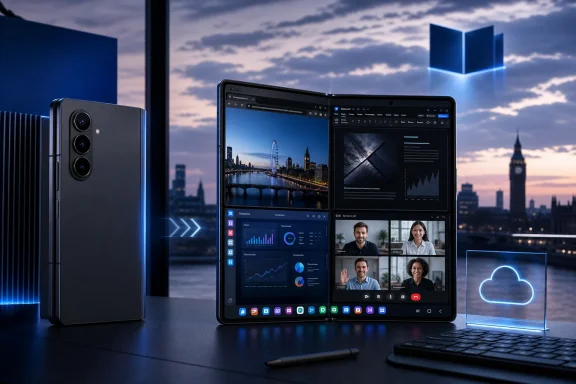
Samsung’s reported decision to raise production of its wider Galaxy Z Fold 8 from roughly 2 million to 2.8 million units is more than a routine supply-chain adjustment. If the figures are accurate, Samsung is making the new 4:3 “Wide Fold” its highest-volume foldable for 2026, ahead of both the Galaxy Z Fold 8 Ultra and Galaxy Z Flip 8—and doing so immediately before the July 22 Galaxy Unpacked event in London. The wager suggests Samsung believes the next phase of foldable competition will be defined not merely by thinner hinges or brighter OLED panels, but by which screen shape best turns a phone into a practical pocket computer.
Samsung helped establish the modern foldable smartphone category with the original Galaxy Fold in 2019, but its early lead came at a cost. The first device suffered a delayed launch after reviewers encountered display failures, debris ingress, and confusion surrounding the protective layer attached to the flexible panel. Samsung redesigned the hardware, strengthened the display assembly, and returned with a device that was still experimental but commercially viable.
Successive Galaxy Z Fold generations improved water resistance, hinge durability, multitasking, camera performance, and software support. Yet the fundamental silhouette remained recognizable: a tall, narrow device when closed that opened into an almost square miniature tablet.
That format carried several advantages. It kept the folded phone relatively easy to grip, created a large canvas for side-by-side applications, and allowed Samsung to reuse a familiar design language over multiple generations.
It also produced persistent compromises. The cover display could feel cramped for typing, the open display was not ideal for conventional widescreen video, and some Android applications struggled to make intelligent use of the unusual proportions. Rival manufacturers increasingly attacked those weaknesses with wider cover screens, thinner bodies, larger batteries, and less conspicuous display creases.
The market has not eliminated those concerns, but the conversation has changed. A premium foldable now needs to be more than a functioning technical demonstration; it must offer a clear productivity, entertainment, or portability advantage over an excellent conventional flagship.
That transition explains why aspect ratio has become strategically important. Once the hinge works reliably enough, the shape of the usable screen becomes one of the strongest determinants of whether unfolding the phone is actually worthwhile.
Those are manufacturing targets rather than guaranteed retail sales. Production plans can change in response to component availability, carrier commitments, preorder data, regional forecasts, yield rates, or unexpected demand.
Even with that caveat, the ranking matters. Samsung is reportedly placing the largest order behind the least familiar design in the family rather than treating it as a limited experiment.
Samsung would not necessarily commit to that volume solely because executives prefer the appearance of a wider device. The change may reflect stronger-than-expected carrier interest, favorable component yields, internal consumer testing, distributor orders, or confidence that pricing will place the model within reach of more buyers than the Ultra.
The adjustment also creates operational consequences:
A 4:3 internal panel resembles the proportions historically associated with tablets, documents, photographs, and many productivity canvases. It is wider relative to its height than Samsung’s earlier Fold screens, potentially making the device feel less like a tall phone that opens and more like a small tablet that closes.
The same applies to photos. Many still images use 4:3 or 3:2 proportions, so a 4:3 foldable can display them with less wasted space than a nearly square screen.
The advantage is not that every application magically becomes better. Rather, the wider canvas more closely resembles the assumptions that developers already make when designing for tablets and desktop-style windows.
A wider panel should make two-column layouts more practical. Two applications displayed side by side could each receive a more conventional portrait-shaped window instead of two extremely narrow strips.
That distinction matters for real work. Outlook beside a browser, Teams beside a document, or a file manager beside a cloud-storage application becomes more useful when both panes retain readable controls.
However, the wider Fold may provide a better compromise for video accompanied by controls, comments, chat, subtitles, or a second application. YouTube, video conferencing, game streaming, and media editing can all benefit from space surrounding the video frame, even when the frame itself does not fill the panel.
This gives Samsung a way to change direction without abandoning existing users. Customers who value the familiar narrow cover screen, mature accessories, or established multitasking behavior can select the Ultra, while those attracted to a more tablet-like shape can choose the Wide Fold.
The rumored portfolio may instead divide the products by purpose:
“Accessible” remains relative in this segment. Even a lower-priced Fold will likely sit well above mainstream Galaxy S and Galaxy A models, especially once storage upgrades, insurance, cases, and financing are considered.
The critical question is whether Samsung treats the wider model as a cheaper Fold or as the default Fold. The reported 2.8 million-unit target points toward the latter.
Samsung’s wider Fold should not be reduced to an imitation of an unreleased Apple product. Samsung has spent years developing flexible panels, hinges, multi-window software, and foldable manufacturing processes, while Apple has yet to ship a foldable phone.
Yet Apple’s expected entry changes the commercial calculations surrounding the entire category. Component suppliers, application developers, carriers, accessory brands, and competing manufacturers all know that an Apple launch could expose foldables to an audience far larger than the existing enthusiast market.
If a foldable iPhone arrives with a wider internal screen, developers may begin treating 4:3 as a priority rather than an edge case. That work could indirectly benefit Android tablets and foldables when companies maintain similar layouts across platforms.
Samsung therefore has an incentive to establish the wider format first. It can claim technical leadership, gather real-world usage data, improve its software, and build market recognition before Apple’s device reaches stores.
Samsung cannot afford to appear reactive after the fact. Launching a 4:3 Galaxy Fold before Apple would allow the company to argue that it identified the superior proportions independently—and that its product is already mature while Apple is shipping a first generation.
That argument will only work if the Fold 8 is polished. Being first with a particular shape means little if Apple later delivers better battery life, application behavior, crease control, cameras, or durability.
Chinese manufacturers have often moved faster on thinness, battery capacity, charging speed, and wide cover displays. Samsung retains major advantages in global distribution, carrier relationships, after-sales support, software updates, and brand recognition, but it can no longer assume that the Galaxy Z Fold defines the hardware frontier.
The broader lesson is that technical leadership is fragmented. One manufacturer may offer the thinnest body, another the largest battery, another the least visible crease, and another the most sophisticated desktop mode.
Samsung’s advantage lies in assembling those pieces into a globally supportable product. The reported volume increase indicates that it wants to convert manufacturing scale into a strategic weapon before the market becomes even more crowded.
That breadth gives developers reasons to create adaptive applications even if foldables remain a minority of phone sales. A well-designed application can adjust navigation, content density, panes, and controls according to available window size rather than targeting one device model.
The wider Fold 8 will test whether that strategy has matured. Samsung can build an excellent shell, but third-party software will determine whether users experience a tablet or merely a stretched phone.
Poorly optimized software may stretch content, waste space, place controls at inconvenient edges, or display a narrow phone interface in the center of the panel. Games may force fixed orientations, video applications may use awkward scaling, and banking or authentication tools may restart when the device changes posture.
This evolution is particularly important for a 4:3 Fold because users will encounter several distinct states:
Samsung’s challenge is to persuade major developers to adopt responsive navigation, dual-pane views, drag-and-drop, keyboard shortcuts, and proper state preservation. The company may also need to optimize its own applications aggressively so that Calendar, Notes, Gallery, Internet, My Files, Health, and SmartThings demonstrate what the new dimensions can do.
The Fold 8’s production volume could help that campaign. Developers are more likely to invest when a manufacturer plans millions of units rather than a small experimental run.
A wider mobile screen does not replace a laptop, but it can reduce the number of occasions when a user needs to open one. That is especially true for reviewing documents, approving changes, joining meetings, managing email, checking dashboards, or remotely accessing a PC.
A 4:3 Fold may improve the opposite direction of that relationship: tasks initiated on the PC can be reviewed more comfortably on the phone after the user steps away. Files synchronized through OneDrive, browser content, email attachments, and Microsoft 365 documents should all benefit from the wider canvas.
The Fold could therefore function as a continuity device rather than a miniature PC. It would handle short periods of mobile work while preserving access to the user’s Windows-centered data and communications.
This could be valuable for administrators responding to alerts, developers checking a build, or employees accessing a virtual desktop. The experience will not equal a Surface or Galaxy Book, but it may be sufficient for urgent intervention.
Samsung DeX could further strengthen the proposition if the Fold 8 supports a mature external-display environment. A foldable that works as a pocket tablet, a Phone Link endpoint, and a desktop-style terminal would offer a more coherent productivity argument than screen size alone.
That clarity could help Samsung reach buyers who admired foldables but never saw a compelling reason to own one. Reading, browsing, shopping, photo viewing, maps, messaging, and social media can all benefit from a wider canvas without requiring specialist knowledge.
Users should not have to unfold a premium device every time they want to reply to a message, scan a boarding pass, change music, take a photograph, or approve a payment. If the wider body makes the cover display short, cramped, or awkward for typing, Samsung may simply replace one ergonomic problem with another.
Conversely, a compact but conventionally proportioned external panel could be an advantage. It may encourage one-handed use while reserving the internal display for deliberate, content-rich sessions.
A wider Fold needs sufficient battery capacity to power two displays, demanding multitasking, wireless connectivity, and on-device AI. It also needs cameras that do not feel conspicuously inferior to Samsung’s Galaxy S Ultra line.
Consumers may forgive a small difference caused by physical constraints. They are less likely to forgive premium pricing paired with mid-tier imaging or slow charging.
Samsung has credible enterprise assets through Knox security and management, long-term software support, broad carrier distribution, and integration with Microsoft services. A wider Fold could strengthen the use case for executives, field specialists, healthcare workers, sales teams, and technicians who frequently review complex information away from a desk.
Potential enterprise scenarios include:
The unusual dimensions may also complicate vehicle mounts, barcode accessories, keyboard cases, and specialized field equipment. Samsung’s larger production target could improve accessory support, but enterprise buyers should validate their complete workflow rather than purchasing on screen size alone.
Panel yields, hinge tolerances, adhesive behavior, ultra-thin glass, display creasing, frame rigidity, dust protection, thermal management, and battery packaging must all meet acceptable standards at scale. A wider chassis changes stress distribution and may require different reinforcement strategies.
It also allows the company to coordinate hardware and panel development earlier in the design cycle. If the 4:3 format becomes popular, Samsung Display may benefit even when competing brands adopt similar panels.
However, internal sourcing does not eliminate risk. A quality issue affecting a high-volume new panel could create shortages across the entire launch, while a weak retail response could leave Samsung and its partners holding expensive inventory.
The stronger indicators will arrive later:
The event’s language will be revealing. If Samsung frames 4:3 as the future of foldable computing, the company is signaling a long-term transition; if it focuses mainly on price or portability, the model may be intended to broaden the range without replacing the established design.
Analysts should watch whether Samsung maintains production, whether retailers begin discounting early, and whether the standard Fold 8 outsells the Ultra without extraordinary subsidies. Strong retention and low return rates would provide the clearest evidence that the new proportions solve real problems.
Developer behavior will offer another signal. If major applications quickly introduce adaptive dual-pane layouts, the 4:3 Fold could influence Android software far beyond Samsung’s own sales.
The reported production increase suggests the company wants to control the transition. It can use its established supply chain, global retail presence, mature foldable software, and relationship with Google and Microsoft to make the wider format feel familiar before Apple presents its alternative.
A successful 4:3 Fold could establish the wider passport-style design as the default for book-style devices. A failed one could demonstrate that portability and cover-screen usability matter more than tablet-like proportions.
Either outcome would influence future products. Samsung can refine the concept, competitors can respond, and developers can decide which large-screen assumptions deserve priority.
The opportunity for Microsoft is to strengthen Phone Link, cross-device clipboard behavior, application handoff, file continuity, authentication, and remote Windows experiences. If foldables become more tablet-like, Windows integration should evolve beyond mirroring notifications and retrieving recent photos.
Samsung’s new form factor could therefore influence not only Android design but also the way mobile devices participate in a Windows-centered workflow.
Samsung appears to be entering its biggest foldable battle with an unusually direct bet: people do not merely want a phone that unfolds into a larger screen; they want it to unfold into the right shape. The reported 2.8 million-unit target gives that idea enough scale to succeed spectacularly—or to expose its weaknesses in public. If Samsung combines the 4:3 panel with sensible pricing, reliable hardware, adaptive software, strong cameras, practical battery life, and deeper Windows integration, the Galaxy Z Fold 8 may become the model that finally shifts foldables from technological curiosities to comprehensible everyday computers.
 Background
Samsung helped establish the modern foldable smartphone category with the original Galaxy Fold in 2019, but its early lead came at a cost. The first device suffered a delayed launch after reviewers encountered display failures, debris ingress, and confusion surrounding the protective layer attached to the flexible panel. Samsung redesigned the hardware, strengthened the display assembly, and returned with a device that was still experimental but commercially viable.Successive Galaxy Z Fold generations improved water resistance, hinge durability, multitasking, camera performance, and software support. Yet the fundamental silhouette remained recognizable: a tall, narrow device when closed that opened into an almost square miniature tablet.
That format carried several advantages. It kept the folded phone relatively easy to grip, created a large canvas for side-by-side applications, and allowed Samsung to reuse a familiar design language over multiple generations.
It also produced persistent compromises. The cover display could feel cramped for typing, the open display was not ideal for conventional widescreen video, and some Android applications struggled to make intelligent use of the unusual proportions. Rival manufacturers increasingly attacked those weaknesses with wider cover screens, thinner bodies, larger batteries, and less conspicuous display creases.
From engineering showcase to product category
For years, foldables were judged primarily on whether they could survive ordinary use. Buyers worried about flexible OLED layers, hinge wear, screen protectors, dust, water exposure, repair costs, and the long-term visibility of the crease.The market has not eliminated those concerns, but the conversation has changed. A premium foldable now needs to be more than a functioning technical demonstration; it must offer a clear productivity, entertainment, or portability advantage over an excellent conventional flagship.
That transition explains why aspect ratio has become strategically important. Once the hinge works reliably enough, the shape of the usable screen becomes one of the strongest determinants of whether unfolding the phone is actually worthwhile.
Samsung’s Reported Production Reversal
According to the South Korean supply-chain report, Samsung initially intended to distribute production more evenly between its wider Fold model and the traditional book-style flagship now expected to carry the Fold 8 Ultra name. The revised plan reportedly allocates approximately 2.8 million units to the standard Galaxy Z Fold 8, around 2 million to the Fold 8 Ultra, and roughly 1.5 million to the Galaxy Z Flip 8.Those are manufacturing targets rather than guaranteed retail sales. Production plans can change in response to component availability, carrier commitments, preorder data, regional forecasts, yield rates, or unexpected demand.
Even with that caveat, the ranking matters. Samsung is reportedly placing the largest order behind the least familiar design in the family rather than treating it as a limited experiment.
Why an additional 800,000 units matters
An increase of 800,000 devices represents a 40 percent rise from the reported earlier target of 2 million. That is significant for any expensive foldable because each unit requires flexible OLED capacity, sophisticated hinge components, reinforced chassis materials, multiple display assemblies, and more complex quality control than a standard slab phone.Samsung would not necessarily commit to that volume solely because executives prefer the appearance of a wider device. The change may reflect stronger-than-expected carrier interest, favorable component yields, internal consumer testing, distributor orders, or confidence that pricing will place the model within reach of more buyers than the Ultra.
The adjustment also creates operational consequences:
- Samsung Display may need to prioritize the wider panel dimensions across its production lines.
- Suppliers may have to increase hinge, frame, battery, camera, and ultra-thin glass output.
- Retail partners will need to allocate more display space and inventory to an unfamiliar form factor.
- Software teams will face greater pressure to ensure popular applications scale correctly at launch.
- Accessory manufacturers must prepare cases and screen protection for two distinct book-style Fold designs.
The 4:3 Foldable Changes the Experience
The reported Galaxy Z Fold 8 is expected to use a 7.6-inch internal display paired with a 5.4-inch external panel. Raw diagonal measurements tell only part of the story because two displays with the same diagonal can provide dramatically different usable areas depending on their aspect ratios.A 4:3 internal panel resembles the proportions historically associated with tablets, documents, photographs, and many productivity canvases. It is wider relative to its height than Samsung’s earlier Fold screens, potentially making the device feel less like a tall phone that opens and more like a small tablet that closes.
Better proportions for documents and websites
Web pages, PDFs, email, spreadsheets, remote desktops, and digital magazines generally benefit from horizontal space. A wider display can show more of a page at a readable scale, reduce excessive line wrapping, and provide room for navigation rails or toolbars without crushing the main content.The same applies to photos. Many still images use 4:3 or 3:2 proportions, so a 4:3 foldable can display them with less wasted space than a nearly square screen.
The advantage is not that every application magically becomes better. Rather, the wider canvas more closely resembles the assumptions that developers already make when designing for tablets and desktop-style windows.
Multitasking could become more natural
Samsung has long promoted multi-window software as a defining Fold feature. Users can place applications side by side, save app pairs, drag content between supported programs, and use a taskbar to switch quickly between recent tools.A wider panel should make two-column layouts more practical. Two applications displayed side by side could each receive a more conventional portrait-shaped window instead of two extremely narrow strips.
That distinction matters for real work. Outlook beside a browser, Teams beside a document, or a file manager beside a cloud-storage application becomes more useful when both panes retain readable controls.
Video remains a mixed case
A 4:3 display will not automatically solve the letterboxing problem for modern video. Most streaming films and television programs use wider ratios, so black bars will remain when content is shown without cropping.However, the wider Fold may provide a better compromise for video accompanied by controls, comments, chat, subtitles, or a second application. YouTube, video conferencing, game streaming, and media editing can all benefit from space surrounding the video frame, even when the frame itself does not fill the panel.
Two Folds Create a New Samsung Hierarchy
Samsung’s reported 2026 lineup is unusual because it separates the book-style foldable into two branches. The standard Fold 8 is expected to introduce the wider 4:3 design, while the Fold 8 Ultra reportedly continues the taller format associated with the established Galaxy Z Fold line.This gives Samsung a way to change direction without abandoning existing users. Customers who value the familiar narrow cover screen, mature accessories, or established multitasking behavior can select the Ultra, while those attracted to a more tablet-like shape can choose the Wide Fold.
“Standard” may no longer mean inferior
Samsung’s naming strategy could create confusion if the standard Fold 8 is the genuinely new model while the Ultra serves as the evolutionary successor. Consumers normally assume that “Ultra” means the largest screen, best cameras, fastest processor, or most advanced design.The rumored portfolio may instead divide the products by purpose:
- The Galaxy Z Fold 8 could emphasize accessibility, wider proportions, and mainstream appeal.
- The Galaxy Z Fold 8 Ultra could emphasize premium materials, cameras, performance, or specialist features.
- The Galaxy Z Flip 8 could remain the compact, fashion-oriented option.
- The previously introduced tri-fold concept could occupy the experimental, maximum-screen category.
Pricing will determine the real strategy
The production increase makes the most sense if Samsung intends to price the standard Fold 8 below the Ultra by a meaningful amount. A modest difference would leave buyers wondering why they should accept reduced specifications, while a large gap could finally create a more accessible entry point for book-style foldables.“Accessible” remains relative in this segment. Even a lower-priced Fold will likely sit well above mainstream Galaxy S and Galaxy A models, especially once storage upgrades, insurance, cases, and financing are considered.
The critical question is whether Samsung treats the wider model as a cheaper Fold or as the default Fold. The reported 2.8 million-unit target points toward the latter.
Apple’s Unannounced Influence
Apple has not publicly announced a foldable iPhone, and every detail about such a product remains unofficial until the company presents it. Nevertheless, years of supply-chain reporting now suggest that Apple is preparing a book-style foldable with an approximately 4:3 internal display and a launch targeted for 2026.Samsung’s wider Fold should not be reduced to an imitation of an unreleased Apple product. Samsung has spent years developing flexible panels, hinges, multi-window software, and foldable manufacturing processes, while Apple has yet to ship a foldable phone.
Yet Apple’s expected entry changes the commercial calculations surrounding the entire category. Component suppliers, application developers, carriers, accessory brands, and competing manufacturers all know that an Apple launch could expose foldables to an audience far larger than the existing enthusiast market.
Apple can validate a category without inventing it
Apple often enters hardware categories after competitors have established the basic technology. Its influence comes from integrating hardware, software, services, retail distribution, and developer support into a product that ordinary consumers can understand.If a foldable iPhone arrives with a wider internal screen, developers may begin treating 4:3 as a priority rather than an edge case. That work could indirectly benefit Android tablets and foldables when companies maintain similar layouts across platforms.
Samsung therefore has an incentive to establish the wider format first. It can claim technical leadership, gather real-world usage data, improve its software, and build market recognition before Apple’s device reaches stores.
The battle is also psychological
The foldable market has spent years being perceived as Samsung’s territory, at least in many Western markets. An Apple entry would shift media attention from whether foldables are viable to which ecosystem offers the best foldable experience.Samsung cannot afford to appear reactive after the fact. Launching a 4:3 Galaxy Fold before Apple would allow the company to argue that it identified the superior proportions independently—and that its product is already mature while Apple is shipping a first generation.
That argument will only work if the Fold 8 is polished. Being first with a particular shape means little if Apple later delivers better battery life, application behavior, crease control, cameras, or durability.
The Wider Competitive Landscape
Samsung and Apple are not competing in isolation. Huawei, Honor, Oppo, Vivo, Google, Motorola, Xiaomi, and other manufacturers have all contributed to the evolution of foldable hardware, although availability differs sharply by region.Chinese manufacturers have often moved faster on thinness, battery capacity, charging speed, and wide cover displays. Samsung retains major advantages in global distribution, carrier relationships, after-sales support, software updates, and brand recognition, but it can no longer assume that the Galaxy Z Fold defines the hardware frontier.
Samsung’s leadership has become less comfortable
Foldable market share fluctuates heavily around individual launches and differs by geography. Samsung has posted commanding quarters, particularly when new Galaxy Z models enter stores, but Huawei has remained exceptionally strong in China and Motorola has demonstrated that competitively priced clamshell devices can gain momentum.The broader lesson is that technical leadership is fragmented. One manufacturer may offer the thinnest body, another the largest battery, another the least visible crease, and another the most sophisticated desktop mode.
Samsung’s advantage lies in assembling those pieces into a globally supportable product. The reported volume increase indicates that it wants to convert manufacturing scale into a strategic weapon before the market becomes even more crowded.
Google’s role remains pivotal
Google has spent years strengthening Android’s support for tablets, foldables, resizable windows, posture changes, and adaptive layouts. The installed base of Android large-screen devices now extends well beyond foldable phones to tablets, ChromeOS hardware, televisions, vehicles, and desktop-style environments.That breadth gives developers reasons to create adaptive applications even if foldables remain a minority of phone sales. A well-designed application can adjust navigation, content density, panes, and controls according to available window size rather than targeting one device model.
The wider Fold 8 will test whether that strategy has matured. Samsung can build an excellent shell, but third-party software will determine whether users experience a tablet or merely a stretched phone.
Software Will Decide Whether 4:3 Works
Aspect ratio is a hardware specification with software consequences. A larger rectangular canvas can improve productivity, but only when applications understand how to reorganize themselves.Poorly optimized software may stretch content, waste space, place controls at inconvenient edges, or display a narrow phone interface in the center of the panel. Games may force fixed orientations, video applications may use awkward scaling, and banking or authentication tools may restart when the device changes posture.
Android 16 raises the expectations
Modern Android releases place greater emphasis on adaptive applications and resizable windows. Developers are increasingly expected to handle changes in screen size, orientation, hinge posture, and multi-window mode rather than locking their applications to a fixed phone layout.This evolution is particularly important for a 4:3 Fold because users will encounter several distinct states:
- They will begin an activity on the external display.
- They will unfold the device and expect the activity to continue.
- The application will resize into a tablet-like window.
- They may open a second application beside it.
- They may rotate the device or partially fold it.
- They will close the phone and expect the session to return to the cover display.
Samsung must avoid brute-force scaling
Manufacturers can use compatibility modes, custom aspect-ratio controls, and letterboxing to keep old applications functional. Those tools are necessary, but they do not create a first-class large-screen experience.Samsung’s challenge is to persuade major developers to adopt responsive navigation, dual-pane views, drag-and-drop, keyboard shortcuts, and proper state preservation. The company may also need to optimize its own applications aggressively so that Calendar, Notes, Gallery, Internet, My Files, Health, and SmartThings demonstrate what the new dimensions can do.
The Fold 8’s production volume could help that campaign. Developers are more likely to invest when a manufacturer plans millions of units rather than a small experimental run.
The Windows Connection
For WindowsForum readers, the most interesting question is how the wider Galaxy Z Fold 8 might fit into a Windows 11 workflow. Samsung and Microsoft have maintained close integration through Link to Windows, Phone Link, Microsoft 365 applications, OneDrive, Outlook, Teams, Quick Share compatibility, and various cross-device features.A wider mobile screen does not replace a laptop, but it can reduce the number of occasions when a user needs to open one. That is especially true for reviewing documents, approving changes, joining meetings, managing email, checking dashboards, or remotely accessing a PC.
Phone Link gains a more capable companion
Phone Link can surface notifications, messages, photos, calls, and supported mobile applications on a Windows PC. Link to Windows is integrated into many Galaxy devices, reducing setup friction compared with less tightly supported Android phones.A 4:3 Fold may improve the opposite direction of that relationship: tasks initiated on the PC can be reviewed more comfortably on the phone after the user steps away. Files synchronized through OneDrive, browser content, email attachments, and Microsoft 365 documents should all benefit from the wider canvas.
The Fold could therefore function as a continuity device rather than a miniature PC. It would handle short periods of mobile work while preserving access to the user’s Windows-centered data and communications.
Remote desktop becomes more credible
A 4:3 display is well suited to older desktop resolutions and many business applications. Remote Windows sessions will still require scaling, touch adaptation, and preferably a keyboard or mouse, but the proportions should waste less space than a very tall or nearly square panel in some configurations.This could be valuable for administrators responding to alerts, developers checking a build, or employees accessing a virtual desktop. The experience will not equal a Surface or Galaxy Book, but it may be sufficient for urgent intervention.
Samsung DeX could further strengthen the proposition if the Fold 8 supports a mature external-display environment. A foldable that works as a pocket tablet, a Phone Link endpoint, and a desktop-style terminal would offer a more coherent productivity argument than screen size alone.
Consumer Impact
The wider Fold 8 may be easier to understand than earlier Fold models because its benefit is visually obvious. Open it, and the user receives something resembling a small conventional tablet rather than an unusually shaped display that requires explanation.That clarity could help Samsung reach buyers who admired foldables but never saw a compelling reason to own one. Reading, browsing, shopping, photo viewing, maps, messaging, and social media can all benefit from a wider canvas without requiring specialist knowledge.
The cover display is the critical compromise
A reported 5.4-inch external screen sounds small by modern flagship standards, although diagonal comparisons can mislead when proportions differ. The key issue is whether the folded device feels comfortable for ordinary phone tasks.Users should not have to unfold a premium device every time they want to reply to a message, scan a boarding pass, change music, take a photograph, or approve a payment. If the wider body makes the cover display short, cramped, or awkward for typing, Samsung may simply replace one ergonomic problem with another.
Conversely, a compact but conventionally proportioned external panel could be an advantage. It may encourage one-handed use while reserving the internal display for deliberate, content-rich sessions.
Cameras and batteries cannot be secondary
Fold buyers have often accepted camera or battery compromises despite paying more than conventional flagship prices. That tolerance will shrink as competition intensifies.A wider Fold needs sufficient battery capacity to power two displays, demanding multitasking, wireless connectivity, and on-device AI. It also needs cameras that do not feel conspicuously inferior to Samsung’s Galaxy S Ultra line.
Consumers may forgive a small difference caused by physical constraints. They are less likely to forgive premium pricing paired with mid-tier imaging or slow charging.
Enterprise Impact
Businesses evaluate foldables differently from enthusiasts. Procurement teams care about lifecycle cost, security, management, repairability, update commitments, accessory availability, device enrollment, and whether employees gain enough productivity to justify the premium.Samsung has credible enterprise assets through Knox security and management, long-term software support, broad carrier distribution, and integration with Microsoft services. A wider Fold could strengthen the use case for executives, field specialists, healthcare workers, sales teams, and technicians who frequently review complex information away from a desk.
A compact device for information-heavy work
The 4:3 panel could be particularly useful for roles involving forms, diagrams, inventory systems, customer records, maps, or remote collaboration. Employees might carry one device instead of a phone and small tablet, reducing synchronization problems and simplifying connectivity.Potential enterprise scenarios include:
- A field technician could view equipment documentation while keeping a service ticket open beside it.
- A salesperson could present a product image or proposal without carrying a tablet.
- A healthcare professional could review schedules and authorized records on a larger mobile canvas.
- An administrator could connect to a Windows environment to address a time-sensitive issue.
- A manager could annotate or approve a document while traveling between meetings.
Total cost remains the obstacle
Flexible displays are expensive to replace, and damaged inner panels can erase any productivity savings. Businesses will need strong insurance, rugged cases, rapid replacement programs, and clear repair arrangements.The unusual dimensions may also complicate vehicle mounts, barcode accessories, keyboard cases, and specialized field equipment. Samsung’s larger production target could improve accessory support, but enterprise buyers should validate their complete workflow rather than purchasing on screen size alone.
Manufacturing and Supply-Chain Implications
Raising production close to launch suggests confidence, but it also increases exposure. Foldables involve more mechanical and material complexity than conventional smartphones, and every dimensional change introduces new manufacturing variables.Panel yields, hinge tolerances, adhesive behavior, ultra-thin glass, display creasing, frame rigidity, dust protection, thermal management, and battery packaging must all meet acceptable standards at scale. A wider chassis changes stress distribution and may require different reinforcement strategies.
Samsung’s vertical integration is an advantage
Samsung can draw on internal expertise in OLED displays, memory, storage, manufacturing, and device assembly. That vertical reach gives it more control over key components than many competitors possess.It also allows the company to coordinate hardware and panel development earlier in the design cycle. If the 4:3 format becomes popular, Samsung Display may benefit even when competing brands adopt similar panels.
However, internal sourcing does not eliminate risk. A quality issue affecting a high-volume new panel could create shortages across the entire launch, while a weak retail response could leave Samsung and its partners holding expensive inventory.
Production is not the same as sell-through
Manufacturing 2.8 million units would not prove that consumers prefer the wider Fold. Devices may enter carrier channels, warehouses, promotional bundles, or regional inventories before they reach end users.The stronger indicators will arrive later:
- Preorder conversion will reveal whether early adopters understand the new positioning.
- Activation data will show whether shipments become actual sales.
- Return rates will expose ergonomic or software problems.
- Trade-in behavior will indicate whether existing Fold owners view the device as an upgrade.
- Discounting will reveal whether Samsung overestimated full-price demand.
- Long-term usage patterns will show whether owners regularly unfold the device.
Strengths and Opportunities
Samsung’s wider foldable strategy creates several credible openings if the reported hardware and production plans translate into a polished commercial product.Where Samsung can gain ground
- The 4:3 internal screen could make documents, websites, photos, and dual-pane applications feel more natural than on narrower or squarer Fold designs.
- A lower position than the Fold 8 Ultra could bring book-style foldables within reach of a broader premium-phone audience.
- Launching before Apple would let Samsung establish user expectations and claim practical experience with the wider format.
- Higher production could encourage developers and accessory makers to treat the model as a mainstream platform rather than an experiment.
- Samsung’s Microsoft integration gives the device a credible role in Windows 11 workflows through Phone Link, OneDrive, Microsoft 365, remote access, and potentially DeX.
- A differentiated Fold family allows Samsung to serve both existing enthusiasts and buyers who rejected the traditional narrow form factor.
- Samsung Display could benefit if 4:3 panels become an industry standard adopted by multiple manufacturers.
Risks and Concerns
The strategy also creates substantial technical and commercial risks. Samsung is adding complexity at the exact moment it needs a clear response to expanding competition.What could undermine the plan
- Two book-style Fold models may confuse buyers if Samsung cannot explain the difference between “standard,” “wide,” and “Ultra.”
- The 5.4-inch cover display may prove too compromised for everyday phone use, particularly if the wider body reduces one-handed comfort.
- Third-party applications may continue to stretch, restart, letterbox, or waste the additional space.
- A high launch price could keep the device within the same enthusiast niche despite its more approachable design.
- Battery capacity and thermal limits may constrain performance in a thinner or differently proportioned chassis.
- Expensive repairs and fragile inner displays could remain barriers for consumers and enterprise fleets.
- Apple may deliver a more cohesive hardware-software experience even if Samsung reaches the 4:3 format first.
- The revised production target could create excess inventory and aggressive discounting if demand forecasts prove optimistic.
What to Watch Next
Samsung’s July 22 Galaxy Unpacked presentation should answer the questions that supply-chain figures cannot. The company must reveal whether the wider Fold is a strategic centerpiece, a price-conscious alternative, or merely another option in an increasingly complicated catalog.The event’s language will be revealing. If Samsung frames 4:3 as the future of foldable computing, the company is signaling a long-term transition; if it focuses mainly on price or portability, the model may be intended to broaden the range without replacing the established design.
The five decisive launch details
- Samsung must clarify the final names and positioning of the Fold 8 and Fold 8 Ultra. Buyers need an immediate explanation of which device succeeds the Fold 7 and why the wider model exists.
- Pricing must create a believable reason to choose the standard Fold. A small discount will not compensate for reduced cameras, storage, performance, or durability.
- The cover display must prove comfortable in demonstrations and reviews. Its dimensions, keyboard experience, app scaling, and reachability may matter more than its diagonal measurement.
- Software demonstrations must go beyond Samsung’s own applications. Real value will depend on browsers, Microsoft 365, messaging, streaming, banking, games, remote desktop tools, and other third-party software.
- Durability and support details must match the production ambition. Buyers will want information about water and dust resistance, hinge testing, screen protection, repair programs, update policies, and trade-in guarantees.
Sales data will matter more than launch applause
Initial excitement can be manufactured through reservation credits, trade-in bonuses, storage upgrades, carrier financing, and limited-time bundles. The more meaningful test will come after those incentives expire.Analysts should watch whether Samsung maintains production, whether retailers begin discounting early, and whether the standard Fold 8 outsells the Ultra without extraordinary subsidies. Strong retention and low return rates would provide the clearest evidence that the new proportions solve real problems.
Developer behavior will offer another signal. If major applications quickly introduce adaptive dual-pane layouts, the 4:3 Fold could influence Android software far beyond Samsung’s own sales.
Looking Ahead
The expected arrival of Apple’s first foldable could turn 2026 into the category’s most consequential year since the original Galaxy Fold. IDC previously projected substantial foldable-market growth around Apple’s entry, but Samsung is not waiting for a competitor to validate the segment it helped create.The reported production increase suggests the company wants to control the transition. It can use its established supply chain, global retail presence, mature foldable software, and relationship with Google and Microsoft to make the wider format feel familiar before Apple presents its alternative.
Screen shape may become the new platform decision
Consumers once compared foldables primarily by hinge gaps, crease visibility, and thickness. Those metrics will remain important, but aspect ratio reaches deeper into daily use because it determines how applications, documents, media, keyboards, and multitasking layouts occupy the available space.A successful 4:3 Fold could establish the wider passport-style design as the default for book-style devices. A failed one could demonstrate that portability and cover-screen usability matter more than tablet-like proportions.
Either outcome would influence future products. Samsung can refine the concept, competitors can respond, and developers can decide which large-screen assumptions deserve priority.
The Windows ecosystem has a stake in the result
Microsoft no longer makes a mainstream dual-screen phone, but Windows users increasingly expect their Android devices to behave as connected extensions of the PC. A more practical foldable display could make that relationship useful away from the desk, especially for documents, communications, cloud files, and remote access.The opportunity for Microsoft is to strengthen Phone Link, cross-device clipboard behavior, application handoff, file continuity, authentication, and remote Windows experiences. If foldables become more tablet-like, Windows integration should evolve beyond mirroring notifications and retrieving recent photos.
Samsung’s new form factor could therefore influence not only Android design but also the way mobile devices participate in a Windows-centered workflow.
Samsung appears to be entering its biggest foldable battle with an unusually direct bet: people do not merely want a phone that unfolds into a larger screen; they want it to unfold into the right shape. The reported 2.8 million-unit target gives that idea enough scale to succeed spectacularly—or to expose its weaknesses in public. If Samsung combines the 4:3 panel with sensible pricing, reliable hardware, adaptive software, strong cameras, practical battery life, and deeper Windows integration, the Galaxy Z Fold 8 may become the model that finally shifts foldables from technological curiosities to comprehensible everyday computers.
References
- Primary source: Digital Trends
Published: 2026-07-21T20:12:08+00:00
Samsung is reportedly preparing for the biggest foldable battle yet - Digital Trends
Samsung has reportedly increased Galaxy Z Fold 8 production, signaling confidence in its new wider foldable ahead of Galaxy Unpacked.www.digitaltrends.com - Related coverage: t3.com
Here's the entire new Samsung foldable family – a week before the Unpacked launch event | T3
Stable door, horse boltedwww.t3.com - Related coverage: digitalcameraworld.com
Samsung turns to titanium to help banish the crease on its next foldable phone screens | Digital Camera World
It should also help improve strength and durabilitywww.digitalcameraworld.com - Related coverage: techradar.com
5 things to expect at Samsung Galaxy Unpacked — from foldable phones to Samsung’s first smart glasses | TechRadar
The date is set for July 22www.techradar.com - Related coverage: sammobile.com
Samsung almost doubles foldable market share while Huawei leads - SamMobile
The latest market data shows that Samsung saw a considerable jump in global foldable market share during Q1 2026. www.sammobile.com