

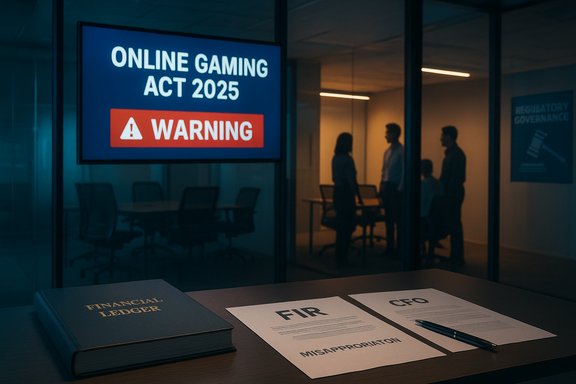
Online gaming firm Gameskraft’s latest restructuring has rippled through India’s gaming ecosystem: the Bengaluru-based company has cut more than half of its workforce amid a twin shock — a sweeping new federal law that effectively bans cash-based online games and the exposure of a massive alleged fraud by its former chief financial officer. The combination of regulatory upheaval and internal governance failure has forced Gameskraft into an emergency retrenchment that industry observers describe as one of the most painful contractions the real‑money gaming sector has seen in recent months.
Source: Storyboard18 Gameskraft layoffs cross 400 as Online Money Gaming ban forces deep restructuring
 Background
The company and its operating model
Gameskraft Technologies grew rapidly as a platform operator in India’s skill‑gaming and fantasy market, operating multiple consumer-facing properties that monetised gameplay through entry fees, wagers, and cash payouts. That business model — commonly described as “real money gaming” — depends on the ability to accept user deposits, process payouts, and host prize-based competitions, which made Gameskraft and peers acutely vulnerable to changes in regulation and payment‑rail policy.The regulatory pivot: Promotion and Regulation of Online Gaming Act, 2025
In mid‑2025 the Indian Parliament enacted the Promotion and Regulation of Online Gaming Act, 2025, which centralises licensing and imposes strict prohibitions on online games involving monetary stakes. The law empowers a national regulator, restricts advertising, and places criminal and civil penalties on operators and third parties who enable money‑based gaming. Implementation was scheduled to commence from October 1, 2025, creating immediate legal uncertainty for platforms that previously operated under state‑by‑state rules. Legal commentators and law‑firms summarised the Act as an effective ban on online money games as presently offered in India, with narrow carve‑outs confined to subscription models, esports and purely non‑monetised social games.What happened at Gameskraft: timeline and turning points
From a planned reduction to a major downsizing
Initial reporting earlier in the year flagged a first wave of layoffs at Gameskraft of roughly 120 employees as the firm began to pause or wind down cash‑vertical offerings after the Act’s passage. Within weeks, however, the terms of the restructuring widened: multiple company communications and industry coverage indicate the reduction expanded to impact several hundred staff, with one report placing the affected headcount at “400+” across teams and functions — representing more than half of a workforce that had been about 600 strong. That rapid escalation reflects the speed at which the commercial basis for Gameskraft’s flagship products was destabilised.The governance shock: alleged ₹231–₹270 crore diversion by the CFO
Compounding the regulatory squeeze was a severe internal governance failure. Gameskraft filed criminal complaints and a First Information Report (FIR) in September alleging that its former Group Chief Financial Officer, identified in reporting as Ramesh Prabhu, diverted large sums from company accounts into personal trading. Forensic review and company disclosures put the unauthorised transfers in the ballpark of ₹231 crore to ₹270 crore across financial years FY20–FY25, with estimated trading losses exceeding ₹250 crore after speculative futures & options (F&O) bets went wrong. Reports say Prabhu sent a voluntary confession email in March 2025 and then became untraceable; the FIR cites charges including criminal breach of trust, theft, forgery and falsification of accounts. Multiple independent outlets have reported and corroborated the basic facts of the FIR and the scale of the alleged misappropriation.Company response and employee support measures
What Gameskraft announced
In public communications to media, Gameskraft framed the exercise as an “organisational restructuring” driven by business‑continuity considerations after the new Act rendered several core verticals non‑viable. The company said impacted employees — including probationers, interns and contract staff — received certain financial and welfare measures. Reported provisions included:- Three months’ salary paid in advance to all impacted employees.
- Severance packages incorporating a one‑time ex‑gratia, notice pay, and leave encashment.
- Short‑term continuation of group medical insurance and term life coverage for affected employees.
- Access to mental health and wellness services, extended maternity leave for women on leave, and career transition assistance including job placement support, reference letters and a priority rehire option.
- Waiver of recoveries tied to joining bonuses, relocation costs and notice period buyouts.
The legal and financial facts: what’s verified, what’s provisional
Key verified facts
- A central legislative change — the Promotion and Regulation of Online Gaming Act, 2025 — has been enacted and is being operationalised with rules and a regulatory authority. Media coverage and legal summaries confirm the Act’s passage and its intent to clamp down on money‑based online gaming while promoting esports and non‑monetised games.
- Gameskraft lodged an FIR alleging major misappropriation and domestic criminal investigations were registered at Marathahalli police station. Multiple reputable national outlets reported the FIR, the charges, and the approximate magnitude of diverted funds and write‑offs.
- The company reported material write‑downs in FY25 financials related to the discovered irregularities and has publicly paused or discontinued certain cash‑vertical services in response to the new legal landscape. Economic and industry press documented operational suspension and write‑offs.
Areas to treat with caution
- The exact number of layoffs. Early reports documented a 120‑person round; later coverage and company statements to specific outlets refer to “about 400+” impacted employees. Different outlets cite different snapshots; the company’s internal categorisation (probationers, contractors, offers honoured) complicates a single consolidated tally. Wherever possible, both the early and later numbers are reported here to reflect that the total affected headcount increased over a short window and that public tallies vary by outlet and time.
- Exact benefit terms. While several welfare measures were described in the company‑level statement to media, those specifics were not replicated across the company’s statutory filings or multiple independent press releases. Therefore the precise durations and caps for insurance coverage, mental health provision and severance arithmetic should be treated as reported by the company to a media outlet and flagged as claims pending formal, independently‑audited disclosure.
Why the law matters: commercial mechanics and market impact
How the Act dismantles real‑money gaming economics
The real‑money model depends on three interlocking capabilities:- The ability to accept and custodise user deposits (or operate escrowed stakes).
- The permissibility of converting in‑game success into withdrawable monetary value.
- The operation of tournaments, contests or wagering events that link skill or chance outcomes to monetary prizes.
Immediate industry consequences
The law prompted a broad pause, pivot and pruning across India’s RMG (real‑money gaming) sector: some firms temporarily suspended operations, others announced layoffs and strategic redirections, and a handful signalled moves to target international markets where regulatory frameworks differ. Aggregated reporting suggests thousands of jobs across multiple companies were impacted in the weeks following enforcement — a systemic shock to a sector that had been a major employer for early‑career product, engineering and operations talent.Governance failure and internal controls: what went wrong at Gameskraft
Anatomy of the alleged fraud
Public reporting indicates the alleged misconduct involved two distinct stages:- Diversion and concealment: Company funds were allegedly routed into accounts under the former CFO’s control and presented as legitimate corporate investments, with falsified mutual fund statements and altered bank records used to disguise the transfers.
- Speculative exposure: The diverted funds were then used in high‑risk derivatives trading (F&O positions) that resulted in substantial losses, prompting an internal audit and write‑down once the positions failed to recover.
Lessons for startups and fast‑growing mid‑market firms
- Treasury governance cannot be deferred. Rapid growth should not delay deployment of robust treasury policy, approval matrices and multi‑party verification for material transactions.
- Continuous audit and forensic readiness. Firms in consumer finance‑adjacent industries should run periodic forensic checks, balanced with normal statutory audit cycles, to detect voluntary or coercive misstatements earlier.
- Board oversight and whistleblower channels. Stronger independent board oversight, clear CFO replacement contingencies and accessible whistleblower reporting reduce the “single point of failure” risk posed by an individual with wide financial autonomy.
Critical analysis: company strategy, communications and systemic risk
Where Gameskraft’s response shows strengths
- The company moved quickly to quantify losses and file criminal complaints, which signals a willingness to escalate and seek legal remedy rather than bury issues internally.
- According to their public narrative, Gameskraft implemented immediate employee support measures and attempted to honour offers and mitigate short‑term harm to staff. If accurately executed, these measures — advance salary, extended insurance, outplacement — represent best practice in compassionate restructuring.
- Pausing or winding down cash‑vertical operations directly in response to the Act reduces legal exposure and shows risk‑aware decision‑making in a volatile regulatory environment.
Weaknesses and unresolved risks
- Timing and transparency: The emergence of the alleged fraud, its timing relative to the law’s passage, and the scale of the write‑offs raise questions about prior governance and why earlier controls failed to detect multi-year diversion.
- Financial survivability: Large write‑offs and the loss of cash‑based product revenue create a capital deficit. Without demonstrable new revenue plans or funding, the firm’s runway and capacity to rebuild teams remain uncertain.
- Reputational contagion: Fraud allegations at a finance‑centric role in a publicly‑exposed consumer business amplifies trust risk with payment partners, merchants, advertisers and users. Rebuilding institutional trust will require transparent remediations and independent audits.
- Regulatory uncertainty: Even as Gameskraft pivots, the final scope and operational rules under the new regulator will be decisive. Pending litigation and the Supreme Court consolidation of challenges mean legal outcomes could evolve — further complicating strategic planning.
Wider implications for the Indian gaming ecosystem
Talent flows and market reallocation
The ban and subsequent layoffs accelerate talent migration: product, engineering and operations professionals from RMG firms will flow into adjacent gaming segments (free‑to‑play titles, mobile casual games, esports infrastructure), to international startups, or into entirely different tech verticals such as fintech or SaaS. This reallocation may produce short‑term unemployment spikes but could also seed a new wave of startups that repurpose talent and capital into alternative monetisation models.Commercial strategy pivots winners and losers
- Winners include companies that had diversified into non‑monetised social games, subscription software, esports and content — these can repurpose user engagement into ad, subscription or trade models.
- Firms heavily concentrated on prize‑based products without large venture reserves or international footprints face existential pressure.
Regulatory and compliance precedent
The Act sets an aggressive regulatory precedent for digital platform regulation in India: the government’s willingness to police ads, payment facilitation and platform conduct signals that businesses operating in borderline categories must proactively engage with regulators and design for compliance from product inception.Practical takeaways: what founders, CFOs and regulators should do next
- Strengthen treasury controls immediately:
- Multi‑signatory approvals for transfers above a defined threshold.
- Mandatory external confirmations for off‑balance “investments.”
- Automated bank reconciliation run daily with exception reporting.
- Reassess product and legal compliance:
- Evaluate existing offerings against the Act’s definitions and migrate cash‑based mechanics to subscription or non‑monetised designs where permitted.
- Work with legal counsel to determine international market viability and licensing paths.
- Communicate candidly with employees and partners:
- Publish transparent timelines for severance and benefits fulfilment.
- Offer certified references and rehire priority windows to maintain employer brand.
- Prepare for forensic audits and regulatory interaction:
- Commission independent external audits to validate bookkeeping and remedial actions.
- Engage with the national regulator proactively to seek clarity on permissible models and any potential exemptions.
- Build contingency cash reserves and alternative revenue funnels:
- Identify near‑term monetisation routes that don’t rely on prize payouts (ads, subscriptions, B2B services).
Conclusion
Gameskraft’s abrupt workforce reduction and the unmasking of a significant alleged CFO fraud have combined with a radical regulatory shift to create a high‑intensity stress test for India’s online gaming industry. The Promotion and Regulation of Online Gaming Act, 2025 has altered the commercial landscape for real‑money games overnight, forcing operators to pivot or pause, and placing governance practices under the microscope. While Gameskraft’s reported welfare measures indicate an attempt to limit harm, the company now faces the twin tasks of rebuilding trust with stakeholders and finding a sustainable, regulation‑compliant business model. For the broader ecosystem, the episode is a stark reminder: rapid growth without equally rapid institutionalisation of controls and regulatory foresight can convert opportunity into crisis. The next phase will reward firms that can combine resilient governance with creative product pivots — and those that fail to adapt may simply exit the market.Source: Storyboard18 Gameskraft layoffs cross 400 as Online Money Gaming ban forces deep restructuring
