

Cybersecurity leaders are being asked to defend a business model that no longer assumes every attack can be stopped. The Gartner® Cyber Resilience Framework Report, made available through Absolute, reflects that shift: security success must increasingly be measured by whether essential operations can continue during compromise, disruption, ransomware, identity failure, or destructive attack—not simply by the number of incidents prevented.
That is an important distinction for Windows-heavy organizations. A compromised endpoint, disrupted Microsoft Entra ID tenant, inaccessible Active Directory domain controller, encrypted file server, or unavailable remote-management platform can quickly become a business continuity event. The defining question is no longer merely “How did the attacker get in?” It is “What can the organization still do safely while core technology is untrusted?”
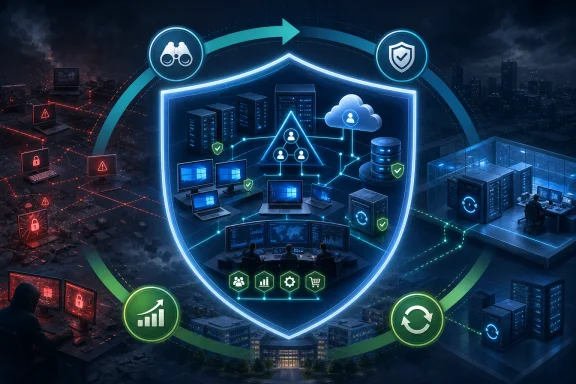
The report presents cyber resilience as a continuous cycle built around four outcomes: anticipate, withstand, recover, and adapt. This is not a replacement for preventive cybersecurity controls. Rather, it is an acknowledgment that prevention, detection, and response must be designed alongside operational survivability.
For organizations that have historically treated incident response, disaster recovery, endpoint management, and business continuity as separate disciplines, that message deserves close attention.
For years, cybersecurity programs were often evaluated through a prevention-first lens. Security teams measured blocked malware, patch compliance, phishing-test rates, firewall events, and the number of detected threats. Those measures still matter, but they do not establish whether a business can function when a high-impact attack bypasses those defenses.
A mature cyber resilience strategy starts from a tougher premise: some controls will fail, some alerts will be missed, and some systems will become unavailable or untrustworthy.
That does not mean organizations should become fatalistic about cyber risk. It means they should engineer for degraded operations. A resilient organization can isolate affected systems, retain access to its most important business capabilities, restore services in a prioritized order, and make meaningful improvements after the event.
The Gartner-oriented framework described in the report focuses on four connected phases:
That is why cyber resilience belongs as much in executive planning and operational design as it does in the security team’s technical roadmap.
From there, leaders must determine what happens next.
Can an attacker move laterally from a standard Windows workstation into privileged infrastructure? Can a compromised user account reset passwords, enroll malicious devices, or access sensitive cloud storage? Can a ransomware event disable endpoint-management tools before recovery begins? Can remote employees still be reached if the corporate network and collaboration environment are impaired?
These are resilience questions because they examine the consequences of control failure, not just the likelihood of intrusion.
Likewise, a business may experience a confirmed intrusion yet avoid a severe operational impact because segmentation, identity controls, alternate communications, resilient endpoint management, and tested recovery plans contained the damage. In that case, the organization should not treat the incident as a success, but it should recognize that its resilience investments worked.
Boards and executive teams increasingly need metrics that connect cyber events to business outcomes, including:
The central task is to identify the business capabilities that must remain available—or be restored quickly enough—to prevent unacceptable financial, safety, legal, regulatory, or customer impact.
A better approach begins with business services. Consider examples such as:
For a Windows environment, that dependency map may reveal uncomfortable realities. A line-of-business system may depend on a legacy Windows Server instance. A business-critical application may rely on Active Directory authentication with no tested fallback. A remote workforce may depend on a single virtual private network design, cloud identity provider, endpoint-management plane, or collaboration platform.
The critical insight is that business resilience is frequently constrained by hidden technical dependencies.
Common examples include:
Organizations should assess whether they can still administer and recover key systems if standard authentication paths are compromised. That includes the availability and protection of privileged accounts, break-glass procedures, credential vault access, domain recovery processes, and secure administrative workstations.
A compromised identity system can undermine otherwise sound technical defenses. If attackers can abuse privileged credentials, modify policies, deploy malware through management tools, create persistent cloud identities, or alter backup settings, recovery becomes much harder.
Anticipation therefore requires more than multi-factor authentication. It requires a clear understanding of who can administer what, from where, with which tools, and under which failure conditions.
That may mean operating at reduced capacity. It may require manual workarounds, isolation of affected network segments, or temporary use of alternate systems. The important point is that the organization has already decided what “acceptable degraded operation” looks like.
When an attacker compromises a Windows endpoint, a segmented architecture can prevent the incident from becoming a total enterprise outage. User networks, server tiers, backup infrastructure, administrative systems, operational technology, cloud management paths, and sensitive applications should not all trust one another by default.
Effective segmentation requires more than drawing lines on a network diagram. It requires enforcing rules that are meaningful during a real intrusion:
A resilient endpoint strategy should account for situations where standard network access, VPN connectivity, directory services, or centralized management platforms are disrupted. Security teams need reliable ways to determine which devices are affected, communicate with users, isolate risky systems, and maintain control over critical endpoints.
For Windows organizations, practical resilience questions include:
A resilient backup program should ensure that recovery data is protected from the same identities, networks, and administrative pathways that attackers can compromise. Backups must be isolated appropriately, monitored for tampering, and tested through actual restoration exercises.
The organization also needs to know whether it can restore the right sequence of systems. Recovering an application before its identity platform, database, certificate authority, DNS service, or network dependencies may not restore the business service at all.
The strongest resilience programs treat backups as part of a broader recovery architecture that includes:
The difference between recovery and resilience is often found in that word: safely.
A basic recovery plan might prioritize core infrastructure first, followed by customer-facing applications, internal tools, and less essential services. But real-world recovery requires more detail. Core services can include identity, DNS, DHCP, certificate services, network connectivity, secure communications, endpoint management, backup access, virtualization, and logging.
The right order will vary by organization. The important thing is that recovery priorities are documented, exercised, and understood by both IT teams and business owners.
A reliable recovery strategy defines:
A clean recovery environment can provide a controlled location for restoring, validating, patching, monitoring, and testing systems before they return to production. This is especially valuable when core identity systems, virtualization layers, management platforms, or domain controllers may have been compromised.
For Windows estates, recovery planning should include detailed procedures for rebuilding or restoring Active Directory, validating administrative access, checking Group Policy integrity, rotating privileged credentials, reviewing Microsoft Entra ID configuration, and re-establishing trusted management channels.
These activities may sound technical, but they are business-critical. If attackers retain identity-level access, the organization may appear recovered while remaining exposed to reinfection, data theft, or renewed disruption.
A resilience framework should include out-of-band communication methods for executives, incident responders, business leaders, employees, vendors, legal counsel, customers, and regulators where appropriate. Contact lists, escalation paths, approved messaging, and decision records should be accessible without relying on the systems most likely to be affected.
This is not merely a public-relations concern. Poor communication can delay containment, confuse employees, impair manual workarounds, and create avoidable legal and reputational risk.
The most resilient organizations do not simply close the incident ticket. They ask whether the incident exposed a design failure, a governance gap, a hidden dependency, a weakness in decision-making, or an unrealistic assumption about recovery.
A stronger adaptation process assigns clear actions, executives accountable for decisions, target dates, and measurable outcomes.
Examples include:
High-value resilience exercises test difficult assumptions:
A security team can recommend multi-factor authentication, segmentation, immutable backups, and endpoint controls. It cannot independently decide which customer services can tolerate degradation, which manual processes are acceptable, how much redundancy is financially justified, or when a high-risk system should be taken offline.
Useful board-level resilience reporting may include:
That is not enough.
The framework only produces value when it changes how systems are designed, how investment is prioritized, and how leadership measures success. Resilience must influence cloud architecture, endpoint strategy, identity administration, backup design, vendor contracts, application modernization, and crisis governance.
It also correctly challenges the idea that cyber defense ends at prevention. In a threat environment shaped by ransomware, credential theft, cloud identity attacks, supply-chain risk, and disruptive attacks against critical services, organizations need to design for continuity under adverse conditions.
Other notable strengths include:
First, resilience can be expensive. Segmentation, recovery environments, redundant access paths, protected backups, identity hardening, endpoint visibility, and tested manual processes require sustained investment. Leaders must be prepared to make explicit trade-offs rather than simply endorsing resilience in principle.
Second, organizations can over-focus on technology. The most damaging weakness may be an unclear decision authority, an untested vendor contact process, a missing recovery credential, or a business unit that has never defined its minimum operating capability.
Third, recovery claims require evidence. A stated recovery time objective is not proof that the organization can meet it. The only credible validation comes from exercises that restore systems, test dependencies, measure elapsed time, and identify what failed.
Fourth, resilience planning must not become an excuse for weak prevention. A company that can recover rapidly still faces serious exposure from stolen data, fraud, intellectual-property loss, regulatory obligations, and reputational damage. The right model combines strong prevention with the ability to continue and recover when prevention fails.
Finally, vendors may use the language of cyber resilience broadly. Organizations should distinguish between a product that improves one part of resilience—such as endpoint visibility, backup protection, identity security, or network segmentation—and a complete enterprise resilience program. No single platform can replace governance, architecture, trained personnel, recovery testing, and business ownership.
The goal is not perfection. The goal is to make the organization materially harder to disrupt and materially faster to restore.
For Windows-centric enterprises, that means treating endpoints, identity systems, administrative tools, backups, cloud management planes, and network boundaries as parts of a single operational resilience architecture. Every one of those elements can become either a point of failure or a path to continued service during a crisis.
Cyber resilience is ultimately not defined by a policy document, a dashboard, or a vendor category. It is demonstrated when a serious attack occurs and the organization can protect people, preserve essential operations, restore trust in its systems, and emerge better prepared for the next disruption.
That is an important distinction for Windows-heavy organizations. A compromised endpoint, disrupted Microsoft Entra ID tenant, inaccessible Active Directory domain controller, encrypted file server, or unavailable remote-management platform can quickly become a business continuity event. The defining question is no longer merely “How did the attacker get in?” It is “What can the organization still do safely while core technology is untrusted?”
The report presents cyber resilience as a continuous cycle built around four outcomes: anticipate, withstand, recover, and adapt. This is not a replacement for preventive cybersecurity controls. Rather, it is an acknowledgment that prevention, detection, and response must be designed alongside operational survivability.
For organizations that have historically treated incident response, disaster recovery, endpoint management, and business continuity as separate disciplines, that message deserves close attention.
 Overview: From Breach Prevention to Business Survivability
For years, cybersecurity programs were often evaluated through a prevention-first lens. Security teams measured blocked malware, patch compliance, phishing-test rates, firewall events, and the number of detected threats. Those measures still matter, but they do not establish whether a business can function when a high-impact attack bypasses those defenses.A mature cyber resilience strategy starts from a tougher premise: some controls will fail, some alerts will be missed, and some systems will become unavailable or untrustworthy.
That does not mean organizations should become fatalistic about cyber risk. It means they should engineer for degraded operations. A resilient organization can isolate affected systems, retain access to its most important business capabilities, restore services in a prioritized order, and make meaningful improvements after the event.
The Gartner-oriented framework described in the report focuses on four connected phases:
- Anticipate the threats, dependencies, and failure scenarios most likely to affect critical operations.
- Withstand an attack while keeping essential services running, even in a constrained or degraded state.
- Recover systems, data, identities, and business processes in a controlled and safe sequence.
- Adapt architecture, governance, procedures, and investment decisions based on lessons learned.
That is why cyber resilience belongs as much in executive planning and operational design as it does in the security team’s technical roadmap.
Why an “Assume Breach” Mindset Is Becoming Essential
The phrase assume breach is sometimes misunderstood as an admission that defenses are ineffective. In practice, it is an operational planning discipline. It requires an organization to assume that an attacker may obtain access to a device, an administrator account, a cloud workload, a SaaS platform, or a trusted third-party connection.From there, leaders must determine what happens next.
Can an attacker move laterally from a standard Windows workstation into privileged infrastructure? Can a compromised user account reset passwords, enroll malicious devices, or access sensitive cloud storage? Can a ransomware event disable endpoint-management tools before recovery begins? Can remote employees still be reached if the corporate network and collaboration environment are impaired?
These are resilience questions because they examine the consequences of control failure, not just the likelihood of intrusion.
The limitation of “zero incidents” as a success metric
A simple incident count can create misleading incentives. A low number of reported incidents may reflect strong controls, but it may also reflect weak detection, unclear reporting processes, or excessive focus on narrow technical events.Likewise, a business may experience a confirmed intrusion yet avoid a severe operational impact because segmentation, identity controls, alternate communications, resilient endpoint management, and tested recovery plans contained the damage. In that case, the organization should not treat the incident as a success, but it should recognize that its resilience investments worked.
Boards and executive teams increasingly need metrics that connect cyber events to business outcomes, including:
- Duration of disruption to critical business services.
- Percentage of priority systems operating in a degraded but acceptable state.
- Time required to isolate affected identity, endpoint, network, and cloud environments.
- Ability to access verified recovery data and recovery documentation.
- Recovery time for the most important services compared with defined objectives.
- Number and severity of unresolved dependencies uncovered during exercises.
- Time taken to establish reliable communications during a major outage.
- Improvement actions completed after incidents and resilience tests.
Anticipate: Identify What Must Not Fail
The first resilience outcome, anticipate, begins with understanding the organization’s true operational priorities. This is not the same as maintaining an inventory of hardware and software, although accurate asset inventory remains foundational.The central task is to identify the business capabilities that must remain available—or be restored quickly enough—to prevent unacceptable financial, safety, legal, regulatory, or customer impact.
Start with critical business services, not technology lists
A technology-first exercise often produces a long list of “critical” applications. That list can become so broad that it is almost impossible to prioritize during an actual incident.A better approach begins with business services. Consider examples such as:
- Processing customer orders.
- Delivering healthcare services.
- Running manufacturing or operational technology processes.
- Paying employees and suppliers.
- Supporting emergency communications.
- Delivering regulated client services.
- Providing secure remote access for essential personnel.
- Maintaining customer support and incident communications.
For a Windows environment, that dependency map may reveal uncomfortable realities. A line-of-business system may depend on a legacy Windows Server instance. A business-critical application may rely on Active Directory authentication with no tested fallback. A remote workforce may depend on a single virtual private network design, cloud identity provider, endpoint-management plane, or collaboration platform.
The critical insight is that business resilience is frequently constrained by hidden technical dependencies.
Threat-informed planning matters
Anticipation should not mean planning equally for every imaginable cyber event. Security leaders should prioritize scenarios that are both plausible and materially disruptive.Common examples include:
- Ransomware with broad Windows endpoint and server encryption.
- Theft or misuse of privileged credentials.
- Cloud identity compromise and malicious tenant administration.
- Destructive attacks against virtual infrastructure or backup repositories.
- Disruption of remote access and endpoint-management capabilities.
- Supply-chain compromise through remote-support tools, managed service providers, or software updates.
- Denial-of-service or cloud availability issues affecting customer-facing systems.
- Insider misuse, whether malicious or accidental.
- Operational technology compromise where IT disruption creates a safety or production impact.
Windows environments need identity-centered anticipation
In many enterprises, Windows endpoints and Windows Server systems are connected through a dense web of identity and administration dependencies. This makes identity resilience a core planning concern.Organizations should assess whether they can still administer and recover key systems if standard authentication paths are compromised. That includes the availability and protection of privileged accounts, break-glass procedures, credential vault access, domain recovery processes, and secure administrative workstations.
A compromised identity system can undermine otherwise sound technical defenses. If attackers can abuse privileged credentials, modify policies, deploy malware through management tools, create persistent cloud identities, or alter backup settings, recovery becomes much harder.
Anticipation therefore requires more than multi-factor authentication. It requires a clear understanding of who can administer what, from where, with which tools, and under which failure conditions.
Withstand: Keep Essential Operations Running Under Attack
The second phase, withstand, is where cyber resilience becomes visibly different from conventional security architecture. The goal is not simply to detect and contain an incident. It is to ensure that essential functions can continue despite the incident.That may mean operating at reduced capacity. It may require manual workarounds, isolation of affected network segments, or temporary use of alternate systems. The important point is that the organization has already decided what “acceptable degraded operation” looks like.
Segmentation is a business continuity control
Network segmentation is often discussed as a security best practice because it limits lateral movement. In a resilience model, it is also a continuity mechanism.When an attacker compromises a Windows endpoint, a segmented architecture can prevent the incident from becoming a total enterprise outage. User networks, server tiers, backup infrastructure, administrative systems, operational technology, cloud management paths, and sensitive applications should not all trust one another by default.
Effective segmentation requires more than drawing lines on a network diagram. It requires enforcing rules that are meaningful during a real intrusion:
- Separate user devices from high-value server workloads.
- Restrict administrative protocols and remote-management paths.
- Limit access between production, development, and test environments.
- Isolate backup systems from ordinary domain administration.
- Reduce unnecessary trust relationships between networks and identities.
- Segment operational technology from enterprise IT wherever possible.
- Ensure security tools do not become a single shared pathway for enterprise compromise.
Endpoint resilience deserves greater attention
Endpoints are frequently where business continuity and cybersecurity meet. They are the interface through which employees work, administrators manage infrastructure, and attackers often gain an initial foothold.A resilient endpoint strategy should account for situations where standard network access, VPN connectivity, directory services, or centralized management platforms are disrupted. Security teams need reliable ways to determine which devices are affected, communicate with users, isolate risky systems, and maintain control over critical endpoints.
For Windows organizations, practical resilience questions include:
- Can critical devices be located and assessed if normal network tools are unavailable?
- Can access controls be enforced when a device is outside the corporate network?
- Can an infected endpoint be contained without disconnecting every employee from essential work?
- Can critical users receive secure instructions if Microsoft Teams, email, or internal portals are unavailable?
- Can administrative teams access trusted recovery devices during an identity or network outage?
- Can endpoint configuration and security posture be verified before a restored device reconnects?
Immutable backups are necessary, but insufficient
Backup strategy is one of the most recognized elements of ransomware preparedness. Yet simply owning backup software does not guarantee recoverability.A resilient backup program should ensure that recovery data is protected from the same identities, networks, and administrative pathways that attackers can compromise. Backups must be isolated appropriately, monitored for tampering, and tested through actual restoration exercises.
The organization also needs to know whether it can restore the right sequence of systems. Recovering an application before its identity platform, database, certificate authority, DNS service, or network dependencies may not restore the business service at all.
The strongest resilience programs treat backups as part of a broader recovery architecture that includes:
- Defined recovery tiers based on business impact.
- Protected and verified backup copies.
- Recovery documentation stored in a separately accessible location.
- Clean-room or isolated recovery environments.
- Preidentified recovery personnel and decision authorities.
- Tested domain, cloud identity, server, endpoint, and application restoration procedures.
- Clear criteria for deciding when an environment is safe to reconnect.
Recover: Restore Trust, Not Just Availability
The third phase, recover, can be the most difficult. Restoring a server or workstation image is comparatively straightforward when the environment is trusted. During a major cyberattack, however, the organization must determine whether restored systems are clean, whether attackers retain access, and whether critical services can be returned safely.The difference between recovery and resilience is often found in that word: safely.
Recovery must be prioritized by business outcome
Every system cannot be restored at once. During an incident, the organization needs an agreed sequence that aligns with critical business capabilities.A basic recovery plan might prioritize core infrastructure first, followed by customer-facing applications, internal tools, and less essential services. But real-world recovery requires more detail. Core services can include identity, DNS, DHCP, certificate services, network connectivity, secure communications, endpoint management, backup access, virtualization, and logging.
The right order will vary by organization. The important thing is that recovery priorities are documented, exercised, and understood by both IT teams and business owners.
A reliable recovery strategy defines:
- What must be restored first to keep the most important service operating.
- What dependencies must be available before that restoration can succeed.
- Who has authority to make trade-offs under pressure.
- What evidence is required before recovered systems are considered trustworthy.
- How the organization will communicate status, risks, and expected service levels.
Clean recovery environments reduce reinfection risk
Organizations recovering from ransomware or persistent intrusion face a serious danger: bringing systems back online before the attacker has been removed.A clean recovery environment can provide a controlled location for restoring, validating, patching, monitoring, and testing systems before they return to production. This is especially valuable when core identity systems, virtualization layers, management platforms, or domain controllers may have been compromised.
For Windows estates, recovery planning should include detailed procedures for rebuilding or restoring Active Directory, validating administrative access, checking Group Policy integrity, rotating privileged credentials, reviewing Microsoft Entra ID configuration, and re-establishing trusted management channels.
These activities may sound technical, but they are business-critical. If attackers retain identity-level access, the organization may appear recovered while remaining exposed to reinfection, data theft, or renewed disruption.
Communication is a recovery dependency
Cyber incident plans sometimes assume that email, collaboration platforms, phones, ticketing systems, and corporate portals will all remain available. That assumption can fail during a major attack.A resilience framework should include out-of-band communication methods for executives, incident responders, business leaders, employees, vendors, legal counsel, customers, and regulators where appropriate. Contact lists, escalation paths, approved messaging, and decision records should be accessible without relying on the systems most likely to be affected.
This is not merely a public-relations concern. Poor communication can delay containment, confuse employees, impair manual workarounds, and create avoidable legal and reputational risk.
Adapt: Turn Incidents and Exercises Into Lasting Improvement
The fourth phase, adapt, prevents cyber resilience from becoming a static compliance program. Every major incident, near miss, tabletop exercise, red-team finding, and recovery test should feed a structured improvement cycle.The most resilient organizations do not simply close the incident ticket. They ask whether the incident exposed a design failure, a governance gap, a hidden dependency, a weakness in decision-making, or an unrealistic assumption about recovery.
Lessons learned must lead to owned actions
Post-incident reviews are valuable only when they produce changes. “Improve communications” or “test backups more frequently” may sound reasonable, but broad recommendations often fail because nobody owns them and no deadline or success measure exists.A stronger adaptation process assigns clear actions, executives accountable for decisions, target dates, and measurable outcomes.
Examples include:
- Removing unnecessary administrative privileges.
- Segmenting a high-risk network connection.
- Establishing an offline recovery runbook.
- Deploying protected administrative workstations.
- Adding alternate communication channels.
- Updating vendor requirements for incident cooperation.
- Testing Active Directory forest recovery.
- Reclassifying a previously overlooked application as business-critical.
- Training executives on recovery decision-making.
- Revising recovery objectives that proved unrealistic.
Exercises should test uncomfortable scenarios
Many organizations run tabletop exercises that focus on familiar ransomware narratives. Those exercises can be useful, but they must not become ceremonial.High-value resilience exercises test difficult assumptions:
- What happens if the identity provider is unavailable or untrusted?
- What if backups exist but their management console is inaccessible?
- What if the security team cannot rely on its normal endpoint telemetry?
- What if a third-party provider is also affected?
- What if critical personnel are unavailable?
- What if an attack occurs during a major business deadline?
- What if the organization must operate manually for several days?
- What if legal, privacy, customer-service, and operational teams disagree on when systems should return online?
Cross-Functional Leadership Is the Framework’s Hardest Requirement
The report’s emphasis on executive buy-in and cross-functional collaboration is arguably its most important point. Cyber resilience cannot be delivered by the CISO alone, because the outcomes involve business priorities, technology architecture, finance, legal obligations, communications, human resources, procurement, facilities, and operational leadership.A security team can recommend multi-factor authentication, segmentation, immutable backups, and endpoint controls. It cannot independently decide which customer services can tolerate degradation, which manual processes are acceptable, how much redundancy is financially justified, or when a high-risk system should be taken offline.
The board needs operationally meaningful reporting
Board discussions should move beyond broad assurances that cybersecurity controls are “in place.” Directors need visibility into material operational risk.Useful board-level resilience reporting may include:
- The organization’s most critical services and their dependencies.
- Recovery objectives for those services.
- Results from recovery and continuity exercises.
- Gaps in backup isolation, identity resilience, or segmentation.
- Exposure created by key third parties and cloud dependencies.
- The time and resources required to address high-priority weaknesses.
- Decisions that require leadership acceptance of residual risk.
Avoid turning resilience into another silo
There is a risk that “cyber resilience” becomes another label applied to existing security work without changing decisions or architecture. An organization may purchase a resilience-oriented product, update a policy, or run an annual tabletop exercise while retaining the same fragile dependencies.That is not enough.
The framework only produces value when it changes how systems are designed, how investment is prioritized, and how leadership measures success. Resilience must influence cloud architecture, endpoint strategy, identity administration, backup design, vendor contracts, application modernization, and crisis governance.
Strengths of the Cyber Resilience Framework
The framework’s greatest strength is its clarity. Anticipate, withstand, recover, and adapt provides a memorable model that can bring security, IT, and business stakeholders into the same discussion.It also correctly challenges the idea that cyber defense ends at prevention. In a threat environment shaped by ransomware, credential theft, cloud identity attacks, supply-chain risk, and disruptive attacks against critical services, organizations need to design for continuity under adverse conditions.
Other notable strengths include:
- Business-centered prioritization: It directs attention toward essential services rather than an undifferentiated list of technical assets.
- Lifecycle thinking: It recognizes that recovery and learning are as important as blocking threats.
- Executive relevance: It provides language for connecting cybersecurity investment to operational outcomes.
- Adaptability: The model can be applied across cloud, on-premises, hybrid, Windows, mobile, and operational technology environments.
- Compatibility with established practices: It complements risk management, incident response, disaster recovery, enterprise architecture, and business continuity programs.
- Focus on survivability: It helps organizations plan for degraded operations instead of treating total availability as the only acceptable state.
Risks, Gaps, and Implementation Challenges
The framework is compelling, but no high-level model automatically solves the difficult parts of resilience.First, resilience can be expensive. Segmentation, recovery environments, redundant access paths, protected backups, identity hardening, endpoint visibility, and tested manual processes require sustained investment. Leaders must be prepared to make explicit trade-offs rather than simply endorsing resilience in principle.
Second, organizations can over-focus on technology. The most damaging weakness may be an unclear decision authority, an untested vendor contact process, a missing recovery credential, or a business unit that has never defined its minimum operating capability.
Third, recovery claims require evidence. A stated recovery time objective is not proof that the organization can meet it. The only credible validation comes from exercises that restore systems, test dependencies, measure elapsed time, and identify what failed.
Fourth, resilience planning must not become an excuse for weak prevention. A company that can recover rapidly still faces serious exposure from stolen data, fraud, intellectual-property loss, regulatory obligations, and reputational damage. The right model combines strong prevention with the ability to continue and recover when prevention fails.
Finally, vendors may use the language of cyber resilience broadly. Organizations should distinguish between a product that improves one part of resilience—such as endpoint visibility, backup protection, identity security, or network segmentation—and a complete enterprise resilience program. No single platform can replace governance, architecture, trained personnel, recovery testing, and business ownership.
Building a Practical Cyber Resilience Roadmap
Organizations do not need to solve every resilience problem at once. A disciplined roadmap can create measurable improvement over time.First, establish the operating baseline
Identify critical business services and map their major technology, identity, data, people, and supplier dependencies. Define the current recovery objectives and determine whether they are based on real testing or assumption.Next, identify the most dangerous single points of failure
Focus on risks that could turn a contained event into an enterprise outage. In Windows environments, these often include privileged identity compromise, weak backup isolation, flat network architecture, unprotected administrative tools, fragile remote-access dependencies, and inadequate endpoint visibility.Then, test recovery before an emergency demands it
Run practical exercises that validate backup restoration, identity recovery, endpoint containment, communication alternatives, and business process workarounds. Measure outcomes rather than relying on written plans.Finally, establish a continuous improvement cadence
Review lessons from incidents, operational outages, vulnerability findings, and exercises. Track remediation work as a leadership priority, not merely a security backlog item.The goal is not perfection. The goal is to make the organization materially harder to disrupt and materially faster to restore.
The Bottom Line
The Gartner® Cyber Resilience Framework Report delivers a timely message: a cybersecurity strategy centered only on stopping attacks is no longer sufficient. Organizations need the capacity to anticipate realistic threats, withstand disruption, recover trusted operations, and adapt as conditions change.For Windows-centric enterprises, that means treating endpoints, identity systems, administrative tools, backups, cloud management planes, and network boundaries as parts of a single operational resilience architecture. Every one of those elements can become either a point of failure or a path to continued service during a crisis.
Cyber resilience is ultimately not defined by a policy document, a dashboard, or a vendor category. It is demonstrated when a serious attack occurs and the organization can protect people, preserve essential operations, restore trust in its systems, and emerge better prepared for the next disruption.
