

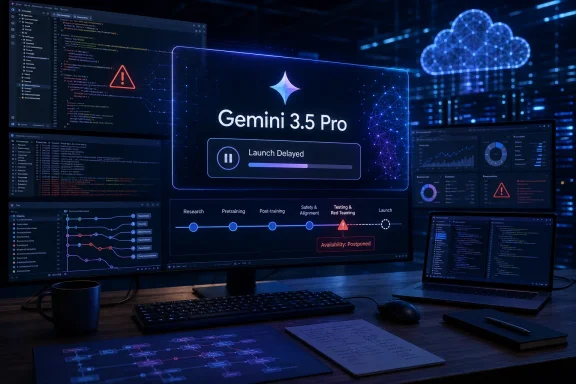
Google has delayed the wider release of Gemini 3.5 Pro, its next high-end AI model, after the model reportedly failed to meet internal targets for code generation. The model had been expected in June following Google I/O, but Google’s public Gemini model page now simply lists 3.5 Pro as “coming soon.”
According to Bloomberg, as summarized by 9to5Google, Google is taking more time to improve Gemini 3.5 Pro’s capabilities, particularly for coding. The report said Google updated training data in late June to address those shortcomings, but the results were reportedly disappointing.
Google has not committed to a replacement release date. In a statement, the company said it is testing Gemini 3.5 Pro, an upgraded Flash model, and other systems with partners while continuing to ship models quickly and keep them cost-effective.
For Windows developers and IT teams, this is primarily a roadmap slip rather than a service outage. Anyone planning to standardize on Gemini 3.5 Pro in Google AI Studio, Vertex AI, Gemini Code Assist, or an in-house agent workflow should not treat the model as imminently available.
Google’s current public lineup still includes Gemini 3.1 Pro for complex work and Gemini 3.5 Flash, which the company positions for agentic and coding workloads. Google’s own published benchmarks put 3.5 Flash ahead of Gemini 3.1 Pro in some coding and tool-use tests, though it remains a different trade-off from the intended Pro-tier release.
That distinction matters for organizations building Windows desktop tooling, Azure- or Google Cloud-connected services, CI automation, or developer-assistance workflows. A project that was scoped around a more capable Gemini 3.5 Pro endpoint may need to stay with the current 3.1 Pro model, use 3.5 Flash where latency and cost matter, or retain a multi-model strategy rather than committing to an unreleased API.
Google has substantial internal experience here. As reported by 9to5Google, the company said in April that 75% of new code at Google was AI-generated and then approved by engineers. Yet production-grade coding is a demanding target: models must generate useful changes without breaking builds, misusing dependencies, exposing secrets, or quietly introducing security flaws.
For admins, that is a useful reminder that a model’s coding benchmark score is not a substitute for controls around source access, secrets management, code review, test gates, and logging. Better model output can reduce grunt work, but it also increases the speed at which flawed changes can reach a repository.
Google has not announced a new date for Gemini 3.5 Pro, so teams should plan against currently available Gemini models rather than the delayed flagship.
According to Bloomberg, as summarized by 9to5Google, Google is taking more time to improve Gemini 3.5 Pro’s capabilities, particularly for coding. The report said Google updated training data in late June to address those shortcomings, but the results were reportedly disappointing.
Google has not committed to a replacement release date. In a statement, the company said it is testing Gemini 3.5 Pro, an upgraded Flash model, and other systems with partners while continuing to ship models quickly and keep them cost-effective.
 The practical impact for Windows developers
For Windows developers and IT teams, this is primarily a roadmap slip rather than a service outage. Anyone planning to standardize on Gemini 3.5 Pro in Google AI Studio, Vertex AI, Gemini Code Assist, or an in-house agent workflow should not treat the model as imminently available.Google’s current public lineup still includes Gemini 3.1 Pro for complex work and Gemini 3.5 Flash, which the company positions for agentic and coding workloads. Google’s own published benchmarks put 3.5 Flash ahead of Gemini 3.1 Pro in some coding and tool-use tests, though it remains a different trade-off from the intended Pro-tier release.
That distinction matters for organizations building Windows desktop tooling, Azure- or Google Cloud-connected services, CI automation, or developer-assistance workflows. A project that was scoped around a more capable Gemini 3.5 Pro endpoint may need to stay with the current 3.1 Pro model, use 3.5 Flash where latency and cost matter, or retain a multi-model strategy rather than committing to an unreleased API.
Coding has become the pressure point
The delay also underlines how central code generation has become to the AI platform race. It is no longer enough for a model to summarize documents or answer questions well; vendors are competing on repository-scale changes, tool calling, terminal work, debugging, and longer-running development agents.Google has substantial internal experience here. As reported by 9to5Google, the company said in April that 75% of new code at Google was AI-generated and then approved by engineers. Yet production-grade coding is a demanding target: models must generate useful changes without breaking builds, misusing dependencies, exposing secrets, or quietly introducing security flaws.
For admins, that is a useful reminder that a model’s coding benchmark score is not a substitute for controls around source access, secrets management, code review, test gates, and logging. Better model output can reduce grunt work, but it also increases the speed at which flawed changes can reach a repository.
Google has not announced a new date for Gemini 3.5 Pro, so teams should plan against currently available Gemini models rather than the delayed flagship.
References
- Primary source: Bitget
Published: 2026-07-17T01:31:06.363000+00:00
Google (GOOGL.US) delays the launch of Gemini 3.5 Pro large language model as code generation capability falls short of goals | Bitget News
According to Zhitong Finance APP, Alphabet (GOOGL.US, GOOG.US) shares fell 4% on Thursday due to news of a delay in the release of its flagship artificial i | Bitget crypto news!www.bitget.com - Independent coverage: yellow.com
Published: 2026-07-17T04:40:33.737000+00:00
- Independent coverage: 富途牛牛
Published: 2026-07-16T22:00:00+00:00
- Related coverage: deepmind.google
Gemini 3.5 — Google DeepMind
Our latest series of Gemini models combine frontier intelligence with action. Built to help you execute complex, multi-step workflows.deepmind.google - Official source: 9to5google.com
Gemini 3.5 Pro delays due to coding performance
In mid-May, Google announced Gemini 3.5 Flash at I/O 2026 and said the Pro version would arrive in June. That deadline has passed.9to5google.com - Related coverage: techtimes.com
Gemini 3.5 Pro Targets July 17 as DeepSeek's July 24 Deadline Hits Developers Now
DeepSeek API migration is mandatory before July 24, 2026 — after that, deepseek-chat and deepseek-reasoner return errors. Gemini 3.5 Pro targets July 17 after Google scrapped its base model for awww.techtimes.com