

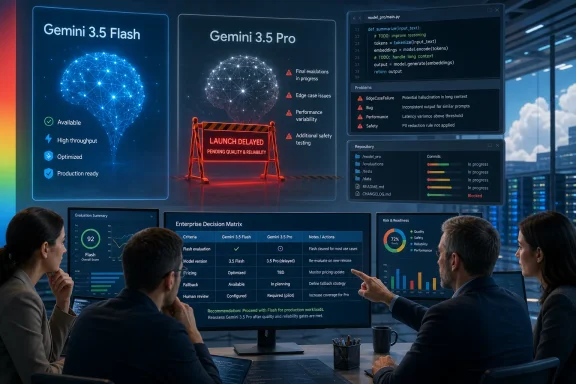
Google’s Gemini 3.5 Pro is reportedly months behind schedule because its coding performance has not cleared Google’s internal bar. For IT buyers, the immediate planning implication is straightforward: treat Gemini 3.5 Flash as the model available for evaluation now, but do not build a production roadmap around Gemini 3.5 Pro until Google states its availability, model version, pricing, and service terms.
The delay matters because Gemini 3.5 Pro has been described in reporting by Bloomberg, republished by the Los Angeles Times, as Google’s most powerful flagship model. Google had been expected to discuss it at its May developer conference, while Technology Org and CNA reported that Alphabet CEO Sundar Pichai said at that conference that it would arrive in June. That expected window has passed. Google is still testing 3.5 Pro with partners, alongside an upgraded Flash model and other systems.
The reported technical issue is coding. According to the Los Angeles Times account, Google attempted to update Gemini’s training data late last month to improve coding performance, but the results reportedly fell short of expectations. That makes this more than a routine launch adjustment: coding is one of the clearest enterprise tests for a model, because teams can quickly measure whether it handles repositories, structured instructions, debugging, tool use, and repeatable output.
Google has said it is “shipping quickly across a wide range of models while keeping them highly cost-effective for customers,” while confirming partner testing of 3.5 Pro, an upgraded Flash model, and other models. That broader portfolio matters, but it does not make Flash and Pro interchangeable. Buyers should evaluate the model that is actually available, not the capability suggested by a future flagship release.
May 2026 — At Google’s annual I/O developer conference, Pichai said Gemini 3.5 Pro would arrive the following month; Gemini 3.5 Flash went live that day, according to Technology Org.
June 12, 2026 — Anthropic reportedly disabled Mythos 5 and Fable 5 after a U.S. export-control order cited national-security concerns.
Late last month — Google reportedly updated Gemini’s training data in an effort to improve coding, but the results did not meet expectations. Anthropic’s curbs were also reportedly lifted after it added safeguards.
The week before the July 16–17 reports — OpenAI reportedly launched GPT-5.6 after a delay tied to U.S. government requests over national-security concerns.
July 16–17, 2026 — Reports said Gemini 3.5 Pro remained months behind schedule, with Alphabet shares falling following the news.
A model that can draft prose but cannot reliably support real software work has a narrower enterprise role. That is why the reported Gemini 3.5 Pro shortfall is important. The issue is not simply that Google has delayed a product. It is that the delayed product is intended to compete in a category where users can perform direct, practical comparisons.
Reporting described employee concern about Anthropic and OpenAI widening their lead in coding-related AI capabilities. Technology Org also pointed to GLM-5.2, a Chinese model said to match Opus 4.8 on coding benchmarks. Benchmark claims should always be read carefully, because test design, tool access, prompting, and evaluation conditions can materially change results. But the broader commercial point is clear: Google is improving Gemini 3.5 Pro against a moving target.
A delayed flagship does not remain fixed in market position while its developer continues testing. Rival models can gain new integrations, developer-tool support, enterprise references, and customer habits during the same period. For buyers, that means the relevant question is not whether a future Pro release will be strong in isolation. It is whether it will be competitive and commercially available when their own platform, budget, and migration decisions must be made.
The market reaction reflected that concern. Reports varied somewhat on the size of Alphabet’s trading decline, with the Los Angeles Times describing an intraday fall of as much as 3.2%, investingLive reporting a 2% decline, and Technology Org and CNA describing a drop of nearly 3%. Those accounts are not necessarily inconsistent; they describe a fast-moving reaction to the same reports.
Google’s response was careful rather than defensive. Its spokesperson emphasized continued shipping across multiple models and a focus on customer cost-effectiveness. That is a reasonable distinction: Google can continue releasing AI products even if one flagship model is delayed. But for customers waiting specifically for a top-end reasoning and coding model, the availability of other Gemini variants is not a complete substitute.
WindowsForum’s analysis, however, is that broad integration can also make flagship releases harder to manage. A model intended for use across multiple product lines may require more compatibility work, product reviews, safety decisions, customer-support preparation, and commercial coordination than a model launched through a narrower API or a small set of early partners.
That should not be mistaken for a reported explanation of the Gemini 3.5 Pro delay. The reporting identifies coding performance as the direct technical concern. But it is reasonable to view the company’s product breadth as part of the operating environment in which a flagship model must be validated and released.
The Los Angeles Times reported that Google Cloud, Google DeepMind, and the Android operating-system team are all building AI coding tools, with consumer product teams involved as well. It also reported pressure from Sergey Brin and others to move faster, alongside accounts of competing groups and duplicated work.
Google has begun responding structurally. Chief AI Architect Koray Kavukcuoglu is working with the main engineering organization to unify internal AI coding tools. Earlier this year, Google formed a dedicated DeepMind AI-coding team led by research engineer Sebastian Borgeaud.
Those moves do not prove that Google has solved duplication or coordination issues. They do show that AI coding has become important enough to warrant dedicated leadership and a more unified approach. For enterprise buyers, that is relevant because product ownership affects practical issues such as release cadence, support, APIs, pricing, model naming, and long-term feature continuity.
The key lesson is not that Google’s organizational structure is uniquely incapable of shipping frontier models. It is that product strategy and model strategy are now tightly connected. A coding model is not just a research artifact. It must fit into developer tools, cloud offerings, security expectations, partner programs, and customer deployment plans.
In practical terms, that points toward the difference between a model that generates code in a chat interface and an agent that operates in a real software environment. A useful coding agent may need context management, tool permissions, memory, access controls, auditability, safeguards, and predictable behavior when it interacts with files, development environments, repositories, and other systems.
WindowsForum’s analysis is that Antigravity appears aimed at solving this operational layer, not merely at improving benchmark performance. That is an important distinction. Better coding output matters, but enterprise adoption also depends on whether the system can be governed, monitored, and constrained in an organization’s actual environment.
Google has said that 75% of its code is generated by AI. That company statement is notable, but it should not be treated as a direct measure of how a public-facing model will perform for outside customers. Internal engineering use can involve established review practices, proprietary tooling, automated testing, controlled access, and workflows tailored to a single organization.
External customers face different conditions. They may have older codebases, inconsistent documentation, mixed toolchains, regulatory obligations, third-party dependencies, and less mature testing coverage. A model that is useful inside Google can still require extensive validation before an enterprise should rely on it for production code changes.
Flash’s mixed customer reception makes the Pro delay more consequential. Rodrigo Davies, a product manager at Figma, said Gemini 3.5 Flash gave the company’s “Figma agent” a sweet spot of speed and quality. That is the kind of workload where responsiveness and iterative interaction can matter as much as maximum reasoning depth.
Platzi chief executive Freddy Vega described a different experience. He said 3.5 Flash was more expensive than Google’s 3.1 Flash predecessor, slower, and less capable than premium competitors. He also said it struggled at times with structured data, leading Platzi to shift some speed-and-reasoning tasks to one of Anthropic’s mid-tier models.
These reports do not necessarily contradict each other. They illustrate a central buyer lesson: model performance is workload-specific. A model can be strong in conversational, design, or rapid-iteration tasks while being a weaker choice for structured extraction, repository work, tool orchestration, or high-volume production automation.
That is why a proof of concept should not stop at generic prompts or public benchmarks. Windows administrators and IT leaders should test the actual data formats, approval flows, latency requirements, logging needs, and failure conditions that matter in their environment.
Technology Org and CNA framed recent OpenAI and Anthropic events as signs that frontier-model launches can face technical, commercial, and government-related constraints at the same time. OpenAI reportedly delayed GPT-5.6 after U.S. government requests tied to national-security concerns about possible misuse. Anthropic reportedly disabled Mythos 5 and Fable 5 after the June 12 export-control order, then restored them after adding safeguards.
The practical conclusion is not that all delays have the same cause. Google’s reported issue is an internal capability shortfall in coding performance. The other reported cases involved government requests, controls, or safeguards. The common planning lesson is that release schedules for advanced models are no longer necessarily linear.
A model can be promising in testing but not ready for broad customer use. It can be commercially attractive but still require additional safeguards. It can be available in one product, region, or partner program without being generally available under enterprise terms.
WindowsForum’s analysis is that government engagement adds another planning variable for vendors and buyers, rather than serving as a complete explanation for Google’s situation. IT teams should therefore avoid treating a model announcement, a conference demonstration, or a partner test as equivalent to a stable production commitment.
For procurement teams, the answer is contractual and operational discipline: ask what model is deployed, where it runs, how data is handled, what fallback exists, what notice is provided for model changes, and what controls remain available if the vendor alters access to a feature.
That makes the near-term planning posture clear:
The delay matters because Gemini 3.5 Pro has been described in reporting by Bloomberg, republished by the Los Angeles Times, as Google’s most powerful flagship model. Google had been expected to discuss it at its May developer conference, while Technology Org and CNA reported that Alphabet CEO Sundar Pichai said at that conference that it would arrive in June. That expected window has passed. Google is still testing 3.5 Pro with partners, alongside an upgraded Flash model and other systems.
The reported technical issue is coding. According to the Los Angeles Times account, Google attempted to update Gemini’s training data late last month to improve coding performance, but the results reportedly fell short of expectations. That makes this more than a routine launch adjustment: coding is one of the clearest enterprise tests for a model, because teams can quickly measure whether it handles repositories, structured instructions, debugging, tool use, and repeatable output.
Google has said it is “shipping quickly across a wide range of models while keeping them highly cost-effective for customers,” while confirming partner testing of 3.5 Pro, an upgraded Flash model, and other models. That broader portfolio matters, but it does not make Flash and Pro interchangeable. Buyers should evaluate the model that is actually available, not the capability suggested by a future flagship release.
 Timeline
May 2026 — At Google’s annual I/O developer conference, Pichai said Gemini 3.5 Pro would arrive the following month; Gemini 3.5 Flash went live that day, according to Technology Org.June 12, 2026 — Anthropic reportedly disabled Mythos 5 and Fable 5 after a U.S. export-control order cited national-security concerns.
Late last month — Google reportedly updated Gemini’s training data in an effort to improve coding, but the results did not meet expectations. Anthropic’s curbs were also reportedly lifted after it added safeguards.
The week before the July 16–17 reports — OpenAI reportedly launched GPT-5.6 after a delay tied to U.S. government requests over national-security concerns.
July 16–17, 2026 — Reports said Gemini 3.5 Pro remained months behind schedule, with Alphabet shares falling following the news.
Action checklist for admins
- Do not tie a production migration, coding-assistant rollout, or procurement deadline to Gemini 3.5 Pro until Google publishes availability and commercial terms.
- Test the currently available Gemini 3.5 Flash against real workloads, especially structured-data handling, repository-scale tasks, latency, output consistency, and cost.
- Preserve portability in model integrations. Retain evaluation prompts, test suites, logging, export paths, and fallback options rather than designing around one future model.
- Separate low-risk assistance from high-impact code changes. Keep human review, automated testing, source-control protections, and access controls in place.
- Ask vendors which specific model and version powers each AI feature. “Gemini” branding alone does not establish the capability level, release status, or data-handling terms.
- Require a documented fallback path if a vendor changes models, withdraws a model tier, changes pricing, or experiences a service interruption.
IT buyer decision matrix
| Decision area | WindowsForum planning guidance | Why it matters |
|---|---|---|
| Current Gemini 3.5 Flash | Use only after workload-specific testing | Customer accounts in the reporting describe different results depending on the task, particularly for speed, structured data, and coding quality |
| Gemini 3.5 Pro roadmap | Do not make a procurement or deployment commitment yet | The model is reportedly still in partner testing and months behind its anticipated window |
| Vendor contracts | Require model/version disclosure | A vendor’s “AI-powered” label does not tell buyers whether a feature uses Flash, Pro, another Gemini variant, or a third-party model |
| Business continuity | Require fallback capability and exportable evaluation data | Model availability, capability, pricing, and safety policies can change faster than a normal software contract cycle |
| Code generation | Keep review and testing controls mandatory | Even a capable coding assistant is not a substitute for validation in production software workflows |
A Missed June Release Turns Coding Into a Strategic Problem
Coding has become one of the most commercially consequential proving grounds for major AI models. It is measurable, valuable, and unusually visible to customers. Developers can quickly tell whether an assistant understands a repository, follows structured requirements, produces valid output, identifies a bug, or merely generates plausible-looking fragments.A model that can draft prose but cannot reliably support real software work has a narrower enterprise role. That is why the reported Gemini 3.5 Pro shortfall is important. The issue is not simply that Google has delayed a product. It is that the delayed product is intended to compete in a category where users can perform direct, practical comparisons.
Reporting described employee concern about Anthropic and OpenAI widening their lead in coding-related AI capabilities. Technology Org also pointed to GLM-5.2, a Chinese model said to match Opus 4.8 on coding benchmarks. Benchmark claims should always be read carefully, because test design, tool access, prompting, and evaluation conditions can materially change results. But the broader commercial point is clear: Google is improving Gemini 3.5 Pro against a moving target.
A delayed flagship does not remain fixed in market position while its developer continues testing. Rival models can gain new integrations, developer-tool support, enterprise references, and customer habits during the same period. For buyers, that means the relevant question is not whether a future Pro release will be strong in isolation. It is whether it will be competitive and commercially available when their own platform, budget, and migration decisions must be made.
The market reaction reflected that concern. Reports varied somewhat on the size of Alphabet’s trading decline, with the Los Angeles Times describing an intraday fall of as much as 3.2%, investingLive reporting a 2% decline, and Technology Org and CNA describing a drop of nearly 3%. Those accounts are not necessarily inconsistent; they describe a fast-moving reaction to the same reports.
Google’s response was careful rather than defensive. Its spokesperson emphasized continued shipping across multiple models and a focus on customer cost-effectiveness. That is a reasonable distinction: Google can continue releasing AI products even if one flagship model is delayed. But for customers waiting specifically for a top-end reasoning and coding model, the availability of other Gemini variants is not a complete substitute.
Google’s Product Breadth Creates a Different Launch Challenge
Google’s AI strategy spans more than a standalone chatbot. Reporting and company positioning connect Gemini to products and services including Search, YouTube, Maps, Android, Workspace, and Cloud. That breadth can help Google place AI capabilities into tools customers already use.WindowsForum’s analysis, however, is that broad integration can also make flagship releases harder to manage. A model intended for use across multiple product lines may require more compatibility work, product reviews, safety decisions, customer-support preparation, and commercial coordination than a model launched through a narrower API or a small set of early partners.
That should not be mistaken for a reported explanation of the Gemini 3.5 Pro delay. The reporting identifies coding performance as the direct technical concern. But it is reasonable to view the company’s product breadth as part of the operating environment in which a flagship model must be validated and released.
The Los Angeles Times reported that Google Cloud, Google DeepMind, and the Android operating-system team are all building AI coding tools, with consumer product teams involved as well. It also reported pressure from Sergey Brin and others to move faster, alongside accounts of competing groups and duplicated work.
Google has begun responding structurally. Chief AI Architect Koray Kavukcuoglu is working with the main engineering organization to unify internal AI coding tools. Earlier this year, Google formed a dedicated DeepMind AI-coding team led by research engineer Sebastian Borgeaud.
Those moves do not prove that Google has solved duplication or coordination issues. They do show that AI coding has become important enough to warrant dedicated leadership and a more unified approach. For enterprise buyers, that is relevant because product ownership affects practical issues such as release cadence, support, APIs, pricing, model naming, and long-term feature continuity.
The key lesson is not that Google’s organizational structure is uniquely incapable of shipping frontier models. It is that product strategy and model strategy are now tightly connected. A coding model is not just a research artifact. It must fit into developer tools, cloud offerings, security expectations, partner programs, and customer deployment plans.
Antigravity Is a Platform Bet on Operational AI Agents
Google has described Antigravity as a common platform for streamlining coding tools. The company describes it as scaffolding for the data, memory, and safety protocols an AI system needs to interact with operating systems and applications.In practical terms, that points toward the difference between a model that generates code in a chat interface and an agent that operates in a real software environment. A useful coding agent may need context management, tool permissions, memory, access controls, auditability, safeguards, and predictable behavior when it interacts with files, development environments, repositories, and other systems.
WindowsForum’s analysis is that Antigravity appears aimed at solving this operational layer, not merely at improving benchmark performance. That is an important distinction. Better coding output matters, but enterprise adoption also depends on whether the system can be governed, monitored, and constrained in an organization’s actual environment.
Google has said that 75% of its code is generated by AI. That company statement is notable, but it should not be treated as a direct measure of how a public-facing model will perform for outside customers. Internal engineering use can involve established review practices, proprietary tooling, automated testing, controlled access, and workflows tailored to a single organization.
External customers face different conditions. They may have older codebases, inconsistent documentation, mixed toolchains, regulatory obligations, third-party dependencies, and less mature testing coverage. A model that is useful inside Google can still require extensive validation before an enterprise should rely on it for production code changes.
Gemini 3.5 Pro and Flash Now Occupy Different Jobs
| Model | Reported status | Intended role in the story | Coding/customer signal |
|---|---|---|---|
| Gemini 3.5 Pro | Months behind schedule; being tested with partners | Google’s most powerful flagship AI model | A training-data update intended to improve coding reportedly did not meet expectations |
| Gemini 3.5 Flash | Went live at May I/O | Faster, lower-latency Gemini option | Figma praised its speed-quality balance; Platzi reported weaker structured-data performance and an awkward price/performance position |
| Upgraded Flash model | Being tested with partners | A forthcoming improved Flash variant | Google has not publicly detailed its final capability profile in the cited reporting |
Platzi chief executive Freddy Vega described a different experience. He said 3.5 Flash was more expensive than Google’s 3.1 Flash predecessor, slower, and less capable than premium competitors. He also said it struggled at times with structured data, leading Platzi to shift some speed-and-reasoning tasks to one of Anthropic’s mid-tier models.
These reports do not necessarily contradict each other. They illustrate a central buyer lesson: model performance is workload-specific. A model can be strong in conversational, design, or rapid-iteration tasks while being a weaker choice for structured extraction, repository work, tool orchestration, or high-volume production automation.
That is why a proof of concept should not stop at generic prompts or public benchmarks. Windows administrators and IT leaders should test the actual data formats, approval flows, latency requirements, logging needs, and failure conditions that matter in their environment.
Washington Has Become Part of the Broader Release Environment
Google’s delay should not be reduced to government involvement. The reporting points to coding performance as the central issue with Gemini 3.5 Pro. Still, Google’s own statement confirms that it is engaged with the U.S. government on model testing and broader safety frameworks.Technology Org and CNA framed recent OpenAI and Anthropic events as signs that frontier-model launches can face technical, commercial, and government-related constraints at the same time. OpenAI reportedly delayed GPT-5.6 after U.S. government requests tied to national-security concerns about possible misuse. Anthropic reportedly disabled Mythos 5 and Fable 5 after the June 12 export-control order, then restored them after adding safeguards.
The practical conclusion is not that all delays have the same cause. Google’s reported issue is an internal capability shortfall in coding performance. The other reported cases involved government requests, controls, or safeguards. The common planning lesson is that release schedules for advanced models are no longer necessarily linear.
A model can be promising in testing but not ready for broad customer use. It can be commercially attractive but still require additional safeguards. It can be available in one product, region, or partner program without being generally available under enterprise terms.
WindowsForum’s analysis is that government engagement adds another planning variable for vendors and buyers, rather than serving as a complete explanation for Google’s situation. IT teams should therefore avoid treating a model announcement, a conference demonstration, or a partner test as equivalent to a stable production commitment.
For procurement teams, the answer is contractual and operational discipline: ask what model is deployed, where it runs, how data is handled, what fallback exists, what notice is provided for model changes, and what controls remain available if the vendor alters access to a feature.
What the Delay Means for Windows and Enterprise Planning
The evidence-led takeaway is narrower than a verdict on Google’s long-term AI position. Gemini 3.5 Pro is reportedly still in testing and has missed its anticipated May/June window by months. Gemini 3.5 Flash is available, but reported customer experience varies by workload. Google is also working to unify parts of its AI coding effort while testing additional model variants with partners.That makes the near-term planning posture clear:
- Evaluate the available Flash model against your own work, rather than assuming Pro-level capability will arrive on a procurement-friendly schedule.
- Do not let a future model announcement become a dependency for a Windows modernization, developer-tool rollout, or AI-assistant contract.
- Demand model and version transparency from vendors, especially where AI is embedded in coding, security, productivity, or support tools.
- Keep evaluation assets portable so a competing model, a different Gemini tier, or a non-AI fallback can be used if availability or performance changes.
- Treat coding assistants as controlled tools, with review, testing, access management, and logging appropriate to the impact of their output.
References
- Primary source: Los Angeles Times
Published: 2026-07-17T15:51:17.803000+00:00
Inside Google's Gemini delay: Coding stumbles, clashing teams and frustrated engineers
Inside Google’s Gemini delay: coding stumbles, clashing teams and frustrated engineerswww.latimes.com - Independent coverage: investingLive
Published: 2026-07-16T18:16:14.581090+00:00
Google Gemini launch delayed as tech falls short of goals - report
Shales of Alphabet dropinvestinglive.com - Independent coverage: technology.org
Published: 2026-07-17T10:07:58+00:00
Google's Gemini 3.5 Pro Launch Is Months Late - Technology Org
Google's flagship Gemini 3.5 Pro is months behind schedule after its coding results fell short of the company's own goals.www.technology.org
- Independent coverage: Digital Trends
Published: 2026-07-17T08:55:20+00:00
Google's next Gemini upgrade might not arrive as soon as expected - Digital Trends
Google has reportedly delayed Gemini 3.5 Pro after the AI model failed to meet internal coding goals, raising concerns about its pace in the AI race.www.digitaltrends.com - Independent coverage: Android Authority
Published: 2026-07-16T21:41:37+00:00
Google’s next flagship Gemini model reportedly stuck months behind schedule
Google is reportedly months late with Gemini 3.5 Pro, as coding performance and internal complexity slow its release.www.androidauthority.com - Independent coverage: Baton Rouge Business Report
Published: 2026-07-16T19:53:26+00:00
Bureaucracy, technology setbacks delay rollout of Google’s Gemini 3.5 Pro
Google has reportedly delayed the release of Gemini 3.5 Pro, its flagship AI model, by several months as it works to improve its capabilities, particularly in coding, Bloomberg reports. The delay has frustrated engineers, AI researchers and managers, many of whom worry that Google is losing its... www.businessreport.com