

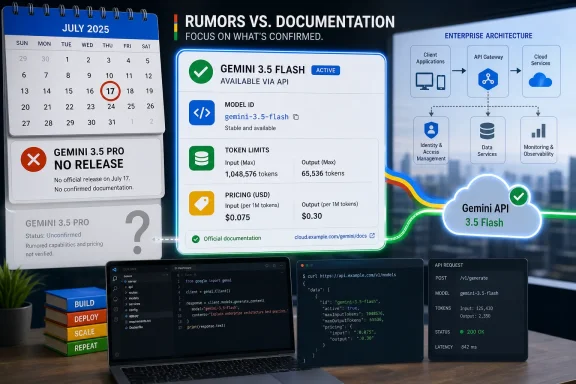
Google’s July 17 target for Gemini 3.5 Pro has passed without a public release, pricing page, model card, API model ID, or a corresponding Vertex AI announcement. The most important practical outcome for developers is simple: Gemini 3.5 Flash remains the current production Gemini 3.5 model, while the Pro-tier launch remains unconfirmed.
Google itself set the expectation in its May 19 Gemini 3.5 announcement. The company said Gemini 3.5 Pro was already being used internally and that it looked forward to rolling it out “next month,” placing the initial public expectation in June. By Saturday, July 18, neither Google’s Gemini API documentation nor its public pricing page lists
That makes the July 17 date circulated by Tech Insider, other blogs, and community posts a missed reported target rather than a verified Google commitment. Yahoo’s technology coverage also noted late on July 17 that the model had not appeared. For Windows developers and IT teams choosing an AI stack today, that distinction matters more than the leak cycle around it: no public endpoint means no reproducible testing, no committed usage cost, and no supported deployment plan.
Google’s confirmed Gemini 3.5 release is Gemini 3.5 Flash. The model is generally available through the Gemini API, Google AI Studio, Android Studio, Gemini Enterprise, and Google’s Antigravity development platform. Google positions Flash as its strongest agentic and coding-focused model to date, with support for function calling, code execution, structured outputs, search grounding, URL context, file search, caching, and preview computer-use capabilities.
The public model documentation sets a 1,048,576-token input limit and a 65,536-token output limit. Google’s posted API pricing is $1.50 per million input tokens and $9 per million output tokens, with cached input priced at $0.15 per million tokens. Those are real figures an engineering or procurement team can model today.
Google also claims Flash surpasses Gemini 3.1 Pro on several coding and agent benchmarks, including Terminal-Bench 2.1, MCP Atlas, and GDPval-AA. As always, vendor benchmarks should be read as directional rather than final proof of workload performance, but the message is clear: Google is not asking developers to wait for Pro before building agentic applications.
For Windows shops, Flash is immediately relevant in more places than a conventional API integration. It can sit behind an internal support portal, assist an Azure DevOps or GitHub workflow, classify intake documents, summarize Teams and SharePoint material after appropriate governance controls, or act as a tool-calling layer in a desktop-adjacent automation system. The caveat is the same one that applies to every hosted AI model: teams must validate data residency, identity controls, logging behavior, retention terms, and connector permissions before attaching the model to business systems.
That does not prove every reported detail is wrong. Large model vendors commonly test products with selected customers before broad availability, and it is plausible that Google is evaluating a more expensive reasoning tier. But a cluster of reports repeating the same numbers is not equivalent to a published service commitment.
The same caution applies to the claim that Google DeepMind scrapped and rebuilt Gemini 3.5 Pro’s base model. It is a consequential assertion: rebuilding a frontier model would imply major changes to training, post-training, safety work, and evaluation. Yet Google has not confirmed it. A delay can be caused by many more mundane factors, including coding quality, reliability under tool use, inference cost, capacity planning, safety testing, or internal product sequencing.
The takeaway for administrators is not to dismiss all rumor reporting, but to keep it in the right box. A preview, a leak, a benchmark screenshot, and a generally available model are four very different operational states.
Neither Google nor Anthropic has publicly confirmed a four-person move in the material available, and the report does not provide names that readers can independently verify. Researcher migration between Google DeepMind, OpenAI, Anthropic, Meta, xAI, and well-funded startups is a persistent feature of the AI industry, but it should not be turned into a product-readiness diagnosis without on-record confirmation.
There is a separate, valid point underneath the speculation. Frontier-model development depends on scarce technical leadership, and major departures can disrupt a roadmap even when the organization remains well resourced. Google has enormous research depth and infrastructure, but its products are now judged against competitors that also have elite teams, powerful distribution, and more frequent model announcements.
Still, a July launch miss does not establish a causal line between personnel changes and a model delay. WindowsForum readers have seen enough vendor roadmaps to recognize the pattern: the absence of a shipping artifact is evidence of a delay; everything else requires proof.
That abstraction is especially important in Windows-heavy environments. A company deploying copilots through .NET services, Power Platform workflows, Copilot Studio, Windows endpoints, Azure-hosted apps, or cross-cloud tooling should assume models will change. Route requests through a service layer, separate prompt and tool policies from model IDs, track cost per completed task rather than token price alone, and retain a tested fallback model.
The immediate milestone is not another rumored date. It is the first public Google artifact: a model ID, release note, pricing table, model card, or Vertex AI availability notice. Until one of those appears, the prudent move is to build against Gemini 3.5 Flash—or another model already in production—and treat Gemini 3.5 Pro as a roadmap item rather than a deployable platform.
Google itself set the expectation in its May 19 Gemini 3.5 announcement. The company said Gemini 3.5 Pro was already being used internally and that it looked forward to rolling it out “next month,” placing the initial public expectation in June. By Saturday, July 18, neither Google’s Gemini API documentation nor its public pricing page lists
gemini-3.5-pro.That makes the July 17 date circulated by Tech Insider, other blogs, and community posts a missed reported target rather than a verified Google commitment. Yahoo’s technology coverage also noted late on July 17 that the model had not appeared. For Windows developers and IT teams choosing an AI stack today, that distinction matters more than the leak cycle around it: no public endpoint means no reproducible testing, no committed usage cost, and no supported deployment plan.
 Google Shipped Flash, Not the Flagship
Google’s confirmed Gemini 3.5 release is Gemini 3.5 Flash. The model is generally available through the Gemini API, Google AI Studio, Android Studio, Gemini Enterprise, and Google’s Antigravity development platform. Google positions Flash as its strongest agentic and coding-focused model to date, with support for function calling, code execution, structured outputs, search grounding, URL context, file search, caching, and preview computer-use capabilities.The public model documentation sets a 1,048,576-token input limit and a 65,536-token output limit. Google’s posted API pricing is $1.50 per million input tokens and $9 per million output tokens, with cached input priced at $0.15 per million tokens. Those are real figures an engineering or procurement team can model today.
Google also claims Flash surpasses Gemini 3.1 Pro on several coding and agent benchmarks, including Terminal-Bench 2.1, MCP Atlas, and GDPval-AA. As always, vendor benchmarks should be read as directional rather than final proof of workload performance, but the message is clear: Google is not asking developers to wait for Pro before building agentic applications.
For Windows shops, Flash is immediately relevant in more places than a conventional API integration. It can sit behind an internal support portal, assist an Azure DevOps or GitHub workflow, classify intake documents, summarize Teams and SharePoint material after appropriate governance controls, or act as a tool-calling layer in a desktop-adjacent automation system. The caveat is the same one that applies to every hosted AI model: teams must validate data residency, identity controls, logging behavior, retention terms, and connector permissions before attaching the model to business systems.
The Rumored Specifications Have Not Graduated Into Documentation
Tech Insider’s report describes a Gemini 3.5 Pro model with a roughly two-million-token context window, pricing of about $15 per million input tokens and $60 per million output tokens, a “Deep Think” reasoning layer, and limited Vertex AI enterprise access. None of those details appears in Google’s public API model catalog, pricing documentation, or May launch post.That does not prove every reported detail is wrong. Large model vendors commonly test products with selected customers before broad availability, and it is plausible that Google is evaluating a more expensive reasoning tier. But a cluster of reports repeating the same numbers is not equivalent to a published service commitment.
The same caution applies to the claim that Google DeepMind scrapped and rebuilt Gemini 3.5 Pro’s base model. It is a consequential assertion: rebuilding a frontier model would imply major changes to training, post-training, safety work, and evaluation. Yet Google has not confirmed it. A delay can be caused by many more mundane factors, including coding quality, reliability under tool use, inference cost, capacity planning, safety testing, or internal product sequencing.
The takeaway for administrators is not to dismiss all rumor reporting, but to keep it in the right box. A preview, a leak, a benchmark screenshot, and a generally available model are four very different operational states.
The Researcher-Exit Claim Needs More Evidence
The supplied report also says four senior Gemini researchers left Google for Anthropic between June 21 and June 27. The timing is presented as evidence of a broader Google AI crisis. That conclusion goes beyond what has been publicly established.Neither Google nor Anthropic has publicly confirmed a four-person move in the material available, and the report does not provide names that readers can independently verify. Researcher migration between Google DeepMind, OpenAI, Anthropic, Meta, xAI, and well-funded startups is a persistent feature of the AI industry, but it should not be turned into a product-readiness diagnosis without on-record confirmation.
There is a separate, valid point underneath the speculation. Frontier-model development depends on scarce technical leadership, and major departures can disrupt a roadmap even when the organization remains well resourced. Google has enormous research depth and infrastructure, but its products are now judged against competitors that also have elite teams, powerful distribution, and more frequent model announcements.
Still, a July launch miss does not establish a causal line between personnel changes and a model delay. WindowsForum readers have seen enough vendor roadmaps to recognize the pattern: the absence of a shipping artifact is evidence of a delay; everything else requires proof.
The API Catalog Is the Better Release Tracker
For technical buyers, the practical release tracker is Google’s own catalog, not a claimed launch calendar. As of July 18, the confirmed public situation is concise:- Gemini 3.5 Flash is generally available as
gemini-3.5-flash. - Gemini 3.5 Flash supports a 1,048,576-token input window and 65,536-token output limit.
- Gemini 3.5 Flash has published paid-tier pricing of $1.50 input and $9 output per million tokens.
- Google’s May 19 announcement said Gemini 3.5 Pro was being used internally and was expected the following month.
- No public
gemini-3.5-proAPI listing, price, model card, or public general-availability notice has appeared.
That abstraction is especially important in Windows-heavy environments. A company deploying copilots through .NET services, Power Platform workflows, Copilot Studio, Windows endpoints, Azure-hosted apps, or cross-cloud tooling should assume models will change. Route requests through a service layer, separate prompt and tool policies from model IDs, track cost per completed task rather than token price alone, and retain a tested fallback model.
The Delay Changes Expectations, Not the Current Build Plan
Google has made Gemini 3.5 Flash the live product, and it is the only Gemini 3.5 model that developers can evaluate publicly with stable documentation and posted pricing. Gemini 3.5 Pro may still arrive soon, perhaps with a substantial reasoning, coding, or long-context advantage. Until Google publishes the model, however, its reported July 17 launch, two-million-token context window, premium pricing, rebuild narrative, and researcher-exit storyline remain varying degrees of unverified.The immediate milestone is not another rumored date. It is the first public Google artifact: a model ID, release note, pricing table, model card, or Vertex AI availability notice. Until one of those appears, the prudent move is to build against Gemini 3.5 Flash—or another model already in production—and treat Gemini 3.5 Pro as a roadmap item rather than a deployable platform.
References
- Primary source: tech-insider.org
Published: 2026-07-17T01:10:46+00:00
Gemini 3.5 Pro Targets July 17 as 4 Researchers Exit [2026]
Gemini 3.5 Pro's July 17 target arrives as 4 Google researchers exit to Anthropic. What's confirmed, what's rumoured, and why it matters.tech-insider.org - Related coverage: tech.yahoo.com
Where is Gemini 3.5 Pro? The AI model announced at Google I/O is still MIA.
Google didn't launch Gemini 3.5 Pro at Google I/O. Now, the company has blown past its promised launch date.tech.yahoo.com - Related coverage: tech-reader.blog
- Related coverage: bloggersideas.com
Gemini 3.5 Pro Leaks Point to July 17 Launch, Rebuilt From Scratch
Leaked details reveal Gemini 3.5 Pro is targeting a July 17 general availability launch after a ground-up rebuild delayed its release by six weeks.www.bloggersideas.com