

Google’s Gemini 3 arrival has reset the terms of reference for generative AI and forced OpenAI into an emergency posture: an internal “code red” focused on shoring up ChatGPT’s day‑to‑day reliability, speed, and personalization as Google presses a multimodal, reasoning‑heavy advantage that is now widely visible on public leaderboards and in product adoption metrics.
The week after Gemini 3’s November release saw a collision of technical disclosures, market metrics, and internal reactions that together mark a clear inflection point. Google positioned Gemini 3 as a unified, multimodal flagship — a family including Gemini 3 Pro and a higher‑latency “Deep Think” tuning — and tied it directly into Search, Workspace, the Gemini app, and developer platforms such as Google AI Studio and Vertex AI. Google’s own reporting during its Q3 earnings commentary placed the Gemini app at over 650 million monthly active users, a dramatic distribution advantage when combined with Search and Android integration. At the same time, independent analytics and press reporting show OpenAI reacting immediately: Sam Altman issued an internal memo declaring a “code red,” reprioritizing teams to focus on ChatGPT’s core experience — reliability, latency, personalization — and pausing or delaying other initiatives like advertising and certain agent launches. Multiple major outlets corroborated the memo and its practical effects. This story is not only about raw model scores. It’s a story about distribution and economics: Google’s Gemini benefits from integrated product surfaces that convert model capability into habitual usage, while OpenAI is trying to defend a very large but — according to market intelligence — cooling user base that still leads in traffic and engagement metrics. The tactical question for enterprises and Windows IT teams shifts from “who built the smartest model?” to “which model delivers the best, most reliable outcomes for my workloads, at acceptable cost and with governance controls I can live with?”
Source: Red94 Google AI news: OpenAI declares code red as Gemini 3 surpasses ChatGPT on every measure
 Background / Overview
The week after Gemini 3’s November release saw a collision of technical disclosures, market metrics, and internal reactions that together mark a clear inflection point. Google positioned Gemini 3 as a unified, multimodal flagship — a family including Gemini 3 Pro and a higher‑latency “Deep Think” tuning — and tied it directly into Search, Workspace, the Gemini app, and developer platforms such as Google AI Studio and Vertex AI. Google’s own reporting during its Q3 earnings commentary placed the Gemini app at over 650 million monthly active users, a dramatic distribution advantage when combined with Search and Android integration. At the same time, independent analytics and press reporting show OpenAI reacting immediately: Sam Altman issued an internal memo declaring a “code red,” reprioritizing teams to focus on ChatGPT’s core experience — reliability, latency, personalization — and pausing or delaying other initiatives like advertising and certain agent launches. Multiple major outlets corroborated the memo and its practical effects. This story is not only about raw model scores. It’s a story about distribution and economics: Google’s Gemini benefits from integrated product surfaces that convert model capability into habitual usage, while OpenAI is trying to defend a very large but — according to market intelligence — cooling user base that still leads in traffic and engagement metrics. The tactical question for enterprises and Windows IT teams shifts from “who built the smartest model?” to “which model delivers the best, most reliable outcomes for my workloads, at acceptable cost and with governance controls I can live with?”What Gemini 3 actually delivers
Multimodality and long context are front and center
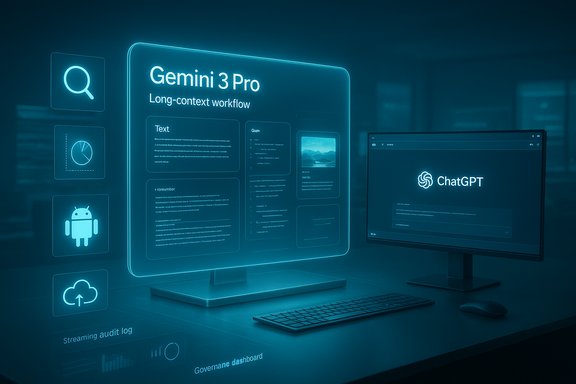
Gemini 3’s defining technical claims center on three dimensions: a very large context window (on the order of one million tokens for top‑tier variants), improved multimodal fusion (text + images + video + code), and agentic tooling that lets the model orchestrate multi‑step workflows. Google’s product messaging emphasizes integrated “Deep Think” modes tuned for higher‑latency, higher‑fidelity reasoning tasks. Multiple official and industry write‑ups repeated the million‑token figure and the Deep Think framing. These capabilities matter for real enterprise tasks: legal and regulatory document analysis, long‑form research synthesis, multi‑hour meeting transcript summarization, and multi‑asset design workflows (for example, combining images, tables, and long documents). The practical value is that teams may be able to feed a single large input — a codebase, a dossier, or an entire project folder — and get a coherent response without stitching together multiple retrieval calls.Reasoning, tool use and agentic workflows
Gemini 3 Pro’s promotional benchmarks focused on reasoning depth and tool‑oriented evaluation suites (coding, multi‑step planning, video understanding), and Google shared scores that placed Pro at or near the top on many public leaderboards. Vendor and community reports repeatedly highlighted sizable year‑over‑year and within‑release improvements on hard reasoning tests and multimodal suites. Independent replications are emerging but typically lag vendor disclosures; nevertheless, the magnitude of the reported gains was large enough to change market perceptions.Image generation: Nano Banana evolution
Gemini’s Nano Banana image family — refreshed under Gemini 3 as Nano Banana Pro — was widely cited as a viral consumer component that boosted app adoption. Improvements to image fidelity, text rendering inside images, and multi‑image fusion were credited for helping drive adoption and attention in consumer channels. Product virality from image generation can translate into faster consumer adoption and therefore a larger feed of real‑world usage that informs product iteration.Benchmarks vs. product reality: what the numbers do and don’t mean
Benchmarks are useful directional signals but they are not a single source of truth for enterprise procurement. Key caveats:- Benchmarks measure specific skills in controlled conditions; they do not prove robustness under varied, real‑world inputs.
- Many headline numbers are vendor‑reported; independent labs and academic replications typically take weeks to reproduce and validate results.
- Access mode matters: vendor demos often allow tool use or code execution that can materially increase scores on reasoning and math tasks — these are not apples‑to‑apples with unaided evaluations.
OpenAI’s “Code Red”: what changed internally
Pause, prioritize, and redeploy
The internal memo — reported by major outlets — directed resources toward improving ChatGPT’s core metrics and delayed several side projects (ad experiments, shopping agents, a proactive assistant called Pulse) to focus on product fundamentals: latency, reliability, personalization, and breadth of coverage. This pivot is classic crisis management for a tech product that depends on perceived quality to support monetization.Tactical levers likely in play
OpenAI’s immediate toolkit for improving ChatGPT includes:- Model refreshes tuned for reliability (reducing hallucinations and variance).
- Systems engineering to lower latency and improve serving reliability under load.
- Product UX work to deepen personalization without compromising privacy.
- Focused fine‑tuning and retrieval augmentation for enterprise use cases.
Usage metrics and market share — the live scoreboard
There are two concurrent narratives about user counts and growth:- OpenAI / ChatGPT: still enormous by any measure, widely reported at roughly 800–810 million monthly active users in recent tracking; however, growth has slowed materially in the latest months, and short‑term month‑over‑month gains are small. Market intelligence firm Sensor Tower observed that ChatGPT’s global MAUs reached approximately 810 million as of November 2025, up 180% year‑over‑year but only about 6% from August to November.
- Google / Gemini: Google reports more than 650 million monthly active users for the Gemini app and very broad exposure across Search (AI Overviews) and Workspace, with queries and usage tripling quarter‑over‑quarter in some product streams. Google’s Q3 communications and earnings commentary explicitly cited the 650M MAU figure. This kind of immediate distribution inside Android and Search amplifies adoption beyond app installs.
International competition and efficiency plays: DeepSeek and others
Beyond Google and OpenAI, an expanding cohort of international challengers is reshaping cost and capability dynamics. Chinese players and startups such as DeepSeek reported new models (DeepSeek‑V3.2) claiming parity with frontier models while promising far lower computational costs (10–25x lower inference costs in some public claims). These efficiency claims are disruptive if validated, because they threaten the cost base of cloud inference and could create attractive alternative procurement channels for enterprises. Business press coverage picked up on these claims; third‑party benchmarking and in‑production cost studies are the necessary next validation steps. Treat these performance and cost claims as potentially transformative but still conditionally verified. Anthropic’s Claude family also continues to narrow enterprise gaps by emphasizing safety, auditability, and pricing that targets corporate buyers. The end result is that every major enterprise buyer now has multiple credible options and is evaluating vendors on a task‑by‑task basis.Financial and infrastructure implications
The compute arms race favors deep pockets
A central structural advantage for Alphabet (Google) is its existing advertising and cloud revenue streams, which provide leverage for aggressive AI infrastructure investment. Google's Q3 2025 commentary linked Gemini’s growth to broader search and cloud momentum and signaled further infrastructure spending. Alphabet’s ability to underwrite large TPU and data‑center builds is a decisive advantage when frontier models scale to trillions of parameters and multi‑modal training corpora. OpenAI’s cost profile has been the focus of intense analyst scrutiny. Multiple outlets and market commenters have highlighted that OpenAI’s commitments to cloud and chip vendors are massive and that the path to profitability depends on maintaining user engagement and monetization. Some public reporting and analysis cited very large multi‑year compute commitments and projections; specific dollar figures (for example, trillion‑scale compute estimates) are reported variably across outlets and should be treated cautiously unless supported by audited filings. Large compute commitments are real; single‑source dollar totals are often model‑dependent and not yet independently auditable.What this means for enterprise procurement
Enterprises that run high‑volume inference workloads or expect heavy multimodal usage should expect:- Rising unit inference costs for premium “Deep Think” or Pro variants.
- New pricing tiers tied to context length and multimodal payloads.
- Greater vendor emphasis on bundling: cloud, tooling, and model access in a single contract.
Practical implications for Windows IT teams and enterprise customers
The Gemini 3 vs. ChatGPT scramble has immediate tactical consequences for IT teams procuring and deploying AI capabilities in Windows‑centric environments.Short‑term checklist (practical, tactical)
- Test vendor models by workload, not by headline benchmarks. Run representative benchmarks for legal summarization, code review, ticket triage, and other production tasks.
- Lock down data flows. Ensure retrieval‑augmented generation (RAG) pipelines, vector stores, and on‑prem/private‑cloud inference options are considered for sensitive data.
- Insist on provenance and audit logs. Demand clear output provenance, traceable retrieval sources, and robust logging for all model calls.
- Budget for tiered pricing. Expect “Deep Think” or Pro modes to command higher per‑token prices and factor that into SLAs.
- Prepare fallback plans. In multi‑vendor setups, maintain the ability to switch inference providers for critical paths in case of throttling or service changes.
Architectural guidance (medium term)
- Adopt hybrid inference: use local or private inference for sensitive operations; leverage public cloud Pro models for non‑sensitive heavy lifting.
- Introduce gating and human‑in‑the‑loop for high‑risk outputs (legal, compliance, finance).
- Implement monitoring for hallucinations, drift and latency: automated detectors that measure factuality and response variance over time.
- Treat model updates like OS updates: stage, validate, and roll out across rings before organization‑wide adoption.
Strengths, risks and the likely near‑term arc
Notable strengths revealed by the Gemini 3 cycle
- Technical traction: Gemini 3 demonstrates that integrated investments (TPUs + Search + Android + Workspace) can convert model gains into rapid user adoption.
- Productization: Google’s push shows how model capability, when quickly embedded into product surfaces, creates immediate user value.
- Market pluralism: Emergent challengers (Anthropic, DeepSeek, open‑source stacks) give enterprises leverage and choice.
Key risks and downsides
- Overreliance on vendor benchmarks: Procurement decisions driven only by leaderboard positions risk missed integration, reliability, and safety gaps.
- Cost inflation: As frontier models expand context windows and multimodal payloads, per‑request costs can spike unpredictably.
- Operational exposure: Agentic capabilities that can act (read mail, schedule events, mutate documents) increase the operational attack surface and governance burden.
- Data governance: Integrated models inside search and productivity suites create additional compliance and egress risk vectors.
What to watch next
- Independent benchmark replications across transparent test harnesses.
- The pace and nature of OpenAI’s product updates in response to the “code red” directive.
- Pricing announcements and tier gating for Gemini Pro/Deep Think, and equivalent offerings from OpenAI/Anthropic.
- Enterprise adoption evidence: Databricks, major ISVs, or cloud partners revealing production deployments that demonstrate real‑world robustness.
Conclusion
The Gemini 3 rollout and OpenAI’s “code red” are more than a headline duel; they illustrate a systemic shift in generative AI competition where capability leadership, product integration, and distribution reach converge. For Windows IT professionals and enterprise buyers, the competitive flare‑up means a few practical realities:- Evaluate models against concrete workload KPIs rather than leaderboard prestige.
- Budget for higher and more variable inference costs as multimodal, long‑context workloads scale.
- Strengthen governance, auditability and fallback strategies as models gain agentic powers and deeper access to enterprise data.
Source: Red94 Google AI news: OpenAI declares code red as Gemini 3 surpasses ChatGPT on every measure
