

Mustafa Suleyman’s blunt admission that Google’s Gemini 3 “can do things that Copilot can’t do” punctures the usual corporate spin: it confirms a practical truth about today’s AI race — different assistants are engineered for different jobs — and it forces Windows users and IT buyers to evaluate utility, governance, and integration rather than marketing superlatives.
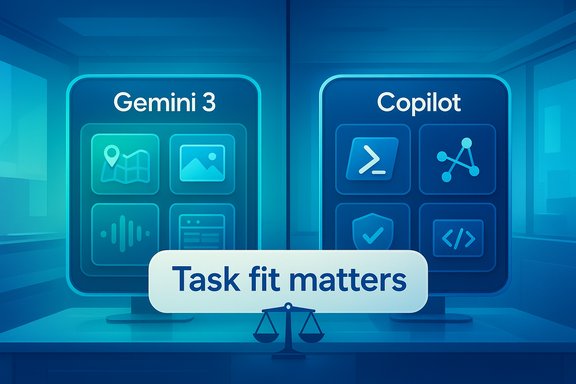
Microsoft and Google are no longer just trading product updates; they are reshaping how people work on personal computers and in enterprises by embedding AI into everyday apps, operating systems, and cloud services. Microsoft’s Copilot is billed as the always-on productivity assistant inside Windows, Microsoft 365, Edge and enterprise connectors. Google’s Gemini 3 is positioned as a reasoning-first, multimodal model distributed across Search, the Gemini app, Vertex/AI Studio and developer tooling, with a heavy emphasis on web grounding and agentic workflows. The contrast in positioning explains why a blunt comparison — Gemini 3 wins at multimodal, Copilot wins at Windows automation — keeps recurring in hands-on tests and analyst write-ups.
Gemini 3’s launch emphasized three engineering pivots: very large context windows, a high-fidelity reasoning tier labeled Deep Think, and native multimodal reasoning that can mix text, images, audio and short video in the same session. Microsoft’s Copilot, by contrast, has doubled down on tenant grounding, screen-aware vision (Copilot Vision), and integrated automation for PowerShell and Microsoft 365 workflows — often routing requests to GPT-5 variants for deeper reasoning when needed. Those design decisions map directly to the practical differences reviewers are seeing.
Why the admission matters:
Representative outcomes from such tests:
On the other side, Google has been iterating fast across model variants, infrastructure (TPUs) and integration points (Search, Maps, Workspace), enabling quick product improvements that compound in user experience. The result is a dynamic market where short-term benchmark or hands-on leadership can put competitors into reactive modes like internal “code red” reprioritizations.
Practical friction points:
Both Gemini and Copilot push productivity forward, but neither is a finished product or a substitute for human oversight. The near-term winners will be teams that pair technical capability with careful governance, rigorous testing, and a clear view on where vendor lock-in is acceptable — or where it’s not.
Source: WebProNews Microsoft AI CEO Admits Google’s Gemini 3 Excels Over Copilot in Multimodal Tasks
 Background
Microsoft and Google are no longer just trading product updates; they are reshaping how people work on personal computers and in enterprises by embedding AI into everyday apps, operating systems, and cloud services. Microsoft’s Copilot is billed as the always-on productivity assistant inside Windows, Microsoft 365, Edge and enterprise connectors. Google’s Gemini 3 is positioned as a reasoning-first, multimodal model distributed across Search, the Gemini app, Vertex/AI Studio and developer tooling, with a heavy emphasis on web grounding and agentic workflows. The contrast in positioning explains why a blunt comparison — Gemini 3 wins at multimodal, Copilot wins at Windows automation — keeps recurring in hands-on tests and analyst write-ups.Gemini 3’s launch emphasized three engineering pivots: very large context windows, a high-fidelity reasoning tier labeled Deep Think, and native multimodal reasoning that can mix text, images, audio and short video in the same session. Microsoft’s Copilot, by contrast, has doubled down on tenant grounding, screen-aware vision (Copilot Vision), and integrated automation for PowerShell and Microsoft 365 workflows — often routing requests to GPT-5 variants for deeper reasoning when needed. Those design decisions map directly to the practical differences reviewers are seeing.
What Suleyman Actually Said — And Why It Matters
Mustafa Suleyman, Microsoft’s head of AI, publicly acknowledged Gemini 3’s strengths in a Bloomberg interview and subsequent coverage. His phrase, “Gemini 3 can do things that Copilot can’t do,” is short but consequential: it admits competitor strength while reiterating Microsoft’s product strategy of embedding Copilot tightly into Windows and enterprise tooling. That admission shifts the debate away from “which model is better overall” toward “which assistant solves my problems more reliably.”Why the admission matters:
- It reduces marketing obfuscation and gives customers practical clarity about trade-offs.
- It signals Microsoft will invest further in bridging capability gaps (talent, tooling, product integration).
- It emphasizes that vendor ecosystems — Maps/Search for Google, Graph/M365 for Microsoft — remain decisive in delivering real-world utility.
Overview: Hands‑On Comparisons and Where Each Assistant Wins
Multiple hands-on head-to-head tests (one widely circulated seven-task test is frequently referenced) demonstrate a recurring pattern: Gemini 3 frequently beats Copilot at consumer web-grounded, multimodal, and creative tasks, while Copilot retains a decisive edge at Windows-specific automation and PowerShell scripting. These practical snapshots are not the same as controlled lab benchmarks, but they capture everyday utility — the workflows that matter for editors, analysts, IT admins and power users.Representative outcomes from such tests:
- Gemini 3: strong wins in travel itinerary planning, map-handling and infographic/image generation due to web grounding and maps hand-offs.
- Copilot: clear win in writing robust PowerShell automation and Windows-specific workflows, leveraging deep OS and M365 knowledge.
- Ties or mixed results: research tasks where tenant access vs public web grounding determines the better answer.
Deep Dive: Why Gemini 3 Shows an Edge in Multimodal Tasks
Native multimodal reasoning and ecosystem handoffs
Gemini 3’s architecture and product integrations let it combine modalities smoothly: it can reason over images, short video snippets, audio and large text sequences in the same session and hand off to Google Maps or search results as first-class components. That makes itinerary planning, map linking and image/infographic generation both faster and more actionable in practice. Gemini tends to avoid fabricating precise geographies by returning live map links or pins rather than producing stylized but inaccurate vector art.Deep Think and very large context windows
Gemini’s Deep Think tier trades latency for deeper chain-of-thought reasoning and higher accuracy on difficult multi-step problems, and some published claims and leaderboard placements show notable gains on reasoning-focused benchmarks. The model family also advertises enormous context windows (hundreds of thousands to a million tokens in top tiers), which supports processing whole documents, books, or long transcripts in a single pass — a practical advantage for long-form summarization and multi-document synthesis. Independent validation of the largest context-window numbers is ongoing, so those figures should be treated as promising vendor claims that need reproducible lab confirmation.Deep Dive: Why Copilot Remains Strong in Windows and Enterprise Workflows
Tenant grounding and screen-aware vision
Copilot’s integration with Microsoft Graph, OneDrive, Outlook and Windows itself is not a marketing afterthought — it changes the assistant’s access model. Copilot can access tenant data in governed ways, extract tables from screenshots, convert screenshots into editable artifacts, and produce automation that maps to Windows idioms. For enterprises that require governance, audit trails and tenant-aware behavior, Copilot’s integration is a material advantage.PowerShell and Windows automation expertise
When a task requires OS-level knowledge — constructing a safe PowerShell rename script with error handling and undo logic, for example — Copilot’s Windows-centric training and product design make it more reliable and immediately useful. Hands-on tests show Copilot producing production-ready automation faster and with safer defaults than a generalist assistant that lacks the same depth of Windows tooling awareness. Still, all generated scripts must be reviewed and sandboxed before use.Talent, Strategy and the Arms Race Behind the Scenes
The competition is not purely algorithmic; it’s also a talent and product-integration war. Microsoft’s recruitment of DeepMind alumni and other high-profile AI talent reflects an urgent push to close capability gaps in multimodal reasoning and agentic tooling. CNBC and other outlets have covered Microsoft’s aggressive hiring to accelerate Copilot’s roadmap — an operational acknowledgement that product gaps are as often human-resource problems as engineering ones.On the other side, Google has been iterating fast across model variants, infrastructure (TPUs) and integration points (Search, Maps, Workspace), enabling quick product improvements that compound in user experience. The result is a dynamic market where short-term benchmark or hands-on leadership can put competitors into reactive modes like internal “code red” reprioritizations.
Market Signals and Adoption Frictions
Even with headline-grabbing model wins, market traction is a distinct axis. Some reports indicate Copilot adoption in certain sectors remains modest, and Microsoft has pushed internal mandates to accelerate Copilot usage inside the company. Separately, public criticism about accuracy, data handling and costs — amplified by analysts and other CEOs — has shaped some enterprise hesitancy. Those critiques have pushed Microsoft to scale back ambitious sales targets in some areas while it addresses reliability and governance concerns. These adoption dynamics show that technical capability alone does not guarantee immediate enterprise substitution.Practical friction points:
- Hardware commitments: Microsoft’s Copilot+ PC push requires advanced onboard compute for certain features, which may deter buyers when alternatives appear less hardware-dependent.
- Governance and data residency concerns: many enterprises prefer non-training contractual guarantees and tenant-grounded connectors before deploying assistants widely.
Risks, Reliability and Ethical Considerations
Hallucinations and factual errors
Both Gemini and Copilot produce confident but incorrect statements — the so-called hallucination problem remains real. Independent analyses have shown significant error rates in AI-generated news summaries and other factual outputs. This is not a partisan issue; it’s a behavior rooted in model limitations and training data characteristics. Treat outputs as drafts that need verification and source links before being used in any high-stakes context.Ecosystem lock-in and vendor lock risk
When an assistant becomes essential to a workflow, it simultaneously increases vendor lock. Copilot’s deep Microsoft 365 binding and Gemini’s tight Maps/Search/Workspace integrations both give their respective vendors leverage — a net win for immediate productivity but a long-term procurement and portability question for organizations. Evaluate long-term data exportability, governance controls and cross-vendor portability before committing large-scale.Data privacy, training and compliance
Free consumer tiers often permit telemetry collection that can influence future model updates; enterprise tiers typically offer non-training guarantees and tighter data residency controls. For regulated industries, enterprise contract terms and connector choices are as important as raw assistant capability. Always choose tenant-aware and non-training enterprise plans when sensitive data is involved.Agentic workflows and operational risk
Agentic AI — where the assistant plans and executes multi-step actions using tools and web services — is powerful but also multiplies risk. Agentic flows must be treated like production systems: require red-teaming, logging, traceability, rollback strategies, and incident playbooks before deployment at scale. Governance tooling that inventories agents, identities, and entitlements is rapidly becoming a prerequisite for enterprise adoption.Practical Recommendations for Windows Users and IT Teams
- Evaluate assistants by task-fit, not splashy benchmark claims. Use Gemini for web research, mapping and creative mockups; use Copilot for Windows automation, tenant-grounded productivity and secure enterprise workflows.
- Require verifiable sources for factual answers. Insist the assistant provides clickable links or a reproducible trace for statements you rely on.
- Sandbox and review all automation. Treat AI-generated scripts as first drafts: run unit tests, code reviews and a safe rollback plan before applying to production systems.
- Choose non-training enterprise tiers for regulated data. Verify contract language on data usage, residency, and training guarantees.
- Maintain multi-assistant workflows. Use pluralism to hedge outages, bias modes and single-vendor shortcomings. A search/creative assistant plus a productivity/automation assistant is a practical combination today.
Strategic Outlook: Where This Rivalry Leads
The public admission from Microsoft’s AI chief is more than an operational note; it’s a signal that the next phase of competition will be about closing ecosystem gaps, scaling reliability and winning enterprise trust. Expect these trends:- Faster iteration on multimodal robustness and hallucination mitigation across vendors, with improvements gated by red-teaming and safety work.
- Increased product bundling and tighter OS/app integrations as vendors try to convert capability into habitual use. Microsoft will push Copilot deeper into Windows and M365; Google will lean into Search and Maps handoffs. This makes vendor strategy as important as raw model performance.
- Talent flows and acquisition competition will accelerate; hiring DeepMind alumni or other top researchers will remain a key lever in the near term.
- Governance tooling and enterprise-grade agent management will become central procurement criteria as agentic use cases expand.
What Remains Unverified and What to Watch
A few prominent claims remain best treated with caution until independent reproductions appear:- Exact benchmark deltas for Deep Think vs Pro variants and the full practical capacity of million-token contexts on publicly accessible tiers. These are vendor-framed claims that need reproducible lab tests.
- Precise, cross-market adoption percentages and enterprise usage data: some reports quoting specific adoption figures (for example, mid-teens percentages in certain sectors) are informative but require independent verification and granular methodology disclosure. Treat them as directional unless backed by primary telemetry data.
Conclusion
Mustafa Suleyman’s candid line — “Gemini 3 can do things that Copilot can’t do” — is a practical wake-up call, not a resignation. It reframes the AI assistant battle as one of task fit, governance and ecosystem leverage rather than a single “best model” trophy. For Windows users and IT buyers, the takeaway is straightforward: match the assistant to the job, insist on verification and governance, and plan for a plural world where multiple AI assistants coexist and complement each other.Both Gemini and Copilot push productivity forward, but neither is a finished product or a substitute for human oversight. The near-term winners will be teams that pair technical capability with careful governance, rigorous testing, and a clear view on where vendor lock-in is acceptable — or where it’s not.
Source: WebProNews Microsoft AI CEO Admits Google’s Gemini 3 Excels Over Copilot in Multimodal Tasks
