

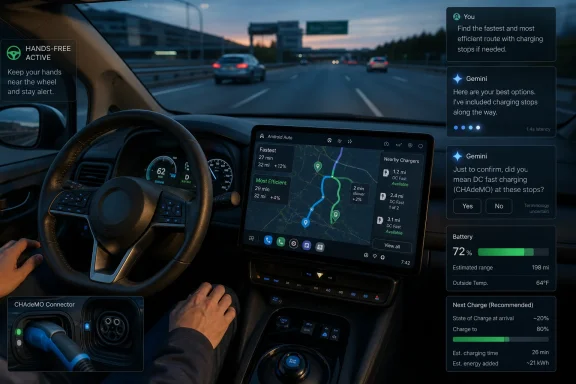
Tom’s Guide tested Gemini in Android Auto in an electric Nissan Leaf and found that Google’s new in-car assistant understood complex charging and routing requests far better than Google Assistant, though it still stumbled over EV terms including CHAdeMO and the charging brand GRIDSERVE. The result is more consequential than a routine assistant upgrade: Google is replacing a brittle command interpreter with a conversational system at the one place where failed interactions are especially frustrating and potentially distracting. Gemini does not need to control the vehicle itself to change the driving experience; it only needs to make navigation, information retrieval, messaging, and media less demanding. The test suggests Google has largely solved the old assistant’s comprehension problem, but has not yet solved the harder questions of accuracy, latency, terminology, and how much drivers should trust a generative model on the road.
Google Assistant’s central weakness in the car was not that it lacked useful functions. It could place calls, play music, send messages, and start navigation, provided the driver used a phrase the software expected, the microphone captured it cleanly, and the service correctly inferred which action should follow.
That combination was unreliable enough to train users to expect failure. Tom’s Guide’s account describes an assistant that could ignore speech altogether or struggle to register an acknowledgement as elementary as “yes.” The practical response was often to repeat the command, simplify it, raise one’s voice, or abandon the voice interface and reach for the screen.
None of those outcomes fits the safety argument used to justify voice control. A hands-free assistant is valuable only when it also minimizes the driver’s cognitive load. If the driver must remember exact syntax, monitor whether the system heard it, diagnose why it failed, and decide how to rephrase the command, the interface has merely moved the distraction from the touchscreen into the conversation.
Gemini changes that contract. Google’s official Android Auto documentation says drivers can speak naturally rather than relying on traditional command phrases, and that Gemini can follow detailed or complex questions. Tom’s Guide’s road test supports that claim: the author found that longer requests containing multiple technical details were not merely transcribed but interpreted.
That distinction is the whole upgrade. Google Assistant was principally waiting for a recognizable instruction. Gemini is attempting to understand the driver’s intent.
The old system’s rigidity was sometimes defended as predictability. A narrow assistant may do less, but at least its supported commands can be documented. In practice, however, that predictability disappeared whenever ordinary language, road noise, an unfamiliar place name, or a slightly different sentence structure entered the exchange.
Gemini’s wager is that probabilistic interpretation will be more usable than a fixed command tree, even if it introduces new failure modes. The Nissan Leaf test makes a strong case that this trade is worthwhile, because a driver no longer has to compress a real-world need into a memorized machine phrase before asking for help.
That makes this a cleaner demonstration than a test in a heavily integrated software-defined vehicle. Gemini was not drawing a charging estimate from a live battery-management system, changing cabin temperature, or silently reading the vehicle’s state. It was working from information supplied verbally by the driver and from services available through the connected phone.
This boundary is important because Android Auto is not the same thing as a native in-car operating environment. Android Auto projects supported phone experiences onto the dashboard, while cars with Google software built directly into the infotainment system can potentially offer deeper vehicle integration. Google has discussed both paths, but the Leaf test concerns the phone-centered Android Auto model.
In other words, the improvement does not depend on buying a new car. A relatively conventional infotainment unit can gain a more capable voice layer because the intelligence lives primarily in Google’s phone and cloud ecosystem. That gives Google an enormous installed base and turns the assistant transition into a software upgrade rather than a vehicle-replacement cycle.
It also limits the risks. Gemini could answer questions and operate across compatible Android Auto applications, but it could not directly manipulate the Leaf’s fundamental driving systems. For now, that separation may be a feature rather than a deficiency.
Automakers have spent years moving controls into touchscreens, often forcing drivers to navigate menus for functions that once had a dedicated switch. Adding a generative assistant to that architecture does not automatically make it safer. If the assistant is unavailable, misunderstands a request, or loses connectivity, the driver still needs an immediate and unambiguous physical method of controlling the car.
The Leaf therefore represents a sensible middle ground: physical controls for the machine, conversational software for the information layer. Gemini is most convincing here not as the brain of the car, but as a better interface to the phone services drivers already use.
Gemini returned an estimate of six hours. It also warned that charging beyond 80% slows the overall process, adding useful context instead of treating the request as a simple arithmetic exercise.
This is precisely the sort of compound query that exposes the difference between a command engine and a language model. There is no single “calculate my charging time” button in Android Auto. The system must extract several values from conversational speech, understand their relationship, estimate the result, and explain why real-world charging may not remain constant.
The author described the six-hour answer as being in the right ballpark but could not confirm that it was correct. That caveat deserves more attention than it received, because EV charging estimates are unusually sensitive to assumptions.
A nominal charger rating does not guarantee that the vehicle will receive that power continuously. Battery temperature, starting state of charge, the car’s charging curve, charger performance, environmental conditions, and the taper near full capacity can all affect the result. A language model can produce a plausible estimate from the numbers it is given, but plausibility is not telemetry.
Gemini also had no direct access to the Leaf’s systems in this test. It knew only what the driver said. If the battery capacity, current charge, or expected power was misstated, misunderstood, or based on an optimistic charger label, the calculation would inherit that error.
This does not make the feature useless. An approximate six-hour answer may be enough to decide whether to leave the vehicle connected overnight, seek a different charger, or stop aiming for 100%. The advice about slower charging beyond 80% is also practically relevant because it reframes the problem: the quickest journey may depend less on reaching a full battery than on leaving once the slower portion of charging begins.
But the answer should be treated as planning guidance, not a promise. Google itself warns that generative AI responses can vary and should be checked for accuracy. In a car, the distinction between a rough estimate and an authoritative vehicle reading needs to be especially clear.
The best future implementation would combine Gemini’s conversational ability with trusted, structured data from the car and charging network. The model could explain the estimate and answer follow-up questions, while the underlying figures came from the battery-management system, navigation route, charger status, and a validated charging curve.
Until that integration exists, drivers should understand what happened in the Leaf: Gemini reasoned from user-provided information. It did not inspect the battery and discover that six hours was the definitive answer.
The same problem occurred with GRIDSERVE. Tom’s Guide inferred that the uppercase styling may have contributed to Gemini treating the names as strings of individual letters rather than pronounceable entities.
Whether capitalization alone caused the failure is not established, but the broader issue is obvious. Voice assistants in cars must cope with a vocabulary full of brand names, model names, road names, abbreviations, charging standards, and terms whose spoken forms cannot be reliably derived from their typography.
For an EV driver, CHAdeMO is not decorative jargon. It identifies a charging interface relevant to whether a station can physically serve the vehicle. A system that understands broad questions about EV charging but fails to recognize the connector name is demonstrating a gap between general language fluency and domain competence.
The workaround was effective. When the driver requested an “ultra fast charger compatible with the Nissan Leaf,” Gemini found nearby options within seconds. The model could infer the desired outcome when the request was expressed as compatibility rather than a named standard.
That is both impressive and troubling. It is impressive because the driver can recover without knowing an approved command. It is troubling because the success of a charging search may depend on whether Gemini recognizes the terminology the driver happens to use.
The rephrased request is also less technically exact. “Ultra fast” is a broad description, while compatibility is more important than marketing language. A location can be fast by one network’s definition and still be unusable by a particular vehicle. Gemini must preserve constraints such as connector type, vehicle compatibility, availability, location, and routing practicality rather than merely surface stations that sound relevant.
This is where generative systems need structured search underneath them. The language model should translate the driver’s intent into filters, but authoritative databases should determine whether a charging site supports the required vehicle and connector. The assistant’s prose should not be allowed to substitute for a verified compatibility field.
Google has an advantage because Gemini can draw on services including Maps and Search, where business details, reviews, opening hours, and location data already live. Tom’s Guide found that Gemini could report when a business closed, discuss expected busyness, and use review information when direct crowd data was unavailable.
Yet charging infrastructure is more demanding than ordinary business discovery. A restaurant’s closing time can be mildly inconvenient if wrong. A charger incorrectly described as compatible can strand a driver or force an unplanned detour.
The recognition failure therefore should not be dismissed as an amusing uppercase bug. It identifies one of the core engineering tasks for in-car AI: the assistant must become less impressed with its own conversational fluency and more rigorous about specialized nouns and structured constraints.
Gemini understood both formulations. When asked to switch to the most efficient option, it explained that the vehicle was already on that route and that there was nothing more useful to change.
This exchange illustrates the value of conversational context. The driver was not required to stop navigation, open a route-options menu, locate an efficiency setting, and compare alternatives on the display. The assistant interpreted a desired outcome and applied it to the active trip.
Older voice systems often exposed app commands rather than user goals. They were good at “navigate to this address” because the instruction mapped neatly onto a button. They were less capable when the driver wanted the system to compare routes according to an attribute such as time, energy use, an intermediate stop, business opening hours, or suitability for a particular journey.
Gemini’s language model can act as a translation layer between the messy request and the structured capabilities of Maps. Google’s own examples emphasize multi-part searches, follow-up questions, and requests for places along an existing route. Tom’s Guide’s test shows why that matters outside a staged demonstration: people naturally describe what they want rather than naming the interface operation required to produce it.
The response that the Leaf was already on the most efficient route is also a small but meaningful usability win. A weaker assistant might acknowledge the command without making a change, restart navigation unnecessarily, or fail because there was no alternative action to execute. Gemini instead explained the state of the system.
That said, an explanation must not become a monologue. Other Android Auto coverage has reported mixed reactions to Gemini, including complaints that it can be overly talkative, stop listening early, or continue an interaction after a driver has completed part of the task on the touchscreen. 9to5Google’s reporting suggests the rollout has not produced uniformly positive experiences.
In a desktop chatbot, excess detail is irritating. In a moving car, it competes with navigation prompts, passenger conversation, road noise, and the driver’s attention. The ideal in-car assistant should be capable of complex reasoning while defaulting to extremely concise speech.
Gemini’s advantage is that it can understand a more elaborate input. It does not follow that its output should be elaborate. Google needs a driving-specific response policy that delivers the action, states any important limitation, and then stops unless the driver asks for more.
A voice assistant does not become safer merely because it can summarize messages, find businesses, discuss reviews, answer general questions, or brainstorm through Gemini Live. Every interaction consumes some attention, including successful ones. A fascinating spoken conversation can be more cognitively demanding than tapping a familiar control while parked.
The stronger safety argument is narrower: Gemini may reduce the number of failed attempts required to complete necessary tasks. If a driver can state a destination, route preference, or charging need once in ordinary language, the system can prevent the repeated corrections that made Google Assistant so aggravating.
Tom’s Guide’s author had not experienced Gemini completely failing to register that speech had occurred, a problem described as nearly daily with Assistant. That improvement matters because an ignored command creates uncertainty. The driver waits, checks the screen, repeats the request, or wonders whether the microphone is active.
Gemini can also preserve context across an exchange. That should allow a driver to refine a result with a short follow-up rather than repeat the whole request. In theory, less repetition means less time spent managing the interface.
But generative AI adds a different category of risk: it can confidently supply inaccurate information. The charging estimate demonstrates the issue in mild form. The answer sounded sensible and may have been approximately correct, but it was not verified against the car.
The stakes rise when the question touches safety, legal restrictions, road conditions, vehicle warnings, or mechanical problems. Gemini should not be treated as a substitute for the dashboard, the owner’s manual, emergency services, roadside assistance, or instructions from the vehicle manufacturer.
There is also the problem of latency. Tom’s Guide observed that some questions take time to process, particularly when they require server communication. A delayed assistant may still be preferable to one that never understands, but timing changes how drivers perceive an interaction.
When a voice system pauses without clearly indicating whether it is listening, processing, or disconnected, users tend to repeat themselves. That can cause duplicate requests or overlapping responses. Google needs unmistakable audio states and a graceful way to cancel an interaction without forcing the driver to look at the screen.
A robust in-car assistant should also fail explicitly. “I could not verify a compatible charger” is safer than silently broadening the request. “I can provide a rough estimate, but I cannot read your battery” is better than presenting a calculated charging time as vehicle telemetry.
The technology’s value will therefore depend less on its most spectacular demonstrations than on its restraint. A good automotive assistant must know when to answer, when to act, when to ask one short clarifying question, and when to admit that it lacks dependable information.
That architectural separation gives drivers a predictable fallback. If Gemini fails, the steering, braking, climate controls, vehicle displays, and charging hardware do not disappear behind the failed interaction. The infotainment assistant remains an accessory to driving rather than an intermediary for every function.
Cars with Google software built into their infotainment systems can support deeper integration because the assistant is part of the vehicle environment rather than a projected phone experience. That could let Gemini answer questions using real battery state, adjust supported vehicle settings, or plan around data exposed by the manufacturer.
Deeper integration would make the charging conversation more useful. Instead of asking the driver to dictate the battery size and state of charge, Gemini could potentially use validated values. It could compare those values with a route and available charging infrastructure, then explain the recommendation conversationally.
It would also expand the failure surface. A mistaken answer is one problem; an incorrectly executed vehicle command is another. Manufacturers and Google will need strict boundaries between generative interpretation and safety-critical controls.
The appropriate design is not to let a language model improvise vehicle operations. Gemini should interpret the request, but a deterministic vehicle interface should validate whether the requested action exists, whether it is permitted in the current driving state, and whether confirmation is required.
This separation will matter to fleet operators and organizations that allow employees to connect managed phones to vehicles. The assistant may process business messages, calendar information, location data, or queries that reveal operational routines. Convenience and data governance will meet on the dashboard.
Google’s Android guidance says the phone’s selected digital assistant affects the Android Auto experience. That means the transition may be driven by user account and handset configuration rather than by anything an organization changes in the car. IT departments responsible for mobile devices should not assume an unchanged dashboard means an unchanged data workflow.
Other reporting provides a necessary counterweight. 9to5Google has documented users who dislike the new behavior, as well as complaints about listening, location selection, excessive speech, and incomplete coordination between touch and voice interactions. TechRadar has separately covered the deterioration some drivers reportedly experienced while waiting for Gemini, with old Assistant functions becoming unreliable.
These accounts do not necessarily contradict Tom’s Guide. Android Auto runs across a sprawling mix of phones, accounts, languages, microphones, head units, vehicle controls, application versions, and network conditions. A strong result in one Nissan Leaf establishes that Gemini can deliver the promised improvement; it does not prove that every installation will behave the same way.
The disagreement instead reveals the nature of Google’s challenge. Assistant was limited but comparatively narrow. Gemini is broader, more contextual, more dependent on account services, and more likely to behave differently according to the task and environment.
That variability is easier to tolerate on a phone, where the user can read the screen, edit a prompt, or switch applications. In a car, the experience must work through speech and often under noisy, time-sensitive conditions.
Google therefore needs automotive quality metrics that go beyond whether Gemini eventually generated a useful response. The company should measure how often drivers must repeat themselves, how long an interaction lasts, how frequently a task is abandoned, whether a touchscreen correction ends the voice session, and whether the assistant chooses the right moment to remain silent.
Proper-noun recognition deserves its own testing. CHAdeMO and GRIDSERVE are examples, but the same class includes vehicle models, charging networks, motorway services, street names, contacts, music artists, and businesses with unconventional branding. The vocabulary changes by region and cannot be solved with a short global list.
There should also be an easy reporting path from the car. If Gemini repeatedly misunderstands a charging brand, Google needs enough context to diagnose the failure without requiring the driver to reconstruct the conversation later. Feedback itself must not become another distracting dashboard workflow.
The good news is that Gemini’s weaknesses appear more tractable than Assistant’s foundational limitation. Assistant often failed because the driver had not spoken in the expected format. Gemini generally understands the format but can fail on a term, source, tool integration, or execution detail.
Those are serious problems, but they are problems inside a more useful architecture. The driver can rephrase “CHAdeMO charger” as “ultra fast charger compatible with the Nissan Leaf” and obtain a result. With Assistant, there was often no reliable conversational route around an unsupported command.
When the driver asks when a business closes, how busy it may be, where to charge, or which route uses less energy, the request crosses several conventional software boundaries. Search may hold business information, Maps may hold the route, reviews may contain wait-time clues, and the active navigation session may determine what “more efficient” means in context.
A traditional assistant needs predefined commands and integrations for each operation. Gemini can parse the request first, then decide which service or combination of services may answer it.
That model is strategically powerful for Google. Android Auto no longer has to expose every useful function as an icon, menu, or memorized voice command. Services can become accessible through ordinary language even when the user does not know which application owns the information.
The risk is that Gemini becomes an opaque intermediary. If it answers from business listings, reviews, general web information, or a calculation based on user-supplied numbers, the driver may not know which source shaped the response. Tom’s Guide’s car-wash example showed Gemini using reviews about waiting times when direct busyness data was unavailable, which was inventive but not equivalent to real-time occupancy.
The assistant needs to communicate those distinctions succinctly. “Reviews often mention a long wait” carries different confidence from “this location is busy now.” “Based on the charging figures you gave me” is more honest than an unexplained six-hour prediction.
This is not merely a fact-checking concern. Source transparency helps drivers decide what action to take. A review-derived estimate may be sufficient for choosing a car wash but inadequate for planning a critical charging stop.
Gemini’s future in the car will be determined by whether Google can make this intent layer both broad and legible. Drivers should not need to understand the application architecture, but they do need to understand the confidence and origin of consequential answers.
The concrete lessons are unusually clear:
 Google Finally Stops Making Drivers Speak Like Computers
Google Assistant’s central weakness in the car was not that it lacked useful functions. It could place calls, play music, send messages, and start navigation, provided the driver used a phrase the software expected, the microphone captured it cleanly, and the service correctly inferred which action should follow.That combination was unreliable enough to train users to expect failure. Tom’s Guide’s account describes an assistant that could ignore speech altogether or struggle to register an acknowledgement as elementary as “yes.” The practical response was often to repeat the command, simplify it, raise one’s voice, or abandon the voice interface and reach for the screen.
None of those outcomes fits the safety argument used to justify voice control. A hands-free assistant is valuable only when it also minimizes the driver’s cognitive load. If the driver must remember exact syntax, monitor whether the system heard it, diagnose why it failed, and decide how to rephrase the command, the interface has merely moved the distraction from the touchscreen into the conversation.
Gemini changes that contract. Google’s official Android Auto documentation says drivers can speak naturally rather than relying on traditional command phrases, and that Gemini can follow detailed or complex questions. Tom’s Guide’s road test supports that claim: the author found that longer requests containing multiple technical details were not merely transcribed but interpreted.
That distinction is the whole upgrade. Google Assistant was principally waiting for a recognizable instruction. Gemini is attempting to understand the driver’s intent.
| Capability | Google Assistant experience | Gemini experience | Remaining limitation |
|---|---|---|---|
| Activation | Voice or steering-wheel button | “Hey Google” or a dedicated voice-command button | Activation still depends on the phone, microphone, and connection |
| Natural speech | Often required precise phrasing | Handles longer, more conversational requests | Ambiguous language can still produce the wrong interpretation |
| EV charging questions | Limited as a command-based assistant | Estimated charging time and supplied charging guidance | The estimate was not independently verified |
| Navigation | Better suited to direct destination commands | Understood “fastest route” and “most energy-efficient route” | It cannot create a better option when the current route is already optimal |
| Proper nouns | Could struggle with unfamiliar language | Generally improved comprehension | Failed on CHAdeMO and GRIDSERVE |
| Responsiveness | Reportedly sometimes failed to register speech | The tester had not experienced ignored speech | Server processing can introduce delays |
Gemini’s wager is that probabilistic interpretation will be more usable than a fixed command tree, even if it introduces new failure modes. The Nissan Leaf test makes a strong case that this trade is worthwhile, because a driver no longer has to compress a real-world need into a memorized machine phrase before asking for help.
A “Dumb” Nissan Leaf Is the Right Car for This Test
The vehicle matters. Tom’s Guide used an electric Nissan Leaf whose infotainment system supports Android Auto and CarPlay but does not expose the vehicle’s underlying controls or operational data to Gemini. Climate settings, battery information, and other essential functions remain separate and are operated through the car’s physical controls.That makes this a cleaner demonstration than a test in a heavily integrated software-defined vehicle. Gemini was not drawing a charging estimate from a live battery-management system, changing cabin temperature, or silently reading the vehicle’s state. It was working from information supplied verbally by the driver and from services available through the connected phone.
This boundary is important because Android Auto is not the same thing as a native in-car operating environment. Android Auto projects supported phone experiences onto the dashboard, while cars with Google software built directly into the infotainment system can potentially offer deeper vehicle integration. Google has discussed both paths, but the Leaf test concerns the phone-centered Android Auto model.
In other words, the improvement does not depend on buying a new car. A relatively conventional infotainment unit can gain a more capable voice layer because the intelligence lives primarily in Google’s phone and cloud ecosystem. That gives Google an enormous installed base and turns the assistant transition into a software upgrade rather than a vehicle-replacement cycle.
It also limits the risks. Gemini could answer questions and operate across compatible Android Auto applications, but it could not directly manipulate the Leaf’s fundamental driving systems. For now, that separation may be a feature rather than a deficiency.
Automakers have spent years moving controls into touchscreens, often forcing drivers to navigate menus for functions that once had a dedicated switch. Adding a generative assistant to that architecture does not automatically make it safer. If the assistant is unavailable, misunderstands a request, or loses connectivity, the driver still needs an immediate and unambiguous physical method of controlling the car.
The Leaf therefore represents a sensible middle ground: physical controls for the machine, conversational software for the information layer. Gemini is most convincing here not as the brain of the car, but as a better interface to the phone services drivers already use.
The Charging Estimate Shows What Gemini Adds—and What It Cannot Know
The strongest demonstration involved a question that Google Assistant was poorly designed to handle. The tester asked how long the Leaf would take to charge to 100%, supplying details about battery size, the existing charge level, and the expected charging speed.Gemini returned an estimate of six hours. It also warned that charging beyond 80% slows the overall process, adding useful context instead of treating the request as a simple arithmetic exercise.
This is precisely the sort of compound query that exposes the difference between a command engine and a language model. There is no single “calculate my charging time” button in Android Auto. The system must extract several values from conversational speech, understand their relationship, estimate the result, and explain why real-world charging may not remain constant.
The author described the six-hour answer as being in the right ballpark but could not confirm that it was correct. That caveat deserves more attention than it received, because EV charging estimates are unusually sensitive to assumptions.
A nominal charger rating does not guarantee that the vehicle will receive that power continuously. Battery temperature, starting state of charge, the car’s charging curve, charger performance, environmental conditions, and the taper near full capacity can all affect the result. A language model can produce a plausible estimate from the numbers it is given, but plausibility is not telemetry.
Gemini also had no direct access to the Leaf’s systems in this test. It knew only what the driver said. If the battery capacity, current charge, or expected power was misstated, misunderstood, or based on an optimistic charger label, the calculation would inherit that error.
This does not make the feature useless. An approximate six-hour answer may be enough to decide whether to leave the vehicle connected overnight, seek a different charger, or stop aiming for 100%. The advice about slower charging beyond 80% is also practically relevant because it reframes the problem: the quickest journey may depend less on reaching a full battery than on leaving once the slower portion of charging begins.
But the answer should be treated as planning guidance, not a promise. Google itself warns that generative AI responses can vary and should be checked for accuracy. In a car, the distinction between a rough estimate and an authoritative vehicle reading needs to be especially clear.
The best future implementation would combine Gemini’s conversational ability with trusted, structured data from the car and charging network. The model could explain the estimate and answer follow-up questions, while the underlying figures came from the battery-management system, navigation route, charger status, and a validated charging curve.
Until that integration exists, drivers should understand what happened in the Leaf: Gemini reasoned from user-provided information. It did not inspect the battery and discover that six hours was the definitive answer.
CHAdeMO Exposes the Weakness Behind the Fluency
Gemini’s most revealing failure came when the author asked for a “CHAdeMO charger.” The system did not understand the charging standard and reportedly rendered the term letter by letter instead of recognizing it as a spoken name.The same problem occurred with GRIDSERVE. Tom’s Guide inferred that the uppercase styling may have contributed to Gemini treating the names as strings of individual letters rather than pronounceable entities.
Whether capitalization alone caused the failure is not established, but the broader issue is obvious. Voice assistants in cars must cope with a vocabulary full of brand names, model names, road names, abbreviations, charging standards, and terms whose spoken forms cannot be reliably derived from their typography.
For an EV driver, CHAdeMO is not decorative jargon. It identifies a charging interface relevant to whether a station can physically serve the vehicle. A system that understands broad questions about EV charging but fails to recognize the connector name is demonstrating a gap between general language fluency and domain competence.
The workaround was effective. When the driver requested an “ultra fast charger compatible with the Nissan Leaf,” Gemini found nearby options within seconds. The model could infer the desired outcome when the request was expressed as compatibility rather than a named standard.
That is both impressive and troubling. It is impressive because the driver can recover without knowing an approved command. It is troubling because the success of a charging search may depend on whether Gemini recognizes the terminology the driver happens to use.
The rephrased request is also less technically exact. “Ultra fast” is a broad description, while compatibility is more important than marketing language. A location can be fast by one network’s definition and still be unusable by a particular vehicle. Gemini must preserve constraints such as connector type, vehicle compatibility, availability, location, and routing practicality rather than merely surface stations that sound relevant.
This is where generative systems need structured search underneath them. The language model should translate the driver’s intent into filters, but authoritative databases should determine whether a charging site supports the required vehicle and connector. The assistant’s prose should not be allowed to substitute for a verified compatibility field.
Google has an advantage because Gemini can draw on services including Maps and Search, where business details, reviews, opening hours, and location data already live. Tom’s Guide found that Gemini could report when a business closed, discuss expected busyness, and use review information when direct crowd data was unavailable.
Yet charging infrastructure is more demanding than ordinary business discovery. A restaurant’s closing time can be mildly inconvenient if wrong. A charger incorrectly described as compatible can strand a driver or force an unplanned detour.
The recognition failure therefore should not be dismissed as an amusing uppercase bug. It identifies one of the core engineering tasks for in-car AI: the assistant must become less impressed with its own conversational fluency and more rigorous about specialized nouns and structured constraints.
Natural-Language Routing Is the Upgrade Drivers Will Notice Every Day
The navigation test was less technically ambitious than the charging calculation, but arguably more important. The author asked for the “fastest route” and later requested the “most energy-efficient route” while already driving.Gemini understood both formulations. When asked to switch to the most efficient option, it explained that the vehicle was already on that route and that there was nothing more useful to change.
This exchange illustrates the value of conversational context. The driver was not required to stop navigation, open a route-options menu, locate an efficiency setting, and compare alternatives on the display. The assistant interpreted a desired outcome and applied it to the active trip.
Older voice systems often exposed app commands rather than user goals. They were good at “navigate to this address” because the instruction mapped neatly onto a button. They were less capable when the driver wanted the system to compare routes according to an attribute such as time, energy use, an intermediate stop, business opening hours, or suitability for a particular journey.
Gemini’s language model can act as a translation layer between the messy request and the structured capabilities of Maps. Google’s own examples emphasize multi-part searches, follow-up questions, and requests for places along an existing route. Tom’s Guide’s test shows why that matters outside a staged demonstration: people naturally describe what they want rather than naming the interface operation required to produce it.
The response that the Leaf was already on the most efficient route is also a small but meaningful usability win. A weaker assistant might acknowledge the command without making a change, restart navigation unnecessarily, or fail because there was no alternative action to execute. Gemini instead explained the state of the system.
That said, an explanation must not become a monologue. Other Android Auto coverage has reported mixed reactions to Gemini, including complaints that it can be overly talkative, stop listening early, or continue an interaction after a driver has completed part of the task on the touchscreen. 9to5Google’s reporting suggests the rollout has not produced uniformly positive experiences.
In a desktop chatbot, excess detail is irritating. In a moving car, it competes with navigation prompts, passenger conversation, road noise, and the driver’s attention. The ideal in-car assistant should be capable of complex reasoning while defaulting to extremely concise speech.
Gemini’s advantage is that it can understand a more elaborate input. It does not follow that its output should be elaborate. Google needs a driving-specific response policy that delivers the action, states any important limitation, and then stops unless the driver asks for more.
The Safety Case Depends on Fewer Repairs, Not More Features
Google presents Gemini as a way to perform more tasks without looking away from the road. That argument is plausible, but it should not be reduced to a feature count.A voice assistant does not become safer merely because it can summarize messages, find businesses, discuss reviews, answer general questions, or brainstorm through Gemini Live. Every interaction consumes some attention, including successful ones. A fascinating spoken conversation can be more cognitively demanding than tapping a familiar control while parked.
The stronger safety argument is narrower: Gemini may reduce the number of failed attempts required to complete necessary tasks. If a driver can state a destination, route preference, or charging need once in ordinary language, the system can prevent the repeated corrections that made Google Assistant so aggravating.
Tom’s Guide’s author had not experienced Gemini completely failing to register that speech had occurred, a problem described as nearly daily with Assistant. That improvement matters because an ignored command creates uncertainty. The driver waits, checks the screen, repeats the request, or wonders whether the microphone is active.
Gemini can also preserve context across an exchange. That should allow a driver to refine a result with a short follow-up rather than repeat the whole request. In theory, less repetition means less time spent managing the interface.
But generative AI adds a different category of risk: it can confidently supply inaccurate information. The charging estimate demonstrates the issue in mild form. The answer sounded sensible and may have been approximately correct, but it was not verified against the car.
The stakes rise when the question touches safety, legal restrictions, road conditions, vehicle warnings, or mechanical problems. Gemini should not be treated as a substitute for the dashboard, the owner’s manual, emergency services, roadside assistance, or instructions from the vehicle manufacturer.
There is also the problem of latency. Tom’s Guide observed that some questions take time to process, particularly when they require server communication. A delayed assistant may still be preferable to one that never understands, but timing changes how drivers perceive an interaction.
When a voice system pauses without clearly indicating whether it is listening, processing, or disconnected, users tend to repeat themselves. That can cause duplicate requests or overlapping responses. Google needs unmistakable audio states and a graceful way to cancel an interaction without forcing the driver to look at the screen.
A robust in-car assistant should also fail explicitly. “I could not verify a compatible charger” is safer than silently broadening the request. “I can provide a rough estimate, but I cannot read your battery” is better than presenting a calculated charging time as vehicle telemetry.
The technology’s value will therefore depend less on its most spectacular demonstrations than on its restraint. A good automotive assistant must know when to answer, when to act, when to ask one short clarifying question, and when to admit that it lacks dependable information.
Android Auto Gains Intelligence Without Becoming the Car
The Leaf test also clarifies a distinction that is likely to become more important as Google expands Gemini across automotive products. Android Auto brought Gemini into the vehicle through the driver’s phone, but Gemini did not gain control of the Leaf itself.That architectural separation gives drivers a predictable fallback. If Gemini fails, the steering, braking, climate controls, vehicle displays, and charging hardware do not disappear behind the failed interaction. The infotainment assistant remains an accessory to driving rather than an intermediary for every function.
Cars with Google software built into their infotainment systems can support deeper integration because the assistant is part of the vehicle environment rather than a projected phone experience. That could let Gemini answer questions using real battery state, adjust supported vehicle settings, or plan around data exposed by the manufacturer.
Deeper integration would make the charging conversation more useful. Instead of asking the driver to dictate the battery size and state of charge, Gemini could potentially use validated values. It could compare those values with a route and available charging infrastructure, then explain the recommendation conversationally.
It would also expand the failure surface. A mistaken answer is one problem; an incorrectly executed vehicle command is another. Manufacturers and Google will need strict boundaries between generative interpretation and safety-critical controls.
The appropriate design is not to let a language model improvise vehicle operations. Gemini should interpret the request, but a deterministic vehicle interface should validate whether the requested action exists, whether it is permitted in the current driving state, and whether confirmation is required.
This separation will matter to fleet operators and organizations that allow employees to connect managed phones to vehicles. The assistant may process business messages, calendar information, location data, or queries that reveal operational routines. Convenience and data governance will meet on the dashboard.
Google’s Android guidance says the phone’s selected digital assistant affects the Android Auto experience. That means the transition may be driven by user account and handset configuration rather than by anything an organization changes in the car. IT departments responsible for mobile devices should not assume an unchanged dashboard means an unchanged data workflow.
Action checklist for admins
- Identify managed Android phones used with Android Auto and determine whether Gemini is permitted under the organization’s AI policy.
- Confirm which Google, messaging, calendar, mapping, and media services employees can access from managed accounts while driving.
- Update relevant phone applications through the organization’s normal deployment and testing process before enabling Gemini broadly.
- Test voice activation, steering-wheel activation, calling, messaging, navigation, cancellation, and network-loss behavior in representative vehicles.
- Warn users that generated estimates and general answers are not substitutes for vehicle telemetry, official safety instructions, or verified operational data.
- Review location, conversation-history, account, and data-retention settings before allowing business use.
The Rollout Replaces One Set of Frustrations With a More Manageable Set
Tom’s Guide’s verdict is overwhelmingly positive: Gemini is described as a night-and-day improvement over Google Assistant. The reasoning is straightforward. It understands more natural speech, handles detailed questions, crosses between supported Android Auto applications, and has so far been more reliable at recognizing that the driver spoke.Other reporting provides a necessary counterweight. 9to5Google has documented users who dislike the new behavior, as well as complaints about listening, location selection, excessive speech, and incomplete coordination between touch and voice interactions. TechRadar has separately covered the deterioration some drivers reportedly experienced while waiting for Gemini, with old Assistant functions becoming unreliable.
These accounts do not necessarily contradict Tom’s Guide. Android Auto runs across a sprawling mix of phones, accounts, languages, microphones, head units, vehicle controls, application versions, and network conditions. A strong result in one Nissan Leaf establishes that Gemini can deliver the promised improvement; it does not prove that every installation will behave the same way.
The disagreement instead reveals the nature of Google’s challenge. Assistant was limited but comparatively narrow. Gemini is broader, more contextual, more dependent on account services, and more likely to behave differently according to the task and environment.
That variability is easier to tolerate on a phone, where the user can read the screen, edit a prompt, or switch applications. In a car, the experience must work through speech and often under noisy, time-sensitive conditions.
Google therefore needs automotive quality metrics that go beyond whether Gemini eventually generated a useful response. The company should measure how often drivers must repeat themselves, how long an interaction lasts, how frequently a task is abandoned, whether a touchscreen correction ends the voice session, and whether the assistant chooses the right moment to remain silent.
Proper-noun recognition deserves its own testing. CHAdeMO and GRIDSERVE are examples, but the same class includes vehicle models, charging networks, motorway services, street names, contacts, music artists, and businesses with unconventional branding. The vocabulary changes by region and cannot be solved with a short global list.
There should also be an easy reporting path from the car. If Gemini repeatedly misunderstands a charging brand, Google needs enough context to diagnose the failure without requiring the driver to reconstruct the conversation later. Feedback itself must not become another distracting dashboard workflow.
The good news is that Gemini’s weaknesses appear more tractable than Assistant’s foundational limitation. Assistant often failed because the driver had not spoken in the expected format. Gemini generally understands the format but can fail on a term, source, tool integration, or execution detail.
Those are serious problems, but they are problems inside a more useful architecture. The driver can rephrase “CHAdeMO charger” as “ultra fast charger compatible with the Nissan Leaf” and obtain a result. With Assistant, there was often no reliable conversational route around an unsupported command.
Google’s Real Product Is the Intent Layer
The most important thing Gemini brings to Android Auto is not chatbot conversation. It is a generalized intent layer over applications and services.When the driver asks when a business closes, how busy it may be, where to charge, or which route uses less energy, the request crosses several conventional software boundaries. Search may hold business information, Maps may hold the route, reviews may contain wait-time clues, and the active navigation session may determine what “more efficient” means in context.
A traditional assistant needs predefined commands and integrations for each operation. Gemini can parse the request first, then decide which service or combination of services may answer it.
That model is strategically powerful for Google. Android Auto no longer has to expose every useful function as an icon, menu, or memorized voice command. Services can become accessible through ordinary language even when the user does not know which application owns the information.
The risk is that Gemini becomes an opaque intermediary. If it answers from business listings, reviews, general web information, or a calculation based on user-supplied numbers, the driver may not know which source shaped the response. Tom’s Guide’s car-wash example showed Gemini using reviews about waiting times when direct busyness data was unavailable, which was inventive but not equivalent to real-time occupancy.
The assistant needs to communicate those distinctions succinctly. “Reviews often mention a long wait” carries different confidence from “this location is busy now.” “Based on the charging figures you gave me” is more honest than an unexplained six-hour prediction.
This is not merely a fact-checking concern. Source transparency helps drivers decide what action to take. A review-derived estimate may be sufficient for choosing a car wash but inadequate for planning a critical charging stop.
Gemini’s future in the car will be determined by whether Google can make this intent layer both broad and legible. Drivers should not need to understand the application architecture, but they do need to understand the confidence and origin of consequential answers.
What the Leaf Test Establishes
Tom’s Guide’s experience does not show that Gemini has “fixed everything” in a literal sense. It shows that Google has addressed the central design failure that made Assistant unpleasant behind the wheel: forcing humans to adapt their speech to the software.The concrete lessons are unusually clear:
- Gemini can be activated with “Hey Google” or a vehicle’s dedicated voice-command button.
- It understood detailed EV charging inputs and estimated six hours to reach 100%, while warning that charging beyond 80% slows the process.
- That estimate was plausible but unverified and did not come from direct access to the Nissan Leaf’s battery systems.
- Gemini understood requests for the “fastest route” and the “most energy-efficient route,” including the context of an active journey.
- It failed to recognize CHAdeMO and GRIDSERVE, but a compatibility-based rephrasing produced nearby charging results.
- The upgrade reduces the need for rigid command syntax, but latency, proper nouns, accuracy, and inconsistent user experiences remain unresolved.
References
- Primary source: Tom's Guide
Published: Sat, 11 Jul 2026 21:25:06 GMT
I tested Google's new Gemini update for Android Auto and it finally fixes everything that made the old Google Assistant so frustrating to use while driving | Tom's Guide
Google Assistant was the bane of my driving experience, but Gemini is already making up for all those past wrongs.www.tomsguide.com - Official source: support.google.com

Talk to Gemini or Google Assistant - Android Auto Help
Gemini is replacing Google Assistant on most mobile devices. Learn more about what you can do with Gemini,
support.google.com
- Related coverage: blog.google
Gemini is coming to cars with Google built-in
Thanks to deep integrations with both your vehicle and your apps, Gemini in cars with Google built-in will help drivers do more safely while still focusing on the road.blog.google - Official source: 9to5google.com
Gemini for Android Auto finally rolling out more widely
Months after it was first announced, Google appears to have opened the floodgates for Gemini on Android Auto, with a...9to5google.com - Official source: gemini.google.com
- Related coverage: android.com
How to Use Gemini to Enhance Android Auto | Android
Learn how Gemini can enhance Android Auto by using smart AI voice control to make the most of your time while on the road.www.android.com
- Related coverage: chevrolet.com
- Related coverage: storage.googleapis.com
- Related coverage: techradar.com
Android Auto users complain about broken Google Assistant, as the slow Gemini rollout continues | TechRadar
The waiting gamewww.techradar.com - Related coverage: androidcentral.com
Android Auto review: Everything you need to drive | Android Central
Android Auto is still the best way to use your phone while in the car, and it continues to evolve to make driving easier.www.androidcentral.com - Related coverage: cincodias.elpais.com
Android Auto recibirá importantes mejoras: Google Maps a pantalla completa, navegación en 3D y más | Lifestyle | SmartLife | Cinco Días
Ha sido anunciado en el Android Show I/O Edition 2026cincodias.elpais.com - Related coverage: axios.com
Google adds Gemini chatbot to Maps for smarter navigation
It's part of the tech giants' push for chatbots everywhere.www.axios.com
