

No migration is required; update the mobile app if needed; shared links redirect; code execution is now available to Ultra and qualifying Workspace users, while AI Pro web rollout is pending.
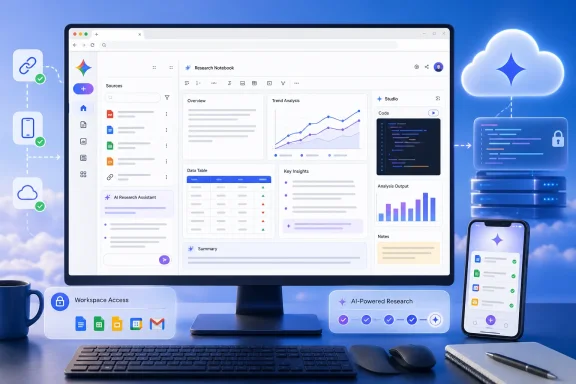
Google renamed NotebookLM to Gemini Notebook on July 16, but the consequential change is not the logo appearing in browser tabs and mobile apps. Google is adding a secure cloud-computing capability that can write and execute code within notebooks, extending the product beyond source-grounded summaries and questions into data analysis and calculations.
For existing users, the rename is primarily an operationally light rebrand. Existing content remains unchanged, and Google says redirects will preserve shared notebooks and existing links. For organizations and Windows users, the practical question is access: cloud code execution is available now for Google AI Ultra users and qualifying Workspace users with AI Ultra Access or AI Expanded Access. Google AI Pro web access is rolling out over the coming weeks.
The change also reinforces Google’s larger product strategy. NotebookLM began as a distinct research assistant built around user-provided sources. Gemini Notebook remains a standalone product, but it is now more visibly part of the Gemini portfolio and is positioned as a place where research, source review, and cloud-based analysis can happen in one browser-centered workflow.
The July 16 change is straightforward on paper. NotebookLM is now Gemini Notebook, with a new colorful logo and a rollout that may take several weeks to reach every interface. The Indian Express reported that existing notebooks, saved content, and familiar features remain intact. Google Workspace’s update says automatic redirects will preserve shared notebooks and existing links.
That means users do not need to move their material into a separate application or rebuild shared resources merely because the branding changes. Mobile users may need to update the app before the new name appears. Workspace administrators do not have a required migration task associated with the rename.
The Northeast Times also characterized the transition as a rebrand rather than a replacement of the underlying research product. That distinction matters because NotebookLM built its reputation on a specific workflow: users bring together a bounded collection of sources, then ask questions, generate summaries, and explore the material in that context.
Google has been making Gemini the umbrella identity for more of its AI products and services. The new name makes Gemini Notebook easier to place within that broader family, even if it can make day-to-day terminology more confusing. Gemini already uses “notebooks” as a term in some contexts, while the standalone product is now called Gemini Notebook.
Forbes contributor and educator-workshop leader Dan Fitzpatrick captured the naming problem in a question: “So are they different products or do we now have Gemini Notebook and Notebooks in Gemini”.
That is more than a branding quibble. Users may encounter the word “notebook” in different Gemini-related interfaces and need to determine whether it refers to a particular workspace, a feature within Gemini, or the full standalone Gemini Notebook service. Google’s naming makes the corporate relationship clearer, but it does not automatically make the task-level distinction clearer for teachers, analysts, students, or ordinary Windows users.
The most useful practical framing is that Gemini Notebook remains the research-oriented product associated with source collections and notebook-based work. The rebrand signals closer alignment with Gemini, not an instruction for users to discard their existing notebooks or change their shared-work habits overnight.
That capability changes what users may attempt inside a notebook. A source-grounded assistant can explain a document collection, identify themes, summarize reports, and answer questions about uploaded material. A system that can also generate and execute code may be able to support analytical tasks involving structured data, calculations, comparisons, and visual outputs.
Google’s announcement presents cloud computing as part of a broader effort to make notebooks more useful for deeper work. The key point is not that every user suddenly becomes a programmer. It is that the product can potentially perform computational steps that previously required moving between a research tool, a spreadsheet, and a coding environment.
For example, a user could bring together survey results, reports, or data files and ask for an analysis that involves calculations rather than prose-only interpretation. A team reviewing policy documents and supporting data could use the notebook environment to explore patterns or produce a chart. The specific usefulness will depend on the available feature set, the user’s subscription access, the source material, and the care taken when reviewing outputs.
That final condition is essential. Automation of an analytical step is not the same as validation of an analytical result. Users should still inspect the source inputs, clarify the question being asked, and review the resulting calculations or charts before relying on them in a decision, report, or formal presentation.
This is the strongest WindowsForum-specific takeaway: Gemini Notebook’s computing capability is browser and cloud based, so Windows users do not need to install a local coding setup to access it. But they should verify results and confirm their plan before relying on code execution for work that matters.
The convenience is real. So is the need for judgment. A result can look polished while still reflecting an unclear prompt, unsuitable source data, or assumptions that deserve review. The same source-tracing discipline that made NotebookLM appealing remains important when a notebook’s output includes calculations or analysis rather than just summaries.
That structure is especially useful for work that extends beyond a single prompt. A user might return to the same collection of reports, notes, transcripts, or files over time. A team might share a notebook as part of a recurring research or planning process. The product’s identity is therefore tied not just to Gemini branding, but to the idea of persistent, source-oriented workspaces.
Google is also expanding where those workspaces may fit into its AI ecosystem. The company has said notebooks will eventually be accessible from AI Mode in Google Search. nokiapoweruser.com reported that folders are also coming, although Google has not provided a release date for that organizational feature.
Taken together, those changes suggest that Google wants the notebook to remain useful across multiple stages of research: finding information, gathering materials, asking questions, and analyzing content. That does not make Gemini Notebook a replacement for every desktop analytics tool or every enterprise research process. It does make the browser-based notebook a more central part of Google’s AI product strategy.
The access story, however, is more complicated than the phrase “every notebook gets a secure cloud computer” might initially imply. Google is building the capability into the product, but actual use of cloud code execution is still tied to subscription tier and rollout status.
Google AI Ultra subscribers and qualifying Workspace users with AI Ultra Access or AI Expanded Access have access now. Google AI Pro web access is rolling out over the coming weeks, and Google has not announced a precise date. The underlying cloud-computing capability remains limited to paid-plan access rather than being presented as a universally available feature.
The table highlights the practical divide in the announcement. The rebrand applies broadly, while code execution is being introduced through paid access and a staged rollout. Users should not assume that seeing the Gemini Notebook name automatically means that cloud computing is enabled for their account.
April: Google integrated NotebookLM into the Gemini app as part of its broader Gemini ecosystem work.
June: Google announced that notebooks would receive access to a secure cloud-based computer for code execution and advanced analysis.
July 16: NotebookLM became Gemini Notebook, and the extended name-and-logo rollout began.
Over the next few weeks: Google AI Pro subscribers are expected to receive web access to cloud computing, although Google has not announced a specific date.
The more meaningful administrative task is communication. Teams that previously understood NotebookLM as a source-based reading, summarizing, and brainstorming tool may now encounter a product that can support code execution and more advanced analysis for eligible accounts.
Organizations should make clear that access is not identical across all users. AI Pro web access is rolling out. Google AI Ultra users and qualifying Workspace users with AI Ultra Access or AI Expanded Access have access now. Administrators should avoid suggesting that they assign or manage personal Google AI Pro access in the same way they manage Workspace access; the relevant organizational question is whether a Workspace user has the qualifying access plan.
The arrival of cloud-based analysis also gives teams a reason to revisit existing AI guidance. The feature may be appropriate for exploration, internal research, and early-stage analysis, depending on an organization’s policies and the data involved. But results intended for decisions, formal reports, academic work, or high-impact business processes should receive human review.
That does not require treating every use of Gemini Notebook as a special governance crisis. It does require recognizing that the product can now produce more than summaries. When a notebook output includes calculations, code-driven analysis, or charts, users should understand that the output needs the same scrutiny they would apply to work completed in a spreadsheet or other analytical tool.
The Gemini Notebook name preserves that product identity while making its connection to Google’s larger AI ecosystem more explicit. The secure cloud computer adds another dimension: users with eligible access can ask the system to perform computational work alongside source-based research.
The change should be read in two parts. First, the rename is designed to be low disruption. Existing content remains unchanged, mobile users may need an app update to see the new branding, and shared links redirect. Second, code execution is a meaningful capability change, but availability depends on plan status and rollout timing.
The Indian Express coverage emphasized continuity for existing notebooks and features. gHacks focused on the new ability to run code and analyze data in the cloud. nokiapoweruser.com highlighted future organization features such as folders. The Northeast Times also covered the rebrand as part of Google’s effort to bring the product more visibly under the Gemini name. Google’s own announcement and Workspace update provide the operational details on redirects, rollout, and qualifying access.
For Windows users, the immediate appeal is simple: there is no local development environment to install before trying supported cloud-based analysis. The corresponding responsibility is equally simple: confirm that the right plan is available, inspect the result, and do not confuse a smoothly generated answer with a verified one.
Google renamed NotebookLM to Gemini Notebook on July 16, but the consequential change is not the logo appearing in browser tabs and mobile apps. Google is adding a secure cloud-computing capability that can write and execute code within notebooks, extending the product beyond source-grounded summaries and questions into data analysis and calculations.
For existing users, the rename is primarily an operationally light rebrand. Existing content remains unchanged, and Google says redirects will preserve shared notebooks and existing links. For organizations and Windows users, the practical question is access: cloud code execution is available now for Google AI Ultra users and qualifying Workspace users with AI Ultra Access or AI Expanded Access. Google AI Pro web access is rolling out over the coming weeks.
The change also reinforces Google’s larger product strategy. NotebookLM began as a distinct research assistant built around user-provided sources. Gemini Notebook remains a standalone product, but it is now more visibly part of the Gemini portfolio and is positioned as a place where research, source review, and cloud-based analysis can happen in one browser-centered workflow.
 Google Has Renamed the Product It Already Began Folding In
The July 16 change is straightforward on paper. NotebookLM is now Gemini Notebook, with a new colorful logo and a rollout that may take several weeks to reach every interface. The Indian Express reported that existing notebooks, saved content, and familiar features remain intact. Google Workspace’s update says automatic redirects will preserve shared notebooks and existing links.That means users do not need to move their material into a separate application or rebuild shared resources merely because the branding changes. Mobile users may need to update the app before the new name appears. Workspace administrators do not have a required migration task associated with the rename.
The Northeast Times also characterized the transition as a rebrand rather than a replacement of the underlying research product. That distinction matters because NotebookLM built its reputation on a specific workflow: users bring together a bounded collection of sources, then ask questions, generate summaries, and explore the material in that context.
Google has been making Gemini the umbrella identity for more of its AI products and services. The new name makes Gemini Notebook easier to place within that broader family, even if it can make day-to-day terminology more confusing. Gemini already uses “notebooks” as a term in some contexts, while the standalone product is now called Gemini Notebook.
Forbes contributor and educator-workshop leader Dan Fitzpatrick captured the naming problem in a question: “So are they different products or do we now have Gemini Notebook and Notebooks in Gemini”.
That is more than a branding quibble. Users may encounter the word “notebook” in different Gemini-related interfaces and need to determine whether it refers to a particular workspace, a feature within Gemini, or the full standalone Gemini Notebook service. Google’s naming makes the corporate relationship clearer, but it does not automatically make the task-level distinction clearer for teachers, analysts, students, or ordinary Windows users.
The most useful practical framing is that Gemini Notebook remains the research-oriented product associated with source collections and notebook-based work. The rebrand signals closer alignment with Gemini, not an instruction for users to discard their existing notebooks or change their shared-work habits overnight.
The Real Upgrade Is an AI That Can Execute, Not Just Explain
Google’s more substantial announcement is that Gemini Notebook is receiving a secure cloud computer capable of writing and executing code. gHacks described the practical implication as the ability to write and run code, analyze data, perform complex calculations, and handle more advanced research tasks without relying on the user’s local device.That capability changes what users may attempt inside a notebook. A source-grounded assistant can explain a document collection, identify themes, summarize reports, and answer questions about uploaded material. A system that can also generate and execute code may be able to support analytical tasks involving structured data, calculations, comparisons, and visual outputs.
Google’s announcement presents cloud computing as part of a broader effort to make notebooks more useful for deeper work. The key point is not that every user suddenly becomes a programmer. It is that the product can potentially perform computational steps that previously required moving between a research tool, a spreadsheet, and a coding environment.
For example, a user could bring together survey results, reports, or data files and ask for an analysis that involves calculations rather than prose-only interpretation. A team reviewing policy documents and supporting data could use the notebook environment to explore patterns or produce a chart. The specific usefulness will depend on the available feature set, the user’s subscription access, the source material, and the care taken when reviewing outputs.
That final condition is essential. Automation of an analytical step is not the same as validation of an analytical result. Users should still inspect the source inputs, clarify the question being asked, and review the resulting calculations or charts before relying on them in a decision, report, or formal presentation.
This is the strongest WindowsForum-specific takeaway: Gemini Notebook’s computing capability is browser and cloud based, so Windows users do not need to install a local coding setup to access it. But they should verify results and confirm their plan before relying on code execution for work that matters.
The convenience is real. So is the need for judgment. A result can look polished while still reflecting an unclear prompt, unsuitable source data, or assumptions that deserve review. The same source-tracing discipline that made NotebookLM appealing remains important when a notebook’s output includes calculations or analysis rather than just summaries.
Google Is Selling a Connected Research Layer, Not a Replacement Chatbot
Google says Gemini Notebook will remain a standalone product, and that assurance should not be overlooked. The service’s value depends in part on having a defined research workspace rather than becoming another generic chat window. A notebook-based workflow gives users a recognizable boundary around a project and its sources.That structure is especially useful for work that extends beyond a single prompt. A user might return to the same collection of reports, notes, transcripts, or files over time. A team might share a notebook as part of a recurring research or planning process. The product’s identity is therefore tied not just to Gemini branding, but to the idea of persistent, source-oriented workspaces.
Google is also expanding where those workspaces may fit into its AI ecosystem. The company has said notebooks will eventually be accessible from AI Mode in Google Search. nokiapoweruser.com reported that folders are also coming, although Google has not provided a release date for that organizational feature.
Taken together, those changes suggest that Google wants the notebook to remain useful across multiple stages of research: finding information, gathering materials, asking questions, and analyzing content. That does not make Gemini Notebook a replacement for every desktop analytics tool or every enterprise research process. It does make the browser-based notebook a more central part of Google’s AI product strategy.
The access story, however, is more complicated than the phrase “every notebook gets a secure cloud computer” might initially imply. Google is building the capability into the product, but actual use of cloud code execution is still tied to subscription tier and rollout status.
Google AI Ultra subscribers and qualifying Workspace users with AI Ultra Access or AI Expanded Access have access now. Google AI Pro web access is rolling out over the coming weeks, and Google has not announced a precise date. The underlying cloud-computing capability remains limited to paid-plan access rather than being presented as a universally available feature.
| User or plan group | Gemini Notebook rebrand | Cloud-computer/code execution status | Timing |
|---|---|---|---|
| Personal Google-account users | Name and logo update; existing content remains unchanged | Paid-plan access is required for cloud computing | Rebrand rollout began July 16 |
| Google AI Pro subscribers | Name and logo update | Web access is rolling out | Over the next few weeks; no specific date announced |
| Google AI Ultra subscribers | Name and logo update | Available now | Available now |
| Qualifying Workspace users with AI Ultra Access or AI Expanded Access | Name and logo update | Available now | Available now |
| Workspace customers and Workspace Individual subscribers | Name and logo update; redirects preserve links | Depends on the account’s qualifying access and rollout status | Interface updates may take time to appear everywhere |
Timeline
2023: Google introduced the experimental product at Google I/O under the working title Project Tailwind.April: Google integrated NotebookLM into the Gemini app as part of its broader Gemini ecosystem work.
June: Google announced that notebooks would receive access to a secure cloud-based computer for code execution and advanced analysis.
July 16: NotebookLM became Gemini Notebook, and the extended name-and-logo rollout began.
Over the next few weeks: Google AI Pro subscribers are expected to receive web access to cloud computing, although Google has not announced a specific date.
The Administrative Work Is Small, but the Governance Work Is Not
Google Workspace administrators have a simple answer to the immediate migration question: no action is required for the rebrand itself. Existing shared notebooks and user links are expected to continue through automatic redirects. The visible name change may take time to reach every interface, particularly while web and mobile updates are rolling out.The more meaningful administrative task is communication. Teams that previously understood NotebookLM as a source-based reading, summarizing, and brainstorming tool may now encounter a product that can support code execution and more advanced analysis for eligible accounts.
Organizations should make clear that access is not identical across all users. AI Pro web access is rolling out. Google AI Ultra users and qualifying Workspace users with AI Ultra Access or AI Expanded Access have access now. Administrators should avoid suggesting that they assign or manage personal Google AI Pro access in the same way they manage Workspace access; the relevant organizational question is whether a Workspace user has the qualifying access plan.
The arrival of cloud-based analysis also gives teams a reason to revisit existing AI guidance. The feature may be appropriate for exploration, internal research, and early-stage analysis, depending on an organization’s policies and the data involved. But results intended for decisions, formal reports, academic work, or high-impact business processes should receive human review.
That does not require treating every use of Gemini Notebook as a special governance crisis. It does require recognizing that the product can now produce more than summaries. When a notebook output includes calculations, code-driven analysis, or charts, users should understand that the output needs the same scrutiny they would apply to work completed in a spreadsheet or other analytical tool.
Action checklist for admins
- Confirm that users understand the access distinction: AI Pro web access is rolling out, while Google AI Ultra and qualifying Workspace AI Ultra Access or AI Expanded Access users have access now.
- Tell users that the NotebookLM name may remain visible temporarily while the Gemini Notebook rollout reaches web and mobile interfaces.
- Update internal guidance, screenshots, and training materials so they distinguish Gemini Notebook from other notebook-related features in Gemini.
- Remind teams that shared links should redirect and that no rebrand migration is required.
- Establish a review expectation for AI-assisted analysis: verify source inputs, the question being asked, calculations, and charts before using results in decisions or formal work.
- Identify sensitive-data workflows that may require additional review or approval before users upload material for AI-assisted research or analysis.
- Encourage users to confirm their account and plan status before planning a workflow around cloud code execution.
What This Rebrand Actually Changes for Research Work
Google’s stated goal of helping people learn and work with AI has not changed, but the kind of work Gemini Notebook can support is expanding. The original NotebookLM proposition was compelling because it gave users a place to work with a defined set of sources instead of relying entirely on a blank chatbot prompt.The Gemini Notebook name preserves that product identity while making its connection to Google’s larger AI ecosystem more explicit. The secure cloud computer adds another dimension: users with eligible access can ask the system to perform computational work alongside source-based research.
The change should be read in two parts. First, the rename is designed to be low disruption. Existing content remains unchanged, mobile users may need an app update to see the new branding, and shared links redirect. Second, code execution is a meaningful capability change, but availability depends on plan status and rollout timing.
The Indian Express coverage emphasized continuity for existing notebooks and features. gHacks focused on the new ability to run code and analyze data in the cloud. nokiapoweruser.com highlighted future organization features such as folders. The Northeast Times also covered the rebrand as part of Google’s effort to bring the product more visibly under the Gemini name. Google’s own announcement and Workspace update provide the operational details on redirects, rollout, and qualifying access.
- NotebookLM was renamed Gemini Notebook on July 16; existing content remains unchanged through the transition.
- No migration is required, and shared notebook links are expected to redirect automatically.
- Mobile users may need to update the app before the new name appears.
- Gemini Notebook remains a standalone research product even as Google aligns it more closely with Gemini.
- Secure cloud computing enables code execution and more advanced analytical work for eligible users.
- Google AI Ultra users and qualifying Workspace AI Ultra Access or AI Expanded Access users have cloud-computing access now.
- Google AI Pro web access is rolling out over the coming weeks, without a specific announced date.
- Folders have been reported as a future feature, but Google has not provided a release date.
For Windows users, the immediate appeal is simple: there is no local development environment to install before trying supported cloud-based analysis. The corresponding responsibility is equally simple: confirm that the right plan is available, inspect the result, and do not confuse a smoothly generated answer with a verified one.
References
- Primary source: Northeast Times
Published: 2026-07-17T22:00:00+00:00
Google renames NotebookLM to Gemini Notebook, adds code tools - Northeast Times
Google renamed NotebookLM to Gemini Notebook on July 16, adding a secure cloud computer to each notebook for native code execution and data analysis.northeasttimes.com - Independent coverage: The Indian Express
Published: 2026-07-17T13:22:02+00:00
Google renames NotebookLM as Gemini Notebook, expands AI research features | Technology News - The Indian Express
The AI-powered research assistant keeps its existing features while gaining broader access to cloud-based computing for Google AI Pro subscribers.indianexpress.com - Independent coverage: gHacks
Published: 2026-07-17T08:23:00+00:00
Google Rebrands NotebookLM as Gemini Notebook and Expands Cloud Computer Access to AI Pro - gHacks Tech News
Google is rebranding NotebookLM as Gemini Notebook and expanding secure cloud computer access to AI Pro subscribers.www.ghacks.net - Independent coverage: nokiapoweruser.com
Published: 2026-07-17T06:44:32+00:00
Google Renames NotebookLM to Gemini Notebook - NPowerUser
Google has officially rebranded NotebookLM as Gemini Notebook, bringing its AI research assistant closer to the growing Gemini ecosystem. - Read in Google AI News on NPowerUser nokiapoweruser.com
- Related coverage: workspaceupdates.googleblog.com
Google Workspace Updates: NotebookLM is now Gemini Notebook
workspaceupdates.googleblog.com
- Related coverage: blog.google
NotebookLM is now Gemini Notebook
NotebookLM is now Gemini Notebook: the same standalone product with deeper Google integration and a secure cloud computer.blog.google