

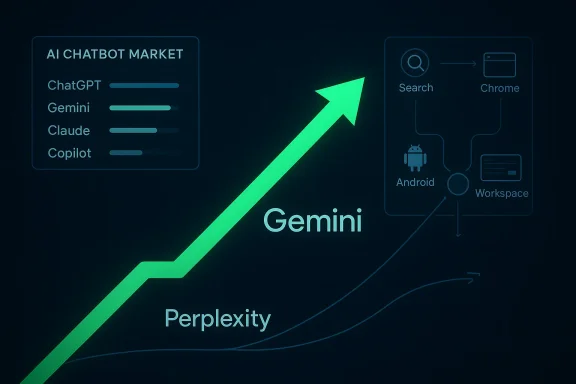
Google Gemini’s rise past Perplexity in AI chatbot referral traffic is more than a monthly ranking tweak; it is a signal that the search-to-chat discovery market is hardening around ecosystem scale, product distribution, and user habit. Statcounter’s March 2026 data shows Gemini climbing to 8.65% of global AI chatbot referrals while Perplexity slipped to 7.07%, marking the first time Google’s assistant has taken the No. 2 spot behind ChatGPT. For publishers and marketers, the message is blunt: AI referral traffic is no longer a single-source story, and the winners are increasingly those embedded across the biggest consumer platforms. (gs.statcounter.com)
The significance of this shift lies in what referral traffic represents. These are not passive impressions or generic brand mentions; they are clicks from users who have already crossed the intent threshold inside an AI interface and then chosen to leave that environment for a website. In other words, AI referrals are an early indicator of whether chatbots are becoming true discovery engines rather than closed answer boxes. Statcounter’s latest numbers show that discovery is becoming more distributed, more competitive, and more valuable. (gs.statcounter.com)
Gemini’s gain is especially notable because it comes from a relatively low starting base. In April 2025, Google’s chatbot accounted for just 2.31% of AI chatbot referrals, but by March 2026 it had nearly quadrupled its share. Perplexity, by contrast, fell from 12.07% in April 2025 to 7.07% in March 2026, a decline of more than 40% from its peak. That divergence suggests that growth in AI referrals is not simply about being an AI-first product; it is about being the AI product with the strongest distribution pipes. (gs.statcounter.com)
ChatGPT remains the dominant force by a wide margin, but its share dipped below 80% for the first time in Statcounter’s dataset, landing at 78.16% in March 2026. That matters because it hints at a market entering a more mature phase. When a category starts to fragment at the top, the next battle is not just for mindshare but for default placement, cross-surface exposure, and retained user behavior. (gs.statcounter.com)
The broader context is also important for publishers. For years, traditional search engines and news organizations worried that AI assistants would answer questions without sending readers outward. The new data does not erase that concern, but it complicates it. Some chatbot platforms are clearly sending more traffic than others, and the businesses that can capture that traffic may be able to turn AI into a measurable audience channel rather than a pure threat. (gs.statcounter.com)
The most striking part is that Gemini’s rise is not framed by a single killer feature. Instead, it appears to be the cumulative effect of Google’s ecosystem leverage across Search, Android, Workspace, and Chrome. That kind of integration creates more surface area for discovery than a standalone app can match. In platform markets, reach often matters more than elegance. (gs.statcounter.com)
The Statcounter data reinforces a familiar lesson from the search era: the best product does not always win; the best-distributed product often does. Gemini does not need to beat every rival on model quality to outperform them on traffic if it is present in more journeys. In that sense, the referral market rewards proximity to the user more than abstract technical superiority. (gs.statcounter.com)
There is also a defensive logic here. If Google did not aggressively integrate Gemini, users could easily treat it as a novelty while relying on ChatGPT or Perplexity for serious work. Instead, Google is trying to make Gemini feel native to the broader Google experience. That strategy may not always produce the most enthusiastic power users, but it can create the largest referral footprint. (gs.statcounter.com)
The downside is that referral growth does not automatically translate into trust or loyalty. Users can click through from Gemini without making it their preferred assistant. So while the referral chart looks encouraging, it does not settle the wider AI-platform race. Google still has to convert distribution into attachment. (gs.statcounter.com)
This does not mean Perplexity is failing. It still commands a meaningful share, and its product is often praised for search-like behavior and citation-heavy responses. But referral traffic is a competition where momentum matters, and the latest trend line is moving in the wrong direction. In the crowded AI market, perception can change quickly once a platform stops appearing to be the growth story. (gs.statcounter.com)
Still, there is no escaping the optics. Once Gemini overtakes you in traffic, the narrative changes from challenger to incumbent threat. That shift can affect investor sentiment, press coverage, and user expectations, even if the actual product quality gap is minimal. In platform markets, narrative is often a form of capital. (gs.statcounter.com)
That decline is worth watching, but it should not be overstated. A platform can lose share while still retaining overwhelming dominance. What matters is whether the loss is temporary noise or the beginning of structural erosion. Right now, the evidence points to fragmentation, not collapse. (gs.statcounter.com)
It also helps explain why rival platforms keep pursuing differentiated positioning. If you cannot beat ChatGPT on scale, you try to beat it on task quality, workflow integration, or citation usefulness. The referral race is therefore also a race to define which use case matters most. (gs.statcounter.com)
That caution is important. A platform can appear to break out when, in reality, it is surfing a temporary attention wave. Still, even if some of Claude’s growth is cyclical, the longer-term trend is undeniably stronger than it was a year ago. From 0.30% in April 2025 to 2.91% in March 2026, the platform has gone from a minor player to a meaningful referral source. (gs.statcounter.com)
If not, the recent growth may flatten once the news cycle cools. That is the risk with any AI product that surges on the back of public conversation rather than platform ubiquity. Growth is valuable, but retention is the real prize. (gs.statcounter.com)
DeepSeek, meanwhile, is almost invisible in this particular dataset at 0.02%. That does not mean it lacks broader strategic significance, but it does mean that, as a referral source for websites, it currently has little measurable impact compared with the major Western assistants. In practical terms, it is not yet shaping traffic strategies for most publishers. (gs.statcounter.com)
This matters especially because Microsoft has invested heavily in AI across its product suite. When the referral data underperforms the strategic ambition, it raises questions about whether users are treating Copilot as a utility feature rather than a discovery destination. That distinction has real implications for traffic and monetization. (gs.statcounter.com)
That means tracking which platforms send readers, which stories earn citations, and which pages convert the best once the user arrives. In a fragmented market, optimization becomes more operational. It is less about abstract SEO lore and more about measurable interaction with emerging referral channels. (gs.statcounter.com)
Commercial teams should also reconsider how they describe AI audiences to advertisers. If AI-driven visitors convert at higher rates, as many industry reports suggest, then these sessions deserve distinct treatment in analytics and sales conversations. Not all referral traffic is equal. (gs.statcounter.com)
For the industry, the bigger story is that AI referral traffic is becoming a serious strategic metric rather than a curiosity. Publishers will track it more closely, platforms will try to influence it more deliberately, and marketers will need to understand which assistants bring not just clicks, but outcomes. The discovery layer of the web is changing, and the companies that adapt fastest will capture the most value. (gs.statcounter.com)
Source: MediaPost Gemini Overtakes Perplexity, Becomes No. 2 Bot Referral To Websites
 Overview
The significance of this shift lies in what referral traffic represents. These are not passive impressions or generic brand mentions; they are clicks from users who have already crossed the intent threshold inside an AI interface and then chosen to leave that environment for a website. In other words, AI referrals are an early indicator of whether chatbots are becoming true discovery engines rather than closed answer boxes. Statcounter’s latest numbers show that discovery is becoming more distributed, more competitive, and more valuable. (gs.statcounter.com)Gemini’s gain is especially notable because it comes from a relatively low starting base. In April 2025, Google’s chatbot accounted for just 2.31% of AI chatbot referrals, but by March 2026 it had nearly quadrupled its share. Perplexity, by contrast, fell from 12.07% in April 2025 to 7.07% in March 2026, a decline of more than 40% from its peak. That divergence suggests that growth in AI referrals is not simply about being an AI-first product; it is about being the AI product with the strongest distribution pipes. (gs.statcounter.com)
ChatGPT remains the dominant force by a wide margin, but its share dipped below 80% for the first time in Statcounter’s dataset, landing at 78.16% in March 2026. That matters because it hints at a market entering a more mature phase. When a category starts to fragment at the top, the next battle is not just for mindshare but for default placement, cross-surface exposure, and retained user behavior. (gs.statcounter.com)
The broader context is also important for publishers. For years, traditional search engines and news organizations worried that AI assistants would answer questions without sending readers outward. The new data does not erase that concern, but it complicates it. Some chatbot platforms are clearly sending more traffic than others, and the businesses that can capture that traffic may be able to turn AI into a measurable audience channel rather than a pure threat. (gs.statcounter.com)
Why referral traffic matters
Referral traffic is a cleaner commercial signal than raw chatbot usage because it ties AI interaction to downstream action. A user who clicks through from Gemini or ChatGPT has already shown a willingness to evaluate a source, compare products, or verify a claim. That makes the traffic pre-qualified in a way that generic organic visits often are not. For publishers, that is the difference between a vanity metric and a revenue opportunity. (gs.statcounter.com)- It measures intent, not just exposure.
- It helps publishers judge which AI platforms are worth optimizing for.
- It often correlates with higher engagement than standard search traffic.
- It can reveal which assistants are sending useful visitors versus merely summarizing content.
- It gives marketers a way to track generative engine optimization in practice.
What changed in March 2026
March’s figures show a reshuffling among the challengers behind ChatGPT. Gemini moved from 7.5% in February to 8.65% in March, Perplexity slipped from 7.88% to 7.07%, Claude jumped from 1.37% to 2.91%, and Copilot edged lower to 3.19%. That is not a random wobble; it reflects a fast-moving market where product releases, platform distribution, and the news cycle can all shift user behavior almost immediately. (gs.statcounter.com)The most striking part is that Gemini’s rise is not framed by a single killer feature. Instead, it appears to be the cumulative effect of Google’s ecosystem leverage across Search, Android, Workspace, and Chrome. That kind of integration creates more surface area for discovery than a standalone app can match. In platform markets, reach often matters more than elegance. (gs.statcounter.com)
Google’s Distribution Advantage
Google’s core strength is not just that Gemini exists, but that it is woven into places where users already spend time. When an assistant is surfaced inside search, mobile operating systems, productivity tools, and browsers, it gains repeated opportunities to become the default place users start a query. That is a powerful advantage, especially when the end goal is a click out to a website. (gs.statcounter.com)The Statcounter data reinforces a familiar lesson from the search era: the best product does not always win; the best-distributed product often does. Gemini does not need to beat every rival on model quality to outperform them on traffic if it is present in more journeys. In that sense, the referral market rewards proximity to the user more than abstract technical superiority. (gs.statcounter.com)
Ecosystem as a traffic engine
Google’s advantage compounds because each surface reinforces the others. Search can introduce Gemini, Android can normalize it, Chrome can shorten the path to use, and Workspace can make it feel operational rather than experimental. That kind of cross-surface familiarity lowers friction and encourages repeat usage. Over time, repeat usage tends to produce more clicks. (gs.statcounter.com)There is also a defensive logic here. If Google did not aggressively integrate Gemini, users could easily treat it as a novelty while relying on ChatGPT or Perplexity for serious work. Instead, Google is trying to make Gemini feel native to the broader Google experience. That strategy may not always produce the most enthusiastic power users, but it can create the largest referral footprint. (gs.statcounter.com)
- Gemini benefits from being where users already are.
- Distribution can matter more than feature parity.
- Ecosystem exposure increases the chance of repeated use.
- Repeated use raises the odds of outbound clicks.
- Default placement is a hidden moat in AI.
What this means for Google
For Google, the upside is obvious: Gemini’s referral growth provides evidence that its AI investments are becoming commercially relevant. That matters inside a company trying to balance product innovation with the economics of its traditional advertising model. If Gemini can produce measurable outbound behavior, it becomes easier to argue that AI is not cannibalizing Google’s ecosystem but extending it. (gs.statcounter.com)The downside is that referral growth does not automatically translate into trust or loyalty. Users can click through from Gemini without making it their preferred assistant. So while the referral chart looks encouraging, it does not settle the wider AI-platform race. Google still has to convert distribution into attachment. (gs.statcounter.com)
Perplexity’s Decline
Perplexity’s retreat from second place is the most visible reversal in the new data. A year ago, it controlled 12.07% of AI chatbot referrals and looked like the clearest challenger to ChatGPT in terms of web-driving behavior. By March 2026, that share had slid to 7.07%, leaving it behind Gemini for the first time. (gs.statcounter.com)This does not mean Perplexity is failing. It still commands a meaningful share, and its product is often praised for search-like behavior and citation-heavy responses. But referral traffic is a competition where momentum matters, and the latest trend line is moving in the wrong direction. In the crowded AI market, perception can change quickly once a platform stops appearing to be the growth story. (gs.statcounter.com)
A product problem or a positioning problem?
The more interesting question is whether Perplexity’s decline reflects product weakness or market positioning. On one hand, it may be losing share simply because Google can out-distribute it. On the other hand, Perplexity’s brand is highly associated with research and retrieval, which may not always translate into the broadest consumer referral volume. That can make it look smaller than it actually is in strategic terms. (gs.statcounter.com)Still, there is no escaping the optics. Once Gemini overtakes you in traffic, the narrative changes from challenger to incumbent threat. That shift can affect investor sentiment, press coverage, and user expectations, even if the actual product quality gap is minimal. In platform markets, narrative is often a form of capital. (gs.statcounter.com)
Why the decline matters to publishers
For publishers, Perplexity’s slide matters because it changes the optimization map. A year ago, some outlets might have focused disproportionately on Perplexity as the AI referral source most likely to send visitors. Now they need to spread that attention across Gemini, ChatGPT, Claude, and Copilot as well. The audience is fragmenting, and the content strategy has to follow. (gs.statcounter.com)- Perplexity’s share has fallen steadily from its peak.
- Its earlier strength no longer guarantees growth.
- Publishers can no longer treat it as the default No. 2 platform.
- The market is rewarding multi-platform optimization.
- The traffic mix is becoming less predictable month by month.
ChatGPT Still Dominates
Even with Gemini’s surge, ChatGPT remains the centerpiece of the AI referral economy. Statcounter’s March 2026 data puts it at 78.16% of all AI chatbot referrals worldwide, still far ahead of every rival combined. That scale means the platform remains the single most important AI source for websites, even as its share has slipped below 80% for the first time. (gs.statcounter.com)That decline is worth watching, but it should not be overstated. A platform can lose share while still retaining overwhelming dominance. What matters is whether the loss is temporary noise or the beginning of structural erosion. Right now, the evidence points to fragmentation, not collapse. (gs.statcounter.com)
The meaning of a sub-80% share
For analysts, the drop below 80% is symbolically important because it signals that the market is no longer consolidating entirely around one assistant. Yet the distance between 78.16% and the next-largest player is still enormous. That means ChatGPT remains the default benchmark for publishers, agencies, and competitors alike. (gs.statcounter.com)It also helps explain why rival platforms keep pursuing differentiated positioning. If you cannot beat ChatGPT on scale, you try to beat it on task quality, workflow integration, or citation usefulness. The referral race is therefore also a race to define which use case matters most. (gs.statcounter.com)
Consumers versus enterprise
For consumers, ChatGPT’s lead likely reflects habit and brand familiarity. For enterprises, the picture is more nuanced because workflow integration, policy controls, and Microsoft/Google stack compatibility can matter as much as raw model appeal. In that context, ChatGPT’s traffic dominance is impressive, but not necessarily the final word on enterprise influence. That distinction matters. (gs.statcounter.com)- ChatGPT remains the most important referral source by far.
- Its share dip is notable but not existential.
- Brand familiarity still drives a lot of consumer behavior.
- Enterprise decision-making may follow different adoption patterns.
- The platform is dominant, but the market is no longer static.
Claude’s Surge
Claude’s jump from 1.37% in February to 2.91% in March is one of the most dramatic moves in the dataset. On a percentage basis, that is a rapid acceleration, and it suggests that Anthropic’s product is benefiting from an unusually favorable moment in public attention. Statcounter also notes that Claude’s week 12 peak of 3.6% eased back to 2.49% in week 13, which hints that some of the surge may have been news-driven. (gs.statcounter.com)That caution is important. A platform can appear to break out when, in reality, it is surfing a temporary attention wave. Still, even if some of Claude’s growth is cyclical, the longer-term trend is undeniably stronger than it was a year ago. From 0.30% in April 2025 to 2.91% in March 2026, the platform has gone from a minor player to a meaningful referral source. (gs.statcounter.com)
News cycle effects and sticky growth
The question for Claude is whether its gains are durable or episodic. Viral attention can create a spike, but referral markets tend to reward repeat usage, not one-time curiosity. If Claude can convert attention into habit, it could become a durable third force behind ChatGPT and Gemini. (gs.statcounter.com)If not, the recent growth may flatten once the news cycle cools. That is the risk with any AI product that surges on the back of public conversation rather than platform ubiquity. Growth is valuable, but retention is the real prize. (gs.statcounter.com)
Why Claude’s rise still matters
Even if the spike partially reflects media attention, Claude’s growth changes competitive expectations. It shows there is room in the market for assistants that are not built around the same exact consumption pattern as ChatGPT. It also tells publishers they should not ignore smaller platforms just because they are not the biggest names. The tail can move quickly. (gs.statcounter.com)- Claude more than doubled its share in one month.
- Its growth appears partly tied to publicity and switching behavior.
- The weekly peak suggests some volatility.
- Sustained growth would make Claude a serious referral player.
- Temporary growth still matters if it changes user habits.
Copilot and DeepSeek
Microsoft Copilot remains relevant but continues to drift downward in share terms. Statcounter places it at 3.19% in March 2026, down from a 5.18% peak in May 2025. That is not trivial, especially given Microsoft’s extensive AI push across Windows, Office, and the broader Microsoft ecosystem. But it does suggest that product presence alone does not guarantee referral leadership. (gs.statcounter.com)DeepSeek, meanwhile, is almost invisible in this particular dataset at 0.02%. That does not mean it lacks broader strategic significance, but it does mean that, as a referral source for websites, it currently has little measurable impact compared with the major Western assistants. In practical terms, it is not yet shaping traffic strategies for most publishers. (gs.statcounter.com)
Microsoft’s challenge
Copilot’s decline is a reminder that a powerful distribution network is not enough if users do not form a strong habit around the product. Microsoft can place Copilot in many contexts, but placement does not automatically equal preference. The company must still convince users that Copilot is the best answer to more than a narrow set of tasks. (gs.statcounter.com)This matters especially because Microsoft has invested heavily in AI across its product suite. When the referral data underperforms the strategic ambition, it raises questions about whether users are treating Copilot as a utility feature rather than a discovery destination. That distinction has real implications for traffic and monetization. (gs.statcounter.com)
The smaller-player problem
DeepSeek’s tiny referral share underscores the broader challenge for niche or emerging assistants. It is one thing to attract attention from technologists; it is another to drive meaningful outbound behavior at scale. Referral share tends to reward products that are not only smart but easy to encounter repeatedly. Visibility beats novelty. (gs.statcounter.com)- Copilot is still in the game, but it has not converted investment into share growth.
- DeepSeek’s referral footprint is currently negligible.
- Distribution helps, but habit matters more.
- Enterprise deployment does not always translate to website referrals.
- The long tail of AI assistants still has a long way to go.
What Publishers Should Do Now
For publishers, the practical takeaway is not to crown a single AI partner. It is to prepare for a multi-platform referral environment in which traffic quality, landing-page behavior, and content structure matter across several assistants. The winners will be the outlets that treat AI like a portfolio, not a bet on one platform. (gs.statcounter.com)That means tracking which platforms send readers, which stories earn citations, and which pages convert the best once the user arrives. In a fragmented market, optimization becomes more operational. It is less about abstract SEO lore and more about measurable interaction with emerging referral channels. (gs.statcounter.com)
Editorial and commercial implications
Newsrooms should think carefully about story packaging because AI assistants do not distribute traffic evenly. Clear structure, clean attribution, and topical authority may influence whether a chatbot links out or simply paraphrases. The traffic opportunity is real, but it will not reward sloppy publishing. (gs.statcounter.com)Commercial teams should also reconsider how they describe AI audiences to advertisers. If AI-driven visitors convert at higher rates, as many industry reports suggest, then these sessions deserve distinct treatment in analytics and sales conversations. Not all referral traffic is equal. (gs.statcounter.com)
Practical steps for media teams
- Audit AI referral sources separately from organic search.
- Track landing-page performance by assistant, not just by traffic total.
- Identify which stories earn the most AI citations and clicks.
- Monitor month-over-month volatility in referral share.
- Build content formats that answer high-intent queries clearly.
- Treat AI platforms as distribution partners with changing incentives.
- Separate AI referrals from standard search in reporting.
- Measure downstream engagement, not only visit counts.
- Optimize headline clarity and source attribution.
- Watch for platform-specific patterns in topical interest.
- Avoid overcommitting to a single chatbot ecosystem.
Strengths and Opportunities
The strongest takeaway from this data is that the AI referral market is becoming commercially legible. That gives publishers, marketers, and platform operators a clearer way to evaluate where user intent is turning into site visits. It also opens a new layer of competition that can reward good content structure, clear citations, and ecosystem reach. There is real upside here. (gs.statcounter.com)- Gemini now has proof that Google’s ecosystem can translate into outbound traffic.
- ChatGPT still delivers the largest audience by a wide margin.
- Claude has momentum that could become durable if retention improves.
- Publishers can diversify their AI traffic strategy instead of relying on one source.
- Marketers can track higher-intent audiences more precisely.
- Product teams have a reason to improve link-out behavior, not just answer quality.
- The market now has a clearer benchmark for generative engine optimization.
Risks and Concerns
The downside of this fragmentation is that traffic may become less predictable even as it becomes more measurable. If AI assistants keep changing their citation and referral behavior, publishers could face volatile month-to-month swings that make planning difficult. There is also the risk that some platforms will continue to answer more questions without sending users away, limiting the upside for web publishers. (gs.statcounter.com)- Referral share can swing quickly on news-cycle momentum.
- Google’s ecosystem advantage may concentrate traffic power further.
- Perplexity’s decline shows that early leadership is fragile.
- ChatGPT’s dominance could still suppress true market competition.
- Platform policy changes could alter referral flows without warning.
- Publishers may overfit content strategies to short-term AI trends.
- Traffic quality gains may not offset lower total visit volume if click-through rates fall.
Looking Ahead
The next few months will show whether Gemini’s climb is a durable structural shift or simply the latest beneficiary of Google’s distribution machine. Claude’s trajectory deserves close attention too, because if its recent gains hold after the news cycle cools, the market may be entering a more genuine three-way race for the attention of high-intent users. Statcounter’s weekly commentary already suggests that short-term spikes can fade quickly. (gs.statcounter.com)For the industry, the bigger story is that AI referral traffic is becoming a serious strategic metric rather than a curiosity. Publishers will track it more closely, platforms will try to influence it more deliberately, and marketers will need to understand which assistants bring not just clicks, but outcomes. The discovery layer of the web is changing, and the companies that adapt fastest will capture the most value. (gs.statcounter.com)
- Watch whether Gemini holds above 8% in coming months.
- Track whether Perplexity stabilizes or keeps sliding.
- Monitor whether Claude’s surge persists after the media cycle fades.
- Compare referral growth against actual on-site engagement.
- Look for changes in Google’s AI integration across Search, Chrome, Android, and Workspace.
Source: MediaPost Gemini Overtakes Perplexity, Becomes No. 2 Bot Referral To Websites
