

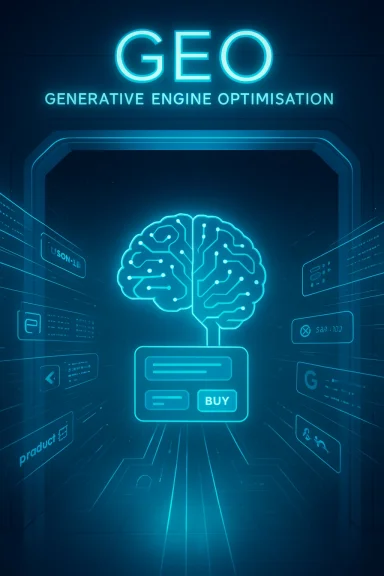
The internet’s front door is changing: conversational generative engines — ChatGPT, Google Gemini, Microsoft Copilot and their cousins — are no longer fringe discovery tools but first-stop interfaces that synthesize answers, route transactions, and increasingly decide what users see before they ever click a blue link. This shift is already forcing marketers and product teams to rethink how they buy attention, measure value, and protect brand reputation; the new playbook is not SEO 2.0 so much as a fundamentally different discipline often called Generative Engine Optimisation (GEO) — being “model‑visible” instead of just “search‑visible.” org](https://generative-engine.org/the-8...why-2025-is-t-1756630986461?utm_source=openai))
The classical search funnel — query, ranked list of links, click — has been the operating model for digital discovery for more than two decades. That model rewarded page-level optimization, backlinks, technical site performance and paid search buys. Over the last three years, however, two parallel experiences have emerged and matured:
Contrast the two frameworks:
A balanced verdict
GEO is not a replacement for all forms of SEO or brand marketing overnight. But it is a strategic inflection point:
Source: Little Black Book | LBBOnline https://lbbonline.com/news/The-New-Front-Door-of-the-Internet/
 Background / Overview
The classical search funnel — query, ranked list of links, click — has been the operating model for digital discovery for more than two decades. That model rewarded page-level optimization, backlinks, technical site performance and paid search buys. Over the last three years, however, two parallel experiences have emerged and matured:- AI Overviews inside search surfaces that synthesize a concise answer and sometimes cite a handful of sources, and
- Native, chat‑first assistants that hold a conversational session, folloestions, and can complete tasks end‑to‑end without routing users to a publisher’s page.
What GEO actually means (and why the name matters)
Generative Engine Optimisation (GEO) describes the set of tactics, signals and commercial relationships that increase the probability an AI engine will select, surface or recommend a brand, product or piece of content inside a synthesized answer or agentic flow.Contrast the two frameworks:
- SEO = ranking signals, backlinks, crawlability, structured data and click-through optimization.
- GEO = trust signals, model ingestion, alignment with an engine’s worldview, corroboration across multiple sources, and often the pd or direct feeds that the engine can ingest.
The numbers that prove attention has already shifted
Two load‑bearing trends validate why brands should take GEO seriously:- OpenAI disclosed that ChatGPT processes in the order of billions of prompts per day — a widely reported figure in mid‑2025 indicated roughly 2.5 billion prompts daily. That scale moves ChatGPT from a novelty into a primary discovery surface for many users. Tech press coverage of OpenAI’s public statements confirms the scale of daily prompts reported by the company.
- Microsoft publicly positioned its Copilot family as a massive attention engine. Company filings and Satya Nadella’s 2025 annual letter confirm the Copilot family has surpassed 100 million monthly active users, and Microsoft has integrated copilot experiences across Bing, Edge, Windows and Office — extending the reach of generative assistants into both consumer and enterprise touchpoints.
Why GEO will change marketing economics
The practical implications of generative engines being the new front door fall into three tight categories: discoverability, monetisation, and measurement.Discoverability: the new selection mechanics
Generative engines synthesize answers based on internal ranking + retrieval systeing the highest‑ranked page for a keyword no longer guarantees you appear in an AI‑synthesized answer. Instead, models look for authoritative, corroborated facts, high‑quality structured data, and sources that match their training/retrieval pipelines.- Brands need to be machine‑readable: schema markup, product feeds, API connectors, and canonical knowledge artifacts (trusted brand statements, press facts, verified profiles) become primary signals.
- Platforms may apply editorial or commercial filters; being included can depend on direct partnerships or paid placements attached to assistant interfaces.
Monetisation: new ad surfaces and direct commerce
Generative engines are evolving into revenue platforms:- OpenAI and other players have publicly explored or started testing ads inside chat assistants — for example, OpenAI announced plans to test ads “at the bottom of answers” when relevant sponsored products exist. That signals a move to monetize assistant sessions beyond subscription tiers.
- Agents that complete transactions (agentic shopping) can embed commerce inside chat flows, compressing conversion time and changing where and how affiliate/referral value is assigned. The frontline of digital commerce may move from product pages to in‑chat purchasing steps.
Measurement: the attribution problem gets worse
Legacy analytics assume a page‑by‑page referral chain and referrer headers. Conversational answers and agentic flows break those assumptions:- Referral attribution can disappear entirely when an assistant answers a question without issuing a redirect.
- UTM‑based campaign tracking becomesurement models will require telemetry partnerships with platforms or reliance on platform-side reporting.
- Early industry experiments show AI‑sourced conversions can be high quality — but tying them back to a specific content piece, campaign or bid strategy will require new instrumentation.
Trust, ethics and brand safety in a conversational world
As chat assistants insert brand names into answers, the risk profile for reputation and misinformation rises.- Conversational advertising — even if labeled — risks eroding user trust if a branded recommendation appears without obvious editorial backing. Users will start asking: “Did I get this suggestion because it’s best, or because someone paid to appear?” Brands must weigh short‑term visibility against long‑term trust risk.
- Model hallucination remains a technicnts synthesize claims without adequate citation, brands can be mis‑represented. That raises legal and compliance concerns for regulated industries (healthcare, finance, legal).
- Platforms are experimenting with hybrid citation models and “read more” links, but the effectiveness of those controls varies by provider and by market. Transparency of sponsorships and rigorous content governance are non‑negotiable in a GEO world.
Practical GEO playbook for brands: immediate to strategic
Below is a prioritized, tactical roadmap that marketing and product teams can execute to begin trading attention at the generative front door.Immediate (next 30–90 days)
- Inventory and canonicalise core facts
- Compile a canonical knowledge pack: brand description, product specs, SKU metadata, permanent press assets, executive bios and standard Q&A. Make these machine‑readable (JSON‑LD, OpenGraph, product feed).
- Lock down structured data
- Ensure product schema, FAQ schema, organization schema and event schema are present and correct on primary properties. These are the easiest signals to feed into retrieval systems.
- Prioritize data feeds
- If you run ecommerce, publish and validate product feeds to merchant APIs (where supported). For services, create a stable facts API that can be consumed by platform partners.
- Audit trust signals
- Ensure reviews, business listings, certifications and third‑party corroborations are current and accessible.
Medium term (3–12 months)
- Test conversation-friendly content formats
- Produce canonical answer pages: short, structured, fact‑dense pages optimized for synthesis (FAQ + single‑topic pages). Aim for high‑quality, neutral tone that an assistant can quote.
- Negotiate connectors and partnerships
- Explore direct data partnerships with major platforms or ad products that support assistant placements. Paid search budgets may be redeployed partially to sponsored assistant formats where offered.
- Instrument for new attribution
- Adopt server‑side event capture, prepare to ingest platform‑provided conversion reports, and model attribution where direct telemetry is absent.
Strategic (12–36 months)
- Build for agentic commerce
- Integrate with conversational checkout and tokenized payments where trust and margins allow. Work with legal to ensure compliance for in‑chat purchases and recurring billing.
- Invest in brand governance and AI ops
- Create a cross‑functional team (product, legal, comms, engineering) to monitor assistant behaviour, report misattribution, and deploy corrections or takedown requests.
- Rethink KPIs and budgets
- Move beyond clicks and CPM, adopt hybrid KPIs (assisted conversion lift, revenue per assistant session) and test shifting a portion of paid search spend into assistant experiments.
How to measure ROI in a world of fewer clicks
Measuring performance when the assistant keeps the user inside its UI requires different instrumentation and experiment design:- Platform telemetry partnerships: where possible, arrange to receive insight reports from platforms that show impressions, mentions and downstream conversions attributable to assistant placements.
- Control experiments: run geo‑targeted A/B experiments (or temporal holdouts) where certain markets get assistant‑fed content or connectors and others do not; measure differential lift in conversions and revenue.
- First‑party signal enrichment: collect first‑party cohort signals (email signups, phone numbers) inside assistant flows when permitted, giving a direct path to measure downstream value.
- Modelled attribution: where telemetry is unavailable, use uplift modeling to infer the impact of assistant visibility on oveeat this as probabilistic evidence rather than deterministic proof.
Risks, unknowns and regulatory heat
GEO presents clear opportunities but also several systemic risks that require attention:- Platform gatekeeping and anti‑competitive risk: major platforms can choose which sources to cite or which partners to favor. That concentration elevates negotiating risk for brands and publishers.
- Privacy and data protection: feeding user data into assistant connectors must comply with local privacy laws, consent frameworks, and platform TOS.
- Ad regulation and disclosure: as assistants begin testing ads, regulators may require stricter disclosure or limit certain ad formats in conversational UIs. Keep legal teams close to product discussions.
- Operational cost and sustainability: serving strg connectors and paying for premium placements will increase operating cost. At scale, the compute and energy demands of generative engines also create sustainability and budget questions.
What publishers, agencies and ad tech need to build now
- Agencies must add GEO audits to their service offering: map a client’s machine‑readable assets, catalogue partner connectors, and test assistant placements as a line item in plans.
- Publishers should expose canonical, structured versions of high‑value reporting and commercial content to increase the chance of being citedstant.
- Ad tech vendors and DSPs should develop visibility products for conversational surfaces — measuring mentions, sponsored placements and post‑session conversions rather than clicks.
A few realistic use cases that prove the model
- Local services: estate agents and restaurants that maintain up‑to‑date JSON‑LD, live availability and verified business profiles are more likely to be recommended in shortlists produced by assistants. Early industry reporting shows agents and businesses with clean structured facts win these shortlists.
- Product discovery: a user asks an assistant for “the best compact torch for camping” — assistants that have access to merchant feeds, verified reviews, and clear product specs can return a ranked shortlist with “buy” actions embedded, compressing the path to transaction. That is exactly the agentic shopping motion many platforms are piloting.
- Enterprise knowledge: companies deploying internal copilots or knowledge connectors benefit by ensuring subject‑matter experts publish canonical FAQs and policy pages; the internal assistant is the front door for employees and must be fed reliable, up‑to‑date facts.
A balanced verdict tion
tion
GEO is not a replacement for all forms of SEO or brand marketing overnight. But it is a strategic inflection point:- For many businesses, GEO will be an opportunity to earn higher‑intent, faster conversions if they adapt their data, content and commercial integration strategies.
- For others — especially pure publishers dependent on referral traffic monetized by display ads — it is a disruption that may shrink traditional traffic and ad revenues unless new monetization and partnership models are found.
Checklist: 12 immediate actions for teams that want to get ahead
- Publish canonical, machine‑readable brand data (JSON‑LD, product feed).
- Create short, authoritative answer pages for top categories and FAQs.
- Audit reviews, business profiles, and third‑party corroborations.
- Map existing paid spend and identify experiments for assistant placements.
- Negotiate data connector pilots with platform partners where possible.
- Add assistant visibility KPIs to dashboards (mentions, assist conversions).
- Implement server‑side event tracking and prepare to ingest platform reports.
- Build a cross‑functional GEO governance team (marketing, product, legal).
- Run A/B holdout experiments to measure lift from assistant visibility.
- Prepare commerce flows for in‑chat checkout where margins support it.
- Draft disclosure policies for conversational sponsorships and ads.
- Monitor platform policy and regulatory developments monthly.
Final analysis — what to budget for, and what to watch
Expect the following near‑term resource demands:- Technical: engineers to produce and maintain canonical APIs/feeds, analytics engineers to model attribution, and site teaanswer‑friendly pages.
- Commercial: budget for assistant placement tests, possible feeds/connector costs, and pilot commerce integrations.
- Talent: new roles in “AI content ops” and “GEO strategy” that bridge SEO, product data and platform partnerships.
- Platform policy changes around advertising and sponsorship disclosures inside assistants.
- Shifts in referral volumes from traditional search channels to assistant sessions.
- The emergence of measurement APIs from platforms that allow brands to see assistant‑driven impressions and conversions.
Source: Little Black Book | LBBOnline https://lbbonline.com/news/The-New-Front-Door-of-the-Internet/
