

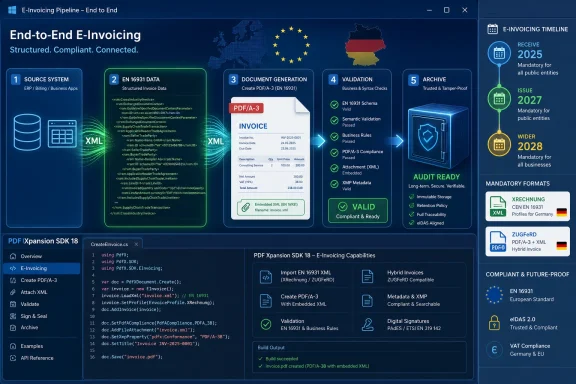
From January 1, 2025, German B2B companies have had to receive structured e-invoices compliant with EN 16931, while the obligation to issue those invoices phases in from 2027 for larger businesses and 2028 for the wider market. That timetable turns what once looked like an accounting-office problem into a software architecture problem. soft Xpansion’s PDF Xpansion SDK 18 arrives squarely in that gap, pitching e-invoicing, PDF generation, PDF/A archiving, validation, and viewing as one developer-facing toolkit rather than a pile of compliance adapters. The interesting story is not that another SDK can make PDFs; it is that Europe’s invoice mandates are quietly forcing document plumbing back into the center of business software.
For years, the PDF was the comfortable endpoint of business software. An ERP system, CRM platform, line-of-business database, or custom workflow application produced a document, attached it to an email, and treated the resulting file as the human-readable truth. That model worked because most invoice processes were still designed around people reading documents, approving them, and occasionally keying data into another system.
Germany’s B2B e-invoicing mandate changes that assumption. A plain PDF invoice may still look like an invoice to a human, but it is not, by itself, the structured electronic invoice the new regime is built around. The core requirement is machine-readable invoice data aligned with EN 16931, the European standard that defines the semantic model for electronic invoicing.
That distinction matters for developers because it moves compliance below the user interface. A finance team can still want a visually familiar invoice, and a customer may still expect a printable representation, but the legal and operational value increasingly sits in structured XML, validation rules, transport formats, and archival behavior. The document is no longer merely a file; it is a container for data, evidence, workflow state, and auditability.
This is where SDK vendors see opportunity. PDF Xpansion SDK 18 is being marketed not as a niche e-invoice converter but as a toolkit for embedding these capabilities directly into software. That pitch reflects a wider shift: compliance features that once lived in external middleware are being pulled closer to the application layer.
That phase-in has created a dangerous comfort zone. Many organizations can survive the receiving phase with a mailbox, a portal login, a converter, or a semi-manual process bolted onto accounting software. The real test comes when issuing structured invoices becomes routine and high-volume.
Issuing an e-invoice is not just receiving one in reverse. It requires the application producing the invoice to know which format to use, how to populate mandatory fields, how to validate business rules, how to attach or embed the human-readable version, and how to preserve the result for audit purposes. If that logic sits outside the core billing system, every product update, tax change, customer-specific requirement, and workflow variation becomes another integration risk.
The 2027 and 2028 dates therefore matter less as deadlines than as forcing functions. They will expose which organizations treated e-invoicing as an IT procurement exercise and which treated it as a redesign of document generation itself. Developers building commercial software for Germany, and increasingly for the wider EU market, cannot assume customers will accept “export to PDF” as the end of the invoice story.
The hard part of e-invoicing is not merely producing a file with the right extension. It is keeping the structured payload, visual representation, validation rules, and business workflow synchronized. A billing app that creates a correct XML invoice but stores an inconsistent PDF copy is asking for trouble. A document management system that archives a PDF but loses the structured invoice data has solved the wrong problem.
This is why hybrid formats such as Factur-X and ZUGFeRD have practical appeal. They can combine a PDF/A-3 document with embedded XML invoice data, giving humans a familiar document and machines a structured payload. That does not eliminate complexity, but it gives developers a design pattern: one artifact can carry both presentation and processable data.
The SDK model also fits how many Windows business applications are actually built. Not every company runs a cloud-native stack with a modern API gateway and a dedicated compliance team. Many German and European businesses still depend on Windows desktop applications, .NET services, COM integrations, C++ modules, local document workflows, and server-side batch jobs. An SDK that targets Windows 10, Windows Server 2016 or later, C++, .NET, and COM is speaking to that installed base rather than pretending it vanished.
PDF/A exists for that world. It is the archival branch of PDF, designed to preserve documents in a self-contained, long-term readable form. For invoice systems, especially those handling structured data embedded in or attached to PDF/A-3 files, the archival format becomes part of the compliance story rather than a back-office afterthought.
This is where unified tooling can reduce the number of cracks in the system. If one component creates the invoice, another renders the PDF, a third validates the XML, a fourth converts to PDF/A, and a fifth archives the result, every handoff is a place for metadata loss, malformed attachments, encoding problems, or version drift. Developers can manage that complexity, but they pay for it in testing, support, and customer-specific exceptions.
PDF Xpansion SDK 18’s inclusion of PDF/A creation and validation alongside e-invoicing is therefore more than a feature-list flourish. It recognizes that the useful output is not “an invoice file” but an invoice record that can pass through business systems, audits, migrations, and retention policies without becoming ambiguous.
A typical legacy workflow might involve an ERP export, a PDF printer driver, an email automation tool, a document management system, an OCR layer for incoming supplier invoices, and a manual exception queue for anything the software does not understand. Each component can be rational on its own. Together, they create a fragile chain that works until a regulation, customer requirement, or volume spike changes the assumptions.
E-invoicing punishes that fragility. Structured invoices need deterministic data, not best-effort extraction. Validation needs consistent rule handling, not manual interpretation. Archiving needs stable artifacts, not scattered copies. Integration needs to happen before the document leaves the application, not after a user notices that an invoice has been rejected.
This is why “without hassle” is a dangerous but revealing phrase. No serious e-invoicing project is hassle-free. The better question is where the hassle lives. If it lives in the SDK vendor’s maintained implementation of formats, validation, PDF/A behavior, and rendering primitives, developers may be able to focus on business logic. If it lives in every customer deployment, support desk, and custom export script, the cost arrives later and with interest.
An SDK approach gives developers the chance to build invoice handling into the product experience rather than bolting it onto the side. A user can create an invoice, preview it, validate it, store it, and send it through an approved workflow without leaving the application. Incoming invoices can be parsed and checked against purchasing, approval, and accounting rules before they land in a queue.
That control matters because e-invoicing is not one uniform business process. A manufacturing supplier, a professional-services firm, a public-sector contractor, and a SaaS vendor may all need EN 16931-compliant invoices, but their surrounding workflows differ. Purchase order matching, cost center coding, customer identifiers, line-item tax treatment, attachments, approvals, and document retention policies vary widely.
Developer-facing tooling is valuable only if it lets those differences survive. The formats may be standardized, but business software rarely is. The best SDKs do not merely hide complexity; they expose the right layers so developers can enforce local business rules without reimplementing the standard from scratch.
PDF Xpansion SDK 18’s Windows-oriented system requirements are not incidental. Support for Windows 10 and Windows Server 2016 or later positions it for the environments where many document-heavy applications actually run. C++, .NET, and COM support likewise map onto the languages and integration models that have powered business document software for decades.
That can be a strength and a constraint. Windows-native SDKs can integrate tightly with existing applications and avoid forcing customers into a wholesale platform migration just to meet an invoicing deadline. But they also put pressure on developers to modernize carefully, especially as organizations reassess older servers, desktop deployment models, and security baselines.
For IT pros, the question is not whether Windows belongs in the workflow. It plainly does. The question is whether the e-invoicing transition becomes another layer of legacy glue or an opportunity to rationalize how Windows applications produce, validate, display, and preserve critical documents.
Validation has several layers. There is structural validation, where the XML must conform to the expected schema. There is semantic validation, where the fields must satisfy the invoice standard and profile rules. There is business validation, where the invoice must match the customer, contract, tax situation, purchase order, or internal approval logic. An SDK can help substantially with the first two, but the third still belongs to the application and the organization.
That division of responsibility is important. Developers should resist treating SDK validation as a magic compliance stamp. It is better understood as a foundation: the library can help ensure the artifact is well-formed and aligned with supported formats, while the application decides whether this invoice should exist, whether the customer data is current, and whether the transaction is legitimate.
This is also where maintainability becomes critical. Standards evolve, profiles change, and national implementations acquire new rules. A compliance-capable SDK is only as useful as its update cadence and clarity. Developers evaluating PDF Xpansion SDK 18 or any rival should look not just at today’s format checklist but at how updates are delivered, documented, tested, and licensed.
The mistake is to treat viewing as separate from processing. In a modern invoice workflow, the visual document and structured data should reinforce each other. A user viewing an invoice should not have to wonder whether the displayed PDF corresponds to the embedded XML. An approver should not need a separate tool to verify that the machine-readable data matches the business transaction.
Integrated viewing can also reduce security and support friction. If an application embeds its own rendering component, administrators may have fewer external dependencies to manage and fewer opportunities for users to open sensitive documents in unmanaged tools. That does not automatically make the workflow secure, but it gives application owners more control over the user path.
For Windows developers, this is especially relevant in vertical software. Many line-of-business products need to show invoices, contracts, statements, delivery notes, and correspondence without becoming general-purpose PDF editors. A viewer component that sits alongside generation, conversion, and validation can make the application feel coherent rather than assembled.
The press release’s mention of bulk PDF documents points to a less glamorous but essential workload. Businesses generate invoices, contracts, notices, policy documents, statements, and personalized communications at scale. Once e-invoicing requirements enter that pipeline, document generation must handle more than page layout. It must manage data integrity, format rules, validation failures, retry behavior, logging, and storage.
Batch workflows also magnify small defects. A field mapping bug that affects one invoice is annoying. The same bug across a nightly billing run can become a finance incident. A PDF/A conversion issue that appears only with certain fonts or attachments is not a minor edge case if it blocks archive compliance for a whole customer segment.
That is why developers should treat document SDKs as production infrastructure. Performance, memory behavior, error reporting, thread safety, diagnostics, and deployment packaging matter. The nicest API in the world is not enough if the batch job fails silently at 2 a.m. or produces files that pass local tests but fail downstream validation.
If e-invoicing is implemented narrowly, companies digitize the invoice but leave the rest of the process manual. That creates a familiar disappointment: the document format is modern, but the workflow still depends on email, spreadsheets, and exception handling. The benefits of structured data arrive only after someone reconciles it against messy upstream processes.
E-ordering support suggests a more ambitious path. If the order and invoice can both be represented structurally, applications can compare them automatically, flag mismatches earlier, and reduce manual rekeying. That is where the real productivity argument sits. Compliance may force the first step, but process automation justifies the investment.
This is also where standards can have a compounding effect. Once businesses adopt structured documents for one part of the transaction cycle, pressure builds to structure the surrounding documents as well. Developers who design only for the invoice deadline may find themselves rebuilding again when customers ask for broader procurement automation.
Engineering teams should evaluate format coverage, sample code, documentation quality, test tooling, support responsiveness, update policy, and licensing clarity. They should test real invoices, not only vendor examples. They should validate against the same external tools, customer portals, and workflows their users will encounter.
They should also examine escape paths. Can generated invoice data be inspected and logged? Can the application handle validation errors gracefully? Can archived documents be opened and verified without the original application? Can the system support multiple invoice profiles without forking the codebase into a mess of customer-specific branches?
A good SDK reduces complexity, but it does not eliminate engineering responsibility. In some ways, it concentrates that responsibility into a smaller number of critical decisions. Choosing the wrong abstraction can be worse than writing too much code, because the failure may not appear until the mandate becomes unavoidable.
That makes e-invoicing a product strategy issue, not just a compliance ticket. Developers of ERP extensions, accounting tools, document management systems, CRM platforms, industry-specific applications, and internal business software need to decide whether invoice intelligence is core to their product or delegated to external services. The answer will shape user experience, pricing, support, and competitive positioning.
For some products, outsourcing e-invoicing to a service provider will make sense. For others, especially those that already own document generation and customer billing, embedding the capability may be the cleaner route. SDKs like PDF Xpansion SDK 18 compete for that second category: developers who want the machinery inside their application without building every standard themselves.
The strategic risk is underestimating how visible this will become to customers. When outgoing mandates phase in, customers will not ask politely whether a product has a theoretical integration. They will ask whether it can issue compliant invoices in their required formats, validate incoming ones, archive them properly, and fit into their existing Windows-heavy workflow. “We are working on it” will age poorly.
Source: The National Law Review Implement E-Invoicing, PDF & PDF/A Without Hassle: How Developers Smartly Tackle These Challenges
 Germany’s E-Invoice Rule Turns PDF From Output Into Infrastructure
For years, the PDF was the comfortable endpoint of business software. An ERP system, CRM platform, line-of-business database, or custom workflow application produced a document, attached it to an email, and treated the resulting file as the human-readable truth. That model worked because most invoice processes were still designed around people reading documents, approving them, and occasionally keying data into another system.Germany’s B2B e-invoicing mandate changes that assumption. A plain PDF invoice may still look like an invoice to a human, but it is not, by itself, the structured electronic invoice the new regime is built around. The core requirement is machine-readable invoice data aligned with EN 16931, the European standard that defines the semantic model for electronic invoicing.
That distinction matters for developers because it moves compliance below the user interface. A finance team can still want a visually familiar invoice, and a customer may still expect a printable representation, but the legal and operational value increasingly sits in structured XML, validation rules, transport formats, and archival behavior. The document is no longer merely a file; it is a container for data, evidence, workflow state, and auditability.
This is where SDK vendors see opportunity. PDF Xpansion SDK 18 is being marketed not as a niche e-invoice converter but as a toolkit for embedding these capabilities directly into software. That pitch reflects a wider shift: compliance features that once lived in external middleware are being pulled closer to the application layer.
The Mandate’s First Deadline Was the Easy One
The January 2025 milestone was deceptively modest. German businesses in scope had to be able to receive e-invoices, but broad sending obligations were deferred. Companies with more than €800,000 in turnover face the outgoing e-invoice requirement from January 1, 2027, while the broader obligation lands on January 1, 2028.That phase-in has created a dangerous comfort zone. Many organizations can survive the receiving phase with a mailbox, a portal login, a converter, or a semi-manual process bolted onto accounting software. The real test comes when issuing structured invoices becomes routine and high-volume.
Issuing an e-invoice is not just receiving one in reverse. It requires the application producing the invoice to know which format to use, how to populate mandatory fields, how to validate business rules, how to attach or embed the human-readable version, and how to preserve the result for audit purposes. If that logic sits outside the core billing system, every product update, tax change, customer-specific requirement, and workflow variation becomes another integration risk.
The 2027 and 2028 dates therefore matter less as deadlines than as forcing functions. They will expose which organizations treated e-invoicing as an IT procurement exercise and which treated it as a redesign of document generation itself. Developers building commercial software for Germany, and increasingly for the wider EU market, cannot assume customers will accept “export to PDF” as the end of the invoice story.
SDKs Are Becoming Compliance Pressure Valves
soft Xpansion’s argument is straightforward: if developers can generate, import, convert, and validate formats such as Peppol BIS Billing, Factur-X, XRechnung, and ZUGFeRD from one SDK, they can avoid stitching together separate tools for PDF rendering, XML handling, PDF/A archiving, and invoice validation. That is the kind of vendor claim any engineering team should inspect carefully, but the architectural direction is sound.The hard part of e-invoicing is not merely producing a file with the right extension. It is keeping the structured payload, visual representation, validation rules, and business workflow synchronized. A billing app that creates a correct XML invoice but stores an inconsistent PDF copy is asking for trouble. A document management system that archives a PDF but loses the structured invoice data has solved the wrong problem.
This is why hybrid formats such as Factur-X and ZUGFeRD have practical appeal. They can combine a PDF/A-3 document with embedded XML invoice data, giving humans a familiar document and machines a structured payload. That does not eliminate complexity, but it gives developers a design pattern: one artifact can carry both presentation and processable data.
The SDK model also fits how many Windows business applications are actually built. Not every company runs a cloud-native stack with a modern API gateway and a dedicated compliance team. Many German and European businesses still depend on Windows desktop applications, .NET services, COM integrations, C++ modules, local document workflows, and server-side batch jobs. An SDK that targets Windows 10, Windows Server 2016 or later, C++, .NET, and COM is speaking to that installed base rather than pretending it vanished.
PDF/A Is the Quiet Half of the Story
E-invoicing gets the regulatory spotlight, but PDF/A may be just as important for the long-term health of the workflow. Invoices are not disposable messages. They are legal, fiscal, and operational records that must remain accessible and verifiable years after the software that created them has changed.PDF/A exists for that world. It is the archival branch of PDF, designed to preserve documents in a self-contained, long-term readable form. For invoice systems, especially those handling structured data embedded in or attached to PDF/A-3 files, the archival format becomes part of the compliance story rather than a back-office afterthought.
This is where unified tooling can reduce the number of cracks in the system. If one component creates the invoice, another renders the PDF, a third validates the XML, a fourth converts to PDF/A, and a fifth archives the result, every handoff is a place for metadata loss, malformed attachments, encoding problems, or version drift. Developers can manage that complexity, but they pay for it in testing, support, and customer-specific exceptions.
PDF Xpansion SDK 18’s inclusion of PDF/A creation and validation alongside e-invoicing is therefore more than a feature-list flourish. It recognizes that the useful output is not “an invoice file” but an invoice record that can pass through business systems, audits, migrations, and retention policies without becoming ambiguous.
The Patchwork Era Is Ending Because It Has To
The press release quotes soft Xpansion CEO Dr. Juri Stern saying document and invoice processing has often been a patchwork of tools and temporary workarounds. That is vendor messaging, but it is also a fair description of many real estates.A typical legacy workflow might involve an ERP export, a PDF printer driver, an email automation tool, a document management system, an OCR layer for incoming supplier invoices, and a manual exception queue for anything the software does not understand. Each component can be rational on its own. Together, they create a fragile chain that works until a regulation, customer requirement, or volume spike changes the assumptions.
E-invoicing punishes that fragility. Structured invoices need deterministic data, not best-effort extraction. Validation needs consistent rule handling, not manual interpretation. Archiving needs stable artifacts, not scattered copies. Integration needs to happen before the document leaves the application, not after a user notices that an invoice has been rejected.
This is why “without hassle” is a dangerous but revealing phrase. No serious e-invoicing project is hassle-free. The better question is where the hassle lives. If it lives in the SDK vendor’s maintained implementation of formats, validation, PDF/A behavior, and rendering primitives, developers may be able to focus on business logic. If it lives in every customer deployment, support desk, and custom export script, the cost arrives later and with interest.
Developers Need Control, Not Just Compliance
The temptation in any mandate-driven market is to buy a black box that promises compliance. That can work for small businesses using standard accounting platforms, but it is less attractive for software vendors, systems integrators, and IT departments maintaining specialized workflows. They need control over how invoice functionality appears inside their applications.An SDK approach gives developers the chance to build invoice handling into the product experience rather than bolting it onto the side. A user can create an invoice, preview it, validate it, store it, and send it through an approved workflow without leaving the application. Incoming invoices can be parsed and checked against purchasing, approval, and accounting rules before they land in a queue.
That control matters because e-invoicing is not one uniform business process. A manufacturing supplier, a professional-services firm, a public-sector contractor, and a SaaS vendor may all need EN 16931-compliant invoices, but their surrounding workflows differ. Purchase order matching, cost center coding, customer identifiers, line-item tax treatment, attachments, approvals, and document retention policies vary widely.
Developer-facing tooling is valuable only if it lets those differences survive. The formats may be standardized, but business software rarely is. The best SDKs do not merely hide complexity; they expose the right layers so developers can enforce local business rules without reimplementing the standard from scratch.
Windows Still Owns a Lot of the Document Workflow
It is fashionable to frame business software as a cloud-only story, but document automation remains deeply tied to Windows. Desktop clients, on-premises services, print workflows, scanner integrations, shared drives, and COM-based automation still appear throughout small and mid-sized enterprises, public administration, finance departments, and industry-specific software.PDF Xpansion SDK 18’s Windows-oriented system requirements are not incidental. Support for Windows 10 and Windows Server 2016 or later positions it for the environments where many document-heavy applications actually run. C++, .NET, and COM support likewise map onto the languages and integration models that have powered business document software for decades.
That can be a strength and a constraint. Windows-native SDKs can integrate tightly with existing applications and avoid forcing customers into a wholesale platform migration just to meet an invoicing deadline. But they also put pressure on developers to modernize carefully, especially as organizations reassess older servers, desktop deployment models, and security baselines.
For IT pros, the question is not whether Windows belongs in the workflow. It plainly does. The question is whether the e-invoicing transition becomes another layer of legacy glue or an opportunity to rationalize how Windows applications produce, validate, display, and preserve critical documents.
Validation Is Where Promises Meet Reality
Any e-invoicing product can claim support for named formats. The more difficult and useful claim is validation. A generated invoice that looks right but fails a customer’s validator, a tax authority rule set, or a network requirement is not a success; it is a support ticket with accounting consequences.Validation has several layers. There is structural validation, where the XML must conform to the expected schema. There is semantic validation, where the fields must satisfy the invoice standard and profile rules. There is business validation, where the invoice must match the customer, contract, tax situation, purchase order, or internal approval logic. An SDK can help substantially with the first two, but the third still belongs to the application and the organization.
That division of responsibility is important. Developers should resist treating SDK validation as a magic compliance stamp. It is better understood as a foundation: the library can help ensure the artifact is well-formed and aligned with supported formats, while the application decides whether this invoice should exist, whether the customer data is current, and whether the transaction is legitimate.
This is also where maintainability becomes critical. Standards evolve, profiles change, and national implementations acquire new rules. A compliance-capable SDK is only as useful as its update cadence and clarity. Developers evaluating PDF Xpansion SDK 18 or any rival should look not just at today’s format checklist but at how updates are delivered, documented, tested, and licensed.
The PDF Viewer Is Not a Cosmetic Add-On
A PDF viewer inside an SDK may sound less exciting than e-invoicing support, but it solves a practical problem. Finance and operations users still need to inspect documents. Developers still need to present invoice records in a way that humans can understand. Approval workflows still benefit from a faithful rendering of what was sent or received.The mistake is to treat viewing as separate from processing. In a modern invoice workflow, the visual document and structured data should reinforce each other. A user viewing an invoice should not have to wonder whether the displayed PDF corresponds to the embedded XML. An approver should not need a separate tool to verify that the machine-readable data matches the business transaction.
Integrated viewing can also reduce security and support friction. If an application embeds its own rendering component, administrators may have fewer external dependencies to manage and fewer opportunities for users to open sensitive documents in unmanaged tools. That does not automatically make the workflow secure, but it gives application owners more control over the user path.
For Windows developers, this is especially relevant in vertical software. Many line-of-business products need to show invoices, contracts, statements, delivery notes, and correspondence without becoming general-purpose PDF editors. A viewer component that sits alongside generation, conversion, and validation can make the application feel coherent rather than assembled.
Bulk Generation Is Where Architecture Gets Tested
Generating one compliant invoice is a demo. Generating thousands or millions, reliably and audibly, is an architecture test.The press release’s mention of bulk PDF documents points to a less glamorous but essential workload. Businesses generate invoices, contracts, notices, policy documents, statements, and personalized communications at scale. Once e-invoicing requirements enter that pipeline, document generation must handle more than page layout. It must manage data integrity, format rules, validation failures, retry behavior, logging, and storage.
Batch workflows also magnify small defects. A field mapping bug that affects one invoice is annoying. The same bug across a nightly billing run can become a finance incident. A PDF/A conversion issue that appears only with certain fonts or attachments is not a minor edge case if it blocks archive compliance for a whole customer segment.
That is why developers should treat document SDKs as production infrastructure. Performance, memory behavior, error reporting, thread safety, diagnostics, and deployment packaging matter. The nicest API in the world is not enough if the batch job fails silently at 2 a.m. or produces files that pass local tests but fail downstream validation.
E-Ordering Hints at the Bigger Automation Agenda
soft Xpansion also points to e-ordering, which may look adjacent to invoicing but belongs to the same transformation. An invoice is only one stage in the procure-to-pay chain. Orders, confirmations, delivery notes, approvals, invoices, and payments are all pieces of the same data trail.If e-invoicing is implemented narrowly, companies digitize the invoice but leave the rest of the process manual. That creates a familiar disappointment: the document format is modern, but the workflow still depends on email, spreadsheets, and exception handling. The benefits of structured data arrive only after someone reconciles it against messy upstream processes.
E-ordering support suggests a more ambitious path. If the order and invoice can both be represented structurally, applications can compare them automatically, flag mismatches earlier, and reduce manual rekeying. That is where the real productivity argument sits. Compliance may force the first step, but process automation justifies the investment.
This is also where standards can have a compounding effect. Once businesses adopt structured documents for one part of the transaction cycle, pressure builds to structure the surrounding documents as well. Developers who design only for the invoice deadline may find themselves rebuilding again when customers ask for broader procurement automation.
The Vendor Claim Should Be Tested Like Any Other Dependency
None of this means developers should accept a press-release feature list at face value. SDK selection is a dependency decision, and invoice compliance raises the stakes. A library that sits inside billing, archiving, and document workflows becomes part of the operational trust boundary.Engineering teams should evaluate format coverage, sample code, documentation quality, test tooling, support responsiveness, update policy, and licensing clarity. They should test real invoices, not only vendor examples. They should validate against the same external tools, customer portals, and workflows their users will encounter.
They should also examine escape paths. Can generated invoice data be inspected and logged? Can the application handle validation errors gracefully? Can archived documents be opened and verified without the original application? Can the system support multiple invoice profiles without forking the codebase into a mess of customer-specific branches?
A good SDK reduces complexity, but it does not eliminate engineering responsibility. In some ways, it concentrates that responsibility into a smaller number of critical decisions. Choosing the wrong abstraction can be worse than writing too much code, because the failure may not appear until the mandate becomes unavoidable.
Europe’s Invoice Mandates Are Product Strategy Now
The German timetable is part of a wider European pattern. Governments want more structured transaction data, better VAT enforcement, faster reporting, and less paper-based friction. Businesses want fewer manual processes and cleaner integration between accounting, procurement, and document management. Software vendors are caught between those forces.That makes e-invoicing a product strategy issue, not just a compliance ticket. Developers of ERP extensions, accounting tools, document management systems, CRM platforms, industry-specific applications, and internal business software need to decide whether invoice intelligence is core to their product or delegated to external services. The answer will shape user experience, pricing, support, and competitive positioning.
For some products, outsourcing e-invoicing to a service provider will make sense. For others, especially those that already own document generation and customer billing, embedding the capability may be the cleaner route. SDKs like PDF Xpansion SDK 18 compete for that second category: developers who want the machinery inside their application without building every standard themselves.
The strategic risk is underestimating how visible this will become to customers. When outgoing mandates phase in, customers will not ask politely whether a product has a theoretical integration. They will ask whether it can issue compliant invoices in their required formats, validate incoming ones, archive them properly, and fit into their existing Windows-heavy workflow. “We are working on it” will age poorly.
The Real Win Is Fewer Places for the Invoice to Break
The practical lesson from PDF Xpansion SDK 18 is not that every developer should buy this particular toolkit. It is that e-invoicing, PDF, PDF/A, viewing, validation, and bulk document generation are becoming one problem. Treating them as separate procurement boxes is how organizations recreate the patchwork they are trying to escape.- German B2B e-invoicing began with mandatory receiving on January 1, 2025, but the bigger software impact arrives when outgoing obligations phase in during 2027 and 2028.
- A plain PDF is no longer enough for many invoice workflows because the compliance value sits in structured EN 16931-aligned data.
- Hybrid approaches such as ZUGFeRD and Factur-X matter because they can connect a human-readable PDF/A document with embedded machine-readable invoice data.
- SDKs are most useful when they reduce format and validation complexity while still giving developers control over business rules and workflow integration.
- Windows-native document tooling remains important because many invoice-heavy applications still run on Windows desktops, servers, .NET stacks, C++ components, and COM integrations.
- The decisive test for any e-invoicing toolkit is not its demo output but its behavior under real validation, bulk generation, archiving, updates, and customer-specific edge cases.
Source: The National Law Review Implement E-Invoicing, PDF & PDF/A Without Hassle: How Developers Smartly Tackle These Challenges
