

Starting 18 June 2026, a cluster of German compliance events will target small and medium-sized firms facing NIS-2 cybersecurity obligations, EU AI Act scrutiny, GDPR exposure, and adjacent quality-management pressures in food production and supply chains. The timing is not accidental. Europe’s regulatory machine is no longer treating cybersecurity, AI governance, and operational quality as separate back-office disciplines. For smaller companies, the new reality is that compliance has become a systems problem — and the training market has smelled the urgency.
The old caricature of regulation was paperwork: a lawyer, a binder, a checklist, and a deadline safely detached from the factory floor. That model is collapsing. NIS-2 turns cybersecurity into a management obligation, the EU AI Act turns software adoption into a risk-classification exercise, and food-safety regimes increasingly turn logistics and quality assurance into evidence trails.
That matters because SMEs rarely have the luxury of specialized compliance silos. The same managing director who signs off on an ERP upgrade may also be responsible for supplier audits, invoice automation, production uptime, customer certifications, and cyber incident reporting. When regulators say “governance,” a large enterprise hears “committee.” A smaller firm hears “another job for someone already doing three.”
Germany is a useful test case because its Mittelstand is precisely the kind of industrial base that makes European regulation consequential. These are not app developers casually experimenting with policy. They are food processors, component manufacturers, logistics firms, energy-adjacent suppliers, and service providers whose Windows estates, SAP systems, Microsoft 365 tenants, production devices, and supplier portals are now part of the compliance surface.
The result is a strange but predictable boomlet: seminars, webinars, certifications, and narrowly packaged training offers promising to translate legislative fog into operational procedure. Some of that is useful. Some of it is opportunistic. All of it reflects a deeper truth: the bottleneck is no longer awareness that regulation exists, but the ability to turn it into daily practice.
That is why German events focused on board liability are more than legal housekeeping. For many smaller companies, cybersecurity has historically meant outsourced antivirus, a managed firewall, and occasional phishing reminders. NIS-2 asks a more uncomfortable question: can management demonstrate that cyber risk is understood, governed, resourced, and reviewed?
The answer, in many firms, will be uneven. A company may run Microsoft 365, Windows Server, Active Directory, SAP, cloud backups, and a patchwork of line-of-business applications without ever having mapped which systems are essential to service continuity. It may know who handles invoices, who handles production, and who handles customer complaints, but not who owns incident escalation when a ransomware note appears at 6:30 a.m.
That is the cultural shift. NIS-2 does not merely punish bad luck after an attack. It demands evidence that the organization has treated cybersecurity as a recurring management discipline before the attack. The difference sounds bureaucratic until a regulator, insurer, customer, or court asks for proof.
For WindowsForum readers, this is where the directive becomes concrete. The compliance conversation quickly lands on familiar terrain: identity management, privileged access, endpoint visibility, backup integrity, patch cadence, supplier access, logging, and incident response. The policy may be European, but the work often begins inside Active Directory groups, Entra ID roles, SharePoint permissions, remote desktop exposure, and neglected servers that everyone assumed someone else was maintaining.
This is why risk assessments of generative AI tools are moving from theoretical to mandatory in practice. If a sales manager pastes customer data into a chatbot, if a quality engineer uses an AI assistant to summarize a nonconformance report, or if finance deploys automated invoice coding, the company has created a governance question. Who approved the tool? What data does it process? Where does that data go? Can outputs be audited? What happens when the model is wrong?
Microsoft Copilot sharpens the issue because it sits close to data that companies already consider internal and familiar. The attraction is obvious: summarize documents, generate email drafts, search across files, accelerate analysis, reduce drudgery. But Copilot is only as well-governed as the tenant it can see. If SharePoint permissions are a decade-old archaeology site, AI does not fix that; it makes the permission problem faster, more visible, and potentially more embarrassing.
The same is true for ChatGPT and similar tools used outside sanctioned enterprise controls. Employees adopt them because they work. Compliance officers worry because they work across boundaries the company may not have mapped. The fight is not really over AI enthusiasm versus AI fear; it is over whether firms can introduce powerful automation without pretending that convenience has no evidentiary trail.
Here the overlap between NIS-2, GDPR, and AI governance becomes unavoidable. Cybersecurity asks whether systems are resilient and access is controlled. Data protection asks whether personal data is lawfully processed and minimized. AI governance asks whether automated outputs are understood, supervised, and appropriately classified. A small firm may experience all three as one problem: nobody has time to document the tools everyone is already using.
The surrounding offerings — 5S, FMEA, supplier management, ISO 9001, AQAP transition training, and full quality-specialist qualifications starting above 2,000 euros — show how the training sector is bundling old and new anxieties. Lean methods and failure analysis are familiar. AI-assisted quality management is newer. Supplier oversight, meanwhile, has become the bridge between the two.
That bridge matters because modern compliance failures are rarely contained inside one company. A food producer’s exposure may sit in a supplier certificate, a transport process, a cleaning record, a software vendor, a cloud service, or a subcontracted maintenance provider with remote access. The neat org chart is less relevant than the chain of dependency.
Training providers are therefore selling translation. They convert directives, standards, and acronyms into workshops a manager can approve and a team can attend. Done well, that is valuable: SMEs need practical implementation paths, not heroic readings of legislative text. Done badly, it becomes certification theater, where the company collects attendance certificates while the underlying process remains unchanged.
This is the market’s temptation. Every regulatory wave creates a vocabulary gap, and vocabulary gaps create products. The hard question for buyers is whether a course leaves behind operational change: a revised access policy, a supplier questionnaire that actually affects procurement, a tested incident plan, a data classification rule employees understand, or an AI review process that prevents sensitive data from wandering into unmanaged systems.
Dr. Ngo Xuan Nam’s reported emphasis on translating technical information into everyday practice is the key point. Compliance does not fail only because companies are careless. It fails because knowledge has to travel from regulators to consultants to managers to line workers to suppliers to inspectors, and every handoff loses precision.
The pasteurized milk example is almost too perfect. If products that have already gone through a safety-relevant process still face quarantine requirements when moving between provinces, the issue is not simply strictness. It is administrative friction masquerading as protection. The burden lands hardest on smaller firms because they have less capacity to absorb delay, duplication, and uncertainty.
Lawyer Nguyen Hung Quang’s call for centralized databases points toward the obvious remedy: make the rule base visible, deduplicated, and usable. That sounds mundane until you compare it with the daily reality of SMEs trying to navigate overlapping authorities, local interpretations, customer requirements, and certification regimes. A fragmented database is not an information problem. It is a cost center.
Europe should recognize the pattern. NIS-2, the AI Act, GDPR, sectoral standards, product-safety rules, and supply-chain mandates may each have their own logic. But firms experience them cumulatively. The compliance stack becomes a tax on organizational attention.
But automation’s second-order effect is scrutiny. Once a process is automated, auditors and regulators can ask how it works, who monitors it, how errors are corrected, and whether exceptions are handled consistently. A human clerk making ad hoc judgments may be inefficient, but an automated system making recurring mistakes can scale the damage.
Vendor assurances that cloud-related hazards do not arise should be treated carefully. Cloud adoption can reduce certain risks, especially when a reputable provider handles infrastructure security better than an SME could on its own. But cloud does not eliminate governance risk. It changes where the questions sit: identity, data residency, contractual controls, access rights, logging, retention, backup strategy, and dependency on third-party service availability.
In SAP-heavy environments, this is not academic. Invoice data can contain supplier information, bank details, tax identifiers, contractual references, and sometimes personal data. If AI is classifying, routing, or extracting that information, the company needs to understand the control model. Efficiency does not erase accountability.
This is where smaller firms can be lulled into a false choice between modernization and compliance. The better framing is that modernization now requires compliance by design. If a process is worth automating, it is worth documenting. If a tool is allowed to act on business records, it is worth governing. If a cloud service becomes critical to daily operations, it belongs in the risk register rather than in a procurement drawer.
That makes sense. A sales lead in food technology is not just selling capacity or ingredients. They may need to understand customer certification demands, product specifications, traceability expectations, hygiene rules, shelf-life constraints, and cross-border documentation. The job becomes part technical adviser, part compliance translator, part business developer.
The same is happening in IT. Sysadmins increasingly need to understand audit evidence. Security staff need to understand business continuity. Developers need to understand data protection and AI governance. Procurement teams need to understand cyber risk in supplier contracts. The old division between “the people who do the work” and “the people who handle compliance” is breaking down.
This is good news for workers who can bridge domains and bad news for companies hoping to buy compliance as a bolt-on service. The valuable employee is not merely the person who knows a standard number. It is the person who can ask how that standard changes a production workflow, a permissions model, a vendor onboarding process, or a customer commitment.
Training providers are responding because the market is short of these translators. But the pipeline cannot be built overnight. A two-day seminar can introduce concepts; it cannot substitute for experience running a plant, securing a Windows estate, handling a supplier dispute, or surviving an audit. The gap between certificate and competence will define the next few years of SME compliance.
If a firm is not sure whether it falls under NIS-2, it may wait. If it is unsure how the AI Act applies to a Copilot deployment, it may let usage grow informally. If it cannot reconcile food-safety documentation across regions or customers, it may rely on tribal knowledge. If it lacks clarity on supplier cyber requirements, it may keep renewing contracts unchanged.
Each individual delay is understandable. Together they create exposure. The firm wakes up with unmanaged AI usage, weak incident reporting, outdated supplier clauses, incomplete access reviews, and a training record that looks better than the controls it supposedly supports.
This is why the most practical advice for SMEs is not to begin with the grandest standard. Begin with the systems and processes that would hurt most if they failed. Identify who owns them, who can access them, which suppliers touch them, what data they process, how incidents are detected, and what evidence exists that management reviews the risk. That exercise is less glamorous than a certification badge, but it is the skeleton on which real compliance hangs.
For Windows-centric shops, the first pass is often brutally revealing. Old service accounts, inherited admin privileges, unmanaged endpoints, stale VPN access, public-facing services, permissive SharePoint libraries, and under-tested backups are not exotic risks. They are the daily sediment of years of “we’ll clean that up later.” NIS-2’s practical value may be that it makes later arrive.
But there is also a defensible argument that the old laissez-faire approach was exhausted. Cyberattacks do not politely stop at enterprise boundaries. Food-safety failures do not respect provincial paperwork. AI tools do not become safe because employees find them useful. Supply-chain dependencies do not become resilient because nobody mapped them.
The uncomfortable answer is that both arguments are true. Europe is right that SMEs sit inside critical supply chains and cannot be exempted from modern risk management. SMEs are right that fragmented, unclear, and duplicative rules can punish the very firms that regulators claim to protect.
That tension should shape enforcement. Regulators should care less about performative paperwork and more about demonstrable risk reduction. Training providers should resist selling fear as a subscription model. Technology vendors should stop implying that cloud platforms or AI features magically remove governance obligations. And SMEs should stop treating compliance as an annual interruption rather than a way to understand their own operations.
The companies that adapt best will not be the ones with the thickest policy binders. They will be the ones that turn compliance into operational literacy: knowing their systems, data, suppliers, responsibilities, and failure modes well enough to make better decisions under pressure.
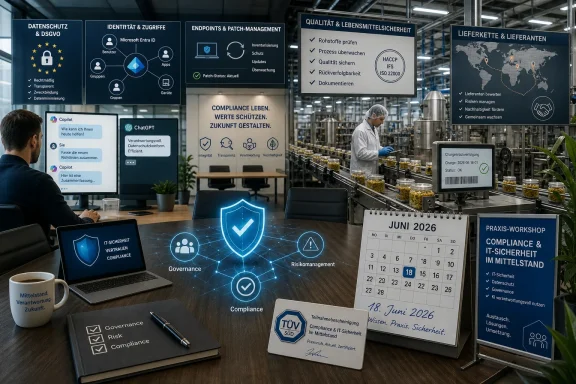 The Compliance Burden Has Moved From Legal Departments to Operating Rooms
The old caricature of regulation was paperwork: a lawyer, a binder, a checklist, and a deadline safely detached from the factory floor. That model is collapsing. NIS-2 turns cybersecurity into a management obligation, the EU AI Act turns software adoption into a risk-classification exercise, and food-safety regimes increasingly turn logistics and quality assurance into evidence trails.That matters because SMEs rarely have the luxury of specialized compliance silos. The same managing director who signs off on an ERP upgrade may also be responsible for supplier audits, invoice automation, production uptime, customer certifications, and cyber incident reporting. When regulators say “governance,” a large enterprise hears “committee.” A smaller firm hears “another job for someone already doing three.”
Germany is a useful test case because its Mittelstand is precisely the kind of industrial base that makes European regulation consequential. These are not app developers casually experimenting with policy. They are food processors, component manufacturers, logistics firms, energy-adjacent suppliers, and service providers whose Windows estates, SAP systems, Microsoft 365 tenants, production devices, and supplier portals are now part of the compliance surface.
The result is a strange but predictable boomlet: seminars, webinars, certifications, and narrowly packaged training offers promising to translate legislative fog into operational procedure. Some of that is useful. Some of it is opportunistic. All of it reflects a deeper truth: the bottleneck is no longer awareness that regulation exists, but the ability to turn it into daily practice.
NIS-2 Makes Cybersecurity a Board-Level Chore, Not an IT Preference
NIS-2 is often described as a cybersecurity directive, but for affected companies its sharpest edge is managerial. The directive expands Europe’s network and information security regime across more sectors and pushes responsibility upward. Management bodies are expected to approve and oversee cyber risk measures; training is not an optional perk but part of the governance expectation.That is why German events focused on board liability are more than legal housekeeping. For many smaller companies, cybersecurity has historically meant outsourced antivirus, a managed firewall, and occasional phishing reminders. NIS-2 asks a more uncomfortable question: can management demonstrate that cyber risk is understood, governed, resourced, and reviewed?
The answer, in many firms, will be uneven. A company may run Microsoft 365, Windows Server, Active Directory, SAP, cloud backups, and a patchwork of line-of-business applications without ever having mapped which systems are essential to service continuity. It may know who handles invoices, who handles production, and who handles customer complaints, but not who owns incident escalation when a ransomware note appears at 6:30 a.m.
That is the cultural shift. NIS-2 does not merely punish bad luck after an attack. It demands evidence that the organization has treated cybersecurity as a recurring management discipline before the attack. The difference sounds bureaucratic until a regulator, insurer, customer, or court asks for proof.
For WindowsForum readers, this is where the directive becomes concrete. The compliance conversation quickly lands on familiar terrain: identity management, privileged access, endpoint visibility, backup integrity, patch cadence, supplier access, logging, and incident response. The policy may be European, but the work often begins inside Active Directory groups, Entra ID roles, SharePoint permissions, remote desktop exposure, and neglected servers that everyone assumed someone else was maintaining.
AI Turns Shadow IT Into a Regulated Habit
The Gütersloh event’s focus on the EU AI Act, GDPR, ChatGPT, and Microsoft Copilot captures the next layer of pressure. AI is not arriving as a neat procurement category. It is arriving as browser tabs, Office integrations, CRM features, ERP plug-ins, transcription tools, and employee workarounds that blur the boundary between productivity and data leakage.This is why risk assessments of generative AI tools are moving from theoretical to mandatory in practice. If a sales manager pastes customer data into a chatbot, if a quality engineer uses an AI assistant to summarize a nonconformance report, or if finance deploys automated invoice coding, the company has created a governance question. Who approved the tool? What data does it process? Where does that data go? Can outputs be audited? What happens when the model is wrong?
Microsoft Copilot sharpens the issue because it sits close to data that companies already consider internal and familiar. The attraction is obvious: summarize documents, generate email drafts, search across files, accelerate analysis, reduce drudgery. But Copilot is only as well-governed as the tenant it can see. If SharePoint permissions are a decade-old archaeology site, AI does not fix that; it makes the permission problem faster, more visible, and potentially more embarrassing.
The same is true for ChatGPT and similar tools used outside sanctioned enterprise controls. Employees adopt them because they work. Compliance officers worry because they work across boundaries the company may not have mapped. The fight is not really over AI enthusiasm versus AI fear; it is over whether firms can introduce powerful automation without pretending that convenience has no evidentiary trail.
Here the overlap between NIS-2, GDPR, and AI governance becomes unavoidable. Cybersecurity asks whether systems are resilient and access is controlled. Data protection asks whether personal data is lawfully processed and minimized. AI governance asks whether automated outputs are understood, supervised, and appropriately classified. A small firm may experience all three as one problem: nobody has time to document the tools everyone is already using.
Training Providers Are Selling Translation, Not Just Education
The TÜV Rheinland Academy’s expanded course slate sits neatly inside this moment. A seminar on artificial intelligence in quality management priced at 1,175 euros is not just a class about algorithms. It is a product shaped for companies that can see AI entering quality processes but lack a shared language for evaluating it.The surrounding offerings — 5S, FMEA, supplier management, ISO 9001, AQAP transition training, and full quality-specialist qualifications starting above 2,000 euros — show how the training sector is bundling old and new anxieties. Lean methods and failure analysis are familiar. AI-assisted quality management is newer. Supplier oversight, meanwhile, has become the bridge between the two.
That bridge matters because modern compliance failures are rarely contained inside one company. A food producer’s exposure may sit in a supplier certificate, a transport process, a cleaning record, a software vendor, a cloud service, or a subcontracted maintenance provider with remote access. The neat org chart is less relevant than the chain of dependency.
Training providers are therefore selling translation. They convert directives, standards, and acronyms into workshops a manager can approve and a team can attend. Done well, that is valuable: SMEs need practical implementation paths, not heroic readings of legislative text. Done badly, it becomes certification theater, where the company collects attendance certificates while the underlying process remains unchanged.
This is the market’s temptation. Every regulatory wave creates a vocabulary gap, and vocabulary gaps create products. The hard question for buyers is whether a course leaves behind operational change: a revised access policy, a supplier questionnaire that actually affects procurement, a tested incident plan, a data classification rule employees understand, or an AI review process that prevents sensitive data from wandering into unmanaged systems.
Food Safety Shows the Same Disease in a Different Body
The Vietnamese example in the source material may seem far from German NIS-2 compliance, but it belongs in the same story. Vietnamese SMEs facing inconsistent food-safety rules and redundant requirements are experiencing the non-digital version of the same structural problem: fragmented obligations are expensive even when each individual rule can be defended.Dr. Ngo Xuan Nam’s reported emphasis on translating technical information into everyday practice is the key point. Compliance does not fail only because companies are careless. It fails because knowledge has to travel from regulators to consultants to managers to line workers to suppliers to inspectors, and every handoff loses precision.
The pasteurized milk example is almost too perfect. If products that have already gone through a safety-relevant process still face quarantine requirements when moving between provinces, the issue is not simply strictness. It is administrative friction masquerading as protection. The burden lands hardest on smaller firms because they have less capacity to absorb delay, duplication, and uncertainty.
Lawyer Nguyen Hung Quang’s call for centralized databases points toward the obvious remedy: make the rule base visible, deduplicated, and usable. That sounds mundane until you compare it with the daily reality of SMEs trying to navigate overlapping authorities, local interpretations, customer requirements, and certification regimes. A fragmented database is not an information problem. It is a cost center.
Europe should recognize the pattern. NIS-2, the AI Act, GDPR, sectoral standards, product-safety rules, and supply-chain mandates may each have their own logic. But firms experience them cumulatively. The compliance stack becomes a tax on organizational attention.
Automation Offers Relief, Then Hands Compliance a Magnifying Glass
The claim that AI-driven invoice coding in SAP systems can cut processing times by up to 80 percent is exactly the kind of vendor promise that attracts overworked SMEs. Finance departments drowning in repetitive tasks do not need a philosophical debate about machine learning. They need fewer manual entries, faster approvals, and fewer late payments.But automation’s second-order effect is scrutiny. Once a process is automated, auditors and regulators can ask how it works, who monitors it, how errors are corrected, and whether exceptions are handled consistently. A human clerk making ad hoc judgments may be inefficient, but an automated system making recurring mistakes can scale the damage.
Vendor assurances that cloud-related hazards do not arise should be treated carefully. Cloud adoption can reduce certain risks, especially when a reputable provider handles infrastructure security better than an SME could on its own. But cloud does not eliminate governance risk. It changes where the questions sit: identity, data residency, contractual controls, access rights, logging, retention, backup strategy, and dependency on third-party service availability.
In SAP-heavy environments, this is not academic. Invoice data can contain supplier information, bank details, tax identifiers, contractual references, and sometimes personal data. If AI is classifying, routing, or extracting that information, the company needs to understand the control model. Efficiency does not erase accountability.
This is where smaller firms can be lulled into a false choice between modernization and compliance. The better framing is that modernization now requires compliance by design. If a process is worth automating, it is worth documenting. If a tool is allowed to act on business records, it is worth governing. If a cloud service becomes critical to daily operations, it belongs in the risk register rather than in a procurement drawer.
The Skills Gap Is Becoming a Hiring Filter
The RAPS Group’s search for a technical sales lead with meat or food technology education illustrates a quieter labor-market shift. Compliance knowledge is no longer reserved for auditors and quality managers. It is becoming embedded in commercial, technical, and customer-facing roles.That makes sense. A sales lead in food technology is not just selling capacity or ingredients. They may need to understand customer certification demands, product specifications, traceability expectations, hygiene rules, shelf-life constraints, and cross-border documentation. The job becomes part technical adviser, part compliance translator, part business developer.
The same is happening in IT. Sysadmins increasingly need to understand audit evidence. Security staff need to understand business continuity. Developers need to understand data protection and AI governance. Procurement teams need to understand cyber risk in supplier contracts. The old division between “the people who do the work” and “the people who handle compliance” is breaking down.
This is good news for workers who can bridge domains and bad news for companies hoping to buy compliance as a bolt-on service. The valuable employee is not merely the person who knows a standard number. It is the person who can ask how that standard changes a production workflow, a permissions model, a vendor onboarding process, or a customer commitment.
Training providers are responding because the market is short of these translators. But the pipeline cannot be built overnight. A two-day seminar can introduce concepts; it cannot substitute for experience running a plant, securing a Windows estate, handling a supplier dispute, or surviving an audit. The gap between certificate and competence will define the next few years of SME compliance.
The Mittelstand’s Real Risk Is Death by Small Uncertainties
Large companies can absorb ambiguity by assigning it to teams. Smaller companies absorb ambiguity by delaying decisions. That is the dangerous part of the current regulatory moment.If a firm is not sure whether it falls under NIS-2, it may wait. If it is unsure how the AI Act applies to a Copilot deployment, it may let usage grow informally. If it cannot reconcile food-safety documentation across regions or customers, it may rely on tribal knowledge. If it lacks clarity on supplier cyber requirements, it may keep renewing contracts unchanged.
Each individual delay is understandable. Together they create exposure. The firm wakes up with unmanaged AI usage, weak incident reporting, outdated supplier clauses, incomplete access reviews, and a training record that looks better than the controls it supposedly supports.
This is why the most practical advice for SMEs is not to begin with the grandest standard. Begin with the systems and processes that would hurt most if they failed. Identify who owns them, who can access them, which suppliers touch them, what data they process, how incidents are detected, and what evidence exists that management reviews the risk. That exercise is less glamorous than a certification badge, but it is the skeleton on which real compliance hangs.
For Windows-centric shops, the first pass is often brutally revealing. Old service accounts, inherited admin privileges, unmanaged endpoints, stale VPN access, public-facing services, permissive SharePoint libraries, and under-tested backups are not exotic risks. They are the daily sediment of years of “we’ll clean that up later.” NIS-2’s practical value may be that it makes later arrive.
Europe Is Forcing SMEs to Become Systems Thinkers
There is a defensible argument that Europe has overcomplicated the compliance environment. SMEs are not wrong to complain that overlapping regulations consume time and money that could otherwise go into product development, hiring, or export growth. The administrative state can be very good at naming risks and less good at reducing the burden of proving that every named risk has been considered.But there is also a defensible argument that the old laissez-faire approach was exhausted. Cyberattacks do not politely stop at enterprise boundaries. Food-safety failures do not respect provincial paperwork. AI tools do not become safe because employees find them useful. Supply-chain dependencies do not become resilient because nobody mapped them.
The uncomfortable answer is that both arguments are true. Europe is right that SMEs sit inside critical supply chains and cannot be exempted from modern risk management. SMEs are right that fragmented, unclear, and duplicative rules can punish the very firms that regulators claim to protect.
That tension should shape enforcement. Regulators should care less about performative paperwork and more about demonstrable risk reduction. Training providers should resist selling fear as a subscription model. Technology vendors should stop implying that cloud platforms or AI features magically remove governance obligations. And SMEs should stop treating compliance as an annual interruption rather than a way to understand their own operations.
The companies that adapt best will not be the ones with the thickest policy binders. They will be the ones that turn compliance into operational literacy: knowing their systems, data, suppliers, responsibilities, and failure modes well enough to make better decisions under pressure.
The June Compliance Rush Reveals the New SME Survival Kit
The events and course launches clustered around mid-June are not isolated calendar items. They are signals that cyber law, AI governance, food safety, quality management, and workforce development are converging into one practical challenge for smaller firms: prove that you know how your business actually works.- German SMEs affected by NIS-2 need to treat cybersecurity as a management responsibility, not merely an outsourced IT task.
- AI tools such as ChatGPT and Microsoft Copilot require governance because they interact with company data, employee workflows, and audit expectations.
- Food-sector firms face rising pressure to connect quality management, supplier oversight, and technical training into daily operations.
- Automation in SAP and similar systems can save time, but it also creates new demands for documentation, monitoring, and accountability.
- Fragmented rules, whether in Europe or Vietnam, hurt smaller firms most because they convert uncertainty into delay, duplicated work, and hidden cost.
- The most valuable hires and training programs will be those that bridge technical expertise with regulatory judgment.
References
- Primary source: AD HOC NEWS
Published: 2026-06-15T03:13:08.212987
New EU Cyber Rules and Food Safety Hurdles Squeeze Small Firms as Training Sector Rushes to Catch Up
From Germany's NIS-2 cybersecurity directive to Asia's fragmented food-safety standards, SMEs face mounting compliance challenges. Training providers respond with specialized courses as automation and regulation converge.www.ad-hoc-news.de - Related coverage: academy-global.tuv.com
- Related coverage: tuv.com
- Related coverage: wsgr.com
