

Gieni AI said on June 9, 2026, that its GieniABX autonomous business execution platform is now aimed at U.S. enterprises through Microsoft Azure, with the system designed to complete business workflows end to end while preserving human approval at critical decision points. The announcement is another sign that the enterprise AI pitch is shifting from “ask a chatbot” to “delegate the process.” That shift is seductive, but it also moves AI from the relatively contained world of drafting and summarizing into the messier territory of permissions, accountability, audit trails, and operational risk. For Windows shops already living inside Microsoft 365, Teams, Entra, Copilot Studio, and Azure, GieniABX is less a curiosity than a preview of where the next fight over enterprise automation will happen.
For the last two years, enterprise AI has been sold as a productivity layer: a better search box, a faster writing assistant, a meeting summarizer, a code companion, a spreadsheet whisperer. That framing was useful because it kept the human worker at the center of the action. AI suggested, drafted, summarized, and recommended; the employee still clicked the button, sent the email, approved the invoice, updated the CRM, or escalated the issue.
GieniABX is being positioned around a more aggressive premise. The company describes it as Autonomous Business Execution Intelligence, a category meant to go beyond assistants and agents by taking operational ownership of a workflow from intent to finished output. In the company’s telling, a user defines the desired outcome and the platform handles the tooling, coordination, data gathering, execution steps, and delivery package.
That is a meaningful line to draw, even if the market will argue over whether the name sticks. The difference between an AI that drafts a market analysis and one that gathers data, validates sources, builds the report, updates systems, starts outreach, and returns a completed work product is not just a difference in convenience. It is a difference in where labor, control, and liability sit.
The timing is not accidental. Microsoft has been steadily turning Azure into the substrate for enterprise AI systems, while Microsoft 365 has become the obvious surface area for workplace agents. If a third-party platform can credibly claim to plug into Foundry, Entra, Teams, Microsoft 365, and Copilot Studio, it is speaking directly to the procurement language of companies that already buy Microsoft as infrastructure rather than as a collection of apps.
For U.S. enterprises, Azure is not merely a cloud provider. It is often where identity, compliance, logs, conditional access, endpoint policy, and Microsoft 365 data gravity already converge. By building on Azure and emphasizing integration with Entra, Foundry, Teams, Microsoft 365, and Copilot Studio, GieniABX is making the argument that its autonomy can be governed through tools IT already understands.
That matters because the biggest obstacle to autonomous AI in business is not model capability. It is institutional permission. A demo can show an AI system completing a task in minutes; a CIO has to ask who authorized the data access, which identity performed the action, where the logs live, how approvals are enforced, and what happens when the wrong external system is updated.
Microsoft’s current AI architecture is increasingly built around precisely those concerns. Foundry gives developers and vendors a place to build and orchestrate AI applications. Entra provides identity and access control. Purview, Defender, Sentinel, and Microsoft’s broader security stack increasingly form the governance layer around both human and non-human actors. Copilot Studio gives organizations a way to build and publish agents into familiar productivity environments.
GieniABX is trying to ride that infrastructure wave. The company’s pitch is that governance is not an add-on but part of the execution model: actions are logged, approval chains are configurable, and humans remain involved at moments that matter. That is exactly the language enterprise buyers want to hear, but it is also where the product will face its hardest scrutiny.
A human approval gate at the end of a report-generation workflow is straightforward. A human approval gate after an agent has already queried databases, created drafts, classified customers, enriched contact records, or prepared outbound communications is more complex. Even if the final send, publish, purchase, or commit action is blocked until a manager approves it, earlier steps may still involve sensitive data handling and system-to-system movement.
This is not an argument against autonomous execution. It is an argument for being precise about it. Enterprises should ask whether GieniABX’s approval controls apply only to final outputs or also to intermediate actions that change business state. They should ask whether approval policies can vary by workflow, data class, user role, department, geography, and risk level. They should ask whether administrators can see not just what the system produced, but why it took each step.
In mature IT environments, approval is not a rubber stamp. It is a control surface. If GieniABX can make that control surface visible, configurable, and auditable, it will have a stronger claim than most AI products making similar “human in the loop” promises. If approval is simply the last screen before a generated artifact is accepted, the autonomy story becomes much less reassuring.
Microsoft Marketplace has become an increasingly important distribution channel for enterprise software because it lets organizations discover, procure, and deploy cloud-aligned offerings through a procurement motion they already trust. For vendors, marketplace availability can shorten sales cycles and reduce friction with customers that want spending to flow through existing Microsoft agreements. For IT buyers, it can simplify vendor review, subscription management, and deployment visibility.
That does not mean a Marketplace listing is a security certification, nor does it prove a product is fit for every regulated workload. But it does change the buyer psychology. A platform that sits adjacent to Microsoft’s enterprise ecosystem and is obtainable through Microsoft’s commercial marketplace starts with a different level of credibility than a random SaaS tool asking for OAuth permissions and a corporate credit card.
For WindowsForum readers, the Marketplace angle is also a reminder of how Microsoft’s platform strategy is expanding. Microsoft is not merely shipping Copilot as a first-party assistant. It is encouraging an ecosystem in which specialized agents and execution systems attach themselves to Microsoft 365, Teams, Azure, and identity services. The result is a workplace where Windows, Office, and Azure are less like applications and more like the operating environment for a fleet of semi-autonomous business actors.
That future creates opportunity for vendors like Gieni AI. It also creates a new administrative burden for the people responsible for keeping the tenant sane.
Like most clean stories in enterprise software, it simplifies a messier reality. Microsoft, Salesforce, ServiceNow, Google, Atlassian, SAP, and a long tail of automation vendors are all trying to blur the same boundary between recommendation and action. Copilot Studio agents can already connect to tools. Power Automate can already trigger workflows. Service management platforms can already remediate incidents. Robotic process automation vendors have been promising “digital workers” for years.
What may be different now is not the dream but the interface and the model capability. Earlier automation required brittle process mapping, dedicated automation teams, narrow integrations, and heavy upfront configuration. Modern agentic systems promise a more flexible layer where natural language intent, model reasoning, tool use, retrieval, and workflow orchestration come together. The human does not script every branch; the system plans and executes within constraints.
That is a real shift, but it should not be confused with magic. The question is not whether an AI can perform an impressive end-to-end workflow in a controlled example. The question is whether it can operate reliably across the ugly variance of enterprise work: incomplete data, stale CRM records, conflicting policies, idiosyncratic spreadsheets, regional compliance rules, missing permissions, ambiguous instructions, and humans who change their minds halfway through a process.
An “executor” category will be earned through repeated operational dependability, not through marketing taxonomy. GieniABX has chosen a bold name for the category it wants to lead. Customers will decide whether the platform behaves like a reliable operations layer or just a more ambitious agent with better packaging.
Most knowledge work still happens inside Outlook, Teams, Excel, Word, PowerPoint, SharePoint, browsers, and line-of-business apps accessed from Windows PCs. Microsoft has spent years making Teams and Microsoft 365 the place where employees communicate, approve, share, search, and collaborate. If autonomous execution systems are going to become normal, they will likely surface inside these familiar environments rather than as separate dashboards that workers must remember to open.
That is why GieniABX’s claimed integration with Teams, Microsoft 365, and Copilot Studio matters. The competitive advantage is not simply that an AI can complete a workflow. It is that the worker can invoke or review that workflow in the same digital workspace where the request originated. The fewer context switches, the more plausible the adoption story.
For administrators, however, that integration creates a new layer of policy design. Teams apps, Copilot agents, connectors, Graph permissions, SharePoint access, mailbox data, and external APIs all become part of the execution chain. A system that can “pull its own data” is useful only if the organization has decided which data it may pull, under whose identity, and for what purpose.
This is where Windows and Microsoft 365 administrators will need to think less like app deployers and more like air traffic controllers. The agentic workplace is not a single product rollout. It is an expanding set of non-human actors moving across collaboration systems, databases, and external services.
That sounds obvious, but it is a profound shift. Traditional software integrations are often treated as service principals, app registrations, API keys, or automation accounts. Employees are treated as users. Autonomous AI systems sit somewhere between the two. They behave like software, but they are asked to perform tasks that resemble delegated labor: researching, deciding between tools, preparing actions, and coordinating across systems.
Microsoft has been moving toward a model in which agents can be registered, inventoried, governed, and monitored as first-class entities. That is the right direction. If an autonomous platform is going to update records, draft messages, move files, or call external services, IT needs to know which agent did it, which user or policy authorized it, which permissions were used, and whether the action deviated from expected behavior.
GieniABX’s emphasis on auditability and ownership tracking addresses the right anxiety. But the devil is in the operational detail. Audit logs that exist but are hard to query will not satisfy incident responders. Approval trails that show only a final signoff will not satisfy compliance teams. Agent identities that share broad permissions will not satisfy security architects who have spent years preaching least privilege.
The risk is not merely that an autonomous system makes a bad recommendation. The risk is that it makes a wrong move at machine speed with valid credentials. That is why execution systems need stronger guardrails than chatbots. They need scoped permissions, environment separation, data-loss controls, anomaly detection, human escalation, rollback planning, and clear ownership when something goes wrong.
A large company can assign teams to market research, sales operations, procurement analysis, reporting, and workflow coordination. A founder-led or mid-market company often relies on a few overextended people to do all of that with spreadsheets, browser tabs, CRM exports, and late-night PowerPoint decks. If an AI execution platform can reliably take a vague business intent and return a usable finished output, the productivity argument is obvious.
The danger is that smaller organizations may also have weaker governance maturity. They may lack dedicated security teams, formal data classification, mature identity policy, and disciplined change management. A product that promises “no technical setup” is attractive to those buyers, but autonomous execution without careful boundaries can amplify messy internal practices rather than fix them.
This is where Azure alignment could help, especially for Microsoft-centric organizations that already use Entra ID, Microsoft 365, and Teams. But platform alignment is not a substitute for policy design. A mid-market sales team that gives an execution system access to customer data, email, documents, and external enrichment sources still needs rules governing who can launch workflows, what data can be used, and what must be approved before action.
The companies that benefit most will probably not be the ones that throw autonomy at every process. They will be the ones that identify repeatable, high-friction workflows where the inputs are knowable, the approval points are clear, and the cost of delay is high.
Market research briefs, competitive summaries, supplier scans, account preparation, sales prospecting support, internal report assembly, meeting follow-up packages, and structured executive updates all fit the pattern. They involve multiple steps and data sources, but they do not necessarily require the AI to directly alter core financial, legal, medical, or production systems. They can deliver value while keeping humans in control of consequential external actions.
That is not a limitation; it is the sane adoption path. Enterprise AI has a bad habit of jumping from “summarize my notes” to “run my department” in the span of a keynote. Real deployments move more slowly because trust has to be earned workflow by workflow.
A practical deployment of GieniABX should start with a narrow definition of success. What exact workflow is being delegated? What systems may be accessed? What is the expected output? What must the human approve? What logs will be reviewed? How will the company measure accuracy, time saved, rework, and user satisfaction? What happens when the system cannot complete the task?
Those questions sound bureaucratic, but they are the difference between useful automation and expensive theater. Autonomous execution should reduce coordination burden, not create a new management layer where employees spend their time checking whether the AI did the work correctly.
That distinction matters. Microsoft wants organizations to use Copilot, but it also wants Azure, Entra, Foundry, Copilot Studio, Defender, Purview, and Microsoft 365 to become the place where third-party agents are built, deployed, observed, and governed. If the enterprise AI market fragments across hundreds of specialized agents, Microsoft still wins if those agents depend on its identity, cloud, productivity, and security layers.
For customers, this has advantages. A Microsoft-centric control plane may reduce vendor sprawl, improve auditability, and keep agent behavior closer to existing compliance and identity policy. It may also make it easier for administrators to see which agents exist and what they are allowed to do.
The trade-off is lock-in. The more business execution moves through Azure-hosted agents tied into Microsoft 365 and Entra, the more deeply organizations bind their operational workflows to Microsoft’s architecture. That may be a reasonable bargain for companies already standardized on Microsoft, but it should be recognized as a strategic commitment rather than a mere deployment detail.
GieniABX’s Azure foundation therefore cuts both ways. It may make the product more acceptable to enterprise IT. It also places the company squarely inside Microsoft’s gravitational field, where partner opportunity and platform dependence arrive together.
It may also be true for selected workflows. Anyone who has assembled a market brief, researched suppliers, prepared a target-account dossier, or stitched together data from multiple systems knows how much time is lost to search, formatting, validation, and handoff. If GieniABX can compress those steps into a reviewed output, the value is not imaginary.
But enterprises should be careful about what they measure. Time-to-first-output is not the same as time-to-trusted-outcome. A report generated in five minutes but requiring two hours of verification may still be useful, but it is not the same as a finished work product that can be confidently acted upon. A workflow that completes quickly but occasionally misses edge cases may create hidden downstream costs.
The right measurement model should include accuracy, rework, escalation rate, approval rejection rate, data quality, compliance exceptions, and user trust over time. It should also include opportunity cost. If a sales operations team is freed from manual list building and can spend more time on strategy, that may be valuable even if the AI output still needs human review.
The key is not to accept “minutes instead of days” as the only metric. The key is to ask whether autonomous execution changes the shape of work in a way that is reliable, governable, and economically meaningful.
That idea sounds empowering. Instead of doing tedious execution work, employees define outcomes, approve key decisions, and focus on strategy. The software becomes a kind of virtual operations team, handling the mechanics while humans steer.
But delegation is itself a skill. Managers know that badly delegated work can create more overhead than doing the task directly. The same will be true with AI execution systems. Employees will need to learn how to specify outcomes clearly, define constraints, inspect outputs, recognize hallucinated confidence, and decide when to intervene.
This could create a new productivity divide inside companies. Workers who know how to operate autonomous systems may become dramatically more effective. Workers who treat them as magic boxes may either distrust them entirely or approve flawed outputs too quickly. The training burden will not disappear just because the product promises no coding.
There is also a labor politics angle that vendors tend to soften. If AI systems take operational ownership of complete workflows, some roles will be redesigned. Some coordination work will shrink. Some teams may become smaller. New work will appear around supervision, governance, workflow design, and exception handling, but that does not mean every displaced task maps neatly onto a better job for the same person.
Enterprises should be honest about this. The “outcome era” is not just a software category. It is a management philosophy with consequences.
What does GieniABX do when the data is contradictory? What happens when a required connector fails? Does the system pause, escalate, retry, or improvise? Can it explain which sources it trusted and which it discarded? Can an administrator reproduce the decision path after the fact? Can a workflow be rolled back if a downstream action was wrong? Can the system distinguish between a low-confidence draft and a result ready for approval?
These are not edge cases. They are the daily reality of business systems. Customer records are duplicated. Supplier data is stale. Regional rules conflict. People use inconsistent terminology. APIs fail. Permissions change. A platform claiming operational ownership must be judged by how gracefully it handles that mess.
Human approval is part of the answer, but not the whole answer. The system also needs calibrated uncertainty. It must know when to stop. It must surface risk rather than bury it under polished output. It must make escalation feel like a feature, not a failure.
If GieniABX can do that, it will deserve attention beyond the press-release cycle. If it cannot, it will join a long line of AI tools that look brilliant in controlled settings and brittle in production.
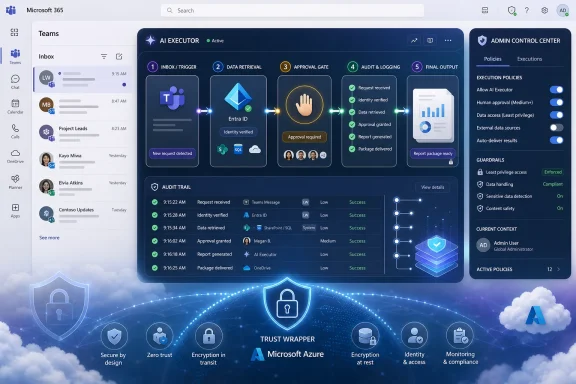 The AI Sales Pitch Has Moved From Advice to Execution
For the last two years, enterprise AI has been sold as a productivity layer: a better search box, a faster writing assistant, a meeting summarizer, a code companion, a spreadsheet whisperer. That framing was useful because it kept the human worker at the center of the action. AI suggested, drafted, summarized, and recommended; the employee still clicked the button, sent the email, approved the invoice, updated the CRM, or escalated the issue.GieniABX is being positioned around a more aggressive premise. The company describes it as Autonomous Business Execution Intelligence, a category meant to go beyond assistants and agents by taking operational ownership of a workflow from intent to finished output. In the company’s telling, a user defines the desired outcome and the platform handles the tooling, coordination, data gathering, execution steps, and delivery package.
That is a meaningful line to draw, even if the market will argue over whether the name sticks. The difference between an AI that drafts a market analysis and one that gathers data, validates sources, builds the report, updates systems, starts outreach, and returns a completed work product is not just a difference in convenience. It is a difference in where labor, control, and liability sit.
The timing is not accidental. Microsoft has been steadily turning Azure into the substrate for enterprise AI systems, while Microsoft 365 has become the obvious surface area for workplace agents. If a third-party platform can credibly claim to plug into Foundry, Entra, Teams, Microsoft 365, and Copilot Studio, it is speaking directly to the procurement language of companies that already buy Microsoft as infrastructure rather than as a collection of apps.
Azure Is the Trust Wrapper, Not Just the Hosting Choice
Gieni AI’s most important strategic decision may not be the “autonomous execution” label. It may be the decision to wrap that claim in Microsoft Azure.For U.S. enterprises, Azure is not merely a cloud provider. It is often where identity, compliance, logs, conditional access, endpoint policy, and Microsoft 365 data gravity already converge. By building on Azure and emphasizing integration with Entra, Foundry, Teams, Microsoft 365, and Copilot Studio, GieniABX is making the argument that its autonomy can be governed through tools IT already understands.
That matters because the biggest obstacle to autonomous AI in business is not model capability. It is institutional permission. A demo can show an AI system completing a task in minutes; a CIO has to ask who authorized the data access, which identity performed the action, where the logs live, how approvals are enforced, and what happens when the wrong external system is updated.
Microsoft’s current AI architecture is increasingly built around precisely those concerns. Foundry gives developers and vendors a place to build and orchestrate AI applications. Entra provides identity and access control. Purview, Defender, Sentinel, and Microsoft’s broader security stack increasingly form the governance layer around both human and non-human actors. Copilot Studio gives organizations a way to build and publish agents into familiar productivity environments.
GieniABX is trying to ride that infrastructure wave. The company’s pitch is that governance is not an add-on but part of the execution model: actions are logged, approval chains are configurable, and humans remain involved at moments that matter. That is exactly the language enterprise buyers want to hear, but it is also where the product will face its hardest scrutiny.
“Human Approval” Is Doing a Lot of Work
The phrase “humans retaining final approval” appears frequently in autonomous AI announcements because it is comforting. It suggests that the machine may do the work, but the person still owns the decision. In practice, however, the value of that safeguard depends on what the human is approving, how much context they receive, and whether the workflow has already created consequences before the approval point.A human approval gate at the end of a report-generation workflow is straightforward. A human approval gate after an agent has already queried databases, created drafts, classified customers, enriched contact records, or prepared outbound communications is more complex. Even if the final send, publish, purchase, or commit action is blocked until a manager approves it, earlier steps may still involve sensitive data handling and system-to-system movement.
This is not an argument against autonomous execution. It is an argument for being precise about it. Enterprises should ask whether GieniABX’s approval controls apply only to final outputs or also to intermediate actions that change business state. They should ask whether approval policies can vary by workflow, data class, user role, department, geography, and risk level. They should ask whether administrators can see not just what the system produced, but why it took each step.
In mature IT environments, approval is not a rubber stamp. It is a control surface. If GieniABX can make that control surface visible, configurable, and auditable, it will have a stronger claim than most AI products making similar “human in the loop” promises. If approval is simply the last screen before a generated artifact is accepted, the autonomy story becomes much less reassuring.
The Marketplace Signal Is Bigger Than the Press Release
The company says GieniABX is live on Microsoft Marketplace and available as standalone software. That is a practical detail with strategic significance.Microsoft Marketplace has become an increasingly important distribution channel for enterprise software because it lets organizations discover, procure, and deploy cloud-aligned offerings through a procurement motion they already trust. For vendors, marketplace availability can shorten sales cycles and reduce friction with customers that want spending to flow through existing Microsoft agreements. For IT buyers, it can simplify vendor review, subscription management, and deployment visibility.
That does not mean a Marketplace listing is a security certification, nor does it prove a product is fit for every regulated workload. But it does change the buyer psychology. A platform that sits adjacent to Microsoft’s enterprise ecosystem and is obtainable through Microsoft’s commercial marketplace starts with a different level of credibility than a random SaaS tool asking for OAuth permissions and a corporate credit card.
For WindowsForum readers, the Marketplace angle is also a reminder of how Microsoft’s platform strategy is expanding. Microsoft is not merely shipping Copilot as a first-party assistant. It is encouraging an ecosystem in which specialized agents and execution systems attach themselves to Microsoft 365, Teams, Azure, and identity services. The result is a workplace where Windows, Office, and Azure are less like applications and more like the operating environment for a fleet of semi-autonomous business actors.
That future creates opportunity for vendors like Gieni AI. It also creates a new administrative burden for the people responsible for keeping the tenant sane.
“Executor” Is a Category Claim, and Category Claims Deserve Skepticism
GieniABX frames the market in three generations: answer machines, agents and copilots, and executors. It is a clean story. Gen 1 answers questions, Gen 2 helps orchestrate work, and Gen 3 completes the work for approval.Like most clean stories in enterprise software, it simplifies a messier reality. Microsoft, Salesforce, ServiceNow, Google, Atlassian, SAP, and a long tail of automation vendors are all trying to blur the same boundary between recommendation and action. Copilot Studio agents can already connect to tools. Power Automate can already trigger workflows. Service management platforms can already remediate incidents. Robotic process automation vendors have been promising “digital workers” for years.
What may be different now is not the dream but the interface and the model capability. Earlier automation required brittle process mapping, dedicated automation teams, narrow integrations, and heavy upfront configuration. Modern agentic systems promise a more flexible layer where natural language intent, model reasoning, tool use, retrieval, and workflow orchestration come together. The human does not script every branch; the system plans and executes within constraints.
That is a real shift, but it should not be confused with magic. The question is not whether an AI can perform an impressive end-to-end workflow in a controlled example. The question is whether it can operate reliably across the ugly variance of enterprise work: incomplete data, stale CRM records, conflicting policies, idiosyncratic spreadsheets, regional compliance rules, missing permissions, ambiguous instructions, and humans who change their minds halfway through a process.
An “executor” category will be earned through repeated operational dependability, not through marketing taxonomy. GieniABX has chosen a bold name for the category it wants to lead. Customers will decide whether the platform behaves like a reliable operations layer or just a more ambitious agent with better packaging.
The Windows Angle Is the Microsoft 365 Work Surface
At first glance, GieniABX may sound like a cloud business application story rather than a Windows story. But the practical path into enterprises runs straight through the Microsoft desktop experience.Most knowledge work still happens inside Outlook, Teams, Excel, Word, PowerPoint, SharePoint, browsers, and line-of-business apps accessed from Windows PCs. Microsoft has spent years making Teams and Microsoft 365 the place where employees communicate, approve, share, search, and collaborate. If autonomous execution systems are going to become normal, they will likely surface inside these familiar environments rather than as separate dashboards that workers must remember to open.
That is why GieniABX’s claimed integration with Teams, Microsoft 365, and Copilot Studio matters. The competitive advantage is not simply that an AI can complete a workflow. It is that the worker can invoke or review that workflow in the same digital workspace where the request originated. The fewer context switches, the more plausible the adoption story.
For administrators, however, that integration creates a new layer of policy design. Teams apps, Copilot agents, connectors, Graph permissions, SharePoint access, mailbox data, and external APIs all become part of the execution chain. A system that can “pull its own data” is useful only if the organization has decided which data it may pull, under whose identity, and for what purpose.
This is where Windows and Microsoft 365 administrators will need to think less like app deployers and more like air traffic controllers. The agentic workplace is not a single product rollout. It is an expanding set of non-human actors moving across collaboration systems, databases, and external services.
The Security Model Must Account for Non-Human Workers
The rise of autonomous execution forces enterprises to confront an awkward fact: agents need identities.That sounds obvious, but it is a profound shift. Traditional software integrations are often treated as service principals, app registrations, API keys, or automation accounts. Employees are treated as users. Autonomous AI systems sit somewhere between the two. They behave like software, but they are asked to perform tasks that resemble delegated labor: researching, deciding between tools, preparing actions, and coordinating across systems.
Microsoft has been moving toward a model in which agents can be registered, inventoried, governed, and monitored as first-class entities. That is the right direction. If an autonomous platform is going to update records, draft messages, move files, or call external services, IT needs to know which agent did it, which user or policy authorized it, which permissions were used, and whether the action deviated from expected behavior.
GieniABX’s emphasis on auditability and ownership tracking addresses the right anxiety. But the devil is in the operational detail. Audit logs that exist but are hard to query will not satisfy incident responders. Approval trails that show only a final signoff will not satisfy compliance teams. Agent identities that share broad permissions will not satisfy security architects who have spent years preaching least privilege.
The risk is not merely that an autonomous system makes a bad recommendation. The risk is that it makes a wrong move at machine speed with valid credentials. That is why execution systems need stronger guardrails than chatbots. They need scoped permissions, environment separation, data-loss controls, anomaly detection, human escalation, rollback planning, and clear ownership when something goes wrong.
Small and Mid-Market Firms May Be the Most Tempted
Gieni AI’s announcement speaks to U.S. small, medium, and enterprise businesses, and that range is telling. Large enterprises have the biggest budgets, but smaller firms may feel the execution gap more acutely.A large company can assign teams to market research, sales operations, procurement analysis, reporting, and workflow coordination. A founder-led or mid-market company often relies on a few overextended people to do all of that with spreadsheets, browser tabs, CRM exports, and late-night PowerPoint decks. If an AI execution platform can reliably take a vague business intent and return a usable finished output, the productivity argument is obvious.
The danger is that smaller organizations may also have weaker governance maturity. They may lack dedicated security teams, formal data classification, mature identity policy, and disciplined change management. A product that promises “no technical setup” is attractive to those buyers, but autonomous execution without careful boundaries can amplify messy internal practices rather than fix them.
This is where Azure alignment could help, especially for Microsoft-centric organizations that already use Entra ID, Microsoft 365, and Teams. But platform alignment is not a substitute for policy design. A mid-market sales team that gives an execution system access to customer data, email, documents, and external enrichment sources still needs rules governing who can launch workflows, what data can be used, and what must be approved before action.
The companies that benefit most will probably not be the ones that throw autonomy at every process. They will be the ones that identify repeatable, high-friction workflows where the inputs are knowable, the approval points are clear, and the cost of delay is high.
The First Workflows Should Be Boring on Purpose
The best early use cases for autonomous business execution are unlikely to be dramatic. They will be boring, repetitive, and bounded.Market research briefs, competitive summaries, supplier scans, account preparation, sales prospecting support, internal report assembly, meeting follow-up packages, and structured executive updates all fit the pattern. They involve multiple steps and data sources, but they do not necessarily require the AI to directly alter core financial, legal, medical, or production systems. They can deliver value while keeping humans in control of consequential external actions.
That is not a limitation; it is the sane adoption path. Enterprise AI has a bad habit of jumping from “summarize my notes” to “run my department” in the span of a keynote. Real deployments move more slowly because trust has to be earned workflow by workflow.
A practical deployment of GieniABX should start with a narrow definition of success. What exact workflow is being delegated? What systems may be accessed? What is the expected output? What must the human approve? What logs will be reviewed? How will the company measure accuracy, time saved, rework, and user satisfaction? What happens when the system cannot complete the task?
Those questions sound bureaucratic, but they are the difference between useful automation and expensive theater. Autonomous execution should reduce coordination burden, not create a new management layer where employees spend their time checking whether the AI did the work correctly.
Microsoft’s Ecosystem Is Becoming the Agent Control Plane
GieniABX also illustrates a larger Microsoft story. The company is positioning itself as both AI vendor and AI control plane.That distinction matters. Microsoft wants organizations to use Copilot, but it also wants Azure, Entra, Foundry, Copilot Studio, Defender, Purview, and Microsoft 365 to become the place where third-party agents are built, deployed, observed, and governed. If the enterprise AI market fragments across hundreds of specialized agents, Microsoft still wins if those agents depend on its identity, cloud, productivity, and security layers.
For customers, this has advantages. A Microsoft-centric control plane may reduce vendor sprawl, improve auditability, and keep agent behavior closer to existing compliance and identity policy. It may also make it easier for administrators to see which agents exist and what they are allowed to do.
The trade-off is lock-in. The more business execution moves through Azure-hosted agents tied into Microsoft 365 and Entra, the more deeply organizations bind their operational workflows to Microsoft’s architecture. That may be a reasonable bargain for companies already standardized on Microsoft, but it should be recognized as a strategic commitment rather than a mere deployment detail.
GieniABX’s Azure foundation therefore cuts both ways. It may make the product more acceptable to enterprise IT. It also places the company squarely inside Microsoft’s gravitational field, where partner opportunity and platform dependence arrive together.
The Productivity Promise Is Real, but the Measurement Problem Remains
The customer quote in the announcement claims that work once requiring days of coordination and data gathering can now be delivered in minutes. That is the kind of result every enterprise AI vendor wants to put in front of buyers.It may also be true for selected workflows. Anyone who has assembled a market brief, researched suppliers, prepared a target-account dossier, or stitched together data from multiple systems knows how much time is lost to search, formatting, validation, and handoff. If GieniABX can compress those steps into a reviewed output, the value is not imaginary.
But enterprises should be careful about what they measure. Time-to-first-output is not the same as time-to-trusted-outcome. A report generated in five minutes but requiring two hours of verification may still be useful, but it is not the same as a finished work product that can be confidently acted upon. A workflow that completes quickly but occasionally misses edge cases may create hidden downstream costs.
The right measurement model should include accuracy, rework, escalation rate, approval rejection rate, data quality, compliance exceptions, and user trust over time. It should also include opportunity cost. If a sales operations team is freed from manual list building and can spend more time on strategy, that may be valuable even if the AI output still needs human review.
The key is not to accept “minutes instead of days” as the only metric. The key is to ask whether autonomous execution changes the shape of work in a way that is reliable, governable, and economically meaningful.
The Line Between Automation and Management Is Blurring
There is a subtle organizational implication in GieniABX’s pitch: every professional becomes a delegator.That idea sounds empowering. Instead of doing tedious execution work, employees define outcomes, approve key decisions, and focus on strategy. The software becomes a kind of virtual operations team, handling the mechanics while humans steer.
But delegation is itself a skill. Managers know that badly delegated work can create more overhead than doing the task directly. The same will be true with AI execution systems. Employees will need to learn how to specify outcomes clearly, define constraints, inspect outputs, recognize hallucinated confidence, and decide when to intervene.
This could create a new productivity divide inside companies. Workers who know how to operate autonomous systems may become dramatically more effective. Workers who treat them as magic boxes may either distrust them entirely or approve flawed outputs too quickly. The training burden will not disappear just because the product promises no coding.
There is also a labor politics angle that vendors tend to soften. If AI systems take operational ownership of complete workflows, some roles will be redesigned. Some coordination work will shrink. Some teams may become smaller. New work will appear around supervision, governance, workflow design, and exception handling, but that does not mean every displaced task maps neatly onto a better job for the same person.
Enterprises should be honest about this. The “outcome era” is not just a software category. It is a management philosophy with consequences.
The Real Test Will Be Failure Handling
Most AI demos show the happy path. Enterprise buyers should focus on the failure path.What does GieniABX do when the data is contradictory? What happens when a required connector fails? Does the system pause, escalate, retry, or improvise? Can it explain which sources it trusted and which it discarded? Can an administrator reproduce the decision path after the fact? Can a workflow be rolled back if a downstream action was wrong? Can the system distinguish between a low-confidence draft and a result ready for approval?
These are not edge cases. They are the daily reality of business systems. Customer records are duplicated. Supplier data is stale. Regional rules conflict. People use inconsistent terminology. APIs fail. Permissions change. A platform claiming operational ownership must be judged by how gracefully it handles that mess.
Human approval is part of the answer, but not the whole answer. The system also needs calibrated uncertainty. It must know when to stop. It must surface risk rather than bury it under polished output. It must make escalation feel like a feature, not a failure.
If GieniABX can do that, it will deserve attention beyond the press-release cycle. If it cannot, it will join a long line of AI tools that look brilliant in controlled settings and brittle in production.
The Azure-Native Executor Arrives With a Practical Checklist
GieniABX’s announcement is not just another AI launch; it is a useful marker for how enterprise AI is being reframed. The question for customers is no longer whether AI can help draft or summarize. It is whether a governed system can be trusted to execute bounded work and return a result worth approving.- Enterprises should treat autonomous execution as a privileged workload, not as a smarter chatbot.
- The first deployments should target bounded workflows where data sources, approval points, and rollback options are clearly defined.
- Microsoft integration is a strength only if administrators actually use Entra, audit logs, data policies, and least-privilege controls to govern the system.
- Human approval should be evaluated as a workflow control, not accepted as a marketing phrase.
- Marketplace availability can reduce procurement friction, but it does not replace security review, compliance mapping, or operational testing.
- The most important pilot metric is not how fast the system produces output, but how often the output survives expert review without costly rework.
References
- Primary source: The Manila Times
Published: Tue, 09 Jun 2026 13:21:23 GMT
Gieni AI Brings Autonomous Business Execution to US Enterprises Through Microsoft Azure | The Manila Times
The Platform, GieniABX, Takes Operational Ownership of Complete Workflows so Organizations Can Focus On Strategy www.manilatimes.net
- Official source: news.microsoft.com
- Related coverage: webdisclosure.com
Orderfox |
Orderfox Schweiz AG introduces Gieni ABX in collaboration with Microsoft, an AI solution that autonomously executes business workflows to completion. Available on www.gieniabx.com and Microsoft Marketplacewww.webdisclosure.com
- Related coverage: techtimes.com
Microsoft Copilot Just Got Smarter: Gieni AI Delivers Instant Insights for the Manufacturing Industry
Microsoft Copilot is gaining new capabilities aimed at a sector that has lagged behind in digital transformation: manufacturing. Gieni is now integrated directly into Copilot and Microsoft Teams,www.techtimes.com - Official source: marketplace.microsoft.com
Gieni AI Market Research Agent
FROM INSIGHT TO ACTION - directly in the Copilot flow!marketplace.microsoft.com
- Related coverage: onvista.de
EQS-News: Die Orderfox Schweiz AG stellt in Zusammenarbeit mit Microsoft Gieni ABX vor: eine bahnbrechende KI-Lösung, die Aufgaben bis zum Abschluss ausführt • onvista
EQS-News: Orderfox / Schlagwort(e): Produkteinführung <br> Die Orderfox Schweiz AG stellt in Zusammenarbeit mit Microsoft Gieni ABX vor: eine bahnbrechende KI-Lösung, die Aufgaben bis zum Abschluss a… www.onvista.de

- Official source: microsoft.com
Microsoft Marketplace | Cloud Solutions, AI Apps, and Agents
Discover Microsoft Marketplace—your trusted source to find, try, and buy cloud solutions, AI apps, and agents from our comprehensive catalog.www.microsoft.com
- Official source: learn.microsoft.com
Find what you need in Microsoft Marketplace - Marketplace customer documentation | Microsoft Learn
Learn about Microsoft Marketplace and how you can find and try out software and solutions in one comprehensive catalog, including intelligent discovery for products.learn.microsoft.com - Official source: cdn-dynmedia-1.microsoft.com
The Next Wave of AI Innovation: Microsoft Introduces Azure AI Foundry, A New Unified AI, and GenAI Platform at Ignite 2024
PDF documentcdn-dynmedia-1.microsoft.com
- Related coverage: assets.ascendientlearning.com
