

GIGABYTE has quietly listed the B850 AORUS Elite X3D, an ATX AM5 motherboard for AMD Ryzen 7000, 8000, and 9000 processors, adding X3D Turbo Mode 2.0 support, a 16+2+2-phase VRM, Wi-Fi 7, 5GbE networking, four M.2 slots, and DDR5 overclocking support up to 8200 MT/s. The board is not a revolution in AM5 so much as a signpost for where the motherboard business is heading. In 2026, the premium feature is no longer just more copper, more slots, or a thicker heatsink. It is firmware that promises to make silicon behave more intelligently than its default settings allow.
The interesting part of the B850 AORUS Elite X3D is not that GIGABYTE made another B850 motherboard. AM5 boards have multiplied into a dense thicket of nearly identical names, regional variants, colorways, and Wi-Fi suffixes. The interesting part is that GIGABYTE has taken a mainstream chipset and given it branding normally reserved for the boards enthusiasts associate with the top end of a product stack.
B850 is not AMD’s flagship AM5 chipset. It sits below X870 and X870E, giving board makers room to hit saner prices while still supporting Ryzen 9000, Ryzen 8000, and Ryzen 7000 processors. That matters because the Ryzen X3D audience is no longer a niche of benchmark chasers willing to buy whatever board has the most expensive chipset attached. The 7800X3D and 9800X3D turned 3D V-Cache into a mainstream gaming recommendation, and board makers are now chasing that audience directly.
The B850 AORUS Elite X3D appears to be GIGABYTE’s answer to a simple market reality: many builders want the gaming performance of an X3D processor without paying for every luxury feature of an X870E board. They still want strong VRM design, modern networking, PCIe 5.0 storage, fast DDR5 profiles, debug tools, and decent rear I/O. They may not need every lane, controller, or USB4 flourish that a flagship board uses to justify its price.
That is why this launch is more consequential than its quiet rollout suggests. GIGABYTE is not merely adding another model to fill a spreadsheet. It is pushing its X3D-specific firmware story down into the part of the market where many Ryzen gaming systems are actually built.
That word, boring, is underrated in motherboard design. A good gaming board should mostly disappear once the system is built. It should train memory reliably, wake from sleep, survive BIOS updates, avoid USB weirdness, and not turn storage lane-sharing into an unpleasant guessing game.
GIGABYTE’s layout suggests the company knows this buyer is not just building a budget box. Four DDR5 DIMM slots with support for up to 256 GB gives the board workstation-adjacent headroom, even if most gaming builds will run two sticks. DDR5 support up to 8200 MT/s is the sort of number that looks good in marketing, though real-world AM5 sweet spots still depend heavily on CPU memory controller quality, module choice, BIOS maturity, and whether the user wants stability or screenshots.
The storage configuration is more meaningful. Four M.2 slots, including two PCIe 5.0 M.2 slots, make the board feel less compromised than many mainstream offerings. For Windows users who keep a boot drive, a game library drive, a scratch drive, and maybe a backup or project SSD inside the system, that is not indulgence anymore. It is the new normal for a high-end desktop that has outgrown SATA.
The trade-off is that lane sharing still matters. A secondary PCIe slot may be disabled when a particular M.2 connector is populated, depending on the final configuration. That is not unusual on this class of board, but it is exactly the kind of footnote builders should read before planning capture cards, 10GbE adapters, sound cards, or other expansion hardware.
That idea is not new in spirit. Motherboard vendors have spent decades selling “one-click overclocking,” automatic voltage rules, game modes, memory enhancement profiles, and other BIOS toggles that promise more performance with less expertise. What is new is the target. X3D chips are not conventional overclocking toys, because AMD’s 3D V-Cache parts tend to be thermally and electrically constrained in ways that make old-school multiplier chasing less relevant.
This changes the motherboard vendor’s job. Instead of simply feeding more voltage into a CPU and hoping the cooler keeps up, the board has to understand which knobs matter for cache-heavy gaming workloads. That can mean frequency behavior, power limits, core scheduling assumptions, memory latency tuning, and sometimes more controversial decisions such as altering simultaneous multithreading behavior or prioritizing certain CCD configurations on dual-chiplet parts.
GIGABYTE’s published language around X3D Turbo Mode 2.0 emphasizes two user-facing profiles: Extreme Gaming Mode and Max Performance Mode. The model names are pure gaming-hardware theater, but the distinction is useful. A mode optimized for games may not be the best mode for compilation, rendering, encoding, virtualization, or heavy multitasking. A mode designed for maximum mixed performance may not produce the highest one-percent lows in every title.
That is the tension at the heart of the board. The B850 AORUS Elite X3D is selling simplicity, but the processors it targets are nuanced. A Ryzen 7 9800X3D, a Ryzen 9 7950X3D, and a Ryzen 9 9950X3D do not present the same tuning problem. The single-CCD chips are relatively straightforward gaming monsters. The dual-CCD chips ask Windows, firmware, drivers, and game detection logic to agree on where threads should run.
For users, the practical question is not whether the feature deserves the AI label. The practical question is whether enabling it changes performance predictably, safely, and transparently. If X3D Turbo Mode 2.0 improves frame pacing in CPU-limited games without harming thermals, stability, or productivity workloads, users will not care whether the algorithm is glamorous. If it disables useful processor features or regresses performance in certain games, the branding will not save it.
That is where motherboard firmware has historically been both powerful and dangerous. The BIOS is close enough to the metal to produce results software utilities cannot always match. It is also close enough to make choices users do not notice until something feels off.
Windows gamers have already learned this lesson through years of chipset driver updates, scheduler tweaks, Game Mode debates, VBS performance arguments, and fTPM stutter fixes. Performance is no longer a single slider. It is the result of a chain that runs from AGESA firmware to Windows scheduling, GPU drivers, anti-cheat systems, power plans, memory training, and the game engine itself.
The B850 AORUS Elite X3D therefore lives or dies by its defaults. If X3D Turbo Mode 2.0 is conservative, reversible, and clearly explained, it could be a useful gaming profile. If it becomes another mysterious toggle that reviewers must warn readers to test title by title, its value narrows to enthusiasts who already know how to benchmark their own systems.
That is typical for motherboard launches, but it also reflects the strange maturity of AM5. AMD’s socket is now established, Ryzen X3D has a clear identity, and board makers are no longer trying to explain the basics. Instead, they are slicing the market into ever-finer personas: the white-build buyer, the compact-system buyer, the overclocker, the creator, the Wi-Fi 7 upgrader, the X3D gamer.
The B850 AORUS Elite X3D is aimed at the last of those buyers. It is a board for someone who already knows they want an X3D CPU and wants the rest of the platform to be tuned around that decision. That is a more specific pitch than “supports AM5,” and it lets GIGABYTE differentiate a board even when the chipset and form factor are familiar.
The absence of pricing is the biggest missing piece. Without a price, the board’s position is theoretical. If it lands close to ordinary B850 Elite models, it becomes an easy upsell for Ryzen X3D buyers. If it creeps too close to X870 pricing, shoppers will start comparing chipset features, USB options, lane allocation, and resale value instead of focusing on the X3D branding.
Motherboard pricing has been one of the sore points of the AM5 era. The platform brought DDR5, PCIe 5.0, heavier power delivery, and richer connectivity, but it also pushed many buyers into board prices that felt disproportionate next to midrange CPUs. A B850 board with premium X3D tuning could help correct that imbalance, but only if the price does not turn the “mainstream” chipset into a cosmetic distinction.
The inclusion of 5GbE is especially welcome. Home networks are slowly moving beyond gigabit, and 2.5GbE has become common enough that it no longer feels premium. A 5GbE controller gives the board more runway for NAS users, large game libraries, media workflows, and local backups. It is not as widely useful as 10GbE in professional environments, but it is a sensible middle ground for high-end consumer desktops.
Wi-Fi 7 is similarly forward-looking, though its real-world value depends on router support, spectrum availability, antenna placement, and local congestion. A desktop connected by Ethernet will usually remain the cleaner choice for latency-sensitive gaming. Still, Wi-Fi 7 and Bluetooth 5.4 give the board a modern baseline for users who cannot run cable or who rely on wireless peripherals.
The onboard buttons also deserve more credit than they usually receive. Power, reset, Clear CMOS, and Q-Flash Plus are the sorts of features that seem minor until a BIOS update fails, a memory profile refuses to train, or a new CPU needs firmware support before the board can boot normally. For enthusiasts, these are convenience features. For less experienced builders, they can be the difference between a recoverable afternoon and an RMA request.
The debug display also matters. Motherboards used to provide clearer diagnostic tools before cost-cutting normalized cryptic LEDs. A proper display can save time when troubleshooting memory training, GPU seating, CPU initialization, or firmware hangs. In an era of large GPUs, tight cases, and aggressive DDR5 profiles, better diagnostics are not decoration.
Ryzen X3D parts sharpen that shift. Their value is not that they clock higher than everything else. Their value is that large cache can make many games behave as if the CPU subsystem is simply closer, faster, and less dependent on memory trips. The best outcome is not a heroic overclock. It is consistency.
That is why X3D-specific boards are interesting. They are not trying to revive the past so much as package a new kind of tuning. The old overclocking board was built around more power. The X3D board is built around smarter constraints.
This is also where buyers need to stay skeptical. A motherboard cannot turn every game into a cache-sensitive workload. It cannot erase GPU bottlenecks at 4K. It cannot guarantee that a competitive shooter, a simulation title, a shader-heavy open-world game, and a poorly threaded legacy engine all respond the same way to a firmware profile.
The best case for X3D Turbo Mode 2.0 is not universal uplift. It is targeted improvement in the scenarios where Ryzen X3D chips are already strongest: CPU-limited gaming, high-refresh esports, simulation workloads, and titles that benefit from cache and latency tuning. That is useful, but it is not magic.
AGESA updates have been central to AM5 since launch. They affect CPU support, memory compatibility, boot behavior, security fixes, and sometimes performance. A board can have excellent hardware and still deliver a frustrating experience if firmware lags behind CPU releases or memory kits behave unpredictably.
This is particularly important for a board marketed around an active performance mode. X3D Turbo Mode 2.0 is not a passive spec like the number of SATA ports. It depends on firmware logic. That means early reviews, long-term BIOS updates, and user reports will matter more than the launch-day product page.
Windows users should also remember that BIOS tuning does not exist in isolation. AMD chipset drivers, Windows updates, Game Bar components, and power management behavior can all influence how Ryzen X3D systems behave. On dual-CCD X3D chips especially, the best configuration is the one where firmware and Windows agree on the preferred cores for gaming.
For admins or power users building standardized desktops, that is a caution flag. A feature that improves a home gaming rig may not be desirable across a fleet of mixed-use machines. Stability, repeatability, and remote supportability often matter more than squeezing out a few percent in select titles.
That confusion is not unique to GIGABYTE. The motherboard market has become a maze of suffixes: Elite, Pro, Master, Ice, AX, WiFi7, X3D, Gaming, Plus, and regional variants. To enthusiasts, these labels signal price tiers and feature bundles. To everyone else, they can look like a product manager spilled Scrabble tiles onto a chipset roadmap.
The B850 AORUS Elite X3D will need a clear price gap to make sense. If it is significantly cheaper than X870 and X870E X3D boards while keeping the most relevant gaming features, it becomes compelling. If it overlaps too heavily with those boards, the buyer has to ask what B850 is giving up.
The chipset distinction matters most for expansion and connectivity. X870 and X870E boards generally offer richer high-speed I/O options, with USB4 more common at the higher end. B850 can still be excellent, but buyers with external storage arrays, high-speed capture workflows, or multiple add-in cards should examine lane diagrams carefully.
For the typical Ryzen X3D gaming build, however, B850 may be enough. One strong GPU slot, multiple M.2 drives, fast networking, Wi-Fi 7, robust power delivery, and good diagnostics cover most needs. The flagship chipset is often more about edge cases than frame rates.
For a Ryzen X3D gaming system, the fastest bootable memory kit is not automatically the best choice. Latency, fabric behavior, stability, and cost all matter. Many users will be better served by a stable EXPO kit than by chasing the highest number on a QVL.
The same caution applies to PCIe 5.0 storage. Two PCIe 5.0 M.2 slots sound excellent, and for some workloads they are. But most games still do not benefit meaningfully from the fastest Gen 5 SSDs, and those drives can run hot enough to make heatsink design important. A well-cooled Gen 4 drive remains a rational choice for many Windows gaming rigs.
The 5GbE controller is more broadly useful, but only if the rest of the network can keep up. A PC connected to a gigabit switch will behave like a gigabit PC. Users looking to exploit 5GbE should plan the whole chain: switch, NAS, cabling, and storage throughput.
That is not a knock against the board. It is a reminder that modern motherboard features are increasingly ecosystem features. The value appears only when the rest of the system is built to use them.
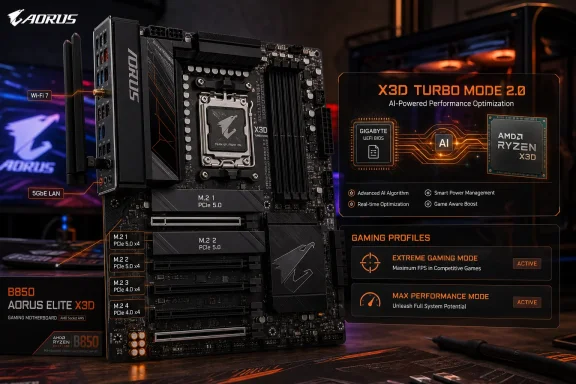 GIGABYTE Turns a Chipset Board Into an X3D Showcase
The interesting part of the B850 AORUS Elite X3D is not that GIGABYTE made another B850 motherboard. AM5 boards have multiplied into a dense thicket of nearly identical names, regional variants, colorways, and Wi-Fi suffixes. The interesting part is that GIGABYTE has taken a mainstream chipset and given it branding normally reserved for the boards enthusiasts associate with the top end of a product stack.B850 is not AMD’s flagship AM5 chipset. It sits below X870 and X870E, giving board makers room to hit saner prices while still supporting Ryzen 9000, Ryzen 8000, and Ryzen 7000 processors. That matters because the Ryzen X3D audience is no longer a niche of benchmark chasers willing to buy whatever board has the most expensive chipset attached. The 7800X3D and 9800X3D turned 3D V-Cache into a mainstream gaming recommendation, and board makers are now chasing that audience directly.
The B850 AORUS Elite X3D appears to be GIGABYTE’s answer to a simple market reality: many builders want the gaming performance of an X3D processor without paying for every luxury feature of an X870E board. They still want strong VRM design, modern networking, PCIe 5.0 storage, fast DDR5 profiles, debug tools, and decent rear I/O. They may not need every lane, controller, or USB4 flourish that a flagship board uses to justify its price.
That is why this launch is more consequential than its quiet rollout suggests. GIGABYTE is not merely adding another model to fill a spreadsheet. It is pushing its X3D-specific firmware story down into the part of the market where many Ryzen gaming systems are actually built.
The Spec Sheet Is Doing Two Jobs at Once
On paper, the B850 AORUS Elite X3D looks like a serious midrange-to-upper-mainstream AM5 board. The reported 16+2+2 digital VRM design, dual 8-pin CPU power connectors, and enlarged heatsinking are more than enough for the Ryzen X3D chips most buyers will pair with it. These processors are prized for gaming efficiency as much as raw wattage, so the point of the VRM is less “can it survive a ridiculous overclock?” and more “can it remain stable, cool, and boring for years?”That word, boring, is underrated in motherboard design. A good gaming board should mostly disappear once the system is built. It should train memory reliably, wake from sleep, survive BIOS updates, avoid USB weirdness, and not turn storage lane-sharing into an unpleasant guessing game.
GIGABYTE’s layout suggests the company knows this buyer is not just building a budget box. Four DDR5 DIMM slots with support for up to 256 GB gives the board workstation-adjacent headroom, even if most gaming builds will run two sticks. DDR5 support up to 8200 MT/s is the sort of number that looks good in marketing, though real-world AM5 sweet spots still depend heavily on CPU memory controller quality, module choice, BIOS maturity, and whether the user wants stability or screenshots.
The storage configuration is more meaningful. Four M.2 slots, including two PCIe 5.0 M.2 slots, make the board feel less compromised than many mainstream offerings. For Windows users who keep a boot drive, a game library drive, a scratch drive, and maybe a backup or project SSD inside the system, that is not indulgence anymore. It is the new normal for a high-end desktop that has outgrown SATA.
The trade-off is that lane sharing still matters. A secondary PCIe slot may be disabled when a particular M.2 connector is populated, depending on the final configuration. That is not unusual on this class of board, but it is exactly the kind of footnote builders should read before planning capture cards, 10GbE adapters, sound cards, or other expansion hardware.
X3D Turbo Mode 2.0 Is the Real Product
The centerpiece is X3D Turbo Mode 2.0, GIGABYTE’s firmware-level performance feature for Ryzen X3D processors. The company describes the technology as using an onboard AI model and hardware-level tuning to dynamically optimize X3D CPU parameters in real time. In plain English, GIGABYTE wants the motherboard to become an active performance manager rather than a passive platform.That idea is not new in spirit. Motherboard vendors have spent decades selling “one-click overclocking,” automatic voltage rules, game modes, memory enhancement profiles, and other BIOS toggles that promise more performance with less expertise. What is new is the target. X3D chips are not conventional overclocking toys, because AMD’s 3D V-Cache parts tend to be thermally and electrically constrained in ways that make old-school multiplier chasing less relevant.
This changes the motherboard vendor’s job. Instead of simply feeding more voltage into a CPU and hoping the cooler keeps up, the board has to understand which knobs matter for cache-heavy gaming workloads. That can mean frequency behavior, power limits, core scheduling assumptions, memory latency tuning, and sometimes more controversial decisions such as altering simultaneous multithreading behavior or prioritizing certain CCD configurations on dual-chiplet parts.
GIGABYTE’s published language around X3D Turbo Mode 2.0 emphasizes two user-facing profiles: Extreme Gaming Mode and Max Performance Mode. The model names are pure gaming-hardware theater, but the distinction is useful. A mode optimized for games may not be the best mode for compilation, rendering, encoding, virtualization, or heavy multitasking. A mode designed for maximum mixed performance may not produce the highest one-percent lows in every title.
That is the tension at the heart of the board. The B850 AORUS Elite X3D is selling simplicity, but the processors it targets are nuanced. A Ryzen 7 9800X3D, a Ryzen 9 7950X3D, and a Ryzen 9 9950X3D do not present the same tuning problem. The single-CCD chips are relatively straightforward gaming monsters. The dual-CCD chips ask Windows, firmware, drivers, and game detection logic to agree on where threads should run.
The AI Label Is Less Important Than the Defaults
GIGABYTE’s “AI” framing will get attention, and some skepticism is deserved. PC hardware marketing has become saturated with AI claims that range from meaningful to ornamental. A trained tuning model built around observed processor behavior is not the same thing as a cloud chatbot, and it should not be judged by the same vocabulary.For users, the practical question is not whether the feature deserves the AI label. The practical question is whether enabling it changes performance predictably, safely, and transparently. If X3D Turbo Mode 2.0 improves frame pacing in CPU-limited games without harming thermals, stability, or productivity workloads, users will not care whether the algorithm is glamorous. If it disables useful processor features or regresses performance in certain games, the branding will not save it.
That is where motherboard firmware has historically been both powerful and dangerous. The BIOS is close enough to the metal to produce results software utilities cannot always match. It is also close enough to make choices users do not notice until something feels off.
Windows gamers have already learned this lesson through years of chipset driver updates, scheduler tweaks, Game Mode debates, VBS performance arguments, and fTPM stutter fixes. Performance is no longer a single slider. It is the result of a chain that runs from AGESA firmware to Windows scheduling, GPU drivers, anti-cheat systems, power plans, memory training, and the game engine itself.
The B850 AORUS Elite X3D therefore lives or dies by its defaults. If X3D Turbo Mode 2.0 is conservative, reversible, and clearly explained, it could be a useful gaming profile. If it becomes another mysterious toggle that reviewers must warn readers to test title by title, its value narrows to enthusiasts who already know how to benchmark their own systems.
The Quiet Launch Says as Much as the Board Does
There is something revealing about the way this board appeared. GIGABYTE did not make a grand stage presentation for it. The product surfaced through listings and support pages, with BIOS entries dated before the wider hardware press noticed the model.That is typical for motherboard launches, but it also reflects the strange maturity of AM5. AMD’s socket is now established, Ryzen X3D has a clear identity, and board makers are no longer trying to explain the basics. Instead, they are slicing the market into ever-finer personas: the white-build buyer, the compact-system buyer, the overclocker, the creator, the Wi-Fi 7 upgrader, the X3D gamer.
The B850 AORUS Elite X3D is aimed at the last of those buyers. It is a board for someone who already knows they want an X3D CPU and wants the rest of the platform to be tuned around that decision. That is a more specific pitch than “supports AM5,” and it lets GIGABYTE differentiate a board even when the chipset and form factor are familiar.
The absence of pricing is the biggest missing piece. Without a price, the board’s position is theoretical. If it lands close to ordinary B850 Elite models, it becomes an easy upsell for Ryzen X3D buyers. If it creeps too close to X870 pricing, shoppers will start comparing chipset features, USB options, lane allocation, and resale value instead of focusing on the X3D branding.
Motherboard pricing has been one of the sore points of the AM5 era. The platform brought DDR5, PCIe 5.0, heavier power delivery, and richer connectivity, but it also pushed many buyers into board prices that felt disproportionate next to midrange CPUs. A B850 board with premium X3D tuning could help correct that imbalance, but only if the price does not turn the “mainstream” chipset into a cosmetic distinction.
Windows Builders Should Care About the I/O More Than the Name
For WindowsForum readers, the practical appeal may be less about X3D Turbo Mode 2.0 and more about the board’s everyday connectivity. The rear I/O appears unusually strong for the class, with multiple USB Type-A ports, dual fast USB-C ports, Wi-Fi 7, onboard buttons, HDMI, optical audio, and wired networking faster than standard 2.5GbE on some comparable boards. These are not luxury details when a system is expected to last through several GPU and storage upgrades.The inclusion of 5GbE is especially welcome. Home networks are slowly moving beyond gigabit, and 2.5GbE has become common enough that it no longer feels premium. A 5GbE controller gives the board more runway for NAS users, large game libraries, media workflows, and local backups. It is not as widely useful as 10GbE in professional environments, but it is a sensible middle ground for high-end consumer desktops.
Wi-Fi 7 is similarly forward-looking, though its real-world value depends on router support, spectrum availability, antenna placement, and local congestion. A desktop connected by Ethernet will usually remain the cleaner choice for latency-sensitive gaming. Still, Wi-Fi 7 and Bluetooth 5.4 give the board a modern baseline for users who cannot run cable or who rely on wireless peripherals.
The onboard buttons also deserve more credit than they usually receive. Power, reset, Clear CMOS, and Q-Flash Plus are the sorts of features that seem minor until a BIOS update fails, a memory profile refuses to train, or a new CPU needs firmware support before the board can boot normally. For enthusiasts, these are convenience features. For less experienced builders, they can be the difference between a recoverable afternoon and an RMA request.
The debug display also matters. Motherboards used to provide clearer diagnostic tools before cost-cutting normalized cryptic LEDs. A proper display can save time when troubleshooting memory training, GPU seating, CPU initialization, or firmware hangs. In an era of large GPUs, tight cases, and aggressive DDR5 profiles, better diagnostics are not decoration.
The Ryzen X3D Audience Has Outgrown the Old Overclocking Myth
For years, enthusiast motherboards were sold on a fantasy of manual overclocking. The buyer was imagined as someone who would spend a weekend inside BIOS, balancing voltage, load-line calibration, memory timings, and fan curves to extract hidden performance. That audience still exists, but modern CPUs have consumed much of the old headroom.Ryzen X3D parts sharpen that shift. Their value is not that they clock higher than everything else. Their value is that large cache can make many games behave as if the CPU subsystem is simply closer, faster, and less dependent on memory trips. The best outcome is not a heroic overclock. It is consistency.
That is why X3D-specific boards are interesting. They are not trying to revive the past so much as package a new kind of tuning. The old overclocking board was built around more power. The X3D board is built around smarter constraints.
This is also where buyers need to stay skeptical. A motherboard cannot turn every game into a cache-sensitive workload. It cannot erase GPU bottlenecks at 4K. It cannot guarantee that a competitive shooter, a simulation title, a shader-heavy open-world game, and a poorly threaded legacy engine all respond the same way to a firmware profile.
The best case for X3D Turbo Mode 2.0 is not universal uplift. It is targeted improvement in the scenarios where Ryzen X3D chips are already strongest: CPU-limited gaming, high-refresh esports, simulation workloads, and titles that benefit from cache and latency tuning. That is useful, but it is not magic.
The BIOS Version May Matter More Than the Box
The support trail around the board points to BIOS maturity as a key part of the story. Early BIOS entries reportedly include AGESA 1.3.0.1b, with optimization for AMD EXPO Ultra Low Latency support. That is the kind of detail casual buyers ignore and experienced AM5 users immediately notice.AGESA updates have been central to AM5 since launch. They affect CPU support, memory compatibility, boot behavior, security fixes, and sometimes performance. A board can have excellent hardware and still deliver a frustrating experience if firmware lags behind CPU releases or memory kits behave unpredictably.
This is particularly important for a board marketed around an active performance mode. X3D Turbo Mode 2.0 is not a passive spec like the number of SATA ports. It depends on firmware logic. That means early reviews, long-term BIOS updates, and user reports will matter more than the launch-day product page.
Windows users should also remember that BIOS tuning does not exist in isolation. AMD chipset drivers, Windows updates, Game Bar components, and power management behavior can all influence how Ryzen X3D systems behave. On dual-CCD X3D chips especially, the best configuration is the one where firmware and Windows agree on the preferred cores for gaming.
For admins or power users building standardized desktops, that is a caution flag. A feature that improves a home gaming rig may not be desirable across a fleet of mixed-use machines. Stability, repeatability, and remote supportability often matter more than squeezing out a few percent in select titles.
The Board’s Real Competition Is Its Own Siblings
GIGABYTE’s own product stack may be the B850 AORUS Elite X3D’s toughest competition. The company already sells multiple AM5 boards with similar naming, and the difference between B850 AORUS Elite, B850 AORUS Elite WiFi7, X870 AORUS Elite X3D, and X870E AORUS Elite X3D is not self-evident to a normal buyer.That confusion is not unique to GIGABYTE. The motherboard market has become a maze of suffixes: Elite, Pro, Master, Ice, AX, WiFi7, X3D, Gaming, Plus, and regional variants. To enthusiasts, these labels signal price tiers and feature bundles. To everyone else, they can look like a product manager spilled Scrabble tiles onto a chipset roadmap.
The B850 AORUS Elite X3D will need a clear price gap to make sense. If it is significantly cheaper than X870 and X870E X3D boards while keeping the most relevant gaming features, it becomes compelling. If it overlaps too heavily with those boards, the buyer has to ask what B850 is giving up.
The chipset distinction matters most for expansion and connectivity. X870 and X870E boards generally offer richer high-speed I/O options, with USB4 more common at the higher end. B850 can still be excellent, but buyers with external storage arrays, high-speed capture workflows, or multiple add-in cards should examine lane diagrams carefully.
For the typical Ryzen X3D gaming build, however, B850 may be enough. One strong GPU slot, multiple M.2 drives, fast networking, Wi-Fi 7, robust power delivery, and good diagnostics cover most needs. The flagship chipset is often more about edge cases than frame rates.
The Fine Print Is Where Enthusiasts Will Decide
The board’s reported support for DDR5 up to 8200 MT/s will look attractive, but memory speed remains one of AM5’s most misunderstood spec lines. High advertised DDR5 speeds are overclocking targets, not guarantees. They depend on the CPU, memory kit, DIMM count, BIOS version, and board topology.For a Ryzen X3D gaming system, the fastest bootable memory kit is not automatically the best choice. Latency, fabric behavior, stability, and cost all matter. Many users will be better served by a stable EXPO kit than by chasing the highest number on a QVL.
The same caution applies to PCIe 5.0 storage. Two PCIe 5.0 M.2 slots sound excellent, and for some workloads they are. But most games still do not benefit meaningfully from the fastest Gen 5 SSDs, and those drives can run hot enough to make heatsink design important. A well-cooled Gen 4 drive remains a rational choice for many Windows gaming rigs.
The 5GbE controller is more broadly useful, but only if the rest of the network can keep up. A PC connected to a gigabit switch will behave like a gigabit PC. Users looking to exploit 5GbE should plan the whole chain: switch, NAS, cabling, and storage throughput.
That is not a knock against the board. It is a reminder that modern motherboard features are increasingly ecosystem features. The value appears only when the rest of the system is built to use them.
The Sensible X3D Buyer Gets a Better Checklist
The B850 AORUS Elite X3D is best understood as a checklist board for the Ryzen X3D era. It combines the features most gaming-focused AM5 builders are likely to want, trims some of the flagship-chipset excess, and adds a firmware identity aimed directly at cache-heavy AMD CPUs. The result could be one of the more practical AM5 boards in GIGABYTE’s lineup if pricing lands where B850 buyers expect it.- The B850 AORUS Elite X3D is a mainstream-chipset AM5 board positioned specifically for Ryzen X3D gaming builds.
- Its strongest hardware arguments are the 16+2+2 VRM design, four M.2 slots, Wi-Fi 7, 5GbE networking, and useful onboard troubleshooting controls.
- X3D Turbo Mode 2.0 is the board’s defining feature, but its value will depend on real-world testing across different Ryzen X3D CPUs and games.
- Buyers should read the storage and PCIe lane-sharing notes before planning add-in cards or fully populating the M.2 slots.
- Pricing will decide whether this board is a smart B850 upgrade or an awkward near-X870 upsell.
- Firmware support may matter as much as the physical board, especially for DDR5 tuning, EXPO behavior, and X3D-specific performance modes.
References
- Primary source: Wccftech
Published: 2026-06-29T11:01:14.948452
GIGABYTE Silently Launches B850 AORUS Elite X3D Motherboard With X3D Turbo Mode 2.0 Support
GIGABYTE's B850 AORUS Elite X3D motherboard features a 16+2+2 VRM, supports X3D Turbo Mode 2.0, and offers impressive I/O connectivity and performance.wccftech.com
- Related coverage: videocardz.com
- Related coverage: gigabyte.com
- Related coverage: us.aorus.com
- Related coverage: store.aorus.com
B850 AORUS ELITE WIFI7 ICE Motherboard in AORUS Official Store | AORUS Official Store
Shop the B850 AORUS ELITE WIFI7 ICE Motherboard in AORUS Official Store by AORUS Official Store. Enjoy free shipping on all orders over EUR150. Shop now!store.aorus.com - Related coverage: ixbt.com
Обзор материнской платы Gigabyte X870E Aorus Elite X3D – почему X3D Turbo Mode 2.0 не стоит включать вслепую / Платформа ПК / iXBT Live
Gigabyte X870E Aorus Elite X3D интересна не количеством наклеек на коробке, а тем, как в ней разведены реальные возможности платформы www.ixbt.com
- Related coverage: download.gigabyte.com
- Related coverage: 8ad48833d1ade579b77fe49652b73f00.r2.cloudflarestorage.com
