

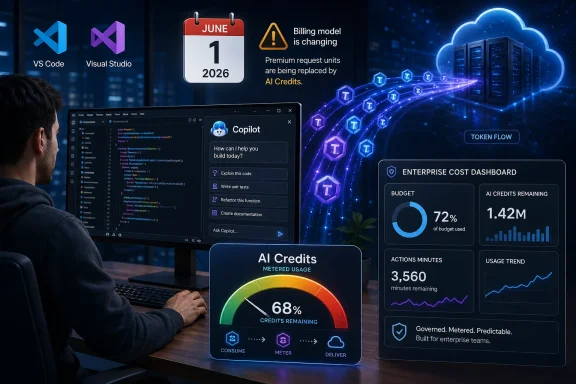
Microsoft’s GitHub is ending the era of Copilot’s AI buffet and moving all Copilot plans to usage-based billing on June 1, 2026, a shift that turns generative coding from a mostly predictable subscription into a metered compute service. The change replaces premium request units with GitHub AI Credits, a token-linked currency that better reflects how much work models actually perform. For developers, IT admins, and enterprises standardizing on AI coding tools, this is more than a pricing tweak: it is a warning that agentic software development now has cloud economics attached.
GitHub Copilot began as a relatively simple in-editor assistant: type a comment, receive a code suggestion, accept or reject it, and move on. That early Copilot was expensive to run, but the usage pattern was narrow enough that a flat monthly subscription made sense. Most interactions were short completions or chat-style prompts, not hours-long autonomous sessions crawling through repositories.
The product has since become a much broader agentic development platform. Copilot now spans chat, command-line workflows, pull request review, repository-aware agents, cloud-based coding sessions, Spark-style app generation, and integrations with third-party coding agents. Each of those capabilities can involve multiple model calls, tool invocations, context retrieval, file analysis, and generated output far beyond the original autocomplete experience.
That evolution has broken the old billing abstraction. Under the premium request model, a small question and a complex autonomous task could look similar from the customer’s bill, even if the back-end cost to GitHub was wildly different. In practice, the heavy user of reasoning models and agents was subsidized by everyone else.
The new model gives GitHub a way to align AI infrastructure cost with customer behavior. It also moves Copilot closer to how cloud platforms bill compute, storage, database queries, and API calls: the meter may be less comforting than a flat fee, but it reflects the underlying cost structure more honestly. For Windows developers using Visual Studio, VS Code, Windows Terminal, GitHub Actions, and Azure DevOps-adjacent workflows, the transition will reshape how AI coding assistance gets budgeted.
In practical terms, one prompt is no longer one workload. A request can now represent a lightweight answer, a repository-wide refactor attempt, or a pull request review that runs through an agentic workflow. Metering by token consumption gives GitHub a finer-grained way to price the real compute involved.
The shift also reflects the unpleasant reality of frontier AI economics. Large models are not just software features; they are rented compute, memory bandwidth, accelerator capacity, and data-center scheduling. When developers leave agents running for long stretches, the bill resembles cloud usage more than a SaaS seat.
Key drivers behind the change include:
GitHub’s documentation frames usage around three broad token categories. Input tokens represent what gets sent to the model, including prompts and context. Output tokens represent what the model generates. Cached tokens represent reusable or stored context, which may be cheaper than fresh input but still has a cost.
The included monthly allowances are tied closely to the base subscription price:
The metered side is where Copilot behaves more like an AI platform than an editor feature. Copilot Chat, Copilot CLI, cloud agent sessions, Copilot Spaces, Spark, third-party agents, and similar model-heavy features will consume credits. This reflects the growing divide between “assistive autocomplete” and “delegated engineering work.”
For developers, the practical question becomes: which Copilot habits burn credits, and which do not? Teams that train users to reserve expensive models for complex tasks may stretch their credits further. Teams that treat agentic AI as an unlimited intern may encounter budget ceilings quickly.
Feature categories now look roughly like this:
Examples are notable. Claude Opus 4.7 moves from a 7.5x multiplier to 27x for annual-plan users. GPT-5.4 moves from 1x to 6x. GPT-4.1, previously treated as included under paid plans in the premium request system, moves to a 1x multiplier for annual subscribers.
That creates three practical options for annual users:
The broader lesson is that annual AI subscriptions are becoming harder to guarantee. When model catalogs, inference costs, and user behavior change every few months, long-term flat pricing becomes risky for vendors. Customers should treat annual AI tool commitments with the same scrutiny they apply to cloud reserved capacity.
Pooled credits help by reducing stranded capacity. If one developer barely uses agentic Copilot while another uses it heavily, the organization’s included usage can be shared rather than trapped at the individual level. That is a meaningful enterprise-friendly feature.
But pooled credits also make internal governance more important. A team experimenting with autonomous code review or repo-wide modernization can consume shared allowance quickly. Without budgets and reporting, a platform team may not know whether the credits are being spent on high-value work or casual experimentation.
Enterprise administrators should prepare a phased response:
This makes code review one of the clearest examples of AI features becoming hybrid workloads. It is partly inference, partly orchestration, and partly CI-style infrastructure. Billing it through a single subscription abstraction would hide real costs that GitHub now wants to expose.
For public repositories, Actions minutes remain free under GitHub’s stated model. For private repositories, teams need to examine review frequency, pull request volume, runner configuration, and existing Actions entitlements. Large engineering organizations that automatically request Copilot reviews on many pull requests could see meaningful consumption.
Teams should evaluate:
This creates a competitive challenge. Vendors want to advertise powerful autonomous development, but they also need to avoid turning heavy users into loss centers. If one company offers too much unlimited usage, it may attract precisely the users most likely to overwhelm infrastructure.
GitHub’s advantage remains distribution. Copilot is deeply integrated with GitHub, VS Code, Visual Studio, pull requests, repositories, Actions, and enterprise identity workflows. That ecosystem position gives Microsoft and GitHub room to impose billing discipline that a smaller standalone tool might struggle to enforce.
Competitors will still use the transition as an opening. Some will market simpler pricing, more generous allowances, or bring-your-own-key flexibility. Others will appeal to developers frustrated by metering. But over time, the underlying economics point in the same direction: serious agentic coding will be paid for by usage, caps, higher tiers, or some blend of all three.
This does not mean teams should become stingy with AI. The best use cases may justify heavy consumption. A successful agentic refactor that saves a senior engineer several hours can be worth far more than the credits consumed.
The problem is waste. Poor prompts, vague tasks, unnecessary tool use, repeated retries, and oversized context windows can turn AI coding into a leaky budget line. Engineering leaders will need to distinguish productive compute from noisy experimentation.
New habits are likely to emerge:
A developer may still press the same shortcut or open the same chat pane. Behind that action, however, the organization may apply model restrictions, budgets, cost center allocation, or spending caps. The editor becomes the interface to a managed AI compute service.
This is consistent with Microsoft’s larger cloud posture. Azure customers already understand metered compute, reserved capacity, quotas, and governance. GitHub Copilot is moving closer to that world, even if it still wears the clothing of a developer productivity subscription.
Microsoft’s strategic opportunity is to make the experience feel coherent. If Copilot billing, GitHub Actions usage, Azure budgets, identity policy, and developer tooling remain fragmented, admins will struggle. If Microsoft integrates reporting and governance cleanly, it could turn billing discipline into an enterprise advantage.
The second thing to watch is how developers react to real-world credit burn rates. Official pricing tables are useful, but they do not always translate neatly into everyday workflows. The market will learn from actual examples: a pull request review, a medium bug fix, a cloud agent session, a CLI planning task, or a repository-wide modernization attempt.
The third thing to watch is how competitors respond. OpenAI, Anthropic, Google, JetBrains, Cursor-style tools, and open-source agent frameworks all have an opening to define themselves against GitHub’s model. Yet most of them face the same compute math, so any promise of unlimited agentic coding deserves scrutiny.
Near-term signals worth monitoring include:
Source: theregister.com Microsoft's GitHub shifts to metered AI billing
 Overview
GitHub Copilot began as a relatively simple in-editor assistant: type a comment, receive a code suggestion, accept or reject it, and move on. That early Copilot was expensive to run, but the usage pattern was narrow enough that a flat monthly subscription made sense. Most interactions were short completions or chat-style prompts, not hours-long autonomous sessions crawling through repositories.The product has since become a much broader agentic development platform. Copilot now spans chat, command-line workflows, pull request review, repository-aware agents, cloud-based coding sessions, Spark-style app generation, and integrations with third-party coding agents. Each of those capabilities can involve multiple model calls, tool invocations, context retrieval, file analysis, and generated output far beyond the original autocomplete experience.
That evolution has broken the old billing abstraction. Under the premium request model, a small question and a complex autonomous task could look similar from the customer’s bill, even if the back-end cost to GitHub was wildly different. In practice, the heavy user of reasoning models and agents was subsidized by everyone else.
The new model gives GitHub a way to align AI infrastructure cost with customer behavior. It also moves Copilot closer to how cloud platforms bill compute, storage, database queries, and API calls: the meter may be less comforting than a flat fee, but it reflects the underlying cost structure more honestly. For Windows developers using Visual Studio, VS Code, Windows Terminal, GitHub Actions, and Azure DevOps-adjacent workflows, the transition will reshape how AI coding assistance gets budgeted.
Why GitHub Is Changing Copilot Billing
GitHub’s central argument is straightforward: Copilot is no longer the same product it was even a year ago. The company says the current premium request model is no longer sustainable because agentic workflows can consume vastly more inference resources than traditional chat. That is the heart of the change.The end of equal-priced prompts
The old billing model counted requests, then applied multipliers for more expensive models. That worked tolerably well when a “request” usually meant a bounded prompt-response exchange. It becomes much weaker when a single developer prompt can trigger planning, code search, test generation, editing, tool use, and follow-up reasoning.In practical terms, one prompt is no longer one workload. A request can now represent a lightweight answer, a repository-wide refactor attempt, or a pull request review that runs through an agentic workflow. Metering by token consumption gives GitHub a finer-grained way to price the real compute involved.
The shift also reflects the unpleasant reality of frontier AI economics. Large models are not just software features; they are rented compute, memory bandwidth, accelerator capacity, and data-center scheduling. When developers leave agents running for long stretches, the bill resembles cloud usage more than a SaaS seat.
Key drivers behind the change include:
- Longer context windows that send more repository data to models
- Agentic tool use that can make multiple calls per user action
- Frontier model selection that costs more than lightweight models
- Autonomous coding sessions that run far beyond chat-style exchanges
- Enterprise adoption that turns occasional experimentation into daily workload
- Capacity pressure across hosted AI infrastructure
How GitHub AI Credits Work
Starting June 1, 2026, Copilot plans will include a monthly allotment of GitHub AI Credits instead of premium request units. One AI Credit equals one cent of value, and Copilot usage is converted into credits based on tokens consumed. Those tokens include input, output, and cached tokens, with rates varying by model.Tokens become the economic unit
This is the critical conceptual change. Developers are no longer spending a request; they are consuming model work. A short prompt to a lightweight model may cost only a fraction of a credit, while a long session with a powerful model across a large repository can consume much more.GitHub’s documentation frames usage around three broad token categories. Input tokens represent what gets sent to the model, including prompts and context. Output tokens represent what the model generates. Cached tokens represent reusable or stored context, which may be cheaper than fresh input but still has a cost.
The included monthly allowances are tied closely to the base subscription price:
- Copilot Pro remains $10 per month and includes 1,000 AI Credits
- Copilot Pro+ remains $39 per month and includes 3,900 AI Credits
- Copilot Business remains $19 per user per month and includes 1,900 AI Credits per user
- Copilot Enterprise remains $39 per user per month and includes 3,900 AI Credits per user
- Existing Business customers receive 3,000 credits per user monthly during the transition window
- Existing Enterprise customers receive 7,000 credits per user monthly during the transition window
What Remains Unlimited and What Does Not
GitHub is not metering every Copilot feature. Paid subscribers will continue to get unlimited code completions and Next Edit Suggestions, which remain core productivity features for day-to-day coding. That distinction matters because it preserves the original Copilot value proposition for many users.The split between assistance and agent work
Inline completions are relatively predictable. They happen frequently, but each interaction is usually small and bounded. GitHub can manage that usage as part of a subscription bundle more easily than it can manage autonomous workflows involving large context windows and multi-step reasoning.The metered side is where Copilot behaves more like an AI platform than an editor feature. Copilot Chat, Copilot CLI, cloud agent sessions, Copilot Spaces, Spark, third-party agents, and similar model-heavy features will consume credits. This reflects the growing divide between “assistive autocomplete” and “delegated engineering work.”
For developers, the practical question becomes: which Copilot habits burn credits, and which do not? Teams that train users to reserve expensive models for complex tasks may stretch their credits further. Teams that treat agentic AI as an unlimited intern may encounter budget ceilings quickly.
Feature categories now look roughly like this:
- Unlimited on paid plans: code completions
- Unlimited on paid plans: Next Edit Suggestions
- Metered by credits: Copilot Chat
- Metered by credits: Copilot CLI
- Metered by credits: Copilot cloud agent
- Metered by credits: Copilot Spaces and Spark
- Metered by credits: third-party coding agents connected through Copilot
- Metered by credits and Actions minutes: Copilot code review
Annual Subscribers Face a Different Transition
Monthly subscribers will move automatically to usage-based billing on June 1, 2026. Annual Copilot Pro and Pro+ subscribers are in a more awkward position because they will remain on the existing premium request model until their current term expires. But GitHub is changing the model multipliers for annual plans, and some of those increases are steep.A bridge that may feel like a squeeze
For annual subscribers, premium requests do not disappear immediately. Instead, expensive models will consume more of the old allowance after June 1. The effect is that annual plan users keep the legacy structure but lose much of the old economics for high-end models.Examples are notable. Claude Opus 4.7 moves from a 7.5x multiplier to 27x for annual-plan users. GPT-5.4 moves from 1x to 6x. GPT-4.1, previously treated as included under paid plans in the premium request system, moves to a 1x multiplier for annual subscribers.
That creates three practical options for annual users:
- Stay on the annual plan until expiration and accept the higher model multipliers.
- Convert to a monthly paid plan before expiration and receive prorated credit for the remaining annual value.
- Allow the annual plan to expire and fall back to Copilot Free unless upgrading again.
The broader lesson is that annual AI subscriptions are becoming harder to guarantee. When model catalogs, inference costs, and user behavior change every few months, long-term flat pricing becomes risky for vendors. Customers should treat annual AI tool commitments with the same scrutiny they apply to cloud reserved capacity.
Enterprise Impact: Budgeting Moves to the Engineering Org
For enterprises, the most important change is not the monthly list price. It is the introduction of pooled included usage and more granular budget controls. GitHub says organizations will be able to manage budgets at enterprise, cost center, and user levels, giving finance and engineering leaders a more cloud-like control plane.From seat counting to consumption governance
Traditional software procurement loves seats because seats are simple. If a company buys 5,000 licenses at a known monthly price, the budget is legible. Usage-based AI disrupts that model because a small number of power users can create disproportionate cost.Pooled credits help by reducing stranded capacity. If one developer barely uses agentic Copilot while another uses it heavily, the organization’s included usage can be shared rather than trapped at the individual level. That is a meaningful enterprise-friendly feature.
But pooled credits also make internal governance more important. A team experimenting with autonomous code review or repo-wide modernization can consume shared allowance quickly. Without budgets and reporting, a platform team may not know whether the credits are being spent on high-value work or casual experimentation.
Enterprise administrators should prepare a phased response:
- Inventory Copilot usage across chat, agents, CLI, and code review.
- Identify high-cost workflows before the billing switch.
- Create budgets by team or cost center rather than relying only on global caps.
- Publish model guidance that tells developers when to use lightweight versus frontier models.
- Monitor code review Actions usage separately from AI Credit usage.
- Review procurement assumptions for Copilot renewals after the transition period.
Copilot Code Review Gets a Second Meter
Copilot code review is receiving special treatment because it will consume both AI Credits and GitHub Actions minutes starting June 1, 2026. That is an important wrinkle for teams using automated reviews on private repositories. It means a pull request review may now hit two separate parts of the GitHub bill.AI reasoning plus runner infrastructure
The reason is architectural. Copilot code review runs on an agentic tool-calling system that uses GitHub-hosted runners for private repositories. The AI model cost is captured through credits, while the execution environment consumes Actions minutes.This makes code review one of the clearest examples of AI features becoming hybrid workloads. It is partly inference, partly orchestration, and partly CI-style infrastructure. Billing it through a single subscription abstraction would hide real costs that GitHub now wants to expose.
For public repositories, Actions minutes remain free under GitHub’s stated model. For private repositories, teams need to examine review frequency, pull request volume, runner configuration, and existing Actions entitlements. Large engineering organizations that automatically request Copilot reviews on many pull requests could see meaningful consumption.
Teams should evaluate:
- Whether every pull request needs AI review
- Whether reviews should be triggered manually or automatically
- How private repository Actions minutes are currently consumed
- Whether larger runners or self-hosted runners change the cost profile
- How AI review feedback compares with human review value
- Whether security-critical repositories need different policies
Competitive Pressure Across AI Coding Tools
GitHub is not making this move in isolation. The entire AI coding market is learning that flat-rate subscriptions collide with agentic usage. OpenAI has moved Codex teams toward token-based pay-as-you-go options, Anthropic continues to manage Claude usage through plan limits and extra usage paths, and Google is competing with Gemini-powered developer tools across its AI subscription tiers.A market-wide pricing correction
The common thread is that coding agents consume more compute than chatbots. A user asking for a summary or a quick function is one thing. A user asking an agent to inspect a codebase, write tests, diagnose failures, run tools, revise patches, and repeat the loop is another.This creates a competitive challenge. Vendors want to advertise powerful autonomous development, but they also need to avoid turning heavy users into loss centers. If one company offers too much unlimited usage, it may attract precisely the users most likely to overwhelm infrastructure.
GitHub’s advantage remains distribution. Copilot is deeply integrated with GitHub, VS Code, Visual Studio, pull requests, repositories, Actions, and enterprise identity workflows. That ecosystem position gives Microsoft and GitHub room to impose billing discipline that a smaller standalone tool might struggle to enforce.
Competitors will still use the transition as an opening. Some will market simpler pricing, more generous allowances, or bring-your-own-key flexibility. Others will appeal to developers frustrated by metering. But over time, the underlying economics point in the same direction: serious agentic coding will be paid for by usage, caps, higher tiers, or some blend of all three.
Developer Behavior Will Change
The most immediate impact will be behavioral. Developers who previously treated model choice as a quality preference will now treat it as a cost decision. That is a major cultural shift for engineering teams accustomed to subscriptions that fade into the background.Prompting becomes cost-aware
When tokens have a visible price, context discipline matters. Dumping entire logs, massive files, or broad repository instructions into a frontier model may still be useful, but it is no longer economically invisible. Developers will need to learn when to narrow scope, summarize context, or switch models.This does not mean teams should become stingy with AI. The best use cases may justify heavy consumption. A successful agentic refactor that saves a senior engineer several hours can be worth far more than the credits consumed.
The problem is waste. Poor prompts, vague tasks, unnecessary tool use, repeated retries, and oversized context windows can turn AI coding into a leaky budget line. Engineering leaders will need to distinguish productive compute from noisy experimentation.
New habits are likely to emerge:
- Use lightweight models for simple explanations and syntax questions
- Reserve frontier models for architecture, debugging, and complex reasoning
- Break large tasks into smaller goals before invoking agents
- Avoid sending irrelevant repository context when a focused file is enough
- Track recurring high-cost workflows and optimize them
- Treat AI review as a policy decision, not a default checkbox
Implications for Windows Developers and Microsoft’s Platform Strategy
For WindowsForum readers, the Copilot billing shift lands inside a broader Microsoft developer ecosystem. Copilot is not just a GitHub product; it is part of Microsoft’s strategy across Windows, Visual Studio Code, Visual Studio, Azure, GitHub Actions, and enterprise software delivery. The economics of Copilot therefore affect how Microsoft positions AI-assisted development on Windows machines.VS Code and Visual Studio users will feel the policy layer
Many Windows developers experience Copilot primarily through VS Code or Visual Studio. The editor remains the front door, but billing is increasingly controlled by GitHub plans, organizational policies, and model-level pricing. That separates the feel of the tool from the governance behind it.A developer may still press the same shortcut or open the same chat pane. Behind that action, however, the organization may apply model restrictions, budgets, cost center allocation, or spending caps. The editor becomes the interface to a managed AI compute service.
This is consistent with Microsoft’s larger cloud posture. Azure customers already understand metered compute, reserved capacity, quotas, and governance. GitHub Copilot is moving closer to that world, even if it still wears the clothing of a developer productivity subscription.
Microsoft’s strategic opportunity is to make the experience feel coherent. If Copilot billing, GitHub Actions usage, Azure budgets, identity policy, and developer tooling remain fragmented, admins will struggle. If Microsoft integrates reporting and governance cleanly, it could turn billing discipline into an enterprise advantage.
Strengths and Opportunities
GitHub’s move may frustrate some customers, but it also creates a more durable foundation for Copilot as agentic development scales. The best version of this transition gives users clearer cost visibility while preserving broad access to everyday coding assistance.- Sustainable economics for expensive AI workloads that cannot be subsidized indefinitely
- More transparent cost signals tied to model choice, token volume, and agent behavior
- Better enterprise controls through pooled credits, budgets, and cost-center governance
- Continued unlimited completions for paid users who rely on Copilot’s core editor experience
- Incentives for efficient prompting and smarter model selection across teams
- Room for richer agentic features because heavy usage can be monetized directly
- Clearer comparison with cloud pricing for organizations already managing metered infrastructure
Risks and Concerns
The risks are equally real. Usage-based billing can be fairer, but it can also be harder to predict. Developers and organizations may discover that AI coding costs are not just variable but psychologically different from fixed SaaS pricing.- Bill shock if users run long agentic sessions without understanding token consumption
- Reduced trust among annual subscribers facing higher model multipliers
- Complex administration when AI Credits, Actions minutes, and seat licenses overlap
- Cost anxiety that discourages developers from using helpful tools
- Model confusion as users struggle to map quality, speed, and price
- Procurement friction for enterprises that prefer predictable annual commitments
- Competitive churn if rival tools offer simpler or more generous pricing during the transition
What to Watch Next
The first thing to watch is GitHub’s promised preview billing experience in early May. If the preview gives users and admins clear projections, the transition could be manageable. If it feels opaque or incomplete, frustration will grow quickly before the June 1 cutoff.The second thing to watch is how developers react to real-world credit burn rates. Official pricing tables are useful, but they do not always translate neatly into everyday workflows. The market will learn from actual examples: a pull request review, a medium bug fix, a cloud agent session, a CLI planning task, or a repository-wide modernization attempt.
The third thing to watch is how competitors respond. OpenAI, Anthropic, Google, JetBrains, Cursor-style tools, and open-source agent frameworks all have an opening to define themselves against GitHub’s model. Yet most of them face the same compute math, so any promise of unlimited agentic coding deserves scrutiny.
Near-term signals worth monitoring include:
- GitHub’s preview bill accuracy before June 1
- Customer reaction from annual Copilot subscribers
- Enterprise policy templates for budgets and model restrictions
- Changes to competing AI coding subscriptions
- Developer guidance around efficient agent workflows
Source: theregister.com Microsoft's GitHub shifts to metered AI billing
