

GitHub Copilot appears to be entering a new and more expensive phase, and the clues now point in a single direction: the platform is shifting away from the simple, predictable subscription story that made it appealing in the first place. Microsoft has already paused new sign-ups for Copilot Pro, Pro+, and Student plans, tightened usage limits for individual users, and removed Opus models from Pro, all in the name of “service reliability” and a “sustainable Copilot experience.” At the same time, GitHub’s own documentation shows the product has been steadily moving toward metered consumption, with premium requests already billed separately and overages possible on paid plans. (github.blog)
The Copilot story has always been a balancing act between convenience and economics. When GitHub Copilot launched, the pitch was simple: pay a flat monthly fee and get access to an AI coding assistant that could accelerate day-to-day development. That model worked well when usage was relatively bounded, suggestions were shorter, and “AI assistance” mostly meant completions, chat, and modestly sized prompts.
The product has since evolved into something far heavier. Copilot now spans chat, agent mode, cloud agents, code review, CLI, Spaces, and even third-party coding integrations. GitHub’s documentation makes clear that many of these features are metered through premium requests, and that usage depends both on the feature and the model selected. In other words, Copilot is no longer just a helper sitting in your editor; it is becoming a broader AI platform with multiple compute-intensive surfaces.
That change matters because the economics of agentic AI are fundamentally different from old-school autocomplete. A modern coding assistant may need to ingest large repositories, maintain context across a session, call tools, and answer follow-up prompts repeatedly. The more capable the model, the more expensive the interaction. GitHub’s own documentation now acknowledges that model multipliers, rate limits, and usage controls are part of normal Copilot operation, which is a strong hint that the platform is wrestling with compute costs in real time.
Microsoft’s recent actions make the pressure visible. On April 20, 2026, GitHub announced that new sign-ups for Copilot Pro, Pro+, and Student were paused, and that the Pro plan no longer includes Opus models. The company framed those changes as necessary to preserve quality for existing users, while also promising refunds for people who decide the revised product no longer works for them. That is usually the language of a company trying to stabilize a product before a deeper pricing redesign lands. (github.blog)
Still, the underlying direction is easy to see. GitHub already charges for premium requests in excess of plan allowances, and its docs explicitly state that certain advanced features consume premium requests at different rates depending on the model. That is effectively a stepped consumption model disguised as a subscription, and moving to full token billing would simply make the cost structure more explicit.
If the reporting is accurate, the key shift is not just pricing; it is incentive design. Requests are a blunt instrument, while tokens map more closely to actual compute usage. That means the heaviest users, most complex prompts, and longest-running workflows would bear a larger share of the cost. In practice, that can push customers to think much more carefully about where and how they use Copilot.
GitHub’s docs also show the platform’s current plan architecture. Copilot Pro is listed at $10 per month, Pro+ at $39, Business at $19 per user per month, and Enterprise at $39 per user per month. The plans differ not just by pricing but by allowances, model access, and organizational controls, which suggests the company has been testing how much complexity customers will tolerate before the subscription story starts to fray.
There is also a clear split between individual and enterprise behavior. Individual users are steered toward plan changes, limits, and refunds. Organizations and enterprises, by contrast, are steered toward budgets, policies, seat assignment, and pooled management. That separation strongly suggests GitHub expects the enterprise side to absorb more granular billing controls first, which would make tokenized usage easier to roll out at scale.
That reality makes flat pricing vulnerable. A monthly subscription works best when average usage is fairly predictable and outliers are rare. But once a product becomes a platform for heavy model use, the outliers stop being edge cases and start becoming the center of gravity. GitHub’s own documentation about model multipliers and premium request consumption is effectively an admission that one-size-fits-all pricing no longer fits the workload.
This is also why the industry keeps gravitating toward usage-based pricing even when customers dislike it. The alternative is to pad subscriptions so heavily that light users overpay, or to cap features so tightly that power users feel cheated. Neither option is good, and both create pressure for a hybrid model. In practice, that hybrid often becomes more expensive than the original subscription everyone thought they were buying.
That said, enterprises also have the most to lose if token usage balloons across teams. GitHub’s docs already note that usage can be pooled and that extra spending can be enabled through policy controls. That creates a governance challenge: once Copilot starts acting more like a metered cloud workload, organizations will need procurement, platform engineering, and security teams to coordinate on usage rules.
Enterprise customers, meanwhile, may be more willing to accept token billing if it is framed as flexibility and control. But even there, the promise only works if GitHub provides enough visibility into consumption to prevent surprise invoices. A pooled credit system can help, but it also creates a new kind of political problem inside organizations: which teams get the expensive AI budget, and who gets told to slow down?
That matters because competition in AI coding no longer revolves purely around model quality. It also revolves around access, rate limits, enterprise controls, and how quickly a provider can be pushed into expensive usage territory. Once customers start comparing not just model performance but billability, usage caps become part of the product review process.
Competitors will notice. If GitHub succeeds with token billing, others may follow by making pricing more explicit and by packaging advanced models as metered add-ons rather than universal perks. If GitHub annoys enough customers, however, rivals could win by offering a simpler, more generous plan even at a higher base price. That tension is where this market will be won or lost.
The practical implication is that teams should start treating Copilot usage the way they treat cloud spend: measurable, monitored, and bounded. If token billing arrives, the companies best prepared will be the ones that already know which workflows deserve premium AI and which ones can be handled by smaller or cheaper models.
This is especially important for organizations with mixed user populations. Senior engineers, platform teams, and AI power users may consume far more than average developers, and the billing change will likely make that imbalance impossible to ignore. The companies that win here will be the ones that manage AI as an operational capability rather than a shiny perk.
This is also a reputational test. Copilot’s early appeal came from being accessible, approachable, and easy to understand. If the company now pushes customers into a world of pooled credits, token rates, multipliers, and budget policies, it risks making the product feel more like a billing system than a developer tool. That perception can matter as much as the actual invoice.
In theory, that is the right long-term architecture for an AI platform. The challenge is getting there without alienating the customers who made Copilot successful in the first place. GitHub has to convince developers that metering is not a retreat from value, but a fairer way to distribute cost. That will be a very hard sell if the transition feels abrupt. (github.blog)
The other thing to watch is whether enterprise customers get clearer pooled-credit controls and more granular reporting. That would suggest GitHub is trying to preserve enterprise trust while changing the economics underneath the product. If those controls arrive first, it would confirm that the company sees organizations as the safest place to land a metered AI model.
Source: Neowin Report: GitHub Copilot is moving to token-based billing from June
 Background
The Copilot story has always been a balancing act between convenience and economics. When GitHub Copilot launched, the pitch was simple: pay a flat monthly fee and get access to an AI coding assistant that could accelerate day-to-day development. That model worked well when usage was relatively bounded, suggestions were shorter, and “AI assistance” mostly meant completions, chat, and modestly sized prompts.The product has since evolved into something far heavier. Copilot now spans chat, agent mode, cloud agents, code review, CLI, Spaces, and even third-party coding integrations. GitHub’s documentation makes clear that many of these features are metered through premium requests, and that usage depends both on the feature and the model selected. In other words, Copilot is no longer just a helper sitting in your editor; it is becoming a broader AI platform with multiple compute-intensive surfaces.
That change matters because the economics of agentic AI are fundamentally different from old-school autocomplete. A modern coding assistant may need to ingest large repositories, maintain context across a session, call tools, and answer follow-up prompts repeatedly. The more capable the model, the more expensive the interaction. GitHub’s own documentation now acknowledges that model multipliers, rate limits, and usage controls are part of normal Copilot operation, which is a strong hint that the platform is wrestling with compute costs in real time.
Microsoft’s recent actions make the pressure visible. On April 20, 2026, GitHub announced that new sign-ups for Copilot Pro, Pro+, and Student were paused, and that the Pro plan no longer includes Opus models. The company framed those changes as necessary to preserve quality for existing users, while also promising refunds for people who decide the revised product no longer works for them. That is usually the language of a company trying to stabilize a product before a deeper pricing redesign lands. (github.blog)
The June Billing Pivot
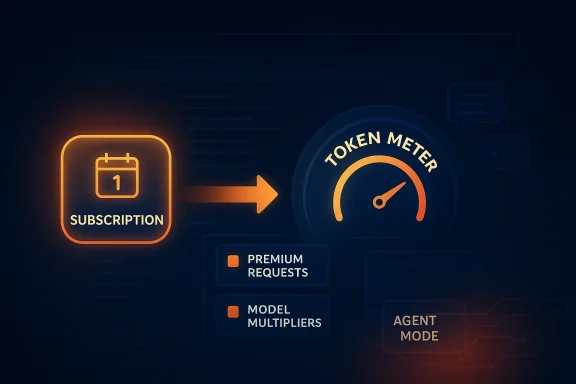
The biggest claim in the current reporting is that GitHub Copilot will move to token-based billing beginning June 1. That would be a meaningful break from the current “requests” framing, where customers buy access to the service and receive allowances measured in premium requests rather than directly paying for model tokens. GitHub has not publicly confirmed that specific June date in the materials available here, so it should be treated as reported, not official. (github.blog)Still, the underlying direction is easy to see. GitHub already charges for premium requests in excess of plan allowances, and its docs explicitly state that certain advanced features consume premium requests at different rates depending on the model. That is effectively a stepped consumption model disguised as a subscription, and moving to full token billing would simply make the cost structure more explicit.
Why this matters
A token model would align Copilot more closely with the way large model providers already price APIs. It would also make the real economics visible to customers, which can be both clarifying and painful. For power users, especially those running long agent sessions, the cost could rise fast, and predictability could become harder to maintain.If the reporting is accurate, the key shift is not just pricing; it is incentive design. Requests are a blunt instrument, while tokens map more closely to actual compute usage. That means the heaviest users, most complex prompts, and longest-running workflows would bear a larger share of the cost. In practice, that can push customers to think much more carefully about where and how they use Copilot.
- The current model already uses premium requests for advanced usage.
- Token pricing would expose the actual cost of large prompts and long sessions.
- Power users would likely see the biggest bill volatility.
- Enterprise budget controls would become more important, not less.
- The change would reduce the appeal of “all-you-can-eat” AI coding.
What GitHub Has Already Confirmed
Before we speculate too far ahead, it is worth separating confirmed facts from rumor. GitHub has officially said that Copilot Pro, Pro+, and Student new sign-ups are paused, and it has officially reduced individual-plan usage limits. It has also officially removed Opus models from Pro and preserved Opus 4.7 only on Pro+, while signaling that older Opus variants are also being removed from Pro+. (github.blog)GitHub’s docs also show the platform’s current plan architecture. Copilot Pro is listed at $10 per month, Pro+ at $39, Business at $19 per user per month, and Enterprise at $39 per user per month. The plans differ not just by pricing but by allowances, model access, and organizational controls, which suggests the company has been testing how much complexity customers will tolerate before the subscription story starts to fray.
The documentation tells the story
GitHub’s documentation now includes a dense web of billing concepts, premium request allowances, multipliers, SKUs, budgets, and overage rules. That is not accidental. When a product starts using phrases like billing entity, model multiplier, and premium request paid usage, it usually means the platform has outgrown the neat simplicity of a flat-fee plan.There is also a clear split between individual and enterprise behavior. Individual users are steered toward plan changes, limits, and refunds. Organizations and enterprises, by contrast, are steered toward budgets, policies, seat assignment, and pooled management. That separation strongly suggests GitHub expects the enterprise side to absorb more granular billing controls first, which would make tokenized usage easier to roll out at scale.
- Copilot pricing has already become more segmented.
- Premium requests already function like a quasi-metered system.
- Individual plans are being tightened first.
- Enterprise customers already have more billing controls.
- The product is being reorganized around usage visibility.
Why Subscriptions Became Hard to Sustain
The core problem is that AI coding workloads are not stable in the way streaming or software licenses used to be. A casual user might generate a handful of short completions and move on, while an agentic user might ask Copilot to inspect code, reason over a repository, draft a plan, execute tool calls, and refine the output several times. The cost difference between those behaviors is enormous, even if both look like “usage” from a customer’s point of view.That reality makes flat pricing vulnerable. A monthly subscription works best when average usage is fairly predictable and outliers are rare. But once a product becomes a platform for heavy model use, the outliers stop being edge cases and start becoming the center of gravity. GitHub’s own documentation about model multipliers and premium request consumption is effectively an admission that one-size-fits-all pricing no longer fits the workload.
The economics of agentic AI
Agentic coding tools are especially expensive because they do more than answer a question. They may generate plans, maintain state, iterate on tasks, and invoke external tools while the user is still in the loop. That turns a single “request” into a potentially long-lived compute event, and that is exactly the kind of workload that token billing is designed to measure.This is also why the industry keeps gravitating toward usage-based pricing even when customers dislike it. The alternative is to pad subscriptions so heavily that light users overpay, or to cap features so tightly that power users feel cheated. Neither option is good, and both create pressure for a hybrid model. In practice, that hybrid often becomes more expensive than the original subscription everyone thought they were buying.
- AI coding is more variable than classic SaaS usage.
- Agent workflows amplify compute costs quickly.
- Flat fees invite abuse by heavy users.
- Usage-based pricing is easier to justify to finance teams.
- The trade-off is less predictability for developers.
Enterprise Versus Consumer Impact
The most important divide in this story is not technical; it is commercial. Individual users care about simplicity, while enterprises care about predictability, governance, and the ability to forecast bills. If GitHub moves to token-based billing, enterprises may actually find it easier to manage than individuals because they already have seat allocation, budgets, and policy enforcement built into the product.That said, enterprises also have the most to lose if token usage balloons across teams. GitHub’s docs already note that usage can be pooled and that extra spending can be enabled through policy controls. That creates a governance challenge: once Copilot starts acting more like a metered cloud workload, organizations will need procurement, platform engineering, and security teams to coordinate on usage rules.
For consumers, the pain is psychological
Individual customers are far less likely to appreciate nuance. They see a monthly price, they expect a certain level of access, and they react negatively when the service suddenly feels rationed. The recent pause on new sign-ups and the reduction in usage limits are already testing that expectation, and token billing would deepen the sense that Copilot is becoming less like a subscription and more like a pay-per-use utility. (github.blog)Enterprise customers, meanwhile, may be more willing to accept token billing if it is framed as flexibility and control. But even there, the promise only works if GitHub provides enough visibility into consumption to prevent surprise invoices. A pooled credit system can help, but it also creates a new kind of political problem inside organizations: which teams get the expensive AI budget, and who gets told to slow down?
- Consumers want flat pricing and fewer surprises.
- Enterprises want governance and spend controls.
- Pooled credits can smooth costs, but only to a point.
- Budget visibility will become a procurement issue.
- Team-level politics may increase around AI access.
The Competitive Pressure From Anthropic and Others
GitHub is not making this move in a vacuum. The broader AI coding market has been moving toward tighter limits, more metering, and stronger segmentation between casual and power users. Anthropic, for example, has already been associated with enterprise token-based billing, and recent moves across the market suggest that the era of cheap, unlimited AI coding is ending.That matters because competition in AI coding no longer revolves purely around model quality. It also revolves around access, rate limits, enterprise controls, and how quickly a provider can be pushed into expensive usage territory. Once customers start comparing not just model performance but billability, usage caps become part of the product review process.
Model access is now a strategy
GitHub’s decision to remove Opus from Pro and keep it for Pro+ is a good example of this segmentation. It is less a feature update than a pricing fence. The most capable models are being reserved for higher-paying users, which suggests the company is protecting premium compute for the customers most likely to generate enough revenue to justify it. (github.blog)Competitors will notice. If GitHub succeeds with token billing, others may follow by making pricing more explicit and by packaging advanced models as metered add-ons rather than universal perks. If GitHub annoys enough customers, however, rivals could win by offering a simpler, more generous plan even at a higher base price. That tension is where this market will be won or lost.
- AI coding rivals are converging on usage controls.
- Premium models are increasingly reserved for top tiers.
- Billing clarity is becoming a competitive feature.
- Simpler pricing could become a differentiator.
- The race is shifting from novelty to sustainable economics.
How Developers Should Read the Signals
Developers should not read this only as a price increase story. It is also a usage-shaping story, and that distinction matters. GitHub is telling users, very plainly, that some workflows are too expensive to be subsidized indefinitely, especially when they involve heavy models, broad context windows, or agentic behavior.The practical implication is that teams should start treating Copilot usage the way they treat cloud spend: measurable, monitored, and bounded. If token billing arrives, the companies best prepared will be the ones that already know which workflows deserve premium AI and which ones can be handled by smaller or cheaper models.
What to do now
There is a straightforward playbook for anyone depending on Copilot in production work. First, map the tasks that truly benefit from premium models. Second, identify which teams are likely to generate the heaviest usage. Third, set budgets and usage policies before the new billing model forces the issue.This is especially important for organizations with mixed user populations. Senior engineers, platform teams, and AI power users may consume far more than average developers, and the billing change will likely make that imbalance impossible to ignore. The companies that win here will be the ones that manage AI as an operational capability rather than a shiny perk.
- Audit current Copilot usage by team and workflow.
- Separate lightweight completion use from agent-heavy use.
- Establish monthly spend caps before token billing lands.
- Decide which models are worth paying premium rates for.
- Train developers on how to avoid wasteful prompt loops.
What the Pricing Reset Means for GitHub
For GitHub, the move would be a recognition that Copilot has crossed a threshold. It is no longer a simple add-on to the developer experience; it is a compute-heavy product line with real infrastructure costs and a growing surface area. That means GitHub has to optimize for margin, reliability, and model access, not just adoption.This is also a reputational test. Copilot’s early appeal came from being accessible, approachable, and easy to understand. If the company now pushes customers into a world of pooled credits, token rates, multipliers, and budget policies, it risks making the product feel more like a billing system than a developer tool. That perception can matter as much as the actual invoice.
The upside for GitHub
To be fair, this also gives GitHub more room to evolve the product. A token model could let the company launch more powerful features without pretending they cost the same as simple chat. It could also make enterprise packaging cleaner, especially if different workloads are separated into different SKUs and policies.In theory, that is the right long-term architecture for an AI platform. The challenge is getting there without alienating the customers who made Copilot successful in the first place. GitHub has to convince developers that metering is not a retreat from value, but a fairer way to distribute cost. That will be a very hard sell if the transition feels abrupt. (github.blog)
- Token billing can support richer features.
- It may also improve cost transparency for enterprises.
- GitHub can separate cheap and expensive workloads more cleanly.
- But it risks making Copilot feel less generous.
- Transition management will matter as much as pricing itself.
Strengths and Opportunities
If GitHub handles the transition well, token-based billing could solve a real structural problem and give the company a more durable Copilot business. It could reduce abuse, better align price with actual compute, and create room for more advanced agentic features without wrecking the economics of the service. The opportunity is to make Copilot feel fairer, even if it feels less cheap.- Better alignment between cost and usage.
- More sustainable economics for heavy model workloads.
- Cleaner enterprise budgeting and cost allocation.
- Room for premium features without broad subsidy.
- Improved visibility into who is using what.
- Stronger incentive to optimize model routing.
- Potentially more durable margins for GitHub.
Risks and Concerns
The biggest danger is customer backlash, especially among individual subscribers who signed up for a predictable monthly price and now face a more variable system. There is also a real risk that the perceived value of Copilot falls if users feel they are being charged twice: once for access and again for the underlying AI work. That kind of frustration can push users toward competing tools. (github.blog)- Surprise billing or bill shock for heavy users.
- Negative reaction to the loss of “flat fee” simplicity.
- More complicated budgeting for smaller teams.
- Increased switching to rival AI coding tools.
- Confusion around premium requests versus tokens.
- Potential underuse if developers self-ration too aggressively.
- Perception that GitHub is monetizing scarcity rather than value.
What to Watch Next
The next few weeks should tell us whether the token-billing story is simply an internal experiment, a phased rollout, or a major product reset. The clearest sign will be whether GitHub publishes an official announcement that matches the reporting and whether it gives customers a conversion path from requests to tokens that is easy to understand. If the company handles the messaging well, it may soften the blow; if not, the market could react sharply. (github.blog)The other thing to watch is whether enterprise customers get clearer pooled-credit controls and more granular reporting. That would suggest GitHub is trying to preserve enterprise trust while changing the economics underneath the product. If those controls arrive first, it would confirm that the company sees organizations as the safest place to land a metered AI model.
Key signals to monitor
- An official GitHub announcement on pricing and billing.
- Any migration guide from requests to tokens.
- Changes to individual plan allowances beyond June.
- New enterprise dashboards or budget tools.
- Reactions from customers using long-running agent workflows.
Source: Neowin Report: GitHub Copilot is moving to token-based billing from June
