

GitHub’s decision to pause new Copilot Individual sign-ups and tighten usage rules marks one of the clearest signals yet that the economics of agentic AI coding tools are changing faster than their original subscription models. The move affects Copilot Pro, Pro+, and Student plans, while also reducing model availability for individual customers and exposing usage limits directly inside VS Code and Copilot CLI. GitHub says the changes are being made to preserve reliability for existing users as long-running agent sessions, parallelized workflows, and higher model demand put pressure on infrastructure. (github.blog)
The new policy is not a minor pricing tweak. It is a direct response to a structural shift in how people are using Copilot, especially in agentic workflows where one request can fan out into many tool calls, subagents, and extended reasoning sessions. GitHub says that the original plan structure was never built for this kind of sustained, compute-heavy usage, and that without intervention, service quality would degrade for everyone. (github.blog)
That framing matters because it reveals the central tension in modern AI products: the customer experience that feels magical on the surface can become extremely expensive behind the scenes. In the earlier era of code completion and lightweight chat, pricing could be anchored around relatively predictable token use. But once Copilot evolved into a more autonomous assistant capable of multi-step tasks, the cost profile changed in ways that subscription plans were not originally designed to absorb. (github.blog)
GitHub’s answer is a blend of capacity management and product segmentation. Existing users keep access, but new sign-ups are paused, usage thresholds are being tightened, and Opus models are no longer available in Pro while remaining in Pro+. GitHub also says Pro+ offers more than 5X the limits of Pro, which clearly positions the higher tier as the destination for users with heavier agent workloads. (github.blog)
This latest move is also consistent with the broader trajectory of Copilot over the last year. GitHub has steadily expanded model choices, agent capabilities, and premium-request billing, while also making targeted model retirements and plan adjustments. The platform has been moving toward a more explicit, usage-governed model for some time; this announcement simply makes that direction unavoidable for individual users. (github.blog)
What makes this different from ordinary rate limiting is that GitHub is now distinguishing between premium requests and usage limits. Premium requests define which models you can access and how many requests you may make, while usage limits are token-based guardrails that cap total consumption within a time window. That means a user can still have premium requests remaining and yet be blocked by a usage ceiling, which is an important conceptual shift for customers accustomed to treating the plan as a simple monthly allowance. (github.blog)
The company’s explanation also suggests that the old plan boundaries blurred two different kinds of demand. Some usage is bursty but reasonable. Other usage is sustained, concurrent, and expensive in ways that are harder to predict. GitHub’s new guardrails are essentially an attempt to split those behaviors apart and charge for the heavier end of the spectrum more explicitly. (github.blog)
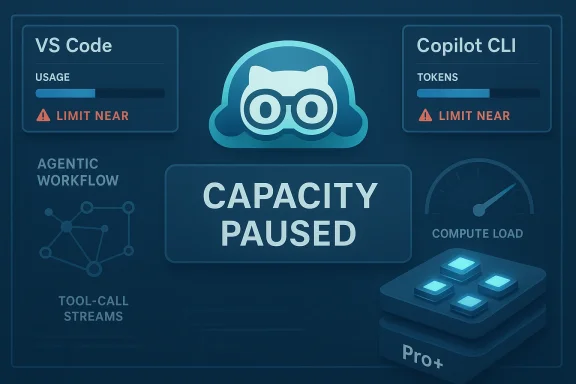
At the same time, GitHub has tightened usage limits for individual plans and made the limits visible inside the tools where users work. This is a subtle but important UX change. By moving the warning into VS Code and Copilot CLI, GitHub is trying to prevent the classic “surprise cutoff” experience that turns a quota issue into a trust issue. (github.blog)
The third major change is model availability. Opus models are no longer available in Pro, while Opus 4.7 remains available in Pro+. GitHub also says that Opus 4.5 and Opus 4.6 will be removed from Pro+ following its changelog updates. That means model access is becoming more tightly tiered, with the most capable frontier models reserved for the most expensive individual plan. (github.blog)
Agentic systems also create a compounding problem. They often use more tokens not because the user is inefficient, but because the product is doing more work on the user’s behalf. That means the more successful the agent becomes, the more likely it is to consume the very quota that enables it. This is the paradox GitHub is now trying to manage. (github.blog)
The company’s mention of tools such as /fleet as higher-token-consumption workflows is another clue. Those workflows are not inherently bad, but they are the kind of concurrent, multi-step operations that can overwhelm shared capacity if many users adopt them at once. GitHub is signaling that agentic scale has moved from a niche concern to a product-wide planning issue. (github.blog)
GitHub’s recent model history shows a pattern of continual adjustment. Earlier changelog posts documented model simplification and retirements, including the deprecation of select Anthropic and OpenAI models and the retirement of Opus 4.6 Fast for Pro+ users. This suggests the company is actively managing both capacity and model portfolio complexity rather than letting everything remain indefinitely available. (github.blog)
There is also a practical reason to prefer fewer default options: clearer operations. Too many overlapping models can create confusion for users and unpredictability for infrastructure teams. By narrowing the available set, GitHub can steer demand toward models it can support more reliably and economically. (github.blog)
This matters because developer tools work best when they are predictable. If an AI assistant suddenly refuses to complete a task after a long session, the user experience is not just inconvenient; it can break a workflow, waste a testing window, or interrupt a deployment task. Visibility gives users at least some chance to adapt before that happens. (github.blog)
The transparency shift also hints at a broader philosophy: GitHub wants the plan to feel bounded rather than mysterious. That is particularly important for individual users who may not have procurement teams, usage dashboards, or internal AI budgets to absorb the surprise. Better visibility is not the same as better value, but it is a meaningful improvement over opaque throttling. (github.blog)
Consumers are more likely to feel the change as a reduction in flexibility. A hobbyist, student, or independent developer may have chosen Pro because it seemed like a simple way to access advanced AI without needing to think about quotas. That simplicity is eroding. GitHub’s refund window and cancellation policy soften the blow, but they do not eliminate the frustration of mid-cycle policy changes. (github.blog)
Enterprises, by contrast, are likely to read this as confirmation that AI usage must be governed more carefully. Most large organizations already expect metering, policy control, and feature segmentation. In that sense, GitHub’s move may actually reinforce enterprise buyers’ confidence that Copilot is being operated with the seriousness of a capacity-managed platform rather than a consumer app. (github.blog)
But the opportunity is not as simple as “cheaper wins.” If a competitor offers looser limits, it must still fund the underlying model use somehow, and that can be difficult at scale. The more realistic advantage may come from better workflow design, better batching, or a narrower focus that reduces waste. In other words, efficiency may become the new differentiator. (github.blog)
GitHub’s own changes suggest it knows this. By emphasizing plan mode, model multipliers, and visible guardrails, the company is trying to reduce accidental waste while preserving room for high-value tasks. That is a sophisticated response, but it also admits that the market is entering a phase where product experience and unit economics are inseparable. (github.blog)
It also creates an opportunity to make usage more legible. Many AI products still fail because customers cannot predict when a workflow will cost too much or stop working. By exposing usage in the UI and separating premium requests from token guardrails, GitHub is giving users a more understandable operating model. That is a meaningful product improvement, even if it arrives alongside a price-like constraint.
There is also a risk that the new guardrails will create a two-tier frustration problem. Casual users may never notice the changes, but heavy users may hit limits precisely when they need the system most. If the limits interrupt productive coding sessions often enough, users could start viewing Copilot as unreliable rather than helpful. (github.blog)
A third concern is competitive leakage. If users perceive that frontier model access is too constrained, they may shift workloads to alternative tools or build hybrid workflows that dilute Copilot’s central role. That may not happen overnight, but it becomes more plausible when usage is tightly metered and high-end models are reserved for premium tiers. (github.blog)
The other thing to watch is how model access evolves. GitHub has already been actively simplifying and retiring model options in the Copilot ecosystem, which suggests that the product roadmap is moving toward fewer but better-managed choices. That may improve service quality, but it will also test whether users value breadth of choice or stability of access more highly. (github.blog)
For now, the key question is whether the market accepts that agentic AI can no longer be treated like a flat, unlimited feature. GitHub is effectively arguing that the future of Copilot requires metered capacity, visible guardrails, and clearer tiering. That may be true, but users will judge the decision less by the logic of infrastructure and more by whether their daily work still feels smooth, affordable, and worth the trade. (github.blog)
Source: The GitHub Blog Changes to GitHub Copilot Individual plans
 Overview
The new policy is not a minor pricing tweak. It is a direct response to a structural shift in how people are using Copilot, especially in agentic workflows where one request can fan out into many tool calls, subagents, and extended reasoning sessions. GitHub says that the original plan structure was never built for this kind of sustained, compute-heavy usage, and that without intervention, service quality would degrade for everyone. (github.blog)That framing matters because it reveals the central tension in modern AI products: the customer experience that feels magical on the surface can become extremely expensive behind the scenes. In the earlier era of code completion and lightweight chat, pricing could be anchored around relatively predictable token use. But once Copilot evolved into a more autonomous assistant capable of multi-step tasks, the cost profile changed in ways that subscription plans were not originally designed to absorb. (github.blog)
GitHub’s answer is a blend of capacity management and product segmentation. Existing users keep access, but new sign-ups are paused, usage thresholds are being tightened, and Opus models are no longer available in Pro while remaining in Pro+. GitHub also says Pro+ offers more than 5X the limits of Pro, which clearly positions the higher tier as the destination for users with heavier agent workloads. (github.blog)
This latest move is also consistent with the broader trajectory of Copilot over the last year. GitHub has steadily expanded model choices, agent capabilities, and premium-request billing, while also making targeted model retirements and plan adjustments. The platform has been moving toward a more explicit, usage-governed model for some time; this announcement simply makes that direction unavoidable for individual users. (github.blog)
Why this matters now
The timing is significant because Copilot’s agent mode and related workflows are becoming more central to the product identity. GitHub has been telling users that agents can tackle more complex coding tasks, but those same workflows are the ones most likely to consume large amounts of compute in concentrated bursts. In other words, the features that make Copilot more valuable are also the features that make the old pricing assumptions less sustainable. (github.blog)The Economics Behind the Change
At the heart of the announcement is a simple but uncomfortable reality: AI inference is expensive, and agentic use cases can be dramatically more costly than traditional chat or autocomplete. GitHub says that in some cases a handful of requests can generate costs that exceed the plan price, especially when users run long trajectories with parallelized tool use. That is the kind of cost curve that subscription businesses try hard to avoid. (github.blog)What makes this different from ordinary rate limiting is that GitHub is now distinguishing between premium requests and usage limits. Premium requests define which models you can access and how many requests you may make, while usage limits are token-based guardrails that cap total consumption within a time window. That means a user can still have premium requests remaining and yet be blocked by a usage ceiling, which is an important conceptual shift for customers accustomed to treating the plan as a simple monthly allowance. (github.blog)
The company’s explanation also suggests that the old plan boundaries blurred two different kinds of demand. Some usage is bursty but reasonable. Other usage is sustained, concurrent, and expensive in ways that are harder to predict. GitHub’s new guardrails are essentially an attempt to split those behaviors apart and charge for the heavier end of the spectrum more explicitly. (github.blog)
Token consumption is now the main story
The emphasis on token consumption is telling because it shows how deeply the business model has shifted toward metered AI usage. If the plan price stays fixed while demand grows through longer sessions, more tool calls, and more model retries, the provider has to choose between losses and limits. GitHub has chosen limits, and it has chosen to make those limits visible. (github.blog)- Session limits are about service reliability and peak load.
- Weekly limits are about total token consumption over time.
- Model multipliers make some models consume limits faster than others.
- Auto mode remains a fallback when weekly limits are hit.
- Pro+ is now the obvious upgrade path for power users. (github.blog)
What Changed for Individual Plans
The headline changes are straightforward, but the implications are broader than they first appear. GitHub has paused new sign-ups for Copilot Pro, Pro+, and Student plans, and it says existing customers are being protected from the service degradation that would otherwise come with unconstrained growth. That means the company is prioritizing continuity for the current base over expansion. (github.blog)At the same time, GitHub has tightened usage limits for individual plans and made the limits visible inside the tools where users work. This is a subtle but important UX change. By moving the warning into VS Code and Copilot CLI, GitHub is trying to prevent the classic “surprise cutoff” experience that turns a quota issue into a trust issue. (github.blog)
The third major change is model availability. Opus models are no longer available in Pro, while Opus 4.7 remains available in Pro+. GitHub also says that Opus 4.5 and Opus 4.6 will be removed from Pro+ following its changelog updates. That means model access is becoming more tightly tiered, with the most capable frontier models reserved for the most expensive individual plan. (github.blog)
What the new tier structure signals
The messaging leaves little doubt about GitHub’s intent. Pro is increasingly a lower-capacity entry plan, while Pro+ is being positioned as the plan for serious agentic use. That is a familiar software pattern, but in AI it feels sharper because the delta is not just convenience or support; it is directly tied to whether a user can complete a task without interruption. (github.blog)- Pro users get lower limits and fewer frontier model options.
- Pro+ users get over 5X the weekly limits.
- Student sign-ups are also paused for now.
- Model choice can disappear temporarily when weekly usage is exhausted.
- Auto model selection remains available as a fallback. (github.blog)
The Agentic Workflow Problem
GitHub is being unusually explicit that agentic workflows are the reason for the policy shift. That matters because it suggests the company is not merely reacting to generic popularity, but to a specific kind of usage pattern that expands quickly once users discover autonomous or semi-autonomous coding assistance. Long-running sessions and parallelized sub-tasks are exactly where inference costs can balloon. (github.blog)Agentic systems also create a compounding problem. They often use more tokens not because the user is inefficient, but because the product is doing more work on the user’s behalf. That means the more successful the agent becomes, the more likely it is to consume the very quota that enables it. This is the paradox GitHub is now trying to manage. (github.blog)
The company’s mention of tools such as /fleet as higher-token-consumption workflows is another clue. Those workflows are not inherently bad, but they are the kind of concurrent, multi-step operations that can overwhelm shared capacity if many users adopt them at once. GitHub is signaling that agentic scale has moved from a niche concern to a product-wide planning issue. (github.blog)
Why parallelism is expensive
Parallel workflows are attractive because they reduce latency and often improve output quality. But each thread of parallel work is another stream of tokens, another chain of model calls, and another load on infrastructure. When multiplied across a large user base, that architecture can outgrow a flat subscription model very quickly. (github.blog)- More agents mean more simultaneous tokens.
- More tokens mean more cost pressure.
- More cost pressure leads to tighter controls.
- Tighter controls can reduce user friction only if they are well explained.
- Poorly explained controls can erode trust even when technically justified.
Model Availability and Tiering
The model changes are just as important as the quota changes. By removing Opus from Pro and keeping Opus 4.7 in Pro+, GitHub is aligning model access more tightly with willingness to pay. That creates a clearer upgrade incentive, but it also raises the stakes for anyone who relied on Pro as an all-purpose plan. (github.blog)GitHub’s recent model history shows a pattern of continual adjustment. Earlier changelog posts documented model simplification and retirements, including the deprecation of select Anthropic and OpenAI models and the retirement of Opus 4.6 Fast for Pro+ users. This suggests the company is actively managing both capacity and model portfolio complexity rather than letting everything remain indefinitely available. (github.blog)
There is also a practical reason to prefer fewer default options: clearer operations. Too many overlapping models can create confusion for users and unpredictability for infrastructure teams. By narrowing the available set, GitHub can steer demand toward models it can support more reliably and economically. (github.blog)
The user experience trade-off
For end users, model tiering is both helpful and frustrating. It is helpful because the product becomes more predictable and the premium tier is easier to understand. It is frustrating because the line between “available” and “not available” now depends not just on capability, but on plan status and token budget. (github.blog)- Model names become a proxy for pricing power.
- Capabilities become stratified by subscription tier.
- Faster models may not always be the most economical choice.
- Auto mode becomes more important as a safety valve.
- Higher-tier users may receive a more stable frontier-model experience.
Transparency Inside VS Code and Copilot CLI
One of the smarter parts of the announcement is the decision to surface usage information in VS Code and Copilot CLI before users hit the wall. That turns a backend policy into a front-end coaching mechanism. Instead of letting the first sign of trouble be a hard stop, GitHub is trying to let users steer away from it in real time. (github.blog)This matters because developer tools work best when they are predictable. If an AI assistant suddenly refuses to complete a task after a long session, the user experience is not just inconvenient; it can break a workflow, waste a testing window, or interrupt a deployment task. Visibility gives users at least some chance to adapt before that happens. (github.blog)
The transparency shift also hints at a broader philosophy: GitHub wants the plan to feel bounded rather than mysterious. That is particularly important for individual users who may not have procurement teams, usage dashboards, or internal AI budgets to absorb the surprise. Better visibility is not the same as better value, but it is a meaningful improvement over opaque throttling. (github.blog)
Practical ways users will adapt
GitHub recommends several behaviors to lower the chance of hitting limits, including choosing models with smaller multipliers, using plan mode, and reducing parallel workflows. These are not just support tips; they are hints about how to work within the product’s cost model. The advice is effectively teaching users to consume AI more efficiently. (github.blog)- Prefer lighter models for routine tasks.
- Reserve frontier models for harder problems.
- Use plan mode to compress wasted iterations.
- Avoid unnecessary concurrency.
- Upgrade to Pro+ if consistent heavy use is required.
Customer Impact: Consumers Versus Enterprises
The direct announcement is aimed at individual plan users, but the ripple effects will be different for consumers and enterprises. For individual subscribers, the impact is immediate and personal: fewer sign-up options, tighter limits, and less access to the most capable models. For enterprise customers, the news is more indirect, but it still matters because individual adoption often shapes expectations across the broader organization. (github.blog)Consumers are more likely to feel the change as a reduction in flexibility. A hobbyist, student, or independent developer may have chosen Pro because it seemed like a simple way to access advanced AI without needing to think about quotas. That simplicity is eroding. GitHub’s refund window and cancellation policy soften the blow, but they do not eliminate the frustration of mid-cycle policy changes. (github.blog)
Enterprises, by contrast, are likely to read this as confirmation that AI usage must be governed more carefully. Most large organizations already expect metering, policy control, and feature segmentation. In that sense, GitHub’s move may actually reinforce enterprise buyers’ confidence that Copilot is being operated with the seriousness of a capacity-managed platform rather than a consumer app. (github.blog)
Different users, different pain points
The consumer story is about surprise and loss of access. The enterprise story is about planning and compliance. Both groups care about reliability, but only individual users are likely to experience the changes as a personal downgrade. That asymmetry helps explain why the announcement spends so much time apologizing to customers while still defending the decision as necessary. (github.blog)- Consumers lose easy access to premium models.
- Students lose a frictionless on-ramp, at least temporarily.
- Enterprises gain a clearer sign that AI capacity is not unlimited.
- Heavy users may need to rethink how they structure workflows.
- Budget-sensitive teams may reassess whether Copilot remains the right fit.
Competitive Implications
From a competitive standpoint, GitHub’s move is both defensive and revealing. It shows that even a market leader with strong distribution must confront the cost pressure of agentic AI. That creates a rare opening for rivals that can market themselves as more generous, more predictable, or more specialized. (github.blog)But the opportunity is not as simple as “cheaper wins.” If a competitor offers looser limits, it must still fund the underlying model use somehow, and that can be difficult at scale. The more realistic advantage may come from better workflow design, better batching, or a narrower focus that reduces waste. In other words, efficiency may become the new differentiator. (github.blog)
GitHub’s own changes suggest it knows this. By emphasizing plan mode, model multipliers, and visible guardrails, the company is trying to reduce accidental waste while preserving room for high-value tasks. That is a sophisticated response, but it also admits that the market is entering a phase where product experience and unit economics are inseparable. (github.blog)
What rivals can learn
Rivals should pay attention to how GitHub is segmenting demand. The company is not simply blocking users; it is differentiating between casual and heavy use, and then using plan design to push users toward the appropriate tier. That is a playbook other AI developer tools may soon copy. (github.blog)- Simpler plans may win early adopters.
- Better transparency may reduce support burden.
- Tiered model access can protect margins.
- Agentic features require tighter economics than autocomplete ever did.
- Users will increasingly compare reliability, not just raw capability.
Strengths and Opportunities
GitHub’s announcement is disruptive, but it also contains several strengths that could help the Copilot ecosystem mature into something more durable. The strongest element is that the company is naming the problem openly instead of pretending the existing model can absorb unlimited agentic demand. That honesty may frustrate users now, but it could preserve trust over time if the company follows through with clearer limits and better capacity planning. (github.blog)It also creates an opportunity to make usage more legible. Many AI products still fail because customers cannot predict when a workflow will cost too much or stop working. By exposing usage in the UI and separating premium requests from token guardrails, GitHub is giving users a more understandable operating model. That is a meaningful product improvement, even if it arrives alongside a price-like constraint.
- Greater transparency in VS Code and Copilot CLI.
- More predictable reliability for existing customers.
- Cleaner plan differentiation between Pro and Pro+.
- Better protection against runaway infrastructure costs.
- Clearer guidance for power users on how to optimize workflows.
- Potentially stronger sustainability for the Copilot business.
- A more realistic pricing framework for agentic AI use.
Risks and Concerns
The biggest risk is trust erosion. Users who signed up expecting a straightforward subscription may feel blindsided by a simultaneous pause in new sign-ups, lower limits, and reduced model access. Even if GitHub’s reasoning is valid, the timing and tone of such changes can make customers feel like they are paying more or getting less without warning. (github.blog)There is also a risk that the new guardrails will create a two-tier frustration problem. Casual users may never notice the changes, but heavy users may hit limits precisely when they need the system most. If the limits interrupt productive coding sessions often enough, users could start viewing Copilot as unreliable rather than helpful. (github.blog)
A third concern is competitive leakage. If users perceive that frontier model access is too constrained, they may shift workloads to alternative tools or build hybrid workflows that dilute Copilot’s central role. That may not happen overnight, but it becomes more plausible when usage is tightly metered and high-end models are reserved for premium tiers. (github.blog)
The hardest trade-offs
GitHub is trying to balance reliability, affordability, and product growth at the same time. Those goals are not always compatible. The tighter the guardrails, the more stable the platform may become; the more restrictive they feel, the more likely users are to resent the product. (github.blog)- Surprise limits can feel punitive.
- Model retirements can disrupt established workflows.
- Paused sign-ups may slow adoption momentum.
- Heavy users may question plan value.
- Support and refunds may become a short-term operational burden.
- Competitors may use the announcement as a marketing wedge.
Looking Ahead
What happens next will depend on whether GitHub can turn a reactive policy change into a stable operating model. If the company uses the next few months to fine-tune limits, improve communication, and clarify how Pro+ differs from Pro in real-world use, the transition may be absorbed with relatively little long-term damage. If not, the change could become a reference point for complaints about Copilot’s affordability and predictability. (github.blog)The other thing to watch is how model access evolves. GitHub has already been actively simplifying and retiring model options in the Copilot ecosystem, which suggests that the product roadmap is moving toward fewer but better-managed choices. That may improve service quality, but it will also test whether users value breadth of choice or stability of access more highly. (github.blog)
For now, the key question is whether the market accepts that agentic AI can no longer be treated like a flat, unlimited feature. GitHub is effectively arguing that the future of Copilot requires metered capacity, visible guardrails, and clearer tiering. That may be true, but users will judge the decision less by the logic of infrastructure and more by whether their daily work still feels smooth, affordable, and worth the trade. (github.blog)
- Monitor whether new sign-ups remain paused or resume later.
- Watch for further model retirements in Pro+.
- Track whether GitHub adjusts session and weekly limits again.
- See whether Pro+ adoption increases among power users.
- Observe whether competitors respond with more generous AI coding plans.
Source: The GitHub Blog Changes to GitHub Copilot Individual plans
