

Microsoft’s GitHub has drawn a hard line under the explosion of agentic coding demand: new sign-ups for Copilot Pro, Copilot Pro+, and Copilot Student are now paused, while existing users face tighter limits and a reshuffled model lineup. The move, announced by GitHub product vice president Joe Binder on April 20, 2026, is the clearest sign yet that the economics of AI-assisted software development are colliding with the reality of infrastructure costs. It also underscores a broader industry problem: the software agents everyone spent last year celebrating are arriving faster than the cloud budgets built to support them. (github.blog)
GitHub Copilot began as a relatively straightforward AI pair programmer: a tool that suggested code completions, answered questions, and helped developers move faster inside familiar environments such as VS Code and GitHub’s own interfaces. Over time, though, the product shifted from autocomplete toward agentic workflows, where the assistant can plan, execute, revise, and continue longer tasks with far more context than a simple prompt-response loop. That shift matters because it changes not just the feature set, but the underlying compute economics. GitHub’s own explanation now says these long-running, parallelized sessions can consume far more resources than the original plan structure was built to support. (github.blog)
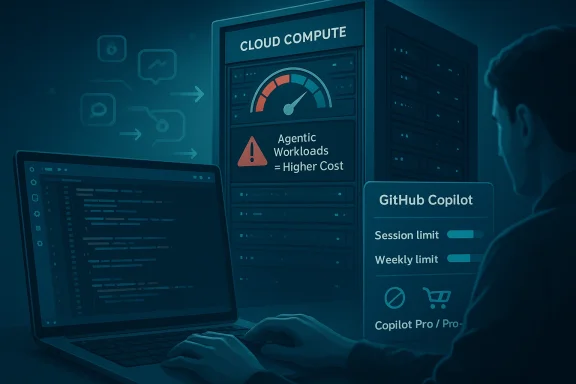
The company’s current pricing and usage model had already been moving toward consumption controls before this week’s pause. In June 2025, GitHub said monthly premium request allowances would be enforced for paid Copilot plans, while base capabilities such as code completions and some chat interactions remained broadly available. By the time GitHub documented its current usage-limits framework, Copilot had two distinct throttles: a session limit and a 7-day weekly limit. That is a classic sign of a product trying to reconcile predictable subscription pricing with highly variable backend spend. (github.blog)
At the same time, the wider AI tooling market has been converging on a similar conclusion: agentic coding is expensive. Google has been touting generous but still bounded usage for Gemini CLI and Gemini Code Assist, while Anthropic and OpenAI have both taken steps to balance demand and cost through rate limits, spend controls, and feature gating. None of this is happening in a vacuum. The industry has spent the last year marketing autonomous software workflows as the next great leap in productivity, but the infrastructure bill has not become any less real just because the demos look magical. (blog.google)
There is also a commercial tension here that is easy to miss. GitHub Copilot’s consumer and student plans were positioned as accessible entry points, but the emergence of power users running multi-step, multi-agent workflows can quickly transform those plans into loss leaders. If a handful of sessions can cost more than the plan price, as GitHub now acknowledges in effect, then the company has to choose between absorbing the hit, lowering reliability, or rewriting the plan. GitHub has chosen all three: pause growth, constrain demand, and move users toward a more expensive tier structure. (github.blog)
The pause applies to the individual plans most likely to be used by enthusiasts, students, and independent developers. That is important because these users tend to be the most visible evangelists for Copilot, and they also often run the most variable workloads. When a product becomes more agentic, the difference between casual usage and heavy usage gets much larger, much faster. (github.blog)
GitHub has also been explicit that free Copilot remains available. That softens the optics somewhat, but it does not erase the fact that the paid entry ladder has changed materially. If you were considering Copilot as a low-friction upgrade, the new reality is that access is now constrained by both availability and limits. (github.blog)
This is not merely a product tweak; it is a monetization strategy disguised as a reliability measure. Session limits are a fairness mechanism, but weekly limits are where the economic pressure becomes obvious. They allow GitHub to cap the worst-case cost of the heaviest users without immediately changing the sticker price of the subscription itself. (github.blog)
GitHub says the limits will be visible in VS Code and Copilot CLI, which is a subtle but useful improvement. Transparency matters because the old complaint with AI services has often been surprise: users do not know when they are near a cap, then hit one mid-task. Making the limit visible is an admission that the old “just ask and it works” model is over. (github.blog)
The premium-request multiplier system is effectively a bridge between the old subscription model and a more granular consumption model. For ordinary users, that may feel like a technical detail. For GitHub, it is a defensive wall around the most expensive workloads. (github.blog)
The broader lesson is that AI products are moving from “all-you-can-eat” to pay according to how hard the model had to work. That is a more honest business model, but it is also a less comforting one for customers who thought they were buying predictable access. (github.blog)
This also explains why a request-based model can become misleading. If a single request launches a sequence of tool calls and model invocations, the apparent simplicity of billing “per request” hides the real backend cost. In finance terms, it is the difference between a flat fee and a variable-cost service with unpredictable tail risk. (github.blog)
For developers, the experience can feel inconsistent. One task may complete cheaply and quickly, while another burns through the session window at speed. That is not necessarily because the assistant is broken; it is because the workload itself is far more complex than an autocomplete suggestion. The more autonomous the agent, the more expensive the autonomy. (github.blog)
The key issue is that users experience Copilot as a service, while GitHub must pay for it as a variable compute workload. When a small share of users runs large-scale agent jobs, the average price can look fine while the marginal cost becomes toxic. That is how you end up with pausing sign-ups even when the product is still highly desired. (github.blog)
This is not unique to GitHub. Anthropic documents rate limits and spend limits tied to usage tiers, while OpenAI has been making Codex pricing more flexible and more explicitly usage-based for some team configurations. The pattern is consistent: the AI industry is converging on constraints because unconstrained agent use is not economically stable at scale.
But reliability measures often feel punitive to users who were not abusing the system. That is the trade-off. Once a product reaches this point, the company cannot optimize for individual convenience and universal availability at the same time. It has to choose which pain to spread around and which pain to concentrate. (github.blog)
A useful way to read GitHub’s move is not as retreat, but as triage. The company is trying to keep the experience usable for committed customers while preventing the most expensive behavior from consuming all available capacity. That is a rational move, even if it is a frustrating one. (github.blog)
Anthropic, meanwhile, has long documented rate and spend limits in its API and help-center materials. OpenAI has also moved toward more explicit pay-as-you-go and usage-bound setups in some offerings. That alignment across vendors suggests a broader industry consensus: the era of generous, loosely constrained AI access is giving way to metered consumption.
The pause also creates room for rivals to market stability as a differentiator. If one vendor is tightening the screws while another advertises larger allowances or more transparent spend controls, buyers will notice. That is particularly true for independent developers and smaller teams that are more sensitive to disruption than large enterprises. (blog.google)
At the enterprise level, though, the story is more nuanced. Organizations generally care less about consumer-style sign-up funnels and more about predictable service, policy control, and procurement clarity. If GitHub can prove it is protecting reliability for paying teams and enterprises, the pause may be viewed internally as a necessary sacrifice rather than a sign of weakness. (github.blog)
If competitors can offer more graceful degradation, better transparency, or cheaper access to less expensive models for routine tasks, they may win users who are not tied to GitHub by habit or enterprise policy. If not, GitHub’s advantage as the default developer platform may continue to outweigh temporary frustrations. The key point is that price and reliability are now strategic weapons, not just operational details. (github.blog)
Enterprises, by contrast, often have the budget and governance to absorb such changes. What matters more to them is whether access remains predictable across the organization and whether the vendor can justify its controls. In that sense, GitHub’s move may actually strengthen enterprise credibility even as it annoys individual consumers. (github.blog)
There is also a subtle channel-shift effect. If individual plans become less attractive, some users will migrate upward into business offerings or move to alternative tools entirely. GitHub probably knows that risk, but it may be preferable to a world where the cheapest plans attract the heaviest users and sink the margin structure. (github.blog)
That said, student programs are also among the easiest to abuse when demand is high and verification is imperfect. GitHub’s note that it recently had to suspend free trials due to abuse suggests the company saw enough pressure to justify intervention. In that context, the pause looks less like a philosophical shift and more like an emergency brake.
The educational market is especially sensitive to perceived fairness. If students believe they are being limited because the vendor oversold capacity, sentiment can sour quickly. But if the company later relaunches access with clearer guardrails, the damage may be temporary. (github.blog)
That advice may seem obvious, but it marks a deeper cultural shift. Developers were invited to think of AI assistance as frictionless, and now they are being taught to budget it. Convenience is giving way to resource awareness, whether users like it or not. (github.blog)
The broader market will be watching for two things in particular: whether AI coding tools can offer predictable economics at high usage, and whether vendors are willing to be more explicit about what “unlimited” really means. The most likely outcome is not a return to the old model, but a gradual normalization of quota-based, model-aware access that looks more like cloud computing and less like a subscription buffet. That may be less glamorous, but it is probably more sustainable. (github.blog)
Source: theregister.com Microsoft's GitHub suspends Copilot account sign-ups
 Background
GitHub Copilot began as a relatively straightforward AI pair programmer: a tool that suggested code completions, answered questions, and helped developers move faster inside familiar environments such as VS Code and GitHub’s own interfaces. Over time, though, the product shifted from autocomplete toward agentic workflows, where the assistant can plan, execute, revise, and continue longer tasks with far more context than a simple prompt-response loop. That shift matters because it changes not just the feature set, but the underlying compute economics. GitHub’s own explanation now says these long-running, parallelized sessions can consume far more resources than the original plan structure was built to support. (github.blog)The company’s current pricing and usage model had already been moving toward consumption controls before this week’s pause. In June 2025, GitHub said monthly premium request allowances would be enforced for paid Copilot plans, while base capabilities such as code completions and some chat interactions remained broadly available. By the time GitHub documented its current usage-limits framework, Copilot had two distinct throttles: a session limit and a 7-day weekly limit. That is a classic sign of a product trying to reconcile predictable subscription pricing with highly variable backend spend. (github.blog)
At the same time, the wider AI tooling market has been converging on a similar conclusion: agentic coding is expensive. Google has been touting generous but still bounded usage for Gemini CLI and Gemini Code Assist, while Anthropic and OpenAI have both taken steps to balance demand and cost through rate limits, spend controls, and feature gating. None of this is happening in a vacuum. The industry has spent the last year marketing autonomous software workflows as the next great leap in productivity, but the infrastructure bill has not become any less real just because the demos look magical. (blog.google)
There is also a commercial tension here that is easy to miss. GitHub Copilot’s consumer and student plans were positioned as accessible entry points, but the emergence of power users running multi-step, multi-agent workflows can quickly transform those plans into loss leaders. If a handful of sessions can cost more than the plan price, as GitHub now acknowledges in effect, then the company has to choose between absorbing the hit, lowering reliability, or rewriting the plan. GitHub has chosen all three: pause growth, constrain demand, and move users toward a more expensive tier structure. (github.blog)
What GitHub Changed
The most immediate change is the simplest to understand: GitHub has stopped accepting new subscriptions for Copilot Pro, Pro+, and Student plans. That means the company is not just tightening a throttle; it is actively closing the door on new individual customers while it recalibrates the service for existing ones. For a subscription product, pausing sign-ups is a blunt but telling signal that demand has outgrown the current operating model. (github.blog)The Sign-up Pause
GitHub says the pause is meant to help the company “serve existing customers more effectively,” and that language is doing a lot of work. On the surface, it sounds like a customer-service decision. In practice, it is also a capacity-management decision, because new entrants would compete for the same pool of inference resources and raise the risk of degraded performance. (github.blog)The pause applies to the individual plans most likely to be used by enthusiasts, students, and independent developers. That is important because these users tend to be the most visible evangelists for Copilot, and they also often run the most variable workloads. When a product becomes more agentic, the difference between casual usage and heavy usage gets much larger, much faster. (github.blog)
GitHub has also been explicit that free Copilot remains available. That softens the optics somewhat, but it does not erase the fact that the paid entry ladder has changed materially. If you were considering Copilot as a low-friction upgrade, the new reality is that access is now constrained by both availability and limits. (github.blog)
Tightened Usage Limits
GitHub is also tightening session and weekly usage limits for individual plans. The company says session limits help preserve availability during peak periods, while weekly limits control for “parallelized, long-trajectory requests” that can become expensive. In other words, GitHub is treating long-running agent sessions less like ordinary chat and more like a resource-intensive workload that needs to be budgeted. (github.blog)This is not merely a product tweak; it is a monetization strategy disguised as a reliability measure. Session limits are a fairness mechanism, but weekly limits are where the economic pressure becomes obvious. They allow GitHub to cap the worst-case cost of the heaviest users without immediately changing the sticker price of the subscription itself. (github.blog)
GitHub says the limits will be visible in VS Code and Copilot CLI, which is a subtle but useful improvement. Transparency matters because the old complaint with AI services has often been surprise: users do not know when they are near a cap, then hit one mid-task. Making the limit visible is an admission that the old “just ask and it works” model is over. (github.blog)
Model Availability Changes
The most consequential product change may be the removal of Anthropic Opus 4.5 and 4.6 from Pro+ subscriptions, alongside the exclusion of Opus models from Pro plans. GitHub says Opus 4.7 remains available in Pro+, Teams, and Enterprise, with a temporary 7.5× premium request multiplier through April 30, 2026. That is a strong hint that GitHub wants fewer casual users on the most expensive models, even as it preserves access for higher-paying customers. (github.blog)Model Tiering and Cost Pressure
This kind of model reshuffling is one of the clearest signs that pricing is inching closer to token-based economics even if the product still presents itself as request-based. GitHub says Copilot currently bills per request, but a request can become much more expensive than expected if it drives the backend into a long chain of reasoning or tool use. That mismatch is exactly where flat-rate subscriptions start breaking down under agentic load. (github.blog)The premium-request multiplier system is effectively a bridge between the old subscription model and a more granular consumption model. For ordinary users, that may feel like a technical detail. For GitHub, it is a defensive wall around the most expensive workloads. (github.blog)
The broader lesson is that AI products are moving from “all-you-can-eat” to pay according to how hard the model had to work. That is a more honest business model, but it is also a less comforting one for customers who thought they were buying predictable access. (github.blog)
Why Agentic Workloads Broke the Math
GitHub’s explanation centers on one phrase: agentic workflows. That matters because the company is not blaming a temporary spike in popularity alone; it is blaming a structural change in how customers use the service. Agents chain together multiple prompts, run tools, execute parallel steps, and keep going until the task is done. That changes the cost profile from a short interaction to a potentially open-ended compute event. (github.blog)Long-Running Sessions Are Different
A traditional coding assistant responds to a question and then goes quiet. An agentic assistant might inspect files, propose changes, retry failed steps, and continue operating across a longer horizon. The cost difference is not just linear; it compounds when multiple sessions run in parallel. GitHub’s warning about “parallelized, long-trajectory requests” is a direct acknowledgment of that compounding effect. (github.blog)This also explains why a request-based model can become misleading. If a single request launches a sequence of tool calls and model invocations, the apparent simplicity of billing “per request” hides the real backend cost. In finance terms, it is the difference between a flat fee and a variable-cost service with unpredictable tail risk. (github.blog)
For developers, the experience can feel inconsistent. One task may complete cheaply and quickly, while another burns through the session window at speed. That is not necessarily because the assistant is broken; it is because the workload itself is far more complex than an autocomplete suggestion. The more autonomous the agent, the more expensive the autonomy. (github.blog)
Token Economics and the Hidden Bill
GitHub’s usage policy effectively reveals the hidden machinery behind the product. Weekly limits cap token consumption, and premium requests apply model-specific multipliers. That architecture makes sense if the company wants to account for different model costs, but it also tells us the business has outgrown its original flat-rate assumptions.The key issue is that users experience Copilot as a service, while GitHub must pay for it as a variable compute workload. When a small share of users runs large-scale agent jobs, the average price can look fine while the marginal cost becomes toxic. That is how you end up with pausing sign-ups even when the product is still highly desired. (github.blog)
This is not unique to GitHub. Anthropic documents rate limits and spend limits tied to usage tiers, while OpenAI has been making Codex pricing more flexible and more explicitly usage-based for some team configurations. The pattern is consistent: the AI industry is converging on constraints because unconstrained agent use is not economically stable at scale.
What This Means for Reliability
There is a consumer-facing upside to limits, too. GitHub says they are intended to protect reliability and prevent degraded service for everyone. That claim is credible because shared inference capacity really can collapse under heavy load, especially when a subset of users is driving long sessions or parallel agent workflows. (github.blog)But reliability measures often feel punitive to users who were not abusing the system. That is the trade-off. Once a product reaches this point, the company cannot optimize for individual convenience and universal availability at the same time. It has to choose which pain to spread around and which pain to concentrate. (github.blog)
A useful way to read GitHub’s move is not as retreat, but as triage. The company is trying to keep the experience usable for committed customers while preventing the most expensive behavior from consuming all available capacity. That is a rational move, even if it is a frustrating one. (github.blog)
The Competitive Landscape
GitHub is not acting alone, and that is perhaps the most important competitive clue in the whole story. Across the sector, AI vendors have been tightening limits, refining billing, and trying to steer users toward more sustainable consumption patterns. The race is no longer just about who has the smartest model; it is about who can afford to deliver the smartest model at scale. (blog.google)Google, Anthropic, and OpenAI Are Sending Similar Signals
Google’s Gemini CLI launch emphasized generous usage caps for individual developers, but still framed those caps explicitly as finite allowances. Google has also since raised limits for some paid subscribers, reinforcing the idea that usage tiering is now part of product strategy rather than an afterthought. The message is clear: free or low-cost access remains a growth lever, but only within carefully managed bounds. (blog.google)Anthropic, meanwhile, has long documented rate and spend limits in its API and help-center materials. OpenAI has also moved toward more explicit pay-as-you-go and usage-bound setups in some offerings. That alignment across vendors suggests a broader industry consensus: the era of generous, loosely constrained AI access is giving way to metered consumption.
Why GitHub’s Move Matters More
GitHub’s decision matters because Copilot sits at the intersection of developer workflow and platform power. It is not just an app; it is a default tool inside the world’s most visible software collaboration ecosystem. When GitHub changes access rules, developers feel it immediately, and competitors can use that moment to argue they offer a better balance of access, price, and predictability. (github.blog)The pause also creates room for rivals to market stability as a differentiator. If one vendor is tightening the screws while another advertises larger allowances or more transparent spend controls, buyers will notice. That is particularly true for independent developers and smaller teams that are more sensitive to disruption than large enterprises. (blog.google)
At the enterprise level, though, the story is more nuanced. Organizations generally care less about consumer-style sign-up funnels and more about predictable service, policy control, and procurement clarity. If GitHub can prove it is protecting reliability for paying teams and enterprises, the pause may be viewed internally as a necessary sacrifice rather than a sign of weakness. (github.blog)
The Real Competitive Battleground
The deeper competitive fight is no longer “who has AI coding.” It is “who can keep AI coding economical once agents start doing real work.” That is a much harder problem, because the answer depends on model efficiency, caching, routing, quotas, user behavior, and cloud capacity all at once. GitHub is merely the latest vendor to show how messy that stack becomes when it leaves the demo stage. (github.blog)If competitors can offer more graceful degradation, better transparency, or cheaper access to less expensive models for routine tasks, they may win users who are not tied to GitHub by habit or enterprise policy. If not, GitHub’s advantage as the default developer platform may continue to outweigh temporary frustrations. The key point is that price and reliability are now strategic weapons, not just operational details. (github.blog)
What Enterprises and Individual Developers Should Read Into This
For enterprise buyers, the most important takeaway is that GitHub is increasingly signaling a tiered reliability model. The company is protecting existing paid users by reducing open-ended pressure on the system. That is likely to reassure procurement teams that Copilot is being managed as an enterprise service rather than a consumer novelty. (github.blog)Enterprise Stability vs. Consumer Friction
Individual developers will feel the disruption first. If you are on Pro or Pro+, the new limits may force you to adapt your workflow, choose lighter models, or upgrade. That is especially likely for power users who rely on Copilot for long debugging sessions, refactoring runs, or agent-assisted experimentation. (github.blog)Enterprises, by contrast, often have the budget and governance to absorb such changes. What matters more to them is whether access remains predictable across the organization and whether the vendor can justify its controls. In that sense, GitHub’s move may actually strengthen enterprise credibility even as it annoys individual consumers. (github.blog)
There is also a subtle channel-shift effect. If individual plans become less attractive, some users will migrate upward into business offerings or move to alternative tools entirely. GitHub probably knows that risk, but it may be preferable to a world where the cheapest plans attract the heaviest users and sink the margin structure. (github.blog)
The Education Angle
The pause on Student sign-ups deserves special attention because it touches the future pipeline of developer adoption. Students are not just customers; they are tomorrow’s professional users, and they shape habits early. Cutting off or constraining that access is a short-term operational win but potentially a long-term branding risk. (github.blog)That said, student programs are also among the easiest to abuse when demand is high and verification is imperfect. GitHub’s note that it recently had to suspend free trials due to abuse suggests the company saw enough pressure to justify intervention. In that context, the pause looks less like a philosophical shift and more like an emergency brake.
The educational market is especially sensitive to perceived fairness. If students believe they are being limited because the vendor oversold capacity, sentiment can sour quickly. But if the company later relaunches access with clearer guardrails, the damage may be temporary. (github.blog)
What Developers Can Do Now
For day-to-day users, the practical response is to treat Copilot more like a metered cloud service than a limitless assistant. That means watching the visible usage counters, favoring smaller models for simpler tasks, and avoiding unnecessary parallel workflows. GitHub itself recommends exactly those behaviors as ways to reduce the chance of hitting limits. (github.blog)That advice may seem obvious, but it marks a deeper cultural shift. Developers were invited to think of AI assistance as frictionless, and now they are being taught to budget it. Convenience is giving way to resource awareness, whether users like it or not. (github.blog)
Strengths and Opportunities
GitHub’s move is disruptive, but it also reveals a company trying to be candid about a hard operational problem rather than quietly degrading the service. If handled well, the change could reset expectations, improve predictability, and preserve the quality of Copilot for the people who depend on it most. It also creates a path toward a more honest AI pricing structure, even if that path is uncomfortable in the short run.- Better reliability for existing customers if capacity is reserved more carefully.
- Clearer limits in VS Code and Copilot CLI should reduce surprise throttling.
- Stronger cost control may prevent extreme usage from distorting the entire plan.
- More transparent tiering could make plan selection easier for power users.
- Enterprise reassurance may improve if GitHub proves it can manage load responsibly.
- Room for product redesign as GitHub tests more sustainable billing models.
- Competitive clarity may help the market settle on realistic AI assistant economics.
Risks and Concerns
The most obvious risk is reputational: pausing new paid sign-ups can look like a product under stress, not a product in control. There is also a real risk of alienating students, independent developers, and smaller teams who may feel they are being asked to pay more or accept less without much warning. In a market where alternatives are abundant, that friction can push users elsewhere.- User frustration from tighter limits and model removals.
- Brand damage if the pause is seen as a capacity failure.
- Customer churn among Pro and Pro+ subscribers who value predictability.
- Education-market backlash from pausing student access.
- Competitive leakage as users sample rival AI coding tools.
- Confusion over billing if request-based and token-based logic diverge further.
- Trust erosion if users believe the service was oversold relative to infrastructure.
Looking Ahead
What happens next will depend on whether GitHub treats this as a temporary stabilization step or the first stage of a more permanent pricing reset. If the company can better align usage, model selection, and billing, it may reopen sign-ups with a cleaner story and fewer surprises. If not, the pause could become a recurring feature of the Copilot business rather than a one-time corrective. (github.blog)The broader market will be watching for two things in particular: whether AI coding tools can offer predictable economics at high usage, and whether vendors are willing to be more explicit about what “unlimited” really means. The most likely outcome is not a return to the old model, but a gradual normalization of quota-based, model-aware access that looks more like cloud computing and less like a subscription buffet. That may be less glamorous, but it is probably more sustainable. (github.blog)
- Reopening of Copilot Pro and Pro+ sign-ups, if capacity stabilizes.
- Further adjustments to weekly limits or premium request multipliers.
- A possible expansion of lower-cost model options for routine tasks.
- New guidance on how Copilot plans will handle agentic workloads.
- More aggressive competition on AI developer tooling prices and allowances.
Source: theregister.com Microsoft's GitHub suspends Copilot account sign-ups
