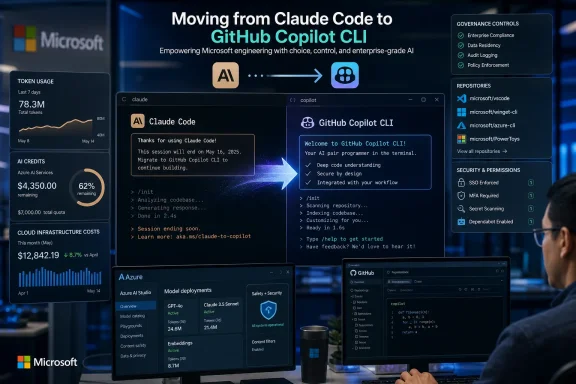
Microsoft reportedly ended most direct Claude Code licenses in its Experiences and Devices organization by June 30, steering affected developers toward GitHub Copilot CLI instead. The Verge first reported the change in May, and subsequent coverage described it as a consolidation around Microsoft’s own developer tooling rather than a break with Anthropic.
That distinction matters. GitHub’s documentation says Copilot CLI can run in a terminal, read and modify project files with permission, and use models from multiple providers. Microsoft can therefore direct internal usage through a product it owns and administers while still offering Anthropic models where they make sense.
The reported license change does not mean Claude has disappeared from Microsoft’s AI stack. Microsoft Foundry continues to list Claude models, including Azure-hosted and Anthropic-hosted options, with Anthropic remaining the seller and operator. Customers can still deploy Claude for supported workloads through the Foundry catalog.
For Windows developers and IT teams, the more immediate point is operational: the preferred internal interface appears to be Copilot CLI, not Anthropic’s standalone Claude Code client. GitHub says Copilot CLI is available on Windows as well as macOS and Linux, and organizations can apply Copilot policies before enabling it for users.
That gives Microsoft a tighter path for identity, policy, telemetry, billing, and product feedback. It also lets the company make Copilot CLI the proving ground for the agentic coding experience it sells to enterprises.
There are nevertheless straightforward financial incentives. Paying for a separate third-party coding product while owning GitHub Copilot creates duplicated software spend and fragmented internal tooling. A June 30 deadline also coincided with Microsoft’s fiscal year-end, making the move a practical time to retire or renegotiate licenses.
The broader enterprise lesson is less dramatic: AI coding tools need measurable controls. Agentic terminal tools can generate substantial model usage because they plan, call tools, inspect repositories, retry work, and sometimes use multiple agents. License counts alone are not enough to predict cost; token consumption, model selection, task type, concurrency, and guardrails matter more.

 varindia.com
That distinction matters. GitHub’s documentation says Copilot CLI can run in a terminal, read and modify project files with permission, and use models from multiple providers. Microsoft can therefore direct internal usage through a product it owns and administers while still offering Anthropic models where they make sense.
 A tool decision, not a Claude exit
The reported license change does not mean Claude has disappeared from Microsoft’s AI stack. Microsoft Foundry continues to list Claude models, including Azure-hosted and Anthropic-hosted options, with Anthropic remaining the seller and operator. Customers can still deploy Claude for supported workloads through the Foundry catalog.For Windows developers and IT teams, the more immediate point is operational: the preferred internal interface appears to be Copilot CLI, not Anthropic’s standalone Claude Code client. GitHub says Copilot CLI is available on Windows as well as macOS and Linux, and organizations can apply Copilot policies before enabling it for users.
That gives Microsoft a tighter path for identity, policy, telemetry, billing, and product feedback. It also lets the company make Copilot CLI the proving ground for the agentic coding experience it sells to enterprises.
The cost argument needs restraint
The decision is easy to cast as proof that frontier-model economics have failed. The evidence is thinner than that. Microsoft has not publicly described the license reduction as a response to GPU, energy, or inference costs, and no public figure establishes that Claude Code’s costs exceeded its productivity value inside Microsoft.There are nevertheless straightforward financial incentives. Paying for a separate third-party coding product while owning GitHub Copilot creates duplicated software spend and fragmented internal tooling. A June 30 deadline also coincided with Microsoft’s fiscal year-end, making the move a practical time to retire or renegotiate licenses.
The broader enterprise lesson is less dramatic: AI coding tools need measurable controls. Agentic terminal tools can generate substantial model usage because they plan, call tools, inspect repositories, retry work, and sometimes use multiple agents. License counts alone are not enough to predict cost; token consumption, model selection, task type, concurrency, and guardrails matter more.
What admins should do
Organizations evaluating coding agents should avoid treating one vendor switch as a verdict on all large models. Instead, establish a small number of practical controls:- Set budgets or credit limits by user, team, and model tier.
- Route routine tasks to lower-cost models and reserve premium reasoning models for difficult work.
- Require approval boundaries for tools that can modify files, run commands, or access production-adjacent systems.
- Track accepted code, defect rates, review time, and developer throughput alongside AI usage.
Update: Additional details (July 19, 2026)
GitHub reportedly shifted Copilot plans to GitHub AI Credits on June 1, with one credit priced at $0.01 and task costs varying by model and usage. The newer report also says Claude reached general availability in Microsoft Foundry this month, reinforcing that the internal Claude Code license pullback does not remove Anthropic models from Microsoft’s customer-facing catalog.Microsoft's Claude Pullback Highlights AI's
Microsoft's Claude Pullback Highlights AI's Growing Economics Challenge
References
- Primary source: varindia.com
Published: 2026-07-18T07:10:19.895997
Microsoft's Claude Pullback Highlights AI's
Microsoft's Claude Pullback Highlights AI's Growing Economics Challengewww.varindia.com
- Related coverage: techradar.com
Microsoft may discontinue Claude Code internally as it looks to push users towards GitHub Copilot | TechRadar
Microsoft wants developers to use GitHub, not Claudewww.techradar.com - Related coverage: forbes.com
Microsoft Ends Claude Code Licenses As It Shifts Developers To Copilot
Microsoft ends Claude Code licenses and shifts developers to its in‑house Copilot model, signaling a strategic move toward AI self‑sufficiency and distribution power.www.forbes.com - Related coverage: winbuzzer.com
Microsoft Shifts Engineers from Claude Code to GitHub Copilot CLI
Microsoft is moving Experiences + Devices engineers from Claude Code to GitHub Copilot CLI by June 30, while keeping its broader Anthropic ties intact. winbuzzer.com
- Related coverage: computerwoche.de
Microsoft streicht Mitarbeitern Claude-Code-Lizenzen | Computerwoche
Wieder stärkerer Fokus auf das hauseigene Tool geplant. www.computerwoche.de
- Related coverage: propakistani.pk
Microsoft Removes Claude Code Licenses for Employees
Microsoft is canceling most direct Claude Code licenses inside its Experiences and Devices division and moving engineers toward GitHub Copilot CLI by thepropakistani.pk
Last edited: