

GitHub on Tuesday, July 7, 2026, opened its standalone Copilot desktop app to free-tier and Education users across Windows, macOS, and Linux, while adding Codex agent sessions to JetBrains IDEs and following a July 2 release of enterprise AI credit controls. Together, the changes remove two of agentic coding’s largest adoption barriers—subscription access and editor lock-in—while acknowledging the third: unpredictable consumption-based costs. GitHub is no longer positioning Copilot primarily as an assistant inside an editor; it is building an agent orchestration layer that can sit above repositories, IDEs, model providers, and corporate billing systems. The result is a substantially more accessible platform, but also one that requires stronger operational discipline than the autocomplete-era Copilot ever did.
As first reported by Tech Times and confirmed in GitHub’s July 7 announcement, the Copilot desktop app is now available on every Copilot plan, including Copilot Free and GitHub Education licenses. During its technical preview, access had been restricted to paid subscribers, excluding the free users who make up much of GitHub’s base of more than 150 million registered accounts.
That restriction mattered because the desktop app is not merely Copilot Chat removed from an IDE and wrapped in a new window. It is designed around delegating multiple development tasks to autonomous agents, supervising their progress, reviewing their changes, and passing completed work into the same pull-request machinery that development teams already use.
Each task begins as its own isolated session backed by a separate git worktree. The worktree shares the main repository’s history and object store, but it maintains its own branch, files, working directory, and git index.
That separation is the app’s most important technical property. Two agents operating in the same checkout can overwrite files, stage incompatible changes, or confuse repository state as each assumes it controls the working directory. Separate worktrees give every session a defined workspace, allowing an agent implementing a feature to run alongside another refactoring a different area without both manipulating the same index.
Isolation does not make parallel agent work inherently safe. Agents can still produce logically conflicting changes, modify shared interfaces in incompatible ways, or make assumptions that fail when branches are combined. What worktrees do is eliminate a lower-level class of collisions that would otherwise make parallel sessions operationally brittle before human review even begins.
Developers can start sessions from GitHub issues, open pull requests, or plain-text prompts. When work is complete, it flows through existing review requirements and branch protections rather than receiving a special path around them.
That integration is more consequential than it sounds. The useful unit of agentic development is not generated code; it is a reviewable change with provenance, checks, policy enforcement, and a credible path into production. GitHub’s advantage is that it already controls much of that path.
Opening the app to free accounts therefore does more than expand a product trial. It teaches developers to treat GitHub as the control plane where autonomous work is assigned, isolated, reviewed, and merged.
The access model also reveals an important economic distinction. Copilot Free can provide an entry point into agent sessions, but agentic work still consumes scarce model capacity under GitHub’s AI credit system. The desktop application may now be broadly available, yet sustained autonomous execution is not economically unlimited.
In other words, free access is not free execution. GitHub has lowered the cost of adopting its workflow while retaining usage-based constraints around the compute that makes the workflow run.
BYOK separates two components that software vendors have often bundled together: the model producing the responses and the runtime organizing the work. A developer can supply the intelligence layer while GitHub provides the session interface, worktree management, repository connection, issue and pull-request entry points, and review workflow.
That is a classic platform strategy. GitHub does not have to capture every dollar spent on inference if it becomes the default place where inference is turned into software changes.
The model market is unusually fluid. Developers may switch providers because of code quality, latency, context-window size, privacy requirements, regional availability, or price. An orchestration environment that survives those model changes occupies a more durable position than one tied to a single provider.
BYOK also gives organizations another procurement path. A company with an existing model agreement may prefer to reuse those credentials instead of buying an overlapping Copilot entitlement for every developer. A small team may want direct control over provider spending, while an individual may prefer a local or separately billed model.
The arrangement is not equivalent to receiving Copilot inference for free. Prompts, repository context, tool definitions, responses, and repeated session state still have to be processed somewhere, and the chosen provider may impose its own rates and restrictions. Developers also inherit responsibility for credential security, provider compatibility, data handling, and model capability.
The practical question is therefore not simply whether BYOK costs less. It is whether the flexibility of provider choice outweighs the simplicity and governance of a managed Copilot plan.
For GitHub, either answer can be strategically useful. A customer who pays GitHub for both runtime and inference is valuable, but a customer who pays another provider while organizing every agent task through GitHub still strengthens GitHub’s position in the development lifecycle.
That is why the desktop app should not be evaluated as another coding assistant. It is an attempt to make GitHub’s agent orchestration layer independent of the outcome of the model competition above it.
If developers can launch several sessions from issues, pull requests, and prompts, code production can expand much faster than human attention. An agent may produce a plausible implementation, tests, documentation, and a pull request in less time than a reviewer needs to understand whether the change belongs in the system.
Branch protections and review requirements remain essential because they force agent output through existing quality gates. But a rule requiring one approving review is only as valuable as the review itself. If agents dramatically increase pull-request volume, organizations may preserve their formal controls while weakening the attention behind them.
The worktree design therefore changes where congestion appears. It reduces collisions during generation and pushes the limiting factor downstream into testing, integration, security review, architecture review, and ownership.
Teams should resist treating parallel sessions as a simple multiplier for developer output. The useful metric is not how many agents can run simultaneously; it is how many trustworthy changes the organization can evaluate and integrate without accumulating hidden defects.
This is particularly important for repositories with broad shared interfaces, complex build environments, or tightly coupled services. Two agents can make clean changes in separate worktrees and still create a difficult merge because their decisions conflict conceptually rather than mechanically.
GitHub’s review integration is the correct foundation, but it does not eliminate that organizational constraint. Agent productivity can move the queue; it cannot abolish the queue.
That closes a meaningful ecosystem gap. GitHub’s most advanced agent workflows have frequently appeared first in environments closely connected to VS Code, even though JetBrains tools remain deeply embedded in enterprise Java, Kotlin, Python, web, and other development stacks.
The integration is not merely access to a Codex-branded model in a chat picker. GitHub describes Codex as an agent provider, meaning the session can perform multi-step development work rather than limiting itself to conversational answers or inline completions.
Setup still requires deliberate local configuration. The developer must install the Codex CLI, open
Copilot Business and Enterprise customers face an additional gate. An administrator must enable the editor preview features policy before users can access the integration.
That policy requirement is appropriate because the feature remains in public preview as of July 7, not general availability. Preview status should influence where organizations permit it, what repositories it can touch, and whether teams depend on it for routine production work.
JetBrains users are not entering an empty AI market. JetBrains has its own native autonomous coding product, Junie, available to JetBrains AI Pro subscribers and built around Mellum, JetBrains’ open-sourced model. Junie’s free tier also offers unlimited completions at low latency.
The competition is therefore not between an agent-enabled JetBrains environment and one without agents. It is between different orchestration systems, model choices, subscription structures, policy controls, and degrees of integration with GitHub-hosted collaboration.
GitHub’s strongest argument is continuity from task to pull request. JetBrains’ strongest argument is that an IDE vendor can integrate AI more deeply into the environment it owns. Developers may ultimately use both, selecting an agent according to the repository, task, model, or corporate policy.
That pluralism is precisely why GitHub wants to make its tooling portable across editor boundaries. If Copilot depends on persuading every enterprise developer to abandon IntelliJ IDEA or PyCharm, it loses before the model comparison begins. If it operates inside those IDEs, the contest moves to workflow quality.
Default Approvals keeps the developer in the execution loop. It is slower, but the interruptions create opportunities to catch an unexpected command, excessive file access, destructive operation, or flawed interpretation before the agent proceeds.
Bypass Approvals removes confirmation dialogs for tool calls but still pauses when the agent needs clarification. That can be a reasonable middle ground for trusted local workflows where the tool boundaries are understood but the task remains ambiguous enough to require human judgment.
Autopilot goes further by approving tool calls and automatically handling clarifying questions. It allows the agent to continue iterating without waiting for the developer, making it suitable for constrained tasks where the environment, expected result, and acceptable actions are well defined.
It is also the mode most likely to magnify a mistake. An incorrect assumption can feed into the next tool call, test run, edit, or retry without a human interruption breaking the chain.
Autopilot can similarly increase AI credit use because autonomous iteration permits more model calls, more context transmission, and more retries before a person notices that the session is moving in the wrong direction. The same feature that makes an agent feel productive can make it expensive.
Approval settings should consequently be treated as policy decisions, not personal interface preferences. Enterprises already control shell access, production credentials, package installation, repository permissions, and deployment rights; autonomous agent permissions belong in the same governance conversation.
The new
Those commands improve visibility, but they also demonstrate how quickly an agent session can expand beyond repository editing. Plugins and MCP servers can expose additional tools, services, context sources, and actions. Every connection enlarges both the agent’s usefulness and its potential blast radius.
An organization evaluating Autopilot should therefore inventory the tools available to the session, not just the source files in the repository. An agent with broad MCP access and auto-approved calls is a different security proposition from one confined to a disposable working tree and a test command.
The old request model obscured the enormous difference between asking a brief coding question and running a long autonomous session. Both could be presented to a user as requests even though the agent session might repeatedly load repository context, invoke tools, inspect output, revise files, and run additional model calls.
Usage-based billing makes that difference visible in the invoice. It also transfers more of the cost uncertainty from GitHub to the customer.
According to GitHub research published in May 2026, agentic coding tasks consume roughly 1,000 times more tokens than standard single-turn chat queries. Tech Times also cites Stanford Digital Economy Lab research finding that re-sent context accounts for approximately 62 percent of total agent inference costs.
That repeated context is central to how agents work. A model must often receive system instructions, tool descriptions, relevant code, previous exchanges, command results, errors, and current task state again as the session progresses.
The user may experience one continuous task, but the provider may be processing a series of expensive inference operations. A request to refactor a large component and verify the result can generate repeated context-heavy calls as the agent reads, edits, runs tests, analyzes failures, and tries again.
Tech Times reports striking examples of monthly bills increasing from $29 to $750 and from $50 to $3,000 under heavy agentic workloads. The publication also reports that Uber consumed its entire 2026 AI coding budget in four months.
Those figures should not be treated as universal forecasts. Workload, model, context size, retry behavior, task complexity, and organizational settings can all produce radically different outcomes.
They do, however, illustrate why autocomplete-era budgets cannot simply be extended to autonomous agents. The cost unit has changed from a developer asking for help to a process repeatedly spending compute while attempting to complete an outcome.
Credit pools let cost center owners cap how much of that shared included balance an individual cost center can draw down. GitHub calculates the limit automatically from the licenses assigned to the cost center and adjusts it when licenses are added or removed.
This preserves an internal accounting boundary. A team should not be able to burn through the included credits associated with other teams merely because it adopted Autopilot earlier or selected more expensive workflows.
When a cost center reaches its cap, administrators can block further included usage or permit the work to continue as additional metered spending when enterprise overages are allowed. That choice separates strict containment from operational continuity.
The feature does not, however, provide complete spending control on its own. GitHub distinguishes between credit pools, which govern the included credits attached to licenses, and per-cost-center budgets, which govern metered overages after included usage is depleted.
An administrator who configures only a credit pool has controlled the distribution of prepaid capacity, not necessarily the final invoice. If overages are permitted without a suitable cost-center budget, usage can continue into metered spending after the pool boundary is reached.
Full cost governance therefore requires both mechanisms. The pool determines how included credits are divided; the budget determines what happens financially after those credits are gone.
Management is currently available through GitHub’s REST API, while a cost-center settings interface remains in development. That API-first state is workable for large organizations with infrastructure automation, but it adds friction for administrators expecting a straightforward billing-console toggle.
The absence of a finished interface also increases the value of configuration-as-code practices. Enterprises should record which cost centers have pools enabled, whether exceeding the cap blocks usage or permits overages, and what separate metered budget applies.
Otherwise, the controls risk becoming difficult to audit just as agent adoption accelerates across departments.
This creates an awkward evaluation period. Organizations testing desktop agents, JetBrains Codex, and hands-off permission modes during July and August may observe usage patterns supported by temporary capacity that will not exist in September.
A successful pilot can therefore conceal an unsustainable steady-state cost. If teams consume most of the promotional buffer while believing their use is routine, the end of the promotion could produce earlier depletion, more blocked sessions, or greater metered overages.
Administrators should treat the promotional credits as measurement capacity rather than a permanent entitlement. The useful question is not whether the organization can stay within its temporary July or August allowance, but what the same workload would cost after August 31.
That analysis should separate experimentation from repeatable work. Initial sessions often consume extra credits while developers learn prompting patterns, agents explore unfamiliar repositories, and teams test several models. Mature workflows may become more efficient, but they may also spread to more users and repositories.
The September reset will expose which effect dominates. Better technique may reduce cost per task, while broader adoption increases the number of tasks.
June 1, 2026 — GitHub replaces flat premium request allocations with token-based GitHub AI Credits priced at $0.01 each.
July 2, 2026 — GitHub publishes AI credit pools for Copilot Business and Enterprise cost centers, initially managed through the REST API.
July 7, 2026 — The standalone Copilot desktop app opens to every Copilot plan, including free-tier and GitHub Education users, across Windows, macOS, and Linux.
July 7, 2026 — Codex becomes available as a JetBrains agent provider in public preview, with administrator policy approval required for Business and Enterprise users.
August 31, 2026 — Promotional Business and Enterprise credit buffers end, and plan allotments return to standard levels.
The free desktop app serves adoption. JetBrains support serves ecosystem reach. Credit pools serve organizational permission to scale.
BYOK ties the strategy together because it allows GitHub to participate even when it does not provide the model subscription. The desktop runtime can become the common layer beneath models from competing providers, just as GitHub repositories already sit beneath teams using different languages, frameworks, editors, and cloud platforms.
This strategy also makes the repository increasingly active. GitHub has historically stored code and coordinated collaboration around it. Agent sessions turn repository issues and pull requests into executable work queues, with branches and worktrees acting as isolation units for machine labor.
That changes the competitive importance of workflow metadata. Issues, review rules, branch protections, checks, ownership files, and repository history are not merely collaboration records; they are context and constraints that agents can use when planning work.
A rival model may write better code on a particular benchmark, but GitHub can argue that its runtime knows where the task came from, how the repository is governed, who must review the output, and what conditions must be met before merge.
The risk is that GitHub’s interests in adoption and consumption may conflict with an enterprise’s interest in restraint. Easier parallel execution increases the chance that more agents run longer and consume more tokens. Cost controls become indispensable partly because the product’s best features make spending easier.
That does not make the controls cosmetic. Credit pools solve a real allocation problem, and explicit permission modes give users meaningful choices. But enterprises should recognize that governance is not an accessory to agentic coding; it is part of the product’s operating model.
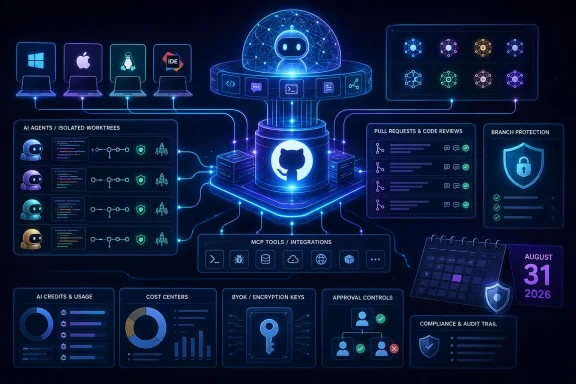 GitHub Is Giving Away the Runtime, Not the Compute
As first reported by Tech Times and confirmed in GitHub’s July 7 announcement, the Copilot desktop app is now available on every Copilot plan, including Copilot Free and GitHub Education licenses. During its technical preview, access had been restricted to paid subscribers, excluding the free users who make up much of GitHub’s base of more than 150 million registered accounts.That restriction mattered because the desktop app is not merely Copilot Chat removed from an IDE and wrapped in a new window. It is designed around delegating multiple development tasks to autonomous agents, supervising their progress, reviewing their changes, and passing completed work into the same pull-request machinery that development teams already use.
Each task begins as its own isolated session backed by a separate git worktree. The worktree shares the main repository’s history and object store, but it maintains its own branch, files, working directory, and git index.
That separation is the app’s most important technical property. Two agents operating in the same checkout can overwrite files, stage incompatible changes, or confuse repository state as each assumes it controls the working directory. Separate worktrees give every session a defined workspace, allowing an agent implementing a feature to run alongside another refactoring a different area without both manipulating the same index.
Isolation does not make parallel agent work inherently safe. Agents can still produce logically conflicting changes, modify shared interfaces in incompatible ways, or make assumptions that fail when branches are combined. What worktrees do is eliminate a lower-level class of collisions that would otherwise make parallel sessions operationally brittle before human review even begins.
Developers can start sessions from GitHub issues, open pull requests, or plain-text prompts. When work is complete, it flows through existing review requirements and branch protections rather than receiving a special path around them.
That integration is more consequential than it sounds. The useful unit of agentic development is not generated code; it is a reviewable change with provenance, checks, policy enforcement, and a credible path into production. GitHub’s advantage is that it already controls much of that path.
Opening the app to free accounts therefore does more than expand a product trial. It teaches developers to treat GitHub as the control plane where autonomous work is assigned, isolated, reviewed, and merged.
The access model also reveals an important economic distinction. Copilot Free can provide an entry point into agent sessions, but agentic work still consumes scarce model capacity under GitHub’s AI credit system. The desktop application may now be broadly available, yet sustained autonomous execution is not economically unlimited.
In other words, free access is not free execution. GitHub has lowered the cost of adopting its workflow while retaining usage-based constraints around the compute that makes the workflow run.
BYOK Turns Copilot Into a Model-Neutral Agent Platform
The desktop app’s bring-your-own-key option may ultimately matter more than the free tier. GitHub says developers without any Copilot plan can use the application with credentials from their own model provider, shifting inference charges and model access outside the Copilot subscription.BYOK separates two components that software vendors have often bundled together: the model producing the responses and the runtime organizing the work. A developer can supply the intelligence layer while GitHub provides the session interface, worktree management, repository connection, issue and pull-request entry points, and review workflow.
That is a classic platform strategy. GitHub does not have to capture every dollar spent on inference if it becomes the default place where inference is turned into software changes.
The model market is unusually fluid. Developers may switch providers because of code quality, latency, context-window size, privacy requirements, regional availability, or price. An orchestration environment that survives those model changes occupies a more durable position than one tied to a single provider.
BYOK also gives organizations another procurement path. A company with an existing model agreement may prefer to reuse those credentials instead of buying an overlapping Copilot entitlement for every developer. A small team may want direct control over provider spending, while an individual may prefer a local or separately billed model.
The arrangement is not equivalent to receiving Copilot inference for free. Prompts, repository context, tool definitions, responses, and repeated session state still have to be processed somewhere, and the chosen provider may impose its own rates and restrictions. Developers also inherit responsibility for credential security, provider compatibility, data handling, and model capability.
The practical question is therefore not simply whether BYOK costs less. It is whether the flexibility of provider choice outweighs the simplicity and governance of a managed Copilot plan.
For GitHub, either answer can be strategically useful. A customer who pays GitHub for both runtime and inference is valuable, but a customer who pays another provider while organizing every agent task through GitHub still strengthens GitHub’s position in the development lifecycle.
That is why the desktop app should not be evaluated as another coding assistant. It is an attempt to make GitHub’s agent orchestration layer independent of the outcome of the model competition above it.
Worktree Isolation Moves the Bottleneck Into Review
The desktop app’s architecture addresses one of the most visible problems created by parallel agents: shared local state. It does not address the harder problem of reviewing more changes than a team can safely absorb.If developers can launch several sessions from issues, pull requests, and prompts, code production can expand much faster than human attention. An agent may produce a plausible implementation, tests, documentation, and a pull request in less time than a reviewer needs to understand whether the change belongs in the system.
Branch protections and review requirements remain essential because they force agent output through existing quality gates. But a rule requiring one approving review is only as valuable as the review itself. If agents dramatically increase pull-request volume, organizations may preserve their formal controls while weakening the attention behind them.
The worktree design therefore changes where congestion appears. It reduces collisions during generation and pushes the limiting factor downstream into testing, integration, security review, architecture review, and ownership.
Teams should resist treating parallel sessions as a simple multiplier for developer output. The useful metric is not how many agents can run simultaneously; it is how many trustworthy changes the organization can evaluate and integrate without accumulating hidden defects.
This is particularly important for repositories with broad shared interfaces, complex build environments, or tightly coupled services. Two agents can make clean changes in separate worktrees and still create a difficult merge because their decisions conflict conceptually rather than mechanically.
GitHub’s review integration is the correct foundation, but it does not eliminate that organizational constraint. Agent productivity can move the queue; it cannot abolish the queue.
JetBrains Is No Longer Outside the Autonomous-Agent Mainstream
The second July 7 announcement brings Codex into the GitHub Copilot plugin for JetBrains IDEs as an agent provider in public preview. Developers working in IntelliJ IDEA, PyCharm, and WebStorm can now run autonomous Codex sessions without moving their primary work into VS Code.That closes a meaningful ecosystem gap. GitHub’s most advanced agent workflows have frequently appeared first in environments closely connected to VS Code, even though JetBrains tools remain deeply embedded in enterprise Java, Kotlin, Python, web, and other development stacks.
The integration is not merely access to a Codex-branded model in a chat picker. GitHub describes Codex as an agent provider, meaning the session can perform multi-step development work rather than limiting itself to conversational answers or inline completions.
Setup still requires deliberate local configuration. The developer must install the Codex CLI, open
Settings > Tools > GitHub Copilot > Chat, enable Codex, point the plugin to the CLI path, and then select Codex from the agent picker in the Copilot Chat panel.Copilot Business and Enterprise customers face an additional gate. An administrator must enable the editor preview features policy before users can access the integration.
That policy requirement is appropriate because the feature remains in public preview as of July 7, not general availability. Preview status should influence where organizations permit it, what repositories it can touch, and whether teams depend on it for routine production work.
JetBrains users are not entering an empty AI market. JetBrains has its own native autonomous coding product, Junie, available to JetBrains AI Pro subscribers and built around Mellum, JetBrains’ open-sourced model. Junie’s free tier also offers unlimited completions at low latency.
The competition is therefore not between an agent-enabled JetBrains environment and one without agents. It is between different orchestration systems, model choices, subscription structures, policy controls, and degrees of integration with GitHub-hosted collaboration.
GitHub’s strongest argument is continuity from task to pull request. JetBrains’ strongest argument is that an IDE vendor can integrate AI more deeply into the environment it owns. Developers may ultimately use both, selecting an agent according to the repository, task, model, or corporate policy.
That pluralism is precisely why GitHub wants to make its tooling portable across editor boundaries. If Copilot depends on persuading every enterprise developer to abandon IntelliJ IDEA or PyCharm, it loses before the model comparison begins. If it operates inside those IDEs, the contest moves to workflow quality.
Permission Modes Turn Convenience Into a Security Decision
The JetBrains update also exposes three permission modes for Copilot CLI sessions. These settings define how often the agent must stop for approval and therefore determine not just convenience, but operational risk and consumption speed.| Permission mode | Tool-call approval | Clarifying questions | Practical posture |
|---|---|---|---|
| Default Approvals | Confirmation dialogs appear according to policy | Surface to the developer | Supervised work where actions require review |
| Bypass Approvals | Tool calls are automatically approved | Still surface to the developer | Faster execution with human guidance retained |
| Autopilot | Tool calls are automatically approved | Answered automatically | Hands-off execution for tightly scoped tasks |
Bypass Approvals removes confirmation dialogs for tool calls but still pauses when the agent needs clarification. That can be a reasonable middle ground for trusted local workflows where the tool boundaries are understood but the task remains ambiguous enough to require human judgment.
Autopilot goes further by approving tool calls and automatically handling clarifying questions. It allows the agent to continue iterating without waiting for the developer, making it suitable for constrained tasks where the environment, expected result, and acceptable actions are well defined.
It is also the mode most likely to magnify a mistake. An incorrect assumption can feed into the next tool call, test run, edit, or retry without a human interruption breaking the chain.
Autopilot can similarly increase AI credit use because autonomous iteration permits more model calls, more context transmission, and more retries before a person notices that the session is moving in the wrong direction. The same feature that makes an agent feel productive can make it expensive.
Approval settings should consequently be treated as policy decisions, not personal interface preferences. Enterprises already control shell access, production credentials, package installation, repository permissions, and deployment rights; autonomous agent permissions belong in the same governance conversation.
The new
/plugins dashboard command adds another dimension by allowing extensions to be installed or toggled during an active session. The /mcp list command shows which Model Context Protocol servers are connected and active.Those commands improve visibility, but they also demonstrate how quickly an agent session can expand beyond repository editing. Plugins and MCP servers can expose additional tools, services, context sources, and actions. Every connection enlarges both the agent’s usefulness and its potential blast radius.
An organization evaluating Autopilot should therefore inventory the tools available to the session, not just the source files in the repository. An agent with broad MCP access and auto-approved calls is a different security proposition from one confined to a disposable working tree and a test command.
GitHub’s Billing Shock Was a Warning About Agent Economics
GitHub’s expansion arrives just over a month after its June 1 transition from flat premium request allocations to token-based GitHub AI Credits. Each credit costs $0.01, and usage depends on the tokens consumed by the selected model and workflow.The old request model obscured the enormous difference between asking a brief coding question and running a long autonomous session. Both could be presented to a user as requests even though the agent session might repeatedly load repository context, invoke tools, inspect output, revise files, and run additional model calls.
Usage-based billing makes that difference visible in the invoice. It also transfers more of the cost uncertainty from GitHub to the customer.
According to GitHub research published in May 2026, agentic coding tasks consume roughly 1,000 times more tokens than standard single-turn chat queries. Tech Times also cites Stanford Digital Economy Lab research finding that re-sent context accounts for approximately 62 percent of total agent inference costs.
That repeated context is central to how agents work. A model must often receive system instructions, tool descriptions, relevant code, previous exchanges, command results, errors, and current task state again as the session progresses.
The user may experience one continuous task, but the provider may be processing a series of expensive inference operations. A request to refactor a large component and verify the result can generate repeated context-heavy calls as the agent reads, edits, runs tests, analyzes failures, and tries again.
Tech Times reports striking examples of monthly bills increasing from $29 to $750 and from $50 to $3,000 under heavy agentic workloads. The publication also reports that Uber consumed its entire 2026 AI coding budget in four months.
Those figures should not be treated as universal forecasts. Workload, model, context size, retry behavior, task complexity, and organizational settings can all produce radically different outcomes.
They do, however, illustrate why autocomplete-era budgets cannot simply be extended to autonomous agents. The cost unit has changed from a developer asking for help to a process repeatedly spending compute while attempting to complete an outcome.
Credit Pools Repair One Governance Failure, Not the Whole Billing Model
GitHub’s July 2 AI credit pools release is an answer to a particular enterprise problem created by pooled included usage. Copilot Business and Enterprise licenses contribute monthly included credits to a shared enterprise balance, but without cost-center limits, one department can consume credits funded by another department’s licenses.Credit pools let cost center owners cap how much of that shared included balance an individual cost center can draw down. GitHub calculates the limit automatically from the licenses assigned to the cost center and adjusts it when licenses are added or removed.
This preserves an internal accounting boundary. A team should not be able to burn through the included credits associated with other teams merely because it adopted Autopilot earlier or selected more expensive workflows.
When a cost center reaches its cap, administrators can block further included usage or permit the work to continue as additional metered spending when enterprise overages are allowed. That choice separates strict containment from operational continuity.
The feature does not, however, provide complete spending control on its own. GitHub distinguishes between credit pools, which govern the included credits attached to licenses, and per-cost-center budgets, which govern metered overages after included usage is depleted.
An administrator who configures only a credit pool has controlled the distribution of prepaid capacity, not necessarily the final invoice. If overages are permitted without a suitable cost-center budget, usage can continue into metered spending after the pool boundary is reached.
Full cost governance therefore requires both mechanisms. The pool determines how included credits are divided; the budget determines what happens financially after those credits are gone.
Management is currently available through GitHub’s REST API, while a cost-center settings interface remains in development. That API-first state is workable for large organizations with infrastructure automation, but it adds friction for administrators expecting a straightforward billing-console toggle.
The absence of a finished interface also increases the value of configuration-as-code practices. Enterprises should record which cost centers have pools enabled, whether exceeding the cap blocks usage or permits overages, and what separate metered budget applies.
Otherwise, the controls risk becoming difficult to audit just as agent adoption accelerates across departments.
Action checklist for admins
- Enable the Copilot CLI policy only for Business and Enterprise groups approved to use the desktop app.
- Enable the editor preview features policy only for teams authorized to test Codex in JetBrains.
- Inventory plugins, MCP servers, local tools, repository permissions, and credentials accessible to agent sessions.
- Establish an organizational default for Default Approvals, Bypass Approvals, and Autopilot rather than leaving permission selection entirely to individuals.
- Create AI credit pools for eligible cost centers and choose whether reaching the included-credit cap blocks work or permits metered continuation.
- Configure separate per-cost-center budgets for overages and monitor usage before the promotional credit buffers expire.
- Review branch protections, required checks, and reviewer capacity before encouraging large numbers of parallel desktop sessions.
The Promotional Buffer Creates an August Deadline
Copilot Business customers currently receive a promotional credit buffer of $30 per user per month, while Copilot Enterprise customers receive $70 per user per month. Those promotional amounts run through August 31, 2026, after which plan allotments return to their standard levels.This creates an awkward evaluation period. Organizations testing desktop agents, JetBrains Codex, and hands-off permission modes during July and August may observe usage patterns supported by temporary capacity that will not exist in September.
A successful pilot can therefore conceal an unsustainable steady-state cost. If teams consume most of the promotional buffer while believing their use is routine, the end of the promotion could produce earlier depletion, more blocked sessions, or greater metered overages.
Administrators should treat the promotional credits as measurement capacity rather than a permanent entitlement. The useful question is not whether the organization can stay within its temporary July or August allowance, but what the same workload would cost after August 31.
That analysis should separate experimentation from repeatable work. Initial sessions often consume extra credits while developers learn prompting patterns, agents explore unfamiliar repositories, and teams test several models. Mature workflows may become more efficient, but they may also spread to more users and repositories.
The September reset will expose which effect dominates. Better technique may reduce cost per task, while broader adoption increases the number of tasks.
Timeline
May 2026 — GitHub publishes research finding that agentic coding tasks consume roughly 1,000 times more tokens than standard single-turn chat queries.June 1, 2026 — GitHub replaces flat premium request allocations with token-based GitHub AI Credits priced at $0.01 each.
July 2, 2026 — GitHub publishes AI credit pools for Copilot Business and Enterprise cost centers, initially managed through the REST API.
July 7, 2026 — The standalone Copilot desktop app opens to every Copilot plan, including free-tier and GitHub Education users, across Windows, macOS, and Linux.
July 7, 2026 — Codex becomes available as a JetBrains agent provider in public preview, with administrator policy approval required for Business and Enterprise users.
August 31, 2026 — Promotional Business and Enterprise credit buffers end, and plan allotments return to standard levels.
The Platform Strategy Is Broader Than Copilot Subscriptions
These releases address three constituencies whose interests do not naturally align. Developers want powerful agents with minimal friction. Platform and security teams want bounded permissions and reviewable output. Finance teams want predictable spending and defensible chargeback.The free desktop app serves adoption. JetBrains support serves ecosystem reach. Credit pools serve organizational permission to scale.
BYOK ties the strategy together because it allows GitHub to participate even when it does not provide the model subscription. The desktop runtime can become the common layer beneath models from competing providers, just as GitHub repositories already sit beneath teams using different languages, frameworks, editors, and cloud platforms.
This strategy also makes the repository increasingly active. GitHub has historically stored code and coordinated collaboration around it. Agent sessions turn repository issues and pull requests into executable work queues, with branches and worktrees acting as isolation units for machine labor.
That changes the competitive importance of workflow metadata. Issues, review rules, branch protections, checks, ownership files, and repository history are not merely collaboration records; they are context and constraints that agents can use when planning work.
A rival model may write better code on a particular benchmark, but GitHub can argue that its runtime knows where the task came from, how the repository is governed, who must review the output, and what conditions must be met before merge.
The risk is that GitHub’s interests in adoption and consumption may conflict with an enterprise’s interest in restraint. Easier parallel execution increases the chance that more agents run longer and consume more tokens. Cost controls become indispensable partly because the product’s best features make spending easier.
That does not make the controls cosmetic. Credit pools solve a real allocation problem, and explicit permission modes give users meaningful choices. But enterprises should recognize that governance is not an accessory to agentic coding; it is part of the product’s operating model.
What Windows and Enterprise Teams Should Carry Forward
For Windows developers, the immediate change is straightforward: the Copilot desktop app no longer requires a paid plan, and JetBrains users can test Codex sessions without relocating their work into VS Code. For enterprise teams, the larger lesson is that access, autonomy, and billing must be evaluated together.- Copilot Free and GitHub Education users can now access the desktop agent app on Windows, macOS, and Linux.
- Developers without any Copilot plan can use BYOK credentials with the desktop runtime.
- Each desktop task receives an isolated git worktree, but logical conflicts and review bottlenecks remain.
- Codex in IntelliJ IDEA, PyCharm, and WebStorm is a public preview, not a general-availability release.
- Business and Enterprise access depends on administrator policies for Copilot CLI and editor preview features.
- Credit pools limit included usage by cost center; separate budgets are still required to govern metered overages.
References
- Primary source: Tech Times
Published: Thu, 09 Jul 2026 13:03:15 GMT
GitHub Copilot Breaks Agent Barrier: Free Desktop App, JetBrains, Cost Controls
GitHub Copilot free desktop app now open to all plan tiers — GitHub also launches Codex as an agent provider in JetBrains IDEs and rolls out AI credit pools giving enterprise admins spending capswww.techtimes.com - Related coverage: github.blog
Cost centers now support AI credit pools - GitHub Changelog
You can now cap how much of your enterprise’s monthly included AI credits a cost center can use. This is available through the REST API today. Management in the cost…github.blog
- Official source: docs.github.com
Usage-based billing for individuals - GitHub Docs
Your Copilot plan includes a monthly allowance of GitHub AI Credits. If you exhaust your AI credits, you can pay extra to keep working. docs.github.com
- Official source: github.com
GitHub Copilot · Your AI pair programmer · GitHub
GitHub is where people build software. More than 150 million people use GitHub to discover, fork, and contribute to over 420 million projects. github.com
- Related coverage: tomshardware.com
Github Copilot customers report up to 100-fold price hikes — AI sticker shock bites as Microsoft switches to usage-based pricing | Tom's Hardware
The AI investment chickens have come home to roost.www.tomshardware.com - Related coverage: itpro.com
Everything you need to know about the GitHub Copilot pricing changes | IT Pro
GitHub Copilot pricing changes mean users will be charged based on consumption, rather than a set number of credits.www.itpro.com
- Related coverage: blog.jetbrains.com